What is a proforma invoice? Uses, format and GST rules
Learn what a proforma invoice is, how it works, and when to use one.

Written by Jotika Teli—Certified Public Accountant with 24 years of experience. Read Jotika's full bio
Published Friday 17 April 2026
Table of contents
Key takeaways
- Use a pro forma invoice after agreeing on price but before finalising a sale, so buyers can arrange financing, get internal approvals, or clear customs without triggering any payment obligation.
- Label the document clearly as "Pro Forma Invoice" and keep it out of your accounts receivable, as it does not count as income and has no impact on your financial records if the sale falls through.
- Avoid using a pro forma invoice for tax or GST purposes, as it is not a valid tax document and cannot replace the official taxable supply information required for completed sales.
- Include shipping details, country of origin, and product weights when sending a pro forma invoice for international trade, as customs authorities need this information to calculate duties and clear goods at the border.
What is a pro forma invoice?
A pro forma invoice is a preliminary billing document sent before a sale is finalised. It outlines products, services, and pricing without requesting immediate payment.
Key characteristics of pro forma invoices include:
- No payment request: Requires no invoice number or due date
- No income recording: Appears nowhere in accounts receivable
- Preliminary agreement only: Confirms transaction details before finalising the sale
Three common reasons for issuing a pro forma invoice
Pro forma invoices serve three main business purposes:
- Secure buyer funding: Help buyers arrange financing or payment terms before purchase
- Support import documentation: Provide required paperwork for calculating duties and clearing customs
- Formalise procurement pricing: Give large organisations more definitive pricing than standard quotes for internal approvals
When to send a pro forma invoice
Send pro forma invoices after price agreement but before sale completion.
Send pro forma invoices at these times:
- After quote acceptance: Both parties have agreed to terms
- Before final processing: The sale, shipping, and final invoicing haven't occurred
- When requested: The customer needs documentation for internal processes
Common customer needs trigger requests for pro forma invoices:
- Import duty calculations: Provide required documentation for customs clearance
- Internal procurement approvals: Provide formal documentation for organisational sign-off
- Financing arrangements: Provide evidence of agreed pricing for loan applications
- Customs documentation: Provide proof of goods value for border clearance
Always confirm final approval before processing the actual sale or issuing the final sales invoice.
What should a pro forma invoice look like?
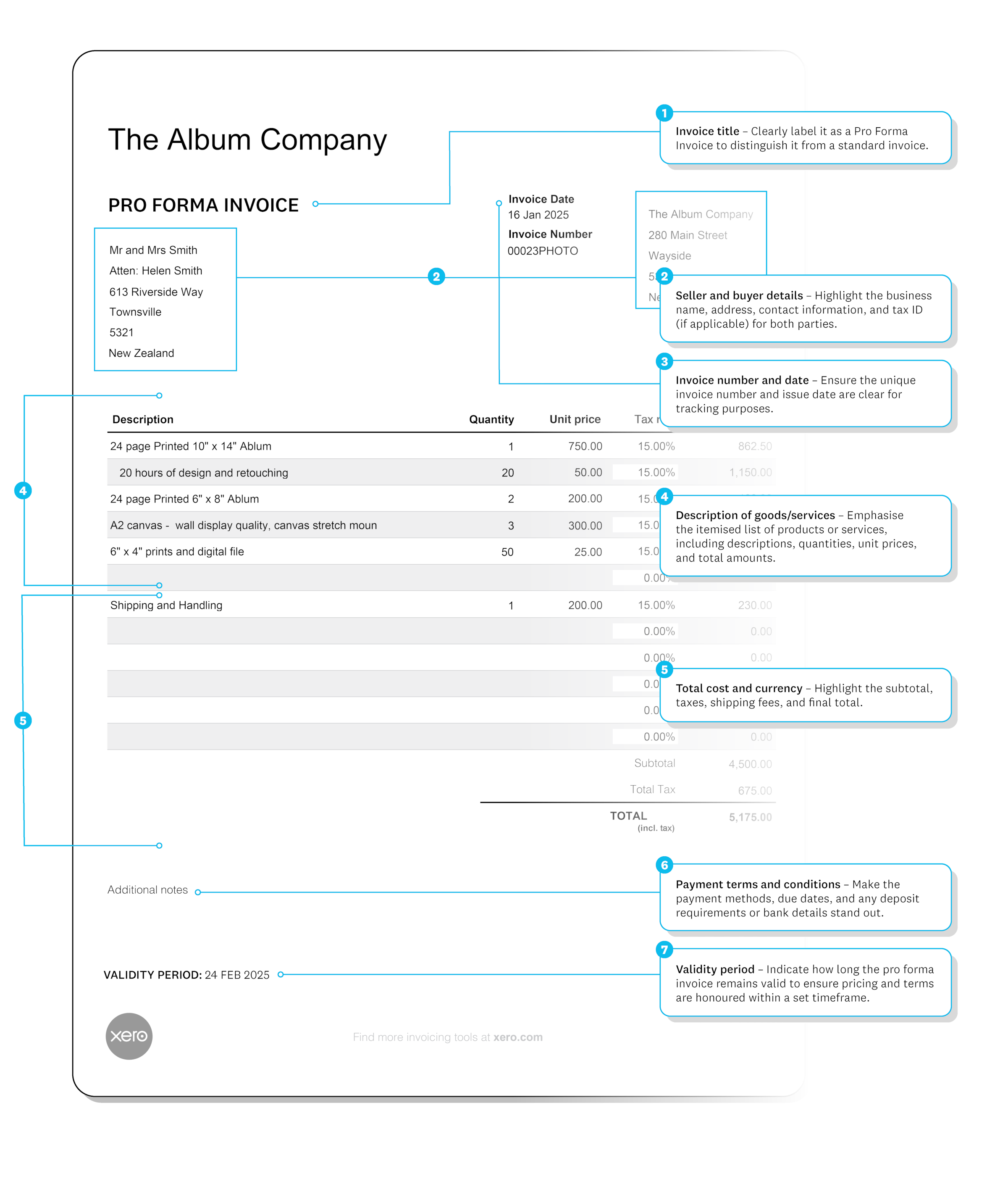
A pro forma invoice format mirrors a standard invoice but includes specific labelling to distinguish it from official billing documents.
Required elements include:
- Document label: Include a clear "Pro Forma Invoice" heading
- Contact details: Include buyer and seller information
- Item descriptions: Include product or service details with pricing
- Terms: Include sale conditions and validity period
- Reference number: Include a tracking identifier (not an official invoice number)
Additional requirements apply for imports:
- Weights and measurements: Include product dimensions for shipping calculations
- Shipping information: Include costs, carrier details, and delivery terms
- Country of origin: Include source location for customs classification
How is a pro forma invoice different from other invoices (and quotes)?
Pro forma invoices differ from other business documents in timing and purpose. Unlike standard invoices, they don't request payment or create accounting entries.
Here's how pro forma invoices compare to sales invoices:
- Pro forma: Sent before sale completion with no payment due
- Sales invoice: Sent after sale finalisation with payment required
Here's how pro forma invoices compare to commercial invoices:
- Pro forma: Serves as preliminary document for planning and approvals
- Commercial invoice: Serves as final document for completed international sales with tariff details
Here's how pro forma invoices compare to quotes:
- Pro forma: Used after price agreement for administrative purposes
- Quote: Used during price negotiation and deal-making
A pro forma invoice isn't a tax invoice
Pro forma invoices have no tax implications because they represent preliminary agreements, not completed sales. You can't use them for GST reporting or compliance.
As of 1 April 2023, official sales must be recorded with documents now known as taxable supply information. Pro forma invoices don't meet this requirement. Official information must be provided within 28 days of a request for supplies over $200.
Key tax considerations include:
- No GST liability: GST applies only when you issue the final sales invoice
- Planning estimates allowed: You can include projected tax amounts for budgeting purposes
- No compliance use: Pro forma invoices can't substitute for official tax documentation
How to create a pro forma invoice
Creating a pro forma invoice lets you provide formal pricing documentation without affecting your accounts. Adapt your standard invoice process with these key modifications.
Follow these creation steps:
- Start with your standard invoice template: Include all typical fields like contact details, item descriptions, and pricing
- Add clear "Pro Forma Invoice" labelling: Mark the document header prominently so it's not confused with a sales invoice
- Keep it out of your accounts: Don't record the document in accounts receivable or recognise it as income
Consider these accounting software factors:
- Check provider guidance: Confirm your software handles pro forma invoices correctly
- Prevent accidental sales recording: Avoid triggering income recognition in accrual accounting
- Maintain separate tracking: Keep pro forma invoices distinct from actual sales invoices
Streamline your invoicing process with Xero
Pro forma invoices help you secure deals and satisfy customer documentation requirements before finalising sales.
Effective invoicing practices save you time and keep your cash flow healthy. E-invoicing can reduce processing costs to less than $10 an invoice. See how Xero invoicing can make your billing easier, get one month free.
FAQs on pro forma invoices
Common questions about pro forma invoices answered.
Is a pro forma invoice legally binding?
No, a pro forma invoice isn't legally binding. It's a good-faith agreement created before you deliver products or services, so neither party is obligated to complete the transaction.
Do I need to cancel a pro forma invoice if the sale doesn't go ahead?
No, you don't need to cancel a pro forma invoice if the sale falls through. Because it's not an official accounting document, it has no impact on your records or financial reporting.
Can I turn a pro forma invoice into a commercial invoice?
No, you can't convert a pro forma invoice into a commercial invoice. Although they contain similar information, a commercial invoice requires additional legal terms, tariff codes, and customs declarations for completed international sales.
Why might a customer ask for a pro forma invoice?
Customers request pro forma invoices for internal approvals or customs clearance. Large organisations may require formal pricing documentation before releasing purchase orders.
Should I pay a pro forma invoice?
No, you shouldn't pay a pro forma invoice. It's a preliminary document that doesn't request payment. Wait for the final sales invoice before making payment.
Related content
What is an invoice?
Get the lowdown on invoices.
How to send an invoice
Find out when and how to send an invoice.
How to make an invoice
Let’s walk through the process of making an invoice.
Disclaimer
Xero does not provide accounting, tax, business or legal advice. This guide has been provided for information purposes only. You should consult your own professional advisors for advice directly relating to your business or before taking action in relation to any of the content provided.
Get one month free
Purchase any Xero plan, and we will give you the first month free.