Cash flow forecast: what it is and how to create one
Learn how a cash flow forecast helps you plan ahead and manage your small business with more confidence.
Written by Jotika Teli—Certified Public Accountant with 24 years of experience. Read Jotika's full bio
Published Monday 20 April 2026
Table of contents
Key takeaways
- Recognize that a cash flow forecast predicts future money coming in and going out, helping you spot cash shortages weeks or months before they happen so you can act early rather than scramble for funds.
- Build your forecast using five key components: starting balance, cash inflows, cash outflows, net cash flow, and closing balance, then use a spreadsheet template or accounting software to calculate your cash position for each period.
- Update your forecast monthly and maintain a rolling 12-month outlook, comparing your predictions to actual results each time so your estimates become more accurate over time.
- Be conservative when estimating income by underestimating sales rather than overestimating them, and account for seasonal highs and lows to make sure your forecast reflects how your business actually runs.
What is a cash flow projection?
A cash flow projection predicts your business's future cash position by estimating money coming in and going out over a set period. This helps you see exactly how much cash you'll have at specific future dates, so you can make confident spending decisions.
A cash flow projection is different from a cash flow statement. A statement focuses on past cash flows, a projection aims to predict the future.
Why is a cash flow projection important?
Cash flow projection helps you avoid cash shortages by showing whether you'll have enough money to pay bills and yourself on time, a crucial safeguard given that roughly 70 percent of recent liquidations have been initiated by Inland Revenue, according to the RBNZ Financial Stability Report. This visibility becomes critical when costs rise and margins shrink, especially as New Zealand's annual GDP recently contracted by 1.1 percent, preventing last-minute scrambles for funds.
Benefits of a cash flow projection
Regular cash flow projections give you early warning of potential problems. Key benefits include:
- Detect shortages early: Identify cash gaps weeks or months ahead.
- Plan strategically: Develop contingency plans before problems hit.
- Assess growth opportunities: Evaluate whether you can afford new investments or hires.
- Secure owner payments: Ensure consistent income for yourself.
- Identify fixable problems: Spot issues like slow-paying customers or poor payment terms.
Key components of a cash flow projection
The five key components of a cash flow projection track your money from start to finish:
- Starting balance: Current cash in your business accounts
- Cash inflows: Expected money coming in from sales, loans, or asset sales
- Cash outflows: Projected expenses and payments going out
- Net cash flow: Whether your cash position improved or declined
- Closing balance: Predicted cash amount at the end of the period
Who is responsible for doing a cash flow projection?
A cash flow dashboard shows how cash balances will rise and fall in response to expected transactions.
You can create cash flow projections yourself using a spreadsheet or accounting software, or you can ask your bookkeeper or accountant to do it. Advisors often complete them quickly because they understand small business cash flow patterns well.
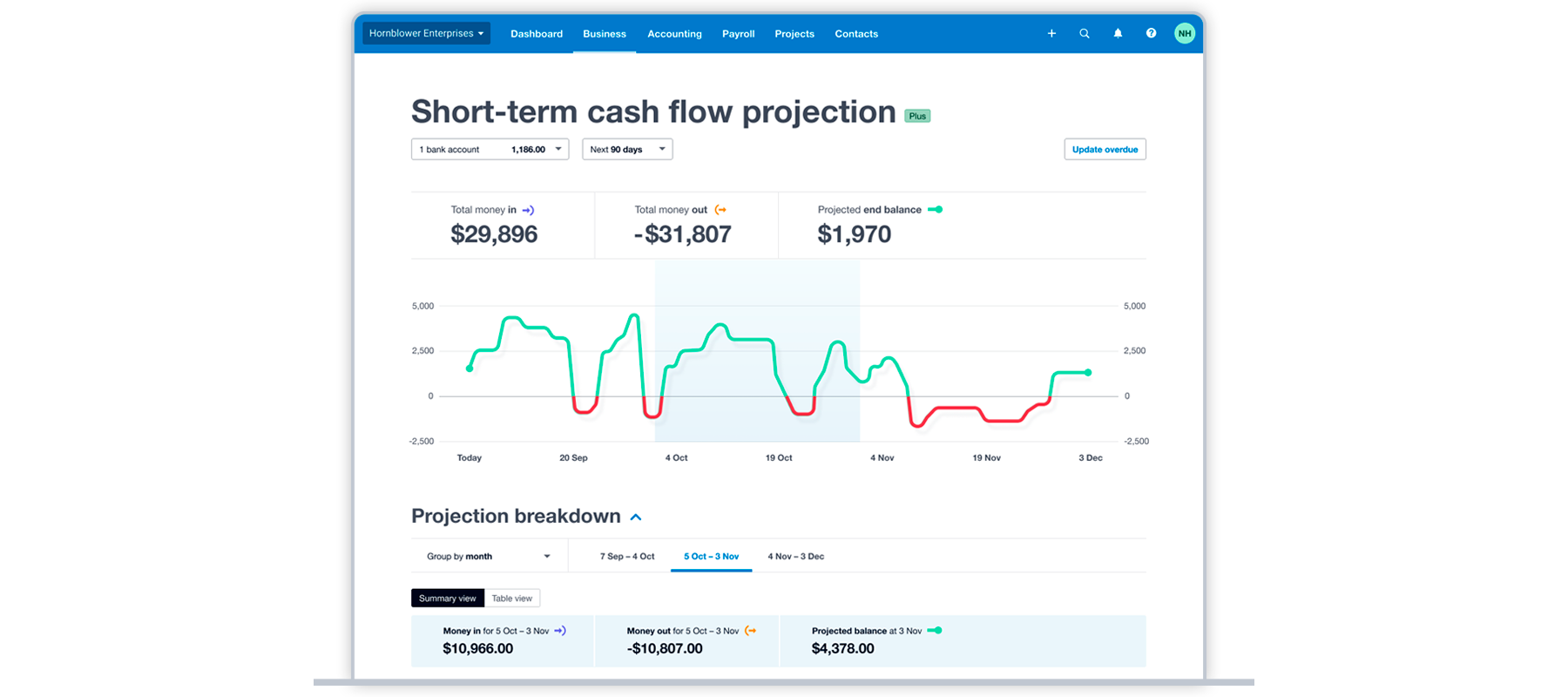
A cash flow dashboard shows how cash balances will rise and fall in response to expected transactions.
How to create a cash flow projection
Creating a cash flow projection means estimating when money will flow in and out, then calculating your resulting cash position over time. You can build projections using spreadsheets or accounting software.
Create a cash flow projection with a spreadsheet
Follow these steps to create your spreadsheet forecast:
- Choose your forecasting period and record your current cash balance
- List all expected cash inflows with specific dates, such as sales receipts, grants, tax refunds, and loans
- List all expected cash outflows with dates, such as regular expenses, annual fees, taxes, and repairs
- Calculate your running cash balance by adding inflows and subtracting outflows
- Review the results to identify potential cash shortages or surpluses
Create a cash flow projection with software
Accounting software speeds up the process by using your existing financial data to generate projections in a few clicks. Xero, for example, tracks your incomings and outgoings and can create a short-term forecast automatically. For longer-term projections, apps like Spotlight, Fathom, and Calxa integrate with your accounting software.
Alternative methods of cash flow projections
Alternative forecasting methods use your balance sheet and income statement to provide longer-term cash flow guidance. These require accounting knowledge, so ask your advisor if you want to explore them.
Example of a cash flow projection
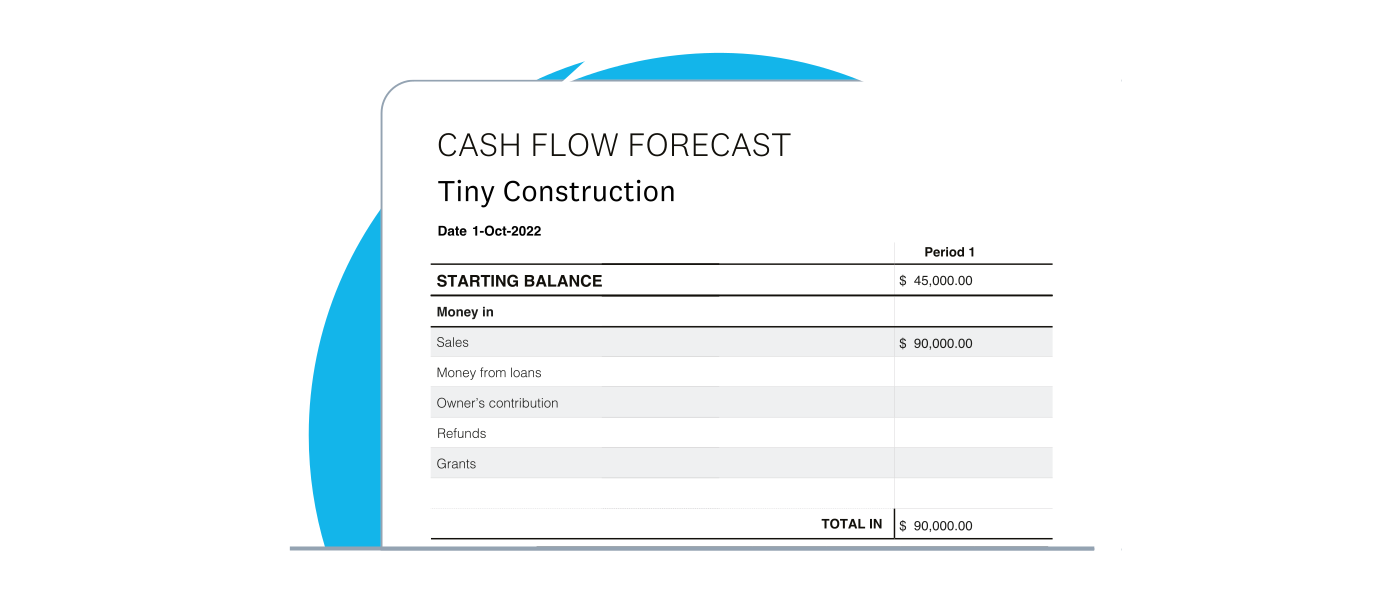
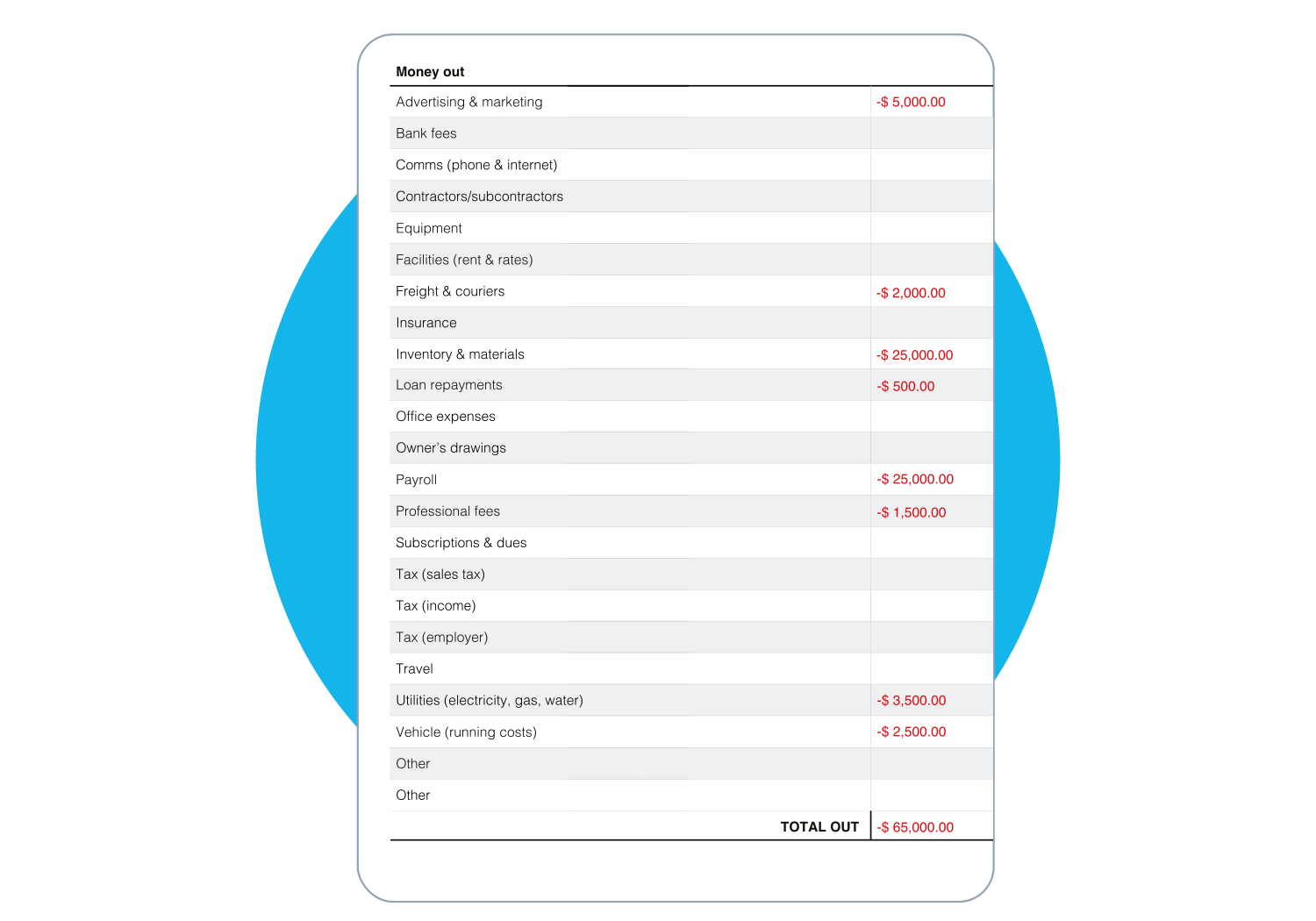
The finance manager of Tiny Construction wants to assess whether the business can afford a $20,000 equipment purchase next month.
Based on current bank balances, Tiny Construction has a starting balance of $45,000. Outstanding invoices and sales forecasts estimate $90,000 in incoming payments within 30 days, with no other incoming payments for the month.
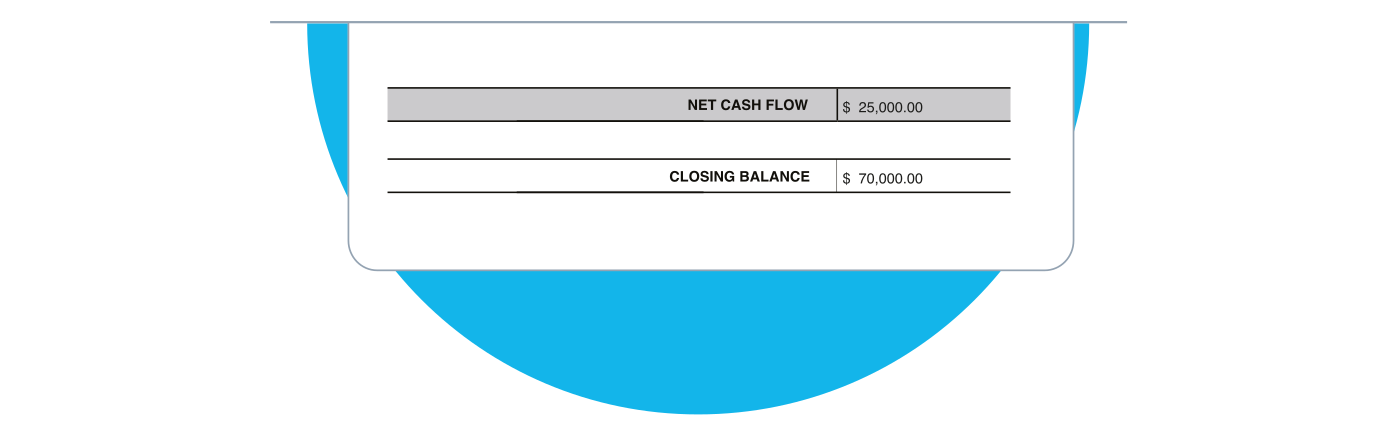
With incoming sales receipts of $90,000 and outgoings of $65,000, the company would add $25,000 in net cash flow. Adding that to the $45,000 of existing cash means the business has $70,000 at month end. This becomes their starting balance for the following month.
If they purchase the equipment with surplus cash, their starting balance drops to $50,000. This example shows how cash flow projections help you make investment decisions and assess whether you can afford a purchase outright or need to consider financing it, keeping in mind that debt over 60% of total funds can leave a business vulnerable in the event of unexpected operational downturns, according to the CPA Australia liquidity risk guide.
How to analyse a cash flow projection
Analyse your projection by examining three key measures:
- Closing balance: Review your predicted cash reserves at each period's end; a current ratio below 1:1 may indicate a shortage of funds.
- Net cash flow: Check whether cash increased or decreased during each period.
- Forecast accuracy: Compare predictions to actual results and identify estimation errors.
Understanding what you over or underestimated reveals business patterns that make your next projection more reliable.
How often should you update your cash flow forecast?
Update your cash flow projections monthly and forecast 3–12 months ahead, though businesses with ten or more daily transactions may need short-term liquidity managed daily and monitored frequently, as recommended in the CPA Australia liquidity risk guide. Shorter-term forecasts (1–3 months) provide high accuracy for immediate planning, while longer-term projections (6–12 months) help with strategic decisions but become less precise.
Experts recommend using a rolling twelve-month forecast to identify liquidity risks. Here's how it works:
- Review and update your forecast at month-end
- Drop the month that just finished
- Extend the forecast by one additional month
- Update remaining months based on new information
Cash flow forecast templates and tools
Tools and templates make forecasting easier, so you don't need to start from scratch.
Cash flow forecast template
A spreadsheet is a simple way to get started. You can build your own or download a free template, giving you full control, though you'll need to enter data manually.
Cash flow forecasting software
Accounting software automates the process by connecting to your bank accounts and using your existing bills and invoices. Xero, for example, can generate a short-term cash flow projection using Xero Analytics in a few clicks, helping you spot shortfalls before they occur.
Tips for accurate cash flow forecasting
Use these tips to make your projections more reliable:
- Review past performance: Look at your financial history to understand your business's natural cycles and make realistic predictions.
- Be conservative with income: Underestimate sales rather than overestimate them to create a buffer if things don't go as planned.
- Account for seasonality: Reflect busy and quiet periods in your forecast rather than assuming every month will be the same.
- Update regularly: Review and update your forecast monthly to keep it relevant and accurate.
- Talk to your advisor: Ask your accountant or bookkeeper to help create and analyse your forecast for insights you might miss.
Take control of your business finances with Xero
Cash flow forecasting gives you control over your financial future. By understanding when money will come in and go out, you can anticipate shortages, plan for growth, and pay bills and yourself consistently. It's a powerful way to move from reacting to financial events to managing them with confidence.
Get one month free to get started today.
FAQs on cash flow forecasting
Here are some common questions small business owners have about cash flow forecasting.
What is the formula for forecasting cash flow?
The formula is: starting cash + projected cash inflows – projected cash outflows = ending cash. Repeat this calculation for each period in your forecast.
What are the different techniques for cash flow forecasting?
The two main methods are the direct method and the indirect method. The direct method tracks cash inflows and outflows (covered in this guide). The indirect method starts with net income and adjusts for non-cash items. It's more complex and typically used for formal financial statements that require a format that classifies cash flows from operating, investing, and financing activities.
How far ahead should I forecast my cash flow?
Aim for a rolling 12-month forecast that you update monthly. For day-to-day management, a shorter 30–90 day forecast provides more detailed, actionable insights.
What's the difference between cash flow forecasting and budgeting?
A cash flow forecast predicts actual cash moving in and out of your bank account, while a budget plans your income and expenses over a period, often including non-cash items like depreciation. A forecast shows whether you'll have the cash to meet your budget.
Disclaimer
Xero does not provide accounting, tax, business or legal advice. This guide has been provided for information purposes only. You should consult your own professional advisors for advice directly relating to your business or before taking action in relation to any of the content provided.
Get one month free
Purchase any Xero plan, and we will give you the first month free.