Marginal cost formula: how to calculate (with examples)
Learn what marginal cost is, how to calculate it, and why it matters for your business.

Written by Jotika Teli—Certified Public Accountant with 24 years of experience. Read Jotika's full bio
Published Wednesday 27 May 2026
Marginal cost formula: how to calculate (with examples)
Learn what marginal cost is, how to calculate it, and why it matters for your business.
Table of contents
- What is marginal cost?
- Why is marginal cost important?
- Components of marginal cost
- The marginal cost formula
- How to calculate marginal cost
- Marginal cost vs average cost
- Marginal revenue vs marginal cost
- The marginal cost curve
- Marginal cost in different business contexts
- Limitations of marginal cost analysis
- Why you should calculate your marginal cost accurately
- Track your costs and grow with confidence
- FAQs on marginal cost
Key takeaways
- Marginal cost is the expense of producing one additional unit, and comparing it to your selling price helps you decide whether to scale up or hold steady.
- The formula is simple: divide the change in total costs by the change in quantity produced, then compare the result to your average cost and revenue per unit.
- When marginal cost sits below average cost, increasing production can boost your profit margins; when it rises above, it's a signal to pause and reassess.
- Understanding marginal cost alongside marginal revenue helps you find the production sweet spot where profits are maximised.
What is marginal cost?
Marginal cost is the additional expense you incur when you produce one more unit of a product or service. It tells you exactly how much that next item costs to make.
This figure helps you determine whether increasing production boosts or hurts your profits. If the cost of making one more unit is less than what you sell it for, you stand to gain. If it's more, you're losing money on every extra unit.
Marginal cost also reveals both short-term cash flow effects and longer-term factors. In the short term, you can see how each additional unit affects your bank balance. Over time, patterns in your marginal cost highlight whether your business becomes more or less efficient as it grows.
Why is marginal cost important?
Knowing your marginal cost gives you a clearer picture of how your costs behave as production changes. This directly affects three core areas of your business: pricing, production decisions, and how you allocate resources.
When setting prices, marginal cost acts as your floor. You need to charge more than it costs to produce each additional unit, or you'll erode your margins. Understanding this number helps you build a pricing strategy that protects your profits.
For production decisions, marginal cost shows you when to ramp up and when to hold. If your marginal cost drops as you produce more, you're benefiting from economies of scale. Your per-unit costs fall because you're spreading fixed costs across a larger number of products.
Resource allocation also improves when you track marginal cost. You can direct materials, labour, and capital toward the products or services where each additional unit delivers the most profit. This keeps your business lean and focused on what actually makes money.
Components of marginal cost
Marginal cost is made up of two main types of expenses: variable costs and fixed costs. Understanding how each one behaves helps you predict what happens to your bottom line when you produce more.
Variable costs change directly with production volume. The more you produce, the more you spend on these items:
- Raw materials and supplies
- Hourly wages for production staff
- Energy and utility costs tied to manufacturing
- Packaging and shipping per unit
Fixed costs stay the same regardless of how many units you produce. These include expenses such as:
- Machinery and equipment
- Rent or lease payments
- Salaried staff not tied to production volume
- Insurance premiums
When you produce more units, your fixed costs get spread across a larger number of products. This lowers the fixed cost per unit. Your variable costs per unit may stay roughly the same, but the total cost per unit drops because the fixed portion shrinks. This is what makes scaling up attractive, at least up to a point.
The marginal cost formula
The formula for marginal cost is straightforward:
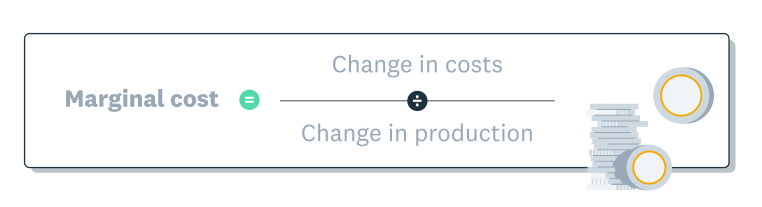
Marginal cost = Change in total costs / Change in quantity produced
To use it, you need two figures. First, find the difference in your total production costs between two output levels. Second, find the difference in the number of units produced. Divide the first by the second, and you have your marginal cost.
The benefits of calculating marginal cost
Calculating marginal cost becomes especially useful when you compare it to your average cost. Average cost is your total production expense divided by the total number of units.
When your marginal cost is lower than your average cost, producing more units pulls your average cost down. This means expanding production could increase your profits.
When your marginal cost is higher than your average cost, each additional unit pushes your average cost up. At that point, it's worth maintaining your current production levels rather than expanding.
Marginal cost example
Consider Mohammed, who runs a small bakery. He currently bakes 100 cakes a day at a total cost of $1,000. That puts his average cost at $10 per cake.
If he bakes one extra cake, his total costs rise to $1,005. The change in cost is $5. The change in quantity is one cake.
Marginal cost = $5 / 1 = $5
Mohammed's marginal cost of $5 is lower than his average cost of $10. This means producing that extra cake brings his average cost down. If he sells each cake for more than $5, expanding production could increase his profit.
How to calculate marginal cost
Follow these five steps to work out the marginal cost for your own business.
- Calculate your current total costs. Add up every expense involved in producing your current output. Include both fixed costs (rent, equipment, salaries) and variable costs (materials, hourly wages, energy).
- Estimate costs for one more unit. Work out what your total costs would be if you produced one additional unit. Focus on which variable costs increase and by how much.
- Find the difference. Subtract your current total costs from the new total costs. This gives you the change in cost.
- Divide by the change in quantity. Divide the cost difference by the number of additional units (in most cases, this is one). The result is your marginal cost.
- Compare to your selling price. If your marginal cost is lower than your selling price, producing more could be profitable. If it's higher, you'd lose money on each extra unit. You can use a margin calculator to check how this affects your overall margins.
Marginal cost vs average cost
These two measures look similar but answer different questions. Understanding both helps you make smarter production and pricing decisions.
Average cost is your total production costs divided by the total number of units you produce. It gives you a broad view of your cost per unit across your entire output. Marginal cost, on the other hand, measures the cost of producing just one additional unit.
The relationship between the two is worth watching closely. When your marginal cost is lower than your average cost, each new unit pulls the average down. Your overall efficiency improves. When your marginal cost rises above your average cost, each new unit drags the average up.
Say you produce 200 units at a total cost of $2,000. Your average cost is $10 per unit. If the 201st unit costs $8 to produce, your new total is $2,008 across 201 units. That gives you a new average cost of roughly $9.99. The cheaper marginal unit brought the average down slightly.
Now imagine the 201st unit costs $14 instead. Your new total would be $2,014, and your average cost rises to about $10.02. That more expensive marginal unit pushed the average up.
This comparison tells you whether scaling production improves or weakens your cost position.
Marginal revenue vs marginal cost
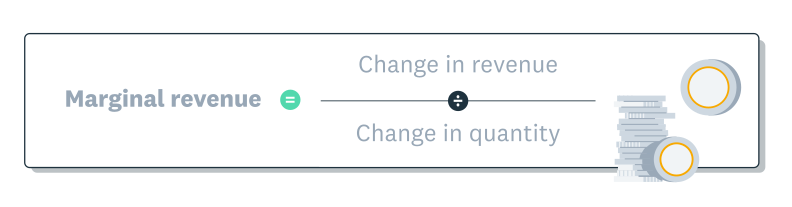
Marginal revenue is the additional income you earn from selling one more unit. The formula mirrors marginal cost:
Marginal revenue = Change in total revenue / Change in quantity sold
To maximise profits, you want to find the point where marginal cost equals marginal revenue. Up to that point, each additional unit adds more to your revenue than it costs to produce. Beyond it, you face diminishing returns, and each extra unit cuts into your profit.
Example of marginal revenue
Alison makes wallets and sells them at $30 each. She's met her current demand and is now considering supplying surplus stock to another vendor at a discounted price of $20 per wallet.
Her marginal revenue on these additional wallets would be $20 per unit, not $30, because the new vendor pays the lower price.
If Alison's marginal cost to produce each extra wallet is $22, she'd lose $2 on every additional wallet sold to that vendor at $20. Even though her standard selling price is $30, the relevant comparison here is the $20 she'd actually receive versus the $22 it costs to make each one.
In this case, supplying the extra wallets doesn't make financial sense. She'd need to either reduce her production costs below $20 per unit or negotiate a higher price with the vendor.
The marginal cost curve
When you plot marginal cost against the number of units produced, you typically see a U-shaped curve. This pattern reflects how production efficiency changes as output grows.
At first, marginal cost tends to fall. As you produce more, you benefit from efficiencies. Your team gets faster, processes become smoother, and you make better use of your existing equipment and space. Each additional unit costs less than the one before.
Eventually, the curve reaches a low point and begins to rise. This happens because of the law of diminishing returns. Your existing resources start to get stretched. Machines run closer to capacity, workers put in overtime, and you might need to source more expensive materials. Each additional unit now costs more than the last.
The curve crosses the average cost line at its lowest point. Before that crossing, marginal cost sits below average cost, pulling it down. After the crossing, marginal cost sits above average cost, pushing it up. This intersection marks the most efficient production level for your business.
Marginal cost in different business contexts
Marginal cost looks different depending on your type of business. Each business model has its own cost dynamics.
Manufacturing: Each additional unit requires raw materials, labour, and machine time. Marginal costs tend to stay relatively stable up to your production capacity, then spike when you need to add shifts, hire temporary workers, or source materials at short notice.
SaaS and digital products: The marginal cost of adding one more user is often near zero. Your main incremental expenses are server capacity and customer support. This makes digital businesses highly scalable, though costs can jump when you hit infrastructure thresholds.
Retail: Your marginal cost per additional item sold includes wholesale purchase price, storage, and shipping. Bulk purchasing discounts can lower marginal cost, but overstocking adds warehousing expenses that push it back up.
Service businesses: Each additional client or project requires staff time, travel, and supplies. Marginal cost depends heavily on how efficiently you manage your team's capacity. Once your team is fully booked, taking on more work usually means hiring, which raises marginal cost significantly.
Limitations of marginal cost analysis
Marginal cost analysis is a useful tool, but it has boundaries. Keep these limitations in mind when making decisions.
The formula assumes costs change in a straight line as production increases. In reality, costs often shift in steps. You might produce 50 extra units with no change in overhead. Then you hit a point where you need a second warehouse or an extra staff member. These jumps can make the basic formula less accurate.
Marginal cost analysis focuses on production costs and ignores value perception. Your customers might pay a premium for your brand, quality, or service. Pricing based purely on marginal cost could lead you to undercharge, leaving money on the table.
Isolating true variable costs can be tricky in practice. Some costs sit in a grey area. A staff member might split time between production and admin. Energy costs might partly relate to production and partly to heating the office. These blurred lines make the calculation less precise.
Finally, marginal cost is a short-run measure. It captures what happens with your next unit but doesn't account for longer-term strategic factors. Investing in new equipment might raise your marginal cost today but lower it substantially over the next year. Balance short-term marginal cost data with your broader business plans.
Why you should calculate your marginal cost accurately
Accurate marginal cost calculations support three key areas of your business.
First, they help you set the right prices. When you know exactly what each additional unit costs to produce, you can set prices that protect your margins without overcharging your customers. This is especially helpful when you're evaluating bulk orders, discounts, or new sales channels.
Second, they guide better production decisions. You can confidently decide whether to increase your sales volume or hold steady. If your marginal cost is rising, that's a signal to pause before committing to higher output.
Third, they drive efficient resource allocation. Knowing your marginal cost across different products or services helps you direct resources where they'll generate the most return. You stop guessing and start making decisions backed by real numbers.
Track your costs and grow with confidence
Accurate cost tracking is the foundation of reliable marginal cost calculations. When your expense data is up to date and well organised, you can quickly spot how costs shift as production changes.
Xero's accounting software gives you automated reporting and real-time visibility into your finances. You can track expenses as they happen, generate reports that break down your costs, and see exactly where your money goes. This makes it straightforward to calculate your marginal cost and act on the results.
Ready to take control of your costs? Get one month free.
FAQs on marginal cost
Common questions about marginal cost and how it applies to your business.
What causes marginal cost to increase?
Marginal cost rises when your resources become stretched. This typically happens when you exceed your current production capacity and need overtime labour, faster (more expensive) shipping, or premium-priced raw materials. Equipment running at full capacity also tends to require more maintenance, adding to costs.
How does marginal cost relate to supply and demand?
When demand increases and you ramp up production, your marginal cost eventually rises due to diminishing returns. This higher cost of supply can push prices up. Conversely, if demand drops and you scale back, your marginal cost may fall as you operate within a more efficient range. The interplay between the two shapes your revenue and pricing decisions.
What is the relationship between marginal cost and economies of scale?
Watch your marginal cost trend as you grow. If it stays flat or drops with each new unit, you're still gaining from economies of scale. The moment marginal cost starts climbing steadily, you've likely passed the efficient range. At that point, consider whether investing in new equipment or renegotiating supplier contracts could reset your cost curve before expanding further.
How does marginal cost affect break-even analysis?
Your break-even point shifts when marginal cost changes. If marginal cost drops, each extra unit adds less to your total expenses, so you cover your fixed costs sooner. If it rises, you either need to sell more units or raise prices to break even. Reviewing marginal cost alongside your break-even target helps you set realistic sales goals each quarter.
Disclaimer
Xero does not provide accounting, tax, business or legal advice. This guide has been provided for information purposes only. You should consult your own professional advisors for advice directly relating to your business or before taking action in relation to any of the content provided.
Get one month free
Purchase any Xero plan, and we will give you the first month free.