What is profit? A guide for small businesses
Learn what profit is, the three main types, how to calculate it and simple ways to grow it.
Published Thursday 23 July 2026
Table of contents
Key takeaways
- Profit is the money left over after your business pays all its expenses, and it's the clearest sign that your business is working.
- There are three main types of profit to track: gross profit, operating profit and net profit. Net profit is what remains once every cost, including tax, is deducted.
- Profit is not the same as revenue, turnover or the cash in your bank account, so it pays to know the difference.
- You can grow profit two ways: bring in more revenue or reduce your expenses. Small changes to either lever add up over time.
What is profit?
Profit is the money your business keeps after paying all its expenses. Put another way, profit is your revenue minus your costs.
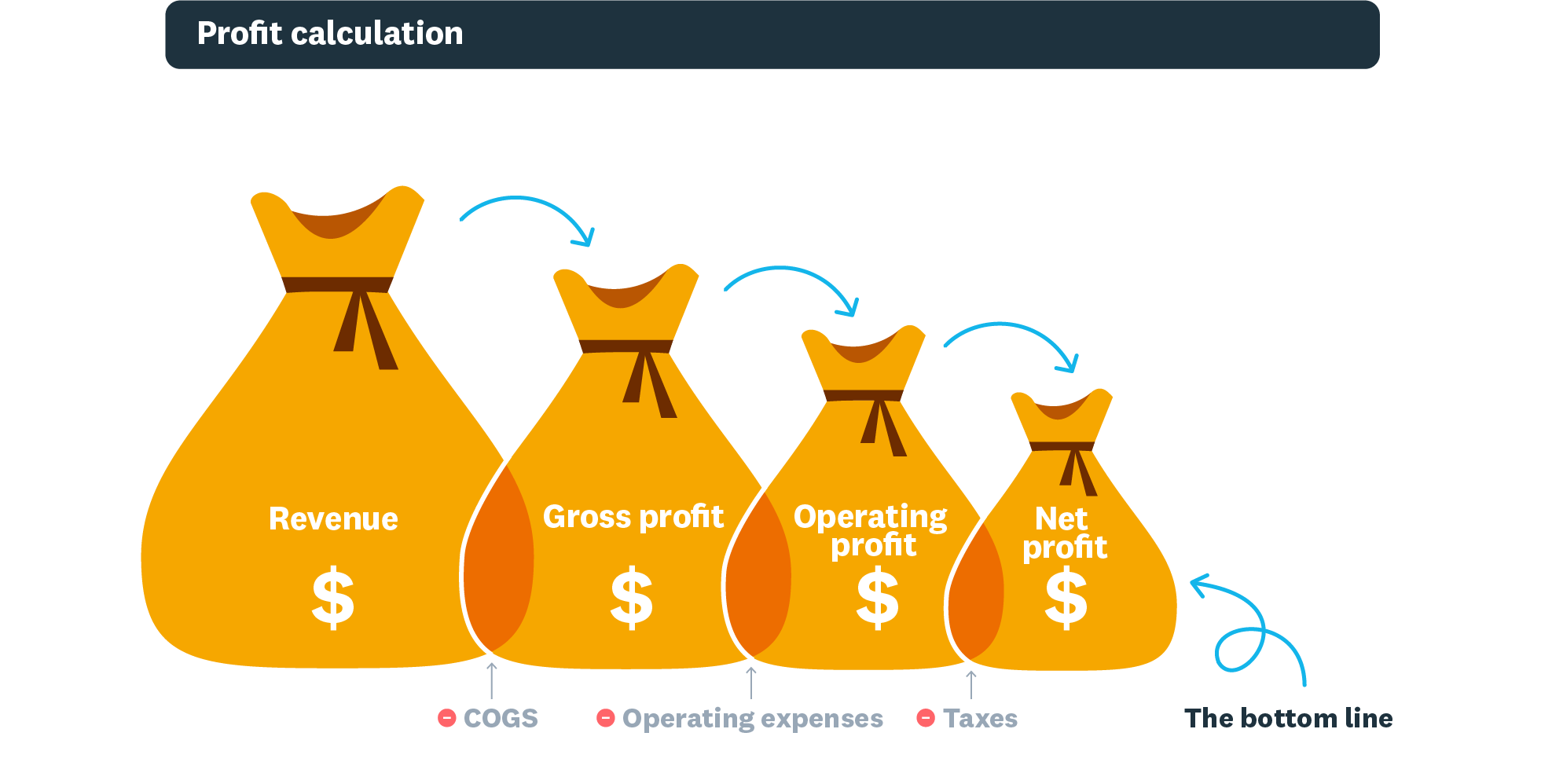
There are three types of profit. Net profit is what you get to keep.
If you sell 10,000 dollars of goods in a month and it costs you 7,000 dollars to run the business that month, your profit is 3,000 dollars. When your costs are higher than your revenue, you make a loss instead.
Profit is the number that tells you whether your business is sustainable. It's what's left to pay yourself, reinvest, or set aside for quieter months.
Profit isn't a single figure; it comes in three main types, and each one tells you something different about your business. Knowing all three helps you see exactly where your money goes.
The 3 main types of profit: gross, operating and net
Your income statement, also called a profit and loss statement, works through these three types in order. You start with gross profit, then operating profit, then net profit.
Gross profit is what's left after you subtract the direct costs of making or delivering what you sell. These direct costs are known as the cost of goods sold (COGS).
Operating profit goes a step further. It's your gross profit minus the everyday costs of running the business, such as rent, wages, and utilities, but before interest and tax.
Net profit is the money left after deducting all your costs, including interest and tax. It's often called your bottom line, and it's the truest measure of what your business actually earns.
Once you know the three types, the formulas follow the same order and build on each other. Here's how to calculate each one, with a simple Australian example to bring it to life.
How to calculate profit
The basic profit formula is straightforward: profit = total revenue minus total costs. From there, you can break it down into the three types.
The three formulas you'll use most often are:
- Gross profit = revenue minus cost of goods sold (COGS)
- Operating profit = gross profit minus operating expenses
- Net profit = operating profit minus interest and tax
Say you run a small cafe in Melbourne. In one month you take 40,000 dollars in revenue, your ingredients and other COGS come to 15,000 dollars, your operating expenses such as rent and wages come to 18,000 dollars, and your interest and tax come to 2,000 dollars.
Your gross profit is 25,000 dollars (40,000 minus 15,000). Your operating profit is 7,000 dollars (25,000 minus 18,000). Your net profit is 5,000 dollars (7,000 minus 2,000).
To turn any of these dollar figures into a percentage, you can use a net profit margin calculator to check your margin in seconds.
People often use profit to mean sales, but they're not the same thing. Keeping these terms straight helps you read your numbers with confidence.
Profit vs revenue, turnover and cash
Revenue, also called turnover, is the total money your business brings in from sales before any costs are taken out. Profit is what's left after those costs are paid, so a business can have high revenue and still make very little profit.
Cash is different again. Cash is the money actually in your bank account right now, which is shaped by timing: when customers pay you and when your bills fall due.
You can be profitable on paper yet short on cash if invoices are slow to come in. That's why managing your cash flow matters just as much as watching your profit.
Profit and profitability sound alike, but they answer different questions. One is a dollar amount; the other is a ratio.
Profit vs profitability
Profit is a dollar figure: the actual money left over, such as 5,000 dollars in a month. Profitability measures how efficiently you turn revenue into profit, and it's usually shown as a percentage.
That percentage is your profit margin, which you work out by dividing profit by revenue. A business earning 5,000 dollars profit on 40,000 dollars revenue has a net profit margin of 12.5%.
Margins let you compare performance over time or against similar businesses, even when the dollar figures differ. If you want to sharpen the direct-cost side of your business, it's worth understanding your gross profit margin as well.
Profit is more than a number on a report; it's what gives your business options. Here's what a healthy profit lets you do.
Why profit matters for your small business
Profit funds your next move. When you keep more of what you earn, you can reinvest in new equipment, hire staff, or launch a new product or service.
It also builds resilience. A profit buffer helps you cover unexpected costs and ride out slower trading periods without scrambling for finance.
Over the longer term, steady profit is what makes growth possible. It shows lenders and investors that your business is worth backing, and it gives you the confidence to plan ahead.
If your profit isn't where you'd like it to be, you have two clear levers to pull. You can bring in more revenue, reduce your expenses, or work on both at once.
How to increase your profit
The first lever is revenue. You can lift revenue by raising prices where the market allows, selling more to existing customers, or reaching new ones, and there are encouraging signs for Australian businesses doing exactly that. According to Xero Small Business Insights, Australian small businesses grew sales 7.3% year-on-year in the December 2025 quarter.
The second lever is your expenses. It helps to look at each type of cost in turn:
- Fixed costs: regular expenses that stay much the same, such as rent and insurance
- Variable costs: expenses that rise and fall with activity, such as delivery and packaging
- Cost of goods sold (COGS): the direct costs of producing what you sell
Trimming waste from any of these lifts your profit without needing a single extra sale. For more practical ideas, see this guide on growing your profit.
Seeing your profit clearly, in real time, makes every one of these decisions easier. Xero brings your revenue, costs and margins together so you always know where you stand.
See your profit clearly with Xero
When your numbers live in one place, working out your profit stops being a monthly guessing game. Xero accounting software tracks your income and expenses automatically and turns them into simple reports you can act on.
That means less time in the books and more time growing the business, with a clear view of your profit whenever you need it. Try Xero accounting software today and get one month free.
Here are answers to some frequently asked questions about profit to round out the essentials.
FAQs on profit
Business owners often ask which profit figure to focus on first, so here's a quick steer.
Which type of profit should I focus on?
Net profit is the most complete measure because it accounts for every cost, including tax. Gross and operating profit are useful for spotting where money is being made or lost along the way.
A common point of confusion is whether a profitable business can still run out of money.
Can a profitable business still run out of cash?
Yes, because profit and cash are different things. If customers are slow to pay while your own bills are due, you can be profitable yet still short on cash.
Many owners want to know how much of their profit to keep aside for tax.
How much profit should I set aside for tax?
A common approach is to set aside a portion of your profit as you earn it, rather than facing a lump sum later. Check the current rates on the Australian Taxation Office (ATO) website, or ask your accountant, so you put away the right amount for your situation.
Finally, owners often ask what counts as a good level of profit.
What is a good profit margin?
A good margin varies widely by industry, so compare yourself against similar businesses rather than a single benchmark. Tracking your margin over time is the best way to see whether your business is heading in the right direction.
Handy resources
Advisor directory
You can search for experts in our advisor directory
How to manage your finances and cash flow
Learn about money management for your small business
Financial reporting
Keep track of your performance with accounting reports
Disclaimer
This glossary is for small business owners. The definitions are written with their requirements in mind. More detailed definitions can be found in accounting textbooks or from an accounting professional. Xero does not provide accounting, tax, business or legal advice.