Trial balance: definition, types and how to prepare
Learn what a trial balance is, the three types and how to prepare one for your business.

Written by Jotika Teli—Certified Public Accountant with 24 years of experience. Read Jotika's full bio
Published Wednesday 27 May 2026
Table of contents
Key takeaways
- A trial balance is a financial report that lists all your general ledger account balances to confirm total debits equal total credits, helping you catch bookkeeping errors before they flow into your financial statements.
- Three types of trial balances serve different stages of your accounting cycle: unadjusted (initial data), adjusted (after corrections), and post-closing (ready for the next period).
- While a trial balance confirms your books are mathematically balanced, it cannot detect every error, so you still need to check for missing transactions, compensating mistakes, and misclassified entries.
- Preparing a trial balance regularly saves time at tax time and gives you a clearer picture of your business finances throughout the year.
What is a trial balance?
A trial balance is a financial report that lists every account balance from your general ledger at a specific point in time. It confirms that your total debits equal your total credits, serving as a key accuracy check before you prepare financial statements. Accurate trial balances also feed into business budgeting, giving you reliable data to plan ahead.
Think of it as a snapshot of all your accounts in one place. If the debit and credit totals match, your books are balanced. If they don't, there's an error somewhere that needs investigating.
Components of a trial balance
A trial balance uses a simple three-column format. Your debit and credit column totals should match so your books balance.
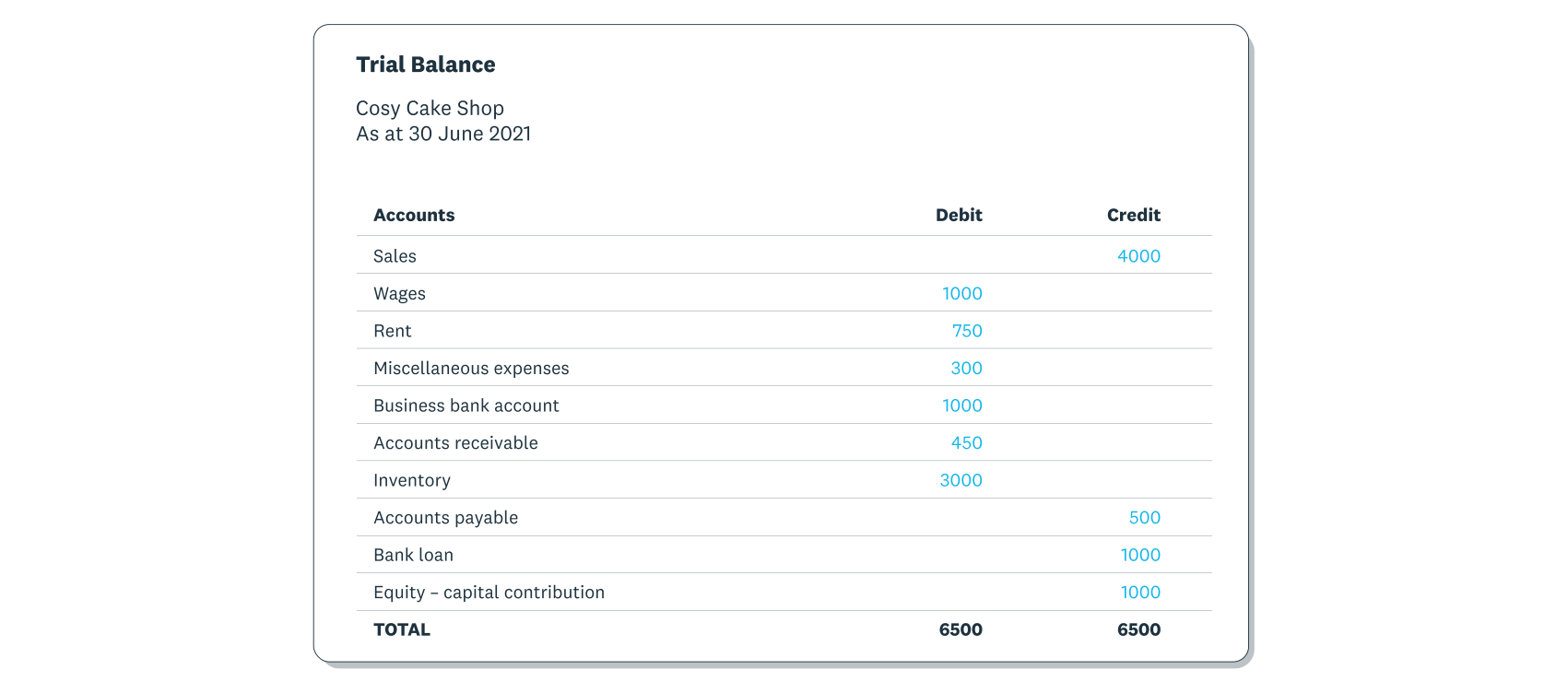
The three columns include:
- Account names: all ledger accounts from your chart of accounts, listed in order.
- Debit column: balances for asset and expense accounts.
- Credit column: balances for liability, equity, and revenue accounts.
Trial balance example
Here is an example of how a trial balance looks for a small business at the end of a financial period. The account names sit in the far left column, with each account's closing balance recorded in either the debit or credit column.
- Cash: $10,000 (debit)
- Accounts receivable: $5,000 (debit)
- Equipment: $15,000 (debit)
- Accounts payable: $8,000 (credit)
- Owner's equity: $12,000 (credit)
- Revenue: $20,000 (credit)
- Rent expense: $10,000 (debit)
In this example, total debits equal $40,000 and total credits equal $40,000. The trial balance is balanced, which means the general ledger entries have been recorded correctly.
Why do you need a trial balance?
A trial balance verifies your bookkeeping accuracy and gives you a clear view of your business finances at any point in time. It is one of the most practical tools for keeping your records in order.
You can use a trial balance to:
- Catch errors early. Check that debits and credits match to spot mistakes before tax time or end-of-year reporting.
- See your financial position. View all account balances in one place for a quick overview of where your business stands.
- Prepare financial statements. Create accurate balance sheets and income statements from clean, balanced data.
- Stay audit-ready. Provide auditors with a clear record of your account balances and their accuracy.
How a trial balance works
A trial balance works on the principle of double-entry bookkeeping, where every transaction is recorded as both a debit and a credit. If all transactions have been entered correctly, total debits will always equal total credits.
Your trial balance groups accounts into two broad categories based on the financial statements they feed into.
Balance sheet accounts include:
- Assets (debit balances): cash, accounts receivable, equipment, inventory, and other items your business owns.
- Liabilities (credit balances): accounts payable, loans, and other amounts your business owes.
- Equity (credit balances): owner's equity, retained earnings, and capital contributions.
Profit and loss (income statement) accounts cover the other side. Revenue accounts carry credit balances and include sales income, service fees, and other earnings. Expense accounts carry debit balances and include rent, salaries, utilities, and other costs of running your business.
When you prepare a trial balance, you transfer each account's closing balance into the correct column. The debit column captures assets and expenses. The credit column captures liabilities, equity, and revenue. If the two columns total the same amount, your books are balanced.
Types of trial balances
Three types of trial balances serve different stages of your accounting cycle. Each builds on the one before it, moving your records from raw data to a clean starting point for the next period.
Unadjusted trial balance
An unadjusted trial balance captures your initial ledger data before any corrections. It shows your day-to-day transactions as first recorded and helps you spot obvious errors early.
After preparing the unadjusted trial balance, you may need to make adjustments such as:
- Accruals: unpaid bills or earned income not yet recorded.
- Deferrals: prepaid income recognised only when earned.
- Depreciation: asset costs spread over their useful life.
These adjustments help you see your true financial position before preparing formal reports.
Adjusted trial balance
An adjusted trial balance summarises the final balances in all accounts after you make corrections. Prepare it after the unadjusted trial balance and before your financial statements.
This version reflects accruals, deferrals, depreciation, and any other adjusting entries. It serves as the direct foundation for your balance sheet and income statement.
Post-closing trial balance
A post-closing trial balance confirms your books are ready for the next accounting period. Prepare it after you finalise financial statements and close temporary accounts like revenue, expenses, and dividends.
The balances of these temporary accounts move into retained earnings. This final check verifies your debits and credits are equal before starting the new period.
How to prepare a trial balance
Preparing a trial balance confirms your books are mathematically correct. You can use accounting software like Xero to automate this process, but understanding the manual steps helps you stay in control of your finances.
Follow these six steps to prepare a trial balance:
- List all general ledger accounts and their closing balances for the accounting period.
- Create two columns: one for debits and one for credits.
- Enter each account's final balance into the correct column (assets and expenses in debit; liabilities, equity, and revenue in credit).
- Add up all the amounts in the debit column.
- Add up all the amounts in the credit column.
- Compare the two totals. If they match, your books are balanced. If they don't, investigate and correct the error before moving on.
Common trial balance errors
Even with careful bookkeeping, errors can creep into your trial balance and throw off your financial reports. Errors in financial records are more common than you might expect. Regular error-checking processes, like preparing a trial balance, help catch these mistakes before they affect your reports.
Watch for these common types of errors:
- Transcription errors. Mistyped amounts, such as entering $500 as $5,000.
- Transposition errors. Swapping digits in a number, for example recording $540 as $450. A quick way to spot these: if the difference between your debit and credit totals is divisible by nine, a transposition error is likely the cause.
- Omission errors. Leaving out transactions completely so they never appear in the trial balance.
- Misclassification errors. Recording transactions in the wrong accounts, such as logging a utility bill under office supplies.
How to correct trial balance errors
When you find errors in your trial balance, correct them promptly to keep your records accurate.
Follow these steps to track down and fix mistakes:
- Re-add both columns to rule out simple arithmetic mistakes.
- If the difference between your debit and credit totals divides evenly by nine, look for a transposition error where two digits have been swapped.
- Compare ledger entries against invoices, receipts, and bank statements to confirm figures are correct.
- Cross-check your general ledger against your bank transactions to find anything missing.
- If you cannot find the error straight away, place the difference in a temporary suspense account so you can still proceed with reporting while you investigate.
- Use accounting software like Xero to automate calculations and flag discrepancies, reducing the chance of manual entry errors.
Limitations of a trial balance
A balanced trial balance confirms that your debits equal your credits, but it does not guarantee your books are free of errors. Several types of mistakes can slip through undetected.
Errors a trial balance cannot catch include:
- Errors of omission. If a transaction is left out entirely, both the debit and credit are missing, so the trial balance still balances.
- Compensating errors. Two or more mistakes that cancel each other out, leaving the totals correct even though individual entries are wrong.
- Errors of principle. Recording a transaction in the wrong type of account, for example treating a capital expense as a revenue expense. The trial balance still balances because the debit and credit amounts are equal.
- Errors of original entry. If the wrong amount is entered on both sides of a transaction, the trial balance will balance but the figures will be incorrect.
- Complete reversal of entries. Recording a debit as a credit and the corresponding credit as a debit. The totals still match, but the accounts are wrong.
Because of these limitations, a trial balance should be one part of your financial review process, not the only check. Reconciling your accounts, reviewing source documents, and running regular reports all help you catch errors that a trial balance alone cannot detect.
Trial balance vs balance sheet
A trial balance and a balance sheet are both important financial reports, but they serve different purposes and audiences. Understanding the differences helps you use each one at the right time.
Here is how they compare:
- Purpose. A trial balance checks that your debits equal your credits. A balance sheet shows your business's financial position at a specific date.
- Audience. A trial balance is an internal document used by bookkeepers and accountants. A balance sheet is a formal financial statement shared with stakeholders, investors, and regulators.
- Content. A trial balance lists every account in your general ledger. A balance sheet only includes asset, liability, and equity accounts.
- Format. A trial balance uses debit and credit columns. A balance sheet is structured around the accounting equation: assets equal liabilities plus equity.
- Frequency. You can prepare a trial balance at any time during the accounting period. A balance sheet is typically prepared at the end of a reporting period, such as monthly, quarterly, or annually.
In short, the trial balance is a working tool that helps you verify accuracy. The balance sheet is a finished report that communicates your financial position to others.
The role of trial balances in financial statements
A trial balance serves as the foundation for your financial statements and audit processes. It verifies your books are mathematically correct before you create formal reports like balance sheets and income statements.
Directors in Australia have a duty of care and diligence under the Corporations Act 2001 when it comes to financial reporting. You can learn more from the Australian Securities and Investments Commission (ASIC) guidance on directors and financial reporting.
A well-prepared trial balance supports your financial reporting in several ways:
- Detects errors before reporting. Confirms that debit and credit totals match, so mistakes don't carry through to your published financial statements.
- Provides clean data for statements. Gives you balanced figures to build your balance sheet and income statement from.
- Supports audit and assurance. Gives auditors confidence in the accuracy of your records, helping meet the standards captured by Australian, New Zealand, and international auditing frameworks. You can read more about record-keeping requirements from the Australian Taxation Office (ATO).
Even when your trial balance is in order, still check for missing transactions or incorrect account classifications. A balanced trial balance is a strong starting point, but it works best alongside regular account reconciliation and review.
Simplify trial balance preparation with Xero
Regular trial balance preparation keeps your books accurate and saves you time at month end. Whether you are checking an unadjusted trial balance for obvious errors or preparing a post-closing trial balance for the next period, the process helps you catch mistakes before they affect your financial statements.
Xero accounting software automates trial balance preparation so you can focus on running your business. It records transactions, flags discrepancies, and produces accurate financial reports without the manual work. Ready to streamline your accounting? Try Xero and get one month free.
FAQs on trial balances
Here are answers to frequently asked questions about trial balances.
What are the rules of trial balances?
The core rule is that total debits must equal total credits. Beyond that, include every account from your general ledger, use the correct chart of accounts, and if the totals don't match, investigate and correct the error before proceeding.
What are the three main purposes of a trial balance?
A trial balance serves three main purposes: spotting bookkeeping errors by checking that debits equal credits, giving you a clear overview of all account balances at a point in time, and providing balanced data as the foundation for preparing accurate financial statements.
What is the difference between a general ledger and a trial balance?
A general ledger is the complete record of every financial transaction your business makes, organised by account. A trial balance is a summary report pulled from the general ledger that lists each account's closing balance in a debit or credit column. The general ledger holds the detail; the trial balance checks the totals.
What should you do if a trial balance doesn't balance?
Start by re-adding both columns to rule out arithmetic errors, then check whether the difference is divisible by nine, which often points to a transposition error. If you still cannot locate the issue, review your source documents against the ledger and use a temporary suspense account while you investigate.
Disclaimer
Xero does not provide accounting, tax, business or legal advice. This guide has been provided for information purposes only. You should consult your own professional advisors for advice directly relating to your business or before taking action in relation to any of the content provided.
Get one month free
Purchase any Xero plan, and we will give you the first month free.