Peer-to-peer lending: how it works, risks, and how to apply
Learn how P2P lending works for UK businesses, what the risks are, and how to apply.
Published Monday 11 May 2026
Table of contents
Key takeaways
- Peer-to-peer (P2P) lending connects your business directly with individual or institutional investors through online platforms, bypassing traditional banks. Interest rates typically range from 3% to 30%, depending on your credit profile and loan type.
- P2P loans can offer faster approval times and more flexible eligibility criteria than high-street banks, making them a practical option if you've been turned down for traditional finance. However, they aren't protected by the Financial Services Compensation Scheme (FSCS).
- The Financial Conduct Authority (FCA) regulates P2P lending platforms in the UK, so you should only borrow through FCA-authorised platforms. Always check the FCA register before committing.
- Before applying, assess your ability to repay, understand the fees involved, and compare P2P lending with alternatives like business loans, overdrafts, and government-backed schemes.
What is peer-to-peer lending?
Peer-to-peer lending is a form of finance that's changed how small businesses access funding. Here's what it means and why it matters.
Peer-to-peer (P2P) lending is a method of borrowing money directly from individuals or institutional investors through an online platform, without going through a traditional bank. The platform acts as a marketplace, matching borrowers who need funds with lenders looking for a return on their investment.
For small businesses, P2P lending offers an alternative route to finance. Instead of applying to a bank, you submit a loan request on a P2P platform. Investors then choose whether to fund part or all of your loan. The platform handles the administration, credit checks, and repayment collection.
P2P lending first appeared in the UK in 2005 and has grown significantly since. The UK was one of the first countries to regulate the sector, and it remains one of the largest P2P markets in Europe.
How does peer-to-peer lending work?
Understanding the mechanics of P2P lending helps you decide whether it's the right fit for your business. The process is straightforward, though it differs from applying for a traditional bank loan.
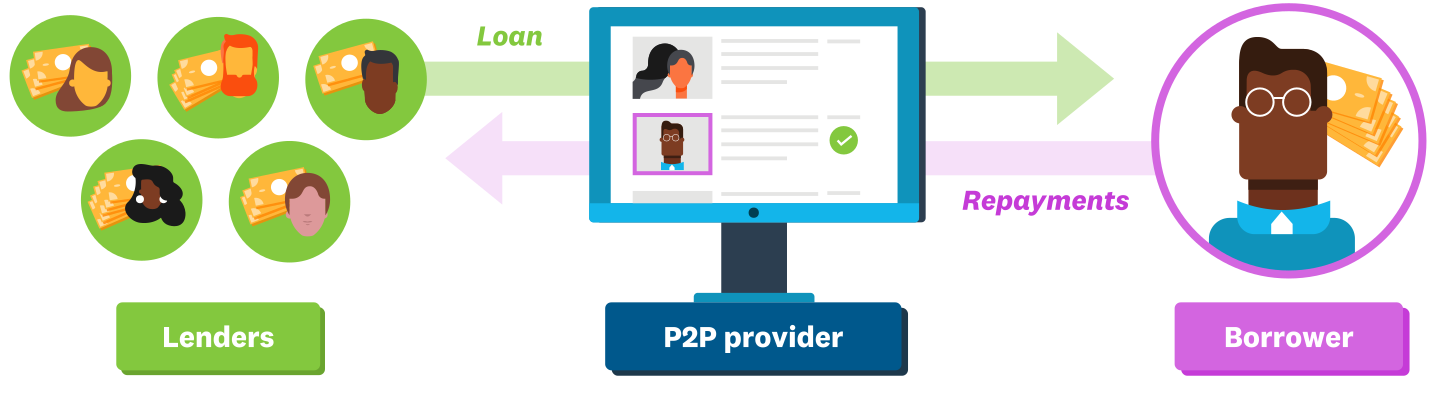
You start by registering on a P2P platform and submitting a loan application. The platform assesses your creditworthiness, assigns a risk rating, and sets an interest rate. Your loan request is then listed on the platform for investors to review.
Investors, who could be individuals or institutions, choose to fund your loan either in full or in part. Most platforms spread your loan across multiple investors to reduce risk. Once enough investors commit, the funds are transferred to your account.
You then repay the loan in regular instalments, typically monthly, over an agreed term. The platform collects your repayments and distributes them to investors. Terms usually range from one to five years, with loan amounts from as little as £1,000 up to several hundred thousand pounds, depending on the platform and your business profile.
The whole process, from application to funding, can take anywhere from a few days to a couple of weeks. That's often faster than traditional bank lending.
Pros and cons of peer-to-peer lending
P2P lending has distinct advantages and drawbacks. Weighing them up helps you make a confident decision about whether this type of finance suits your business.
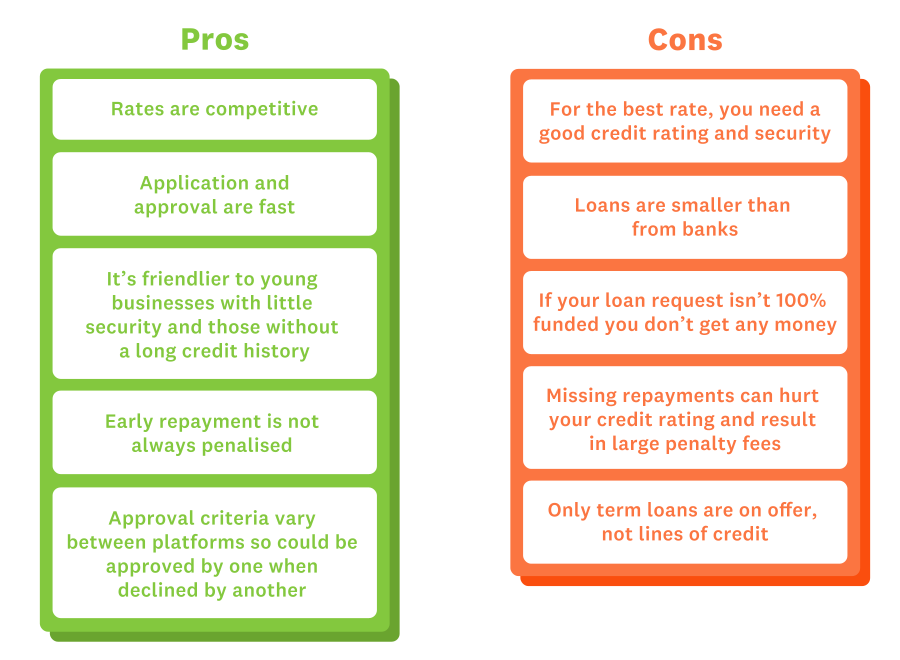
Faster access to funds
One of the biggest draws of P2P lending is speed. Many platforms can approve and fund a loan within 5 to 14 days. Traditional bank loans often take several weeks or longer, especially for smaller businesses without an established lending history.
More flexible eligibility
P2P platforms often consider a wider range of factors when assessing applications. If you've been trading for a shorter period or don't have a perfect credit history, you may still qualify. Some platforms accept businesses with as little as six months of trading history.
Competitive interest rates for strong borrowers
If your business has a solid credit profile, P2P interest rates can be competitive with, or even lower than, traditional bank rates. Rates typically start from around 3% to 6% for lower-risk borrowers. Higher-risk borrowers may face rates of 15% to 30%.
Fixed repayment terms
Most P2P loans come with fixed interest rates and set repayment schedules. This makes it easier to plan your cash flow and budget for monthly repayments without worrying about rate fluctuations.
No FSCS protection
A significant downside is that P2P investments aren't covered by the Financial Services Compensation Scheme (FSCS). While this primarily affects investors, it also means the platforms themselves may carry more risk. If a platform fails, there's no government safety net.
Potentially higher costs for riskier borrowers
If your credit score is lower or your business is newer, you'll likely face higher interest rates. Arrangement fees, which typically range from 1% to 6% of the loan amount, can also add to the overall cost.
Less personal support
Unlike a bank relationship manager, P2P platforms are primarily digital. You won't typically have a dedicated contact to discuss your financial needs or renegotiate terms if your circumstances change.
Types of peer-to-peer lending
P2P lending isn't one-size-fits-all. Different types of P2P loans serve different purposes, so it's worth understanding which one aligns with your business needs.
Lending to individuals
Personal P2P lending connects individual borrowers with individual lenders. While this type isn't directly aimed at businesses, some sole traders use personal P2P loans to fund smaller business expenses. Loan amounts are typically lower, ranging from £1,000 to £25,000.
Lending to businesses
Business P2P lending is the most relevant type for small business owners. Platforms like Funding Circle connect businesses with investors willing to fund working capital, equipment purchases, or expansion plans. Loan amounts can range from £10,000 to £500,000 or more, with terms from six months to five years.
Lending against property
Property-backed P2P lending, also known as secured lending, uses property as collateral. Platforms such as Kuflink, Folk2Folk, and CapitalStackers specialise in this area. Because the loan is secured, interest rates tend to be lower. However, you risk losing the property if you can't repay.
Is peer-to-peer lending right for your business?
Choosing the right type of finance depends on your specific situation. P2P lending works well in some scenarios but isn't always the best option.
P2P lending could be a good fit if you need funds relatively quickly and traditional banks have turned you down or their process is too slow. It's also worth considering if you want a fixed repayment schedule and don't need an ongoing line of credit.
It may be less suitable if you need a very large loan, if you'd prefer face-to-face support, or if you want the security of FSCS-protected lending. Businesses with very low credit scores may also find that the interest rates offered through P2P platforms are higher than other options.
Consider your repayment capacity carefully. P2P loans typically require fixed monthly payments, so you'll need steady cash flow to keep up. If your income fluctuates, a more flexible facility like an overdraft or revolving credit might suit you better.
What to consider before applying for a P2P loan
Before submitting a P2P loan application, take time to review a few things. Preparation improves your chances of approval and helps you secure better terms.
Here are the key factors to think through:
- Your credit profile: check your business and personal credit scores before applying. A stronger score typically means lower interest rates
- How much you need: borrow only what you need. Larger loans attract more scrutiny and potentially higher rates
- Repayment affordability: map out your monthly cash flow to confirm you can comfortably meet repayments. Late or missed payments can damage your credit score
- Total cost of borrowing: factor in the interest rate, arrangement fees, and any other charges. Compare the total cost across different platforms
- Platform reputation: check the platform is authorised by the Financial Conduct Authority (FCA). Read reviews and look into how the platform handles defaults and late payments
- Your business financials: most platforms ask for recent accounts, bank statements, and a business plan. Having these ready speeds up the process
How to apply for peer-to-peer lending
Applying for a P2P loan follows a fairly standard process. Here's how it typically works, step by step.
- Choose an FCA-authorised platform that suits your borrowing needs. Compare rates, terms, and fees across platforms like Funding Circle, Folk2Folk, and Kuflink.
- Register on your chosen platform and complete the application form. You'll provide details about your business, the loan amount, and what you plan to use the funds for.
- Submit supporting documents. This usually includes recent business accounts, bank statements, identification, and sometimes a business plan.
- Wait for the platform to assess your application. They'll run credit checks, review your financials, and assign a risk rating that determines your interest rate.
- Once approved, your loan is listed for investors. Funding can take anywhere from a few days to two weeks, depending on the platform and loan size.
- Receive the funds in your business account and begin making repayments according to the agreed schedule.
Risks of peer-to-peer lending
Every form of borrowing carries risk. Understanding the specific risks of P2P lending helps you make a more informed decision and avoid unexpected problems.
Default risk
If your business struggles to make repayments, you could default on the loan. This typically triggers penalty fees and collection action from the platform. In severe cases, it could lead to legal proceedings or, for secured loans, the loss of your collateral.
Credit score impact
Applying for a P2P loan involves a credit check, which leaves a mark on your credit file. If you apply to multiple platforms in a short period, this could temporarily lower your score. Missed or late repayments will have a more lasting negative effect.
Fees and charges
Beyond the interest rate, P2P platforms often charge arrangement fees (typically 1% to 6% of the loan), late payment fees, and early repayment fees. These can add up, so read the terms carefully before committing.
Personal guarantees
Some P2P platforms require a personal guarantee, particularly for unsecured business loans. This means you're personally liable if your business can't repay. Your personal assets, including your home, could be at risk.
Platform failure
P2P platforms are businesses themselves, and they can fail. While FCA regulation requires platforms to have wind-down plans to manage existing loans if they close, the process can be disruptive. Your repayment terms may change, and you could face delays or uncertainty.
FSCS non-coverage
P2P lending is not covered by the Financial Services Compensation Scheme. If a platform fails and there are issues with recovering your loan or managing repayments, there's no government compensation available. This differs from deposits held with banks, which are protected up to £85,000 per person per institution.
FCA regulation and peer-to-peer lending
Understanding the regulatory landscape gives you added confidence when choosing a P2P platform. Regulation protects both borrowers and investors.
The Financial Conduct Authority (FCA) has regulated P2P lending platforms in the UK since April 2014. All platforms that operate in the UK must be FCA-authorised, which means they must meet specific standards for transparency, risk management, and client money handling.
FCA rules require platforms to clearly disclose their fee structures, default rates, and how they assess borrower risk. Platforms must also have adequate wind-down plans, so existing loans continue to be managed even if the platform itself ceases trading.
Before applying through any P2P platform, check the FCA register to confirm it's authorised. Be cautious of platforms that aren't listed, as they may be operating illegally.
It's worth noting that FCA regulation doesn't eliminate risk. It sets minimum standards, but it doesn't guarantee you won't lose money or face difficulties. The absence of FSCS protection means you should still carry out thorough due diligence on any platform you use.
Alternatives to peer-to-peer lending
P2P lending is just one of several ways to fund your business. Comparing it with other options helps you find the best match for your circumstances.
Here are some common alternatives:
- Bank loans: traditional business loans from high-street banks often offer lower interest rates for established businesses. The application process is typically longer, but you benefit from FSCS protection on deposits and an established complaints process
- Business overdrafts: an overdraft gives you flexible, short-term access to funds. Interest rates can be higher than P2P loans, but you only pay for what you use
- Government-backed schemes: the British Business Bank offers several programmes, including the Start Up Loans scheme (loans up to £25,000 for businesses under three years old) and the Recovery Loan Scheme. These often come with favourable terms and mentoring support
- Invoice finance: if your cash flow is tied up in unpaid invoices, invoice financing lets you borrow against outstanding invoices. You'll typically receive 80% to 90% of the invoice value upfront
- Asset finance: this lets you spread the cost of equipment, vehicles, or machinery over time. The asset itself acts as security, which can mean lower interest rates
- Angel investors or venture capital: if you're looking for larger sums and are willing to give up equity, angel investors or venture capital firms could be an option. This route suits businesses with strong growth potential
Manage your business finances with Xero
Whatever funding route you choose, keeping your finances organised makes the process smoother. Clear, up-to-date financial records help you present a stronger case to lenders and stay on top of repayments.
Xero's cloud accounting software helps you track cash flow, manage invoices, and stay on top of your business finances in real time. With automated bank feeds and simple reporting, you can monitor your financial health and prepare the documentation lenders need.
FAQs on peer-to-peer lending
Here are answers to frequently asked questions about peer-to-peer lending for UK small businesses.
Is peer-to-peer lending safe for businesses?
P2P lending through FCA-authorised platforms is a legitimate and regulated form of borrowing. However, it's not risk-free. P2P investments aren't covered by the FSCS, and platforms can fail. Always verify a platform's FCA authorisation and read the terms carefully before borrowing.
What interest rates can you expect with P2P lending?
Interest rates vary depending on your credit profile, loan amount, and the platform. Lower-risk borrowers typically see rates from 3% to 6%, while higher-risk borrowers may face rates of 15% to 30%. Arrangement fees of 1% to 6% also apply on most platforms.
Is peer-to-peer lending regulated in the UK?
Yes. The FCA has regulated P2P lending platforms since April 2014. All UK P2P platforms must be FCA-authorised, which requires them to meet standards for transparency, risk management, and client money handling. Check the FCA register before using any platform.
Can startups get peer-to-peer loans?
Some P2P platforms accept businesses with as little as six months of trading history. However, newer businesses typically face higher interest rates due to their limited track record. You may also want to explore the Start Up Loans scheme, which offers loans up to £25,000 with mentoring support for businesses under three years old.
What happens if a P2P lending platform goes bust?
FCA regulation requires P2P platforms to have wind-down plans. This means a third party or the platform's administrators should continue managing existing loans and collecting repayments. However, the process can be slow and disruptive, and there's no FSCS protection to compensate you if things go wrong.
Disclaimer
Xero does not provide accounting, tax, business or legal advice. This guide has been provided for information purposes only. You should consult your own professional advisors for advice directly relating to your business or before taking action in relation to any of the content provided.
How to finance your business in the UK
Need finance for your business? Learn about the types of finance, approaching lenders and investors and more.
- What is business finance?
Learn how business finance works and find the right funding for your small business.
- How much business funding do you need?
Knowing how much money you need will help you choose the right type of finance. These tips will help you find a number.
- Debt versus equity finance
Most forms of funding fall into one of two camps. Let’s look at the main pros and cons of debt versus equity.
- Main types of finance
It takes money to make money. So what sort of finance options are there? Here are the types that fund most businesses.
- How to get a business loan
Find the right business loan and put together a strong application with this step-by-step guide.
- Peer-to-peer lending
Learn how P2P lending works for UK businesses, what the risks are, and how to apply.
- Friends and family loans
Learn how to borrow from friends and family for your business, with tips on agreements, tax, and relationships.
- Invoice financing
Turn unpaid invoices into working capital. Learn how invoice financing works and which type suits your business.
- How to find investors
Find the right investors for your business with this guide to funding types, where to look, and how to prepare.
- Angel investors versus venture capitalists
Angel investors and venture capitalists are alternative finance sources. What can they offer your business?
- How crowdfunding works
Learn how crowdfunding works, the different models, and how to launch a successful campaign for your small business.
- Small business grants
Find UK small business grants, check eligibility, and apply with confidence.
- Pitching for business funding
Learn how to pitch your business to investors and lenders with practical, step-by-step guidance.
Download the guide to financing your business
Your intro to the different types of finance, including their pros and cons. Fill out the form to receive our finance guide as a PDF.
Now that you have your guide
Managing finances can feel overwhelming. With Xero’s powerful tools, small businesses can stay organised and confident.