Profit margin: what it is, how to calculate and improve
Profit margin helps you track performance and build a stronger business. Learn how to improve yours.
Written by Jotika Teli—Certified Public Accountant with 24 years of experience. Read Jotika's full bio
Published Friday 17 April 2026
Table of contents
Key takeaways
- Calculate your profit margin by dividing your profit by your revenue and multiplying by 100 — this percentage lets you compare performance over time and against competitors more easily than looking at dollar amounts alone.
- Track all three margin types (gross, operating, and net) for different purposes: use gross margin to evaluate pricing, operating margin to assess day-to-day efficiency, and net margin to understand your true overall profitability.
- Boost your profit margins by focusing on three core areas: cutting unnecessary costs, improving how efficiently you run your operations, and adjusting your pricing to reflect the value you deliver.
- Compare your profit margins against industry benchmarks and your own past performance regularly, as there is no single "good" margin that applies to every business — what matters is whether your trend is moving in the right direction.
What is a profit margin?
Profit margin is the percentage of revenue you keep after paying all business expenses. It tells you how much profit you generate for every dollar of sales.
A strong profit margin signals good financial health. It shows you earn enough to cover costs and still make money. Use it to spot what's working and where you could cut costs.
Profit margins vs net profit
Net profit is a dollar amount. Profit margin is a percentage. Here's how they differ:
- Net profit: the actual dollars left after paying all expenses
- Profit margin: the percentage of revenue that becomes profit
For example, if you earn $100,000 revenue and have $20,000 net profit, your profit margin is 20%. The percentage format helps you compare performance across time periods and against competitors.
How profit margins work
Profit margin measures efficiency. It shows how well you turn revenue into profit you keep.
When you sell a product or service, you receive revenue. But you spend money to make that sale. Profit margin tells you what percentage remains after expenses. A higher margin means you keep more of each dollar you make.
Types of profit margins
Three types of profit margins measure different aspects of your profitability:
- Gross profit margin: shows revenue remaining after paying for goods or services sold (cost of goods sold). Use it to set pricing strategies and compare performance over time.
- Operating profit margin: reveals profit after paying production costs like wages and materials, but before taxes and interest. It shows how profitable your core operations are. Investors and lenders use it to assess business viability.
- Net profit margin: measures income left after paying all costs, taxes, and expenses. In New Zealand, the standard company tax rate is 28%, so include this in your final calculation.
Understanding the differences between margin types
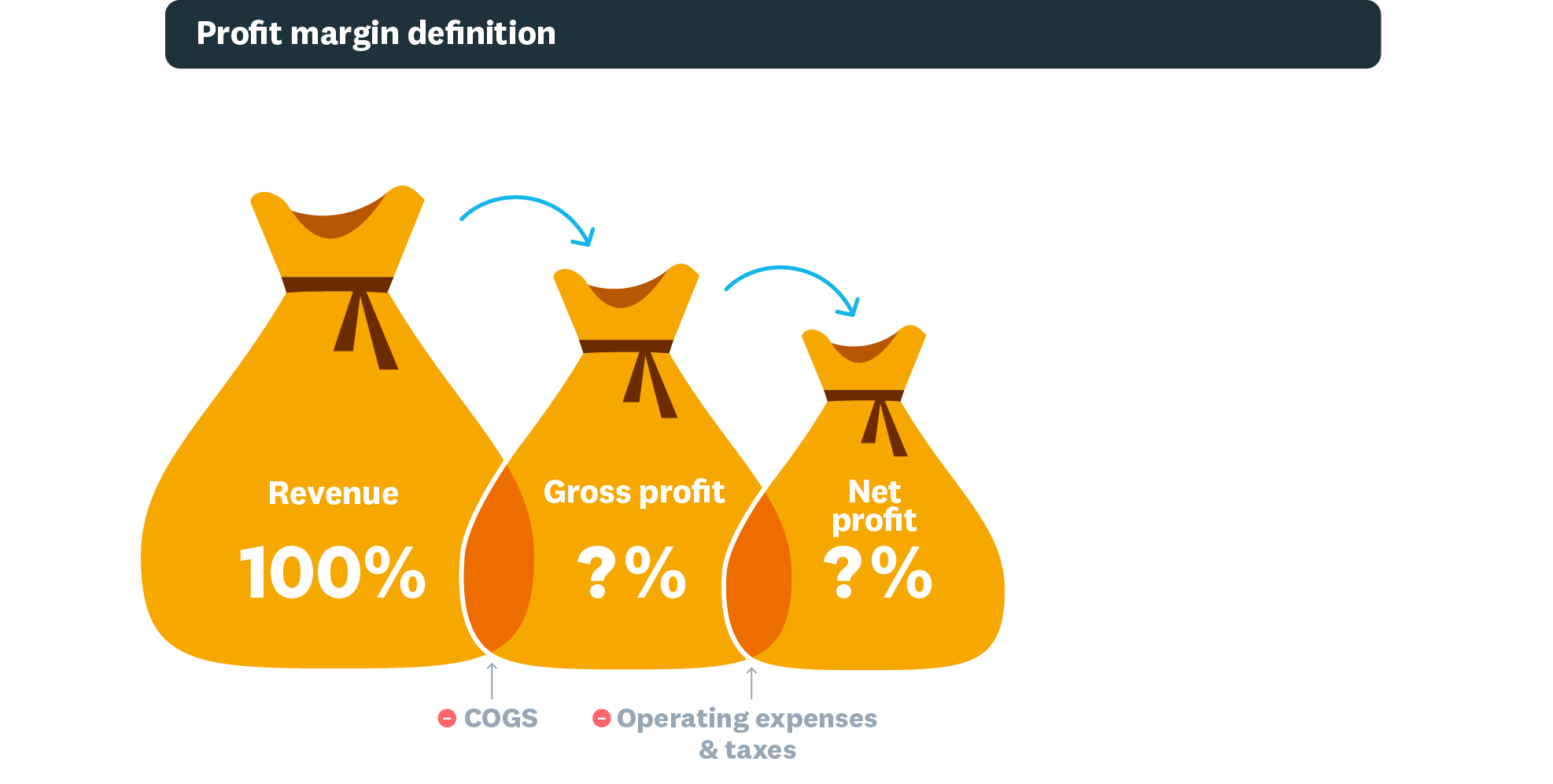
The three profit margin types form a hierarchy. Gross margin is always the highest, operating margin sits in the middle, and net margin is the lowest. Each one subtracts more costs from your revenue.
Here's how they relate:
- Gross profit margin: revenue minus cost of goods sold. Shows your pricing power and production efficiency
- Operating profit margin: gross profit minus operating expenses. Shows how well you run day-to-day operations
- Net profit margin: operating profit minus taxes and interest. Shows what you actually keep
Which margin should you prioritise? It depends on what you're trying to understand:
- Evaluating pricing: focus on gross margin
- Assessing operational efficiency: focus on operating margin
- Understanding true profitability: focus on net margin
For most small business decisions, net profit margin gives you the clearest picture of financial health.
Why do profit margins matter?
Profit margins matter because they reveal your financial health. They show how efficiently you turn sales into profit.
Use profit margins to make key business decisions:
- Pricing strategy: set prices that ensure healthy margins.
- Cost control: identify where expenses eat into profits.
- Resource allocation: direct investment toward high-margin activities.
- Funding applications: banks and investors evaluate margins when making lending decisions.
What is a good profit margin?
A good profit margin depends on your industry and business model. There's no universal percentage that applies to every business. Profit margins vary significantly across industries and business models.
Industry examples:
- Low-end retail: high sales volume, low margins (2–6%)
- Luxury retail: lower volume, high margins (50%+)
Your gross profit margin is always higher than your operating margin, which is higher than your net margin. Focus on operating and net margins for the clearest picture of your business health.
Benefits of high profit margins for growth
High profit margins typically mean a business:
- attracts investment more easily due to financial health
- reinvests in its own growth
- innovates with pricing strategies to find a competitive edge
Look closely at your performance to find trends and opportunities, and benchmark against competitors to see if you're in a strong position.
Do high profit margins guarantee growth?
High profit margins don't guarantee growth. While healthy margins support growth, they don't always increase as your business scales. If costs rise quickly, margins may shrink.
Focus on sustainable growth and keep profit margins in mind when making business decisions.
Factors affecting profit margins
Profit margins change due to market conditions and business strategy. Key factors include:
- Industry type: Retail and hospitality often have higher overheads, so their margins are usually lower than business consulting.
- Economic conditions: Inflation and high interest rates increase costs. The Reserve Bank of New Zealand notes that around 80% of bank lending to businesses is on a floating rate or reprices within three months.
- Interest rates: If you've borrowed to fund your business, higher rates reduce margins. Effective interest rates on business lending have increased by 4 percentage points since mid-2021.
- Location: Rent and taxes vary by area, affecting your costs and pricing strategies.
How to calculate profit margins
Profit margin formula: (Profit ÷ Revenue) × 100 = profit margin %
This universal formula applies to all profit margin types. The percentage format lets you compare performance across time periods, business sizes, and competitors.
Gross profit margin calculation
Say your business makes $20,000 cleaning offices. It costs $8,000 to provide those services, so your gross profit is $12,000.
Calculation: $12,000 ÷ $20,000 × 100 = 60% gross profit margin
Use the gross profit margin calculator to work this out.
Net profit margin calculation
You also pay $4,000 in taxes, so your net profit is $8,000.
Calculation: $8,000 ÷ $20,000 × 100 = 40% net profit margin
Try our net profit margin calculator.
Operating profit margin calculation
You spend another $3,000 on operating expenses, so your operating profit is $5,000.
Calculation: $5,000 ÷ $20,000 × 100 = 25% operating profit margin
How to increase your profit margins
Three strategies boost profit margins: cost control, operational efficiency, and pricing optimisation. Focus your improvement efforts on these core areas for maximum impact on profitability.
Control your costs
Reduce operational expenses by:
- reviewing subscriptions and cancelling unused services
- removing items you no longer need
- managing labour costs through efficient scheduling
Make your operations more efficient
Increase operational efficiency by:
- delivering great customer service to retain customers
- encouraging your team to innovate and find better processes
- investing in staff training so everyone performs at their best
Adjust your pricing
A strong pricing strategy that fits your industry and customers helps you maximise revenue and boost margins. Consider:
- adjusting prices dynamically to fit demand and seasonal changes
- offering premium packages and bundles to increase revenue
Learn from high-profit-margin businesses
Some industries tend to have higher profit margins than others. You can increase your margins by building a strong value proposition, running operations efficiently, and building customer loyalty.
Industries with high profit margins
Industries with typically high profit margins include:
- Luxury goods: premium pricing supports strong margins.
- Software and technology: low variable costs after development.
- Online businesses: lower overheads than bricks-and-mortar stores.
Tips for maintaining high profit margins
Even if you're not in a high-profit sector, you can raise margins by following practices used by high-profit businesses:
- Communicate a strong value proposition: customers trust brands when they understand why they should buy from you instead of competitors.
- Run an efficient operation: streamline processes, use resources efficiently, and reduce unnecessary costs.
- Nurture loyal customers: strong products, excellent service, and clever marketing create a reliable revenue stream.
Analyse your profit margins for better business decisions
Profit margin analysis drives better business decisions:
- Pricing decisions: identify which products or services generate the highest margins, then adjust prices and focus on profitable offerings.
- Budget planning: allocate resources toward high-margin activities that deliver better returns.
- Investment strategy: direct growth investments toward your most profitable business areas.
What profit margin trends reveal
Profit margin trends are patterns in your margins over time. They indicate financial health and operational efficiency.
What trends reveal:
- Steady increase: suggests improving financial health.
- Ongoing decline: indicates potential problems to address.
There's no single 'good' profit margin. Comparing your trends with competitors gives valuable insights into your market performance.
Track your margins with the right tools
Accounting software makes tracking profit margins easy. You get a real-time view of financial health, so you can spot trends and make smarter decisions quickly.
With the right tools, you can:
- automate margin calculations
- generate reports in seconds
- see exactly where your money is going
This helps you focus on running your business, not just your books. Start a free trial of Xero to see how it works for you.
FAQs on profit margins
Here are answers to common questions about profit margins.
What does a 5% profit margin mean for my business?
A 5% profit margin means you keep 5 cents as profit for every dollar of revenue after all expenses are paid.
How do I know if my profit margin is too low?
Compare your margin to your industry's average and your own past performance. If you're consistently below those benchmarks, review your pricing or costs.
What's the difference between profit margin and markup?
Profit margin is profit as a percentage of revenue (selling price). Markup is profit as a percentage of cost. They're two different ways to measure profitability.
Do profit margins vary by season?
Yes, profit margins often vary by season. Changes in customer demand, supply costs, and operating expenses can all affect your margins throughout the year.
Should I focus on gross or net profit margin?
Track both. Gross profit margin shows how profitable your products or services are on their own. Net profit margin gives you the bigger picture of overall financial health after every expense is included.
Disclaimer
Xero does not provide accounting, tax, business or legal advice. This guide has been provided for information purposes only. You should consult your own professional advisors for advice directly relating to your business or before taking action in relation to any of the content provided.