What is a pro forma invoice? A guide for Canadian businesses
Learn what a pro forma invoice is, when to use one, and how it works for Canadian businesses.

Written by Jotika Teli—Certified Public Accountant with 24 years of experience. Read Jotika's full bio
Published Wednesday 27 May 2026
Table of contents
Key takeaways
- A pro forma invoice is a preliminary document that outlines expected costs before a sale is finalized, helping both buyers and sellers agree on terms upfront.
- Pro forma invoices play a key role in international trade by supporting customs clearance, securing buyer financing, and reducing disputes over pricing or delivery terms.
- In Canada, businesses importing goods may need a Canada Customs Invoice alongside a pro forma invoice, and GST/HST obligations don't begin until a final tax invoice is issued.
- While a pro forma invoice resembles a standard invoice, it isn't legally binding and can be revised or cancelled before a transaction is completed.
What is a pro forma invoice?
A pro forma invoice is a preliminary bill of sale sent to a buyer before goods are delivered or services are provided. It outlines the estimated costs, quantities, and terms of a planned transaction so both parties can review and agree on the details before committing.
Unlike a final invoice, a pro forma invoice isn't a demand for payment. Instead, it serves as a good faith estimate that helps set expectations around pricing, delivery timelines, and payment terms. Think of it as a detailed proposal that gives your buyer confidence in what they're about to purchase.
Pro forma invoices are especially common in international trade, where buyers and sellers need clear documentation before goods cross borders. In 2024, over 53,000 Canadian businesses exported goods worth $712.8 billion, with small and medium-sized enterprises making up 97% of all exporting firms, according to Innovation, Science and Economic Development (ISED) Canada. If your business is among them, pro forma invoices can help you communicate costs clearly and avoid misunderstandings with overseas buyers.
Why use a pro forma invoice?
Pro forma invoices bring clarity to transactions before any money changes hands. They're useful for both buyers and sellers because they set clear expectations early in the process.
For sellers, a pro forma invoice helps you:
- provide a good faith estimate of costs, so your buyer knows exactly what to expect
- outline transaction details like quantities, shipping terms, and delivery timelines upfront
- reduce the risk of payment disputes by documenting agreed terms before the sale
- speed up customs clearance when shipping goods internationally
For buyers, a pro forma invoice helps you:
- review and approve costs before committing to a purchase
- secure financing or budget approval using a formal cost estimate
- prepare import documentation and arrange customs clearance in advance
- compare quotes from different suppliers using a standardized format
3 common reasons for issuing a pro forma invoice
While pro forma invoices can be useful in many situations, there are three scenarios where they're particularly valuable for small businesses.
- Securing financing: some buyers need to show their bank or lender proof of an upcoming purchase before they can release funds. A pro forma invoice gives them a formal document with the expected costs, quantities, and terms, which makes it easier to get a loan or line of credit approved.
- Clearing customs: customs authorities typically require documentation that describes what's being shipped and its estimated value. A pro forma invoice fills that role before a commercial invoice is available. Importers enrolled in the Release Prior to Payment program can receive their goods before paying duties and taxes, provided they have posted financial security through the Canada Border Services Agency (CBSA) Assessment and Revenue Management (CARM) system. Getting your documentation right from the start can help avoid delays at the border.
- Satisfying procurement requirements: many organizations, particularly government agencies and large corporations, require a formal cost estimate before they can issue a purchase order. A pro forma invoice meets this requirement by providing a detailed breakdown of what will be delivered and at what price.
When to send a pro forma invoice
You should send a pro forma invoice after a buyer has accepted your quote but before the sale is finalized. It bridges the gap between a verbal agreement and the final transaction by putting the agreed terms in writing.
In practice, this means sending the pro forma invoice once you and your buyer have agreed on the product or service, pricing, and general terms. The buyer can then use it to arrange payment, secure financing, or prepare for customs clearance on their end.
With Canadian exports to non-US markets growing by 13.6% in recent years, according to Global Affairs Canada, more businesses are navigating international documentation requirements. If you're selling to buyers outside Canada, sending a pro forma invoice early in the process can help avoid delays and keep the transaction on track.
What should a pro forma invoice include?
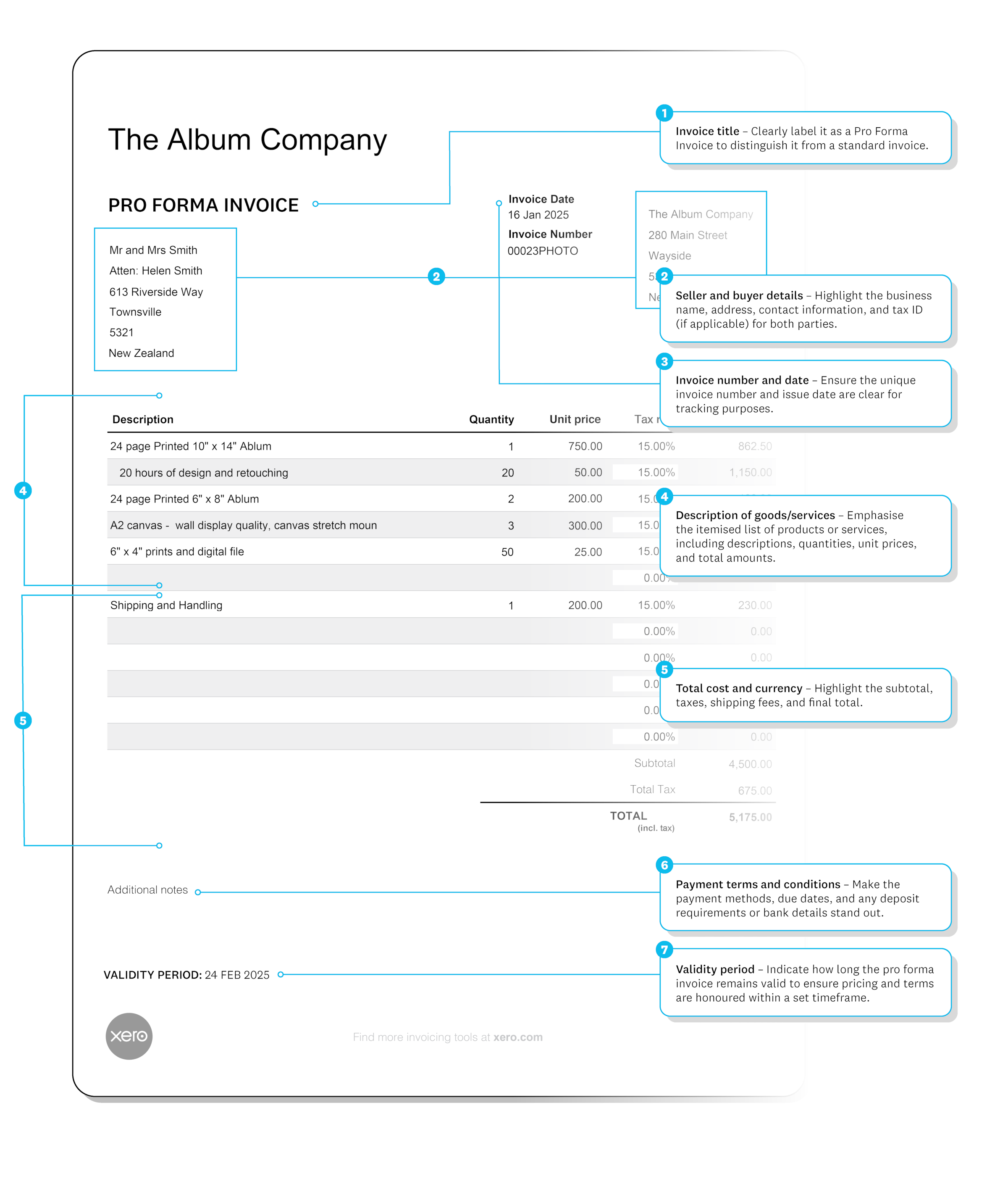
A pro forma invoice should include enough detail for the buyer to understand exactly what they're purchasing and on what terms. Here are the key fields to include.
- The words "pro forma invoice" clearly displayed at the top of the document
- Your business name, address, and contact details
- The buyer's name, address, and contact details
- A unique invoice number for tracking purposes
- The date the pro forma invoice was issued
- A description of the goods or services, including quantities and unit prices
- The total estimated cost, including any applicable taxes
- Payment terms, such as due date and accepted payment methods
- The currency of the transaction
- An expiry date, after which the pricing may no longer be valid
If you're shipping goods internationally, you should also include:
- the weight and dimensions of the shipment
- Harmonized System (HS) codes for the goods being shipped
- the country of origin
- shipping method and estimated delivery date
- Incoterms (international commercial terms) that define who is responsible for shipping, insurance, and duties
How to create a pro forma invoice
Creating a pro forma invoice doesn't need to be complicated. Follow these five steps to put one together.
1. Gather your buyer's details
Start by collecting the buyer's full business name, address, and contact information. If the transaction involves international shipping, you'll also need their tax identification number and any relevant import licence details.
2. Describe the goods or services
List each item or service you're providing, along with the quantity, unit price, and a brief description. Be specific; vague descriptions can cause confusion or delays, especially at customs.
3. Calculate the total cost
Add up the individual line items and include any additional charges such as shipping, insurance, or handling fees. If applicable, note the estimated Goods and Services Tax/Harmonised Sales Tax (GST/HST) amount. Clearly state the currency you're invoicing in.
4. Set your payment and delivery terms
Specify when payment is due, which payment methods you accept, and the expected delivery date. For international orders, include the relevant Incoterms to clarify responsibilities for shipping and duties.
5. Review and send
Double-check all the details for accuracy. Make sure the buyer's information is correct, the pricing adds up, and the terms reflect what you've agreed on. Then send the pro forma invoice to your buyer for review. A pre-built template from Xero can help you create a professional-looking document quickly.
Pro forma invoices in Canada
If you're doing business in Canada, there are a few additional considerations to keep in mind when using pro forma invoices.
When importing goods into Canada, the Canada Border Services Agency (CBSA) may require a Canada Customs Invoice (CCI) for shipments valued at $2,500 or more. A pro forma invoice can support the customs process, but it doesn't replace the CCI when one is required.
For GST/HST purposes, a pro forma invoice isn't a tax invoice. Your GST/HST obligations begin when you issue a final invoice or when goods are delivered, whichever comes first. For more on how Canadian tax rates affect your business, see the guide to small business tax rates in Canada. Until then, a pro forma invoice simply documents the expected terms of the transaction.
Canada's CARM system has modernized how importers manage their customs accounts, pay duties, and post security. If you're importing goods regularly, it's worth familiarising yourself with CARM to streamline your border processes.
Pro forma invoices can also be useful for interprovincial trade within Canada, particularly for large orders where the buyer needs a formal cost estimate before committing to a purchase.
How is a pro forma invoice different from other invoices and quotes?
It's easy to confuse pro forma invoices with other business documents. Here's how they compare to the most common alternatives.
- Pro forma invoice vs sales invoice: a sales invoice is a formal request for payment issued after goods or services have been delivered. It's a legally binding document that records the transaction for accounting and tax purposes. A pro forma invoice, on the other hand, is issued before the sale is finalized and doesn't create a legal obligation to pay. Xero's guide on sending invoices walks through the process step by step.
- Pro forma invoice vs commercial invoice: a commercial invoice is used in international trade to declare the value of goods being shipped across borders. Customs authorities use it to calculate duties and taxes. While a pro forma invoice can serve a similar purpose during the pre-sale stage, the commercial invoice is the official document required for customs clearance once the sale is complete.
- Pro forma invoice vs quote: a quote (or quotation) is a price estimate you give to a potential buyer before they commit to a purchase. It's less detailed than a pro forma invoice and typically doesn't include shipping terms, delivery dates, or payment conditions. A pro forma invoice goes a step further by formalising those details into a document that resembles an invoice.
How a pro forma invoice differs from a tax invoice
Pro forma invoices don't carry the same legal weight as a tax invoice. In Canada, a tax invoice is the document that triggers your GST/HST reporting obligations.
According to the Canada Revenue Agency (CRA), you must issue an invoice that meets specific requirements for GST/HST purposes. A pro forma invoice doesn't meet these requirements because it's a preliminary estimate, not a record of a completed transaction.
This means you shouldn't use a pro forma invoice to claim input tax credits or report GST/HST collected. Always issue a proper tax invoice once the sale is finalized and goods or services have been delivered.
Simplify your invoicing with Xero
Creating and managing invoices doesn't have to be time-consuming. With Xero's cloud accounting software, you can build professional invoices, set up automatic payment reminders, and track what's been paid and what's outstanding, all from one place.
Whether you're sending pro forma invoices to international buyers or final invoices to local clients, Xero helps you stay organized and get one month free to see how it works for your business.
FAQs on pro forma invoices
Here are some frequently asked questions about pro forma invoices.
Is a pro forma invoice legally binding?
No, a pro forma invoice is not legally binding. It's a preliminary document that outlines expected costs and terms, but it doesn't create a legal obligation for the buyer to pay or the seller to deliver.
Can a pro forma invoice be cancelled?
Yes, because a pro forma invoice isn't a binding agreement, either party can cancel or revise it before the transaction is finalized. If the terms change, you can issue an updated pro forma invoice to reflect the new details.
Can you turn pro forma invoices into commercial invoices?
Yes, once the sale is confirmed and the goods are ready to ship, you can convert a pro forma invoice into a commercial invoice. The commercial invoice will include the final, confirmed details of the transaction and serve as the official customs document.
Can you use a pro forma invoice for tax purposes in Canada?
No, a pro forma invoice can't be used for GST/HST reporting or to claim input tax credits. You need to issue a final tax invoice that meets CRA requirements once the transaction is complete.
Is it OK to pay a pro forma invoice?
While a buyer can choose to pay based on a pro forma invoice, it's not standard practice. Pro forma invoices are typically used for planning and approval purposes. Payment is usually made once a final invoice has been issued.
What are the advantages of pro forma invoices?
Pro forma invoices give buyers and sellers a clear picture of transaction costs and terms before committing. They help secure financing, smooth out customs processes for international shipments, and reduce the risk of disputes by putting agreed details in writing early.
Related content
What is an invoice?
Get the lowdown on invoices.
How to send an invoice
Find out when and how to send an invoice.
How to make an invoice
Let’s walk through the process of making an invoice.
Disclaimer
Xero does not provide accounting, tax, business or legal advice. This guide has been provided for information purposes only. You should consult your own professional advisors for advice directly relating to your business or before taking action in relation to any of the content provided.
Start using Xero for free
Access Xero features for 30 days, then decide which plan best suits your business.