How to calculate operating profit
Learn what operating profit is and how to calculate it, with a simple formula and worked example.
Published Thursday 23 July 2026
Table of contents

How to calculate operating profit
Key takeaways
- Operating profit is the profit your business makes from its core operations after operating costs, before interest and tax.
- Operating profit is also called EBIT, which stands for earnings before interest and tax.
- The formula is operating profit = gross profit minus operating expenses minus depreciation, with loan interest left out.
- Operating profit margin shows operating profit as a percentage of revenue, so you can compare profitability over time.
What is operating profit?
Operating profit is the profit your business makes from its core operations after operating costs, before you account for interest and tax. It's also known as EBIT, which stands for earnings before interest and tax.

This figure tells you how well the day-to-day running of your business performs on its own. It strips out costs that aren't tied to operations, like loan interest and tax, so you get a clear view of whether your core activities make money.
Operating profit formula
You can work out operating profit with a simple formula that builds on your gross profit. It takes your gross profit, then subtracts the costs of running the business and the depreciation on your assets.
The operating profit formula is:
Handy resources
Advisor directory
You can search for experts in our advisor directory
How to manage your finances and cash flow
Learn about money management for your small business
Financial reporting
Keep track of your performance with accounting reports
Operating profit = gross profit - operating expenses - depreciation
Interest on loans is left out of this calculation, which is why operating profit is the same as EBIT.
How to calculate operating profit
Once you know your gross profit, working out operating profit takes a few short steps. You count depreciation as an extra cost and remove any loan interest from your costs.
- Start with your gross profit, which is your revenue minus the cost of goods sold.
- Add up your operating expenses, such as rent, wages, electricity and phone.
- Include depreciation on your assets as an additional cost.
- Leave out interest on loans, so the result equals EBIT.
- Subtract your operating expenses and depreciation from gross profit to get your operating profit.
Example of an operating profit calculation
A quick example shows how the numbers come together. Say a business sold $20,000 of products or services over a period.
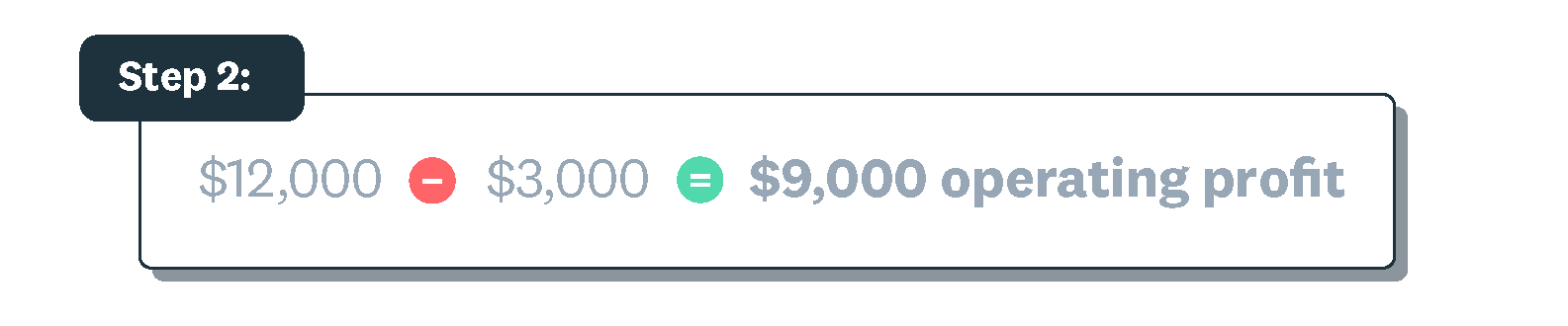
It cost $8,000 to provide them, which leaves $12,000 of gross profit. After $3,000 of operating costs like rent, electricity and phone, the operating profit is $9,000.
Operating profit vs gross profit, net profit and EBIT
These terms all measure profit, but each one covers a different stage of your finances. Knowing how they differ helps you read your reports with confidence.
- Gross profit is revenue minus the cost of goods sold
- Operating profit is gross profit minus operating expenses, and it equals EBIT (earnings before interest and tax)
- Net profit is what remains after all expenses and taxes
- EBIT is another name for operating profit, so the two figures match
What is operating profit margin?
Operating profit margin turns your operating profit into a percentage, so you can track profitability as your revenue changes. You work it out by dividing operating profit by revenue, then multiplying by 100.
Using the earlier example, $9,000 of operating profit divided by $20,000 of revenue gives an operating profit margin of 45%.
How to improve your operating profit
A few practical changes can lift your operating profit over time. Look at both what you charge and what you spend to run the business.
- Raise prices carefully where the market allows
- Cut operating costs that add little value
- Improve efficiency in your day-to-day processes
- Review supplier costs and negotiate better rates
Track your operating profit with Xero
Seeing your profitability at a glance makes it easier to plan your next move. Xero brings your numbers together so you can run financial reports and watch your operating profit over time.
Keep an eye on your core performance and try it for yourself when you get one month free.
FAQs on operating profit
Here are answers to some frequently asked questions about operating profit to round out the detail above.
Is operating profit the same as EBIT?
Yes, operating profit and EBIT are the same figure. Both measure earnings from core operations before interest and tax.
What is the difference between operating profit and net profit?
Operating profit is gross profit minus operating expenses, before interest and tax. Net profit is what remains after all expenses and taxes are taken out.
Why does operating profit exclude interest?
Interest relates to how you finance your business, not how you run its operations. Leaving it out shows the profit your core activities generate on their own.
What is a good operating profit margin?
A good operating profit margin varies by industry, so compare yours with similar businesses. Tracking your own margin over time is often the clearest sign of progress.
Related terms
Learn more about operating profit
Handy resources
Advisor directory
You can search for experts in our advisor directory
Income statement template
Download an income statement template to help track your profitability
Financial reporting
Keep track of your performance with accounting reports
Disclaimer
This glossary is for small business owners. The definitions are written with their requirements in mind. More detailed definitions can be found in accounting textbooks or from an accounting professional. Xero does not provide accounting, tax, business or legal advice.