Canada Small Business Insights
This analysis focuses on core performance metrics of sales growth, late payments and time to be paid.

Small business sales still lower than a year ago
Published: 30 July 2026
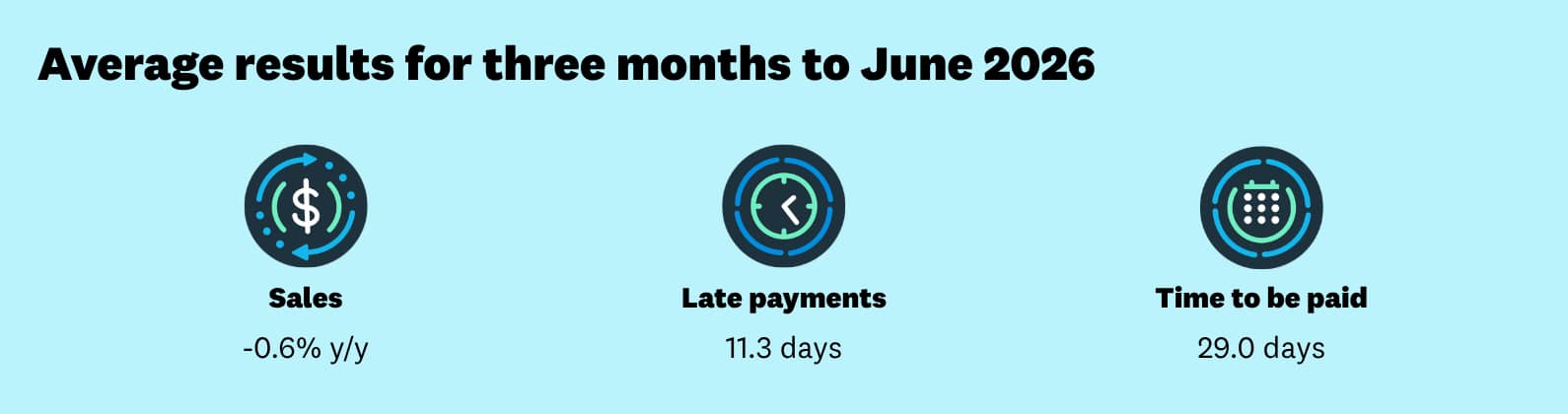
The latest Xero Small Business Insights (XSBI) data shows Canadian small businesses, in aggregate, continue to make fewer sales than a year ago. The 0.6% year-over-year fall in the June quarter is the third consecutive quarter where sales have been lower than a year ago. Payment times also remain elevated. On average, small businesses were paid 11.3 days late in the June quarter - almost a day longer than the 2025 average. Overall, the biggest positive from this data is that performance didn't get worse, but it is not improving much either. Ongoing higher-than-usual gasoline prices, due to the Middle East conflict, have added to what were already difficult conditions and continue to constrain consumer spending, squeeze profit margins and put pressure on cash flows.
Small business sales fell 0.6% year-over-year (y/y) in the June quarter. Sales have been lower than a year ago for three consecutive quarters (-3.0% y/y March quarter and -1.3% y/y December quarter) and for eight of the past twelve months. The Middle East conflict has made conditions harder for Canadian small businesses, but they were already difficult due to the impact of US trade policy since April 2025.
The monthly data illustrates how rising gasoline prices have stretched household budgets and impacted small business sales over the quarter. Gasoline prices began rising in March, soon after the conflict started. This didn't appear to have an immediate impact on small business sales, which managed a rare rise of 0.4% y/y in March. However, gasoline prices continued to increase over the following weeks, peaking in May. This prolonged period of higher-than-normal prices, and the flow-on effects to the price of other goods, meant households had to start diverting spending away from small businesses in order to fill up their cars and pay for other essentials. Sales fell again in both April (-2.7% y/y) and May (-3.0% y/y). Hope for a ceasefire in June, even a temporary one, saw gasoline prices dip again which freed up some capacity for spending and sales actually rose 3.8% y/y in June. The June data should be treated with caution, however. We apply a late reporting adjustment to allow for delays in finalizing business accounts. This is based on historical experience, however it has been over-adjusting in recent months i.e. the June data point is likely to be revised down in future months.
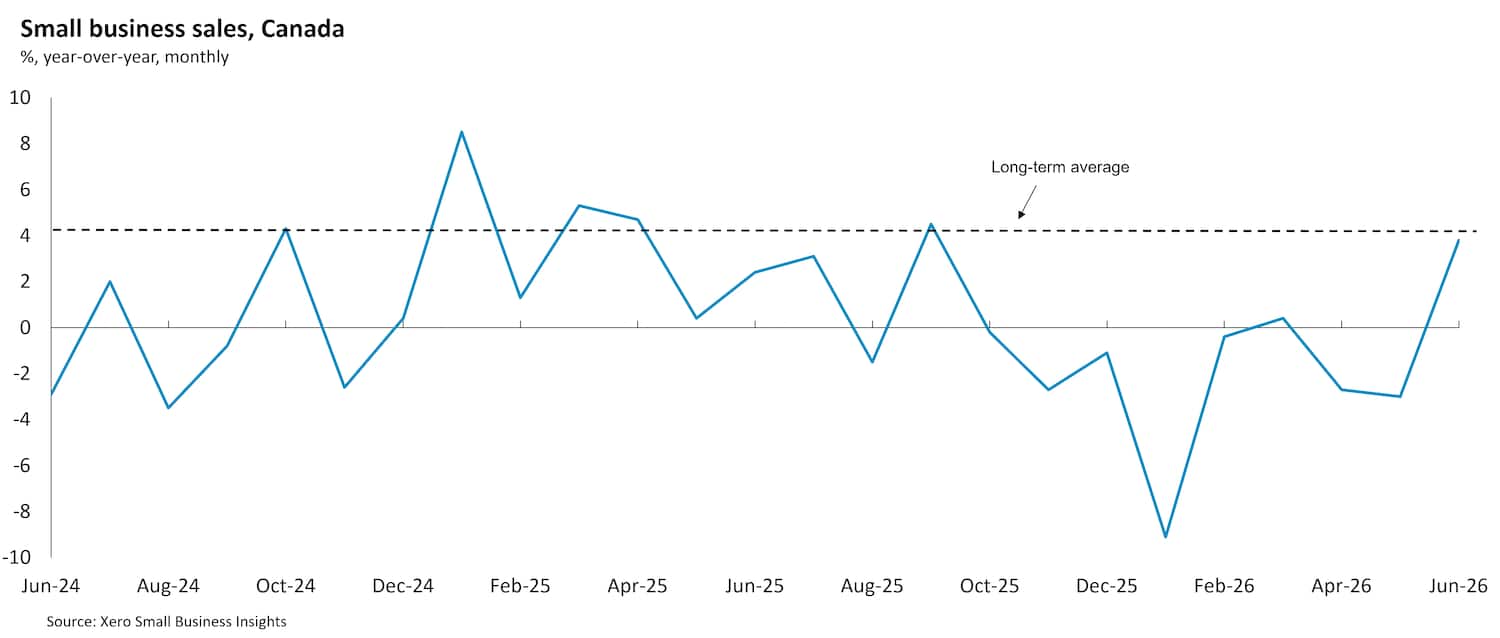
The Middle East conflict has made conditions harder for Canadian small businesses, but they were already difficult due to the impact of US trade policy since April 2025
XSBI Canada March 2026 - June 2026 data
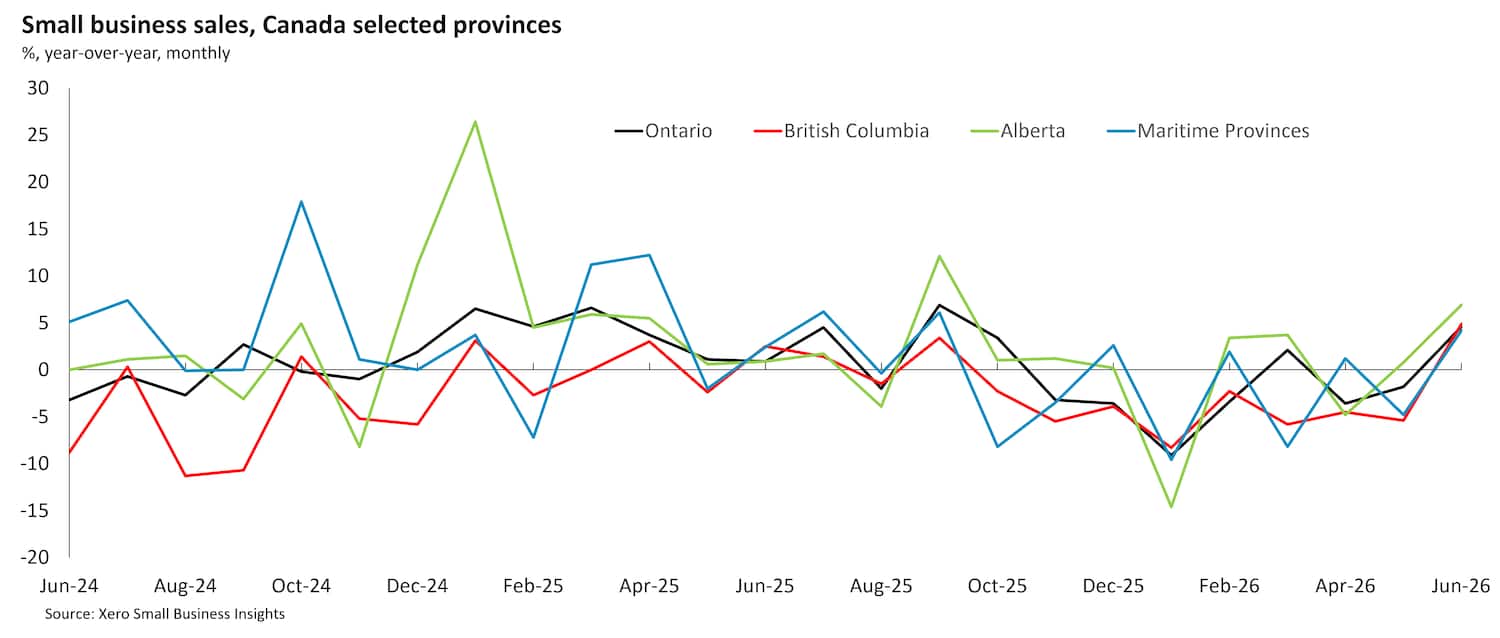
This month XSBI has expanded its provincial level data set, providing data on the Maritime Provinces. This region combines New Brunswick, Nova Scotia and Prince Edward Island. In the June quarter Alberta (+1.0% y/y) was the best performing province, a rare beneficiary of higher global oil prices. Sales in the Maritime Provinces were similar to the June quarter of last year (+0.2% y/y). Both Ontario (-0.3% y/y) and British Columbia (-1.7% y/y) had lower sales than a year ago.
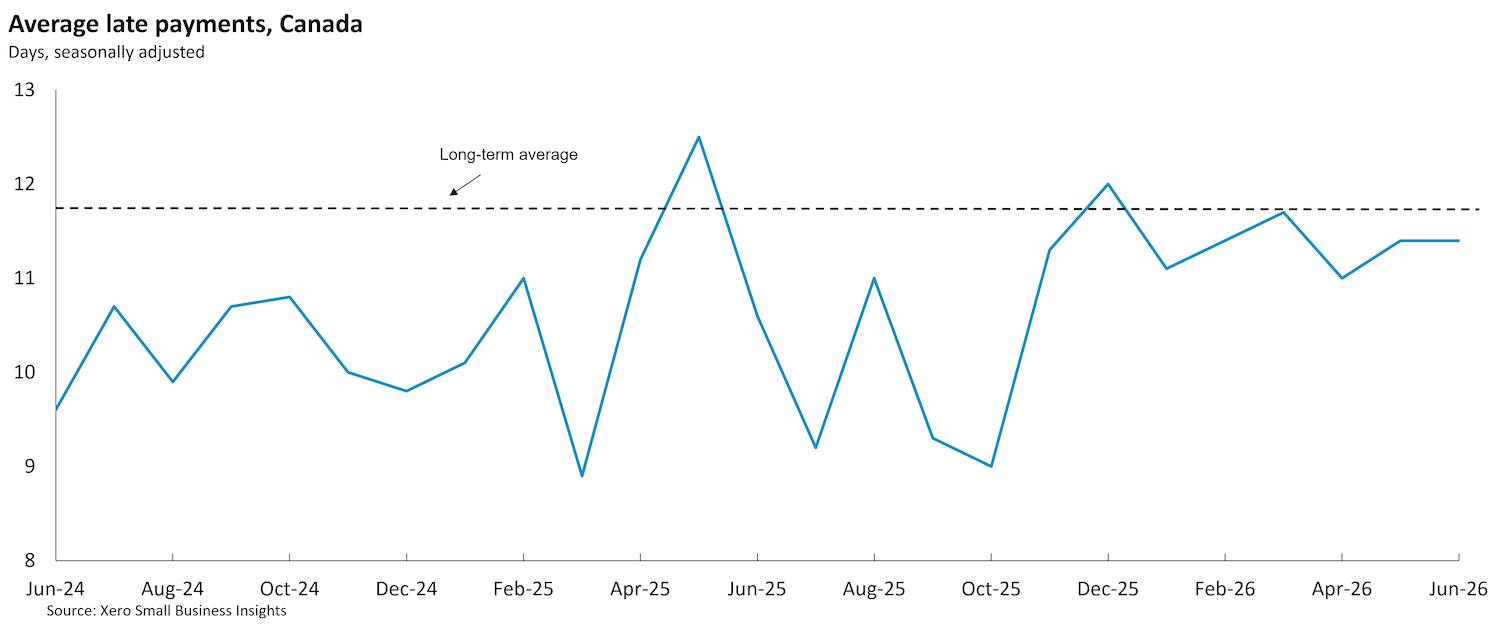
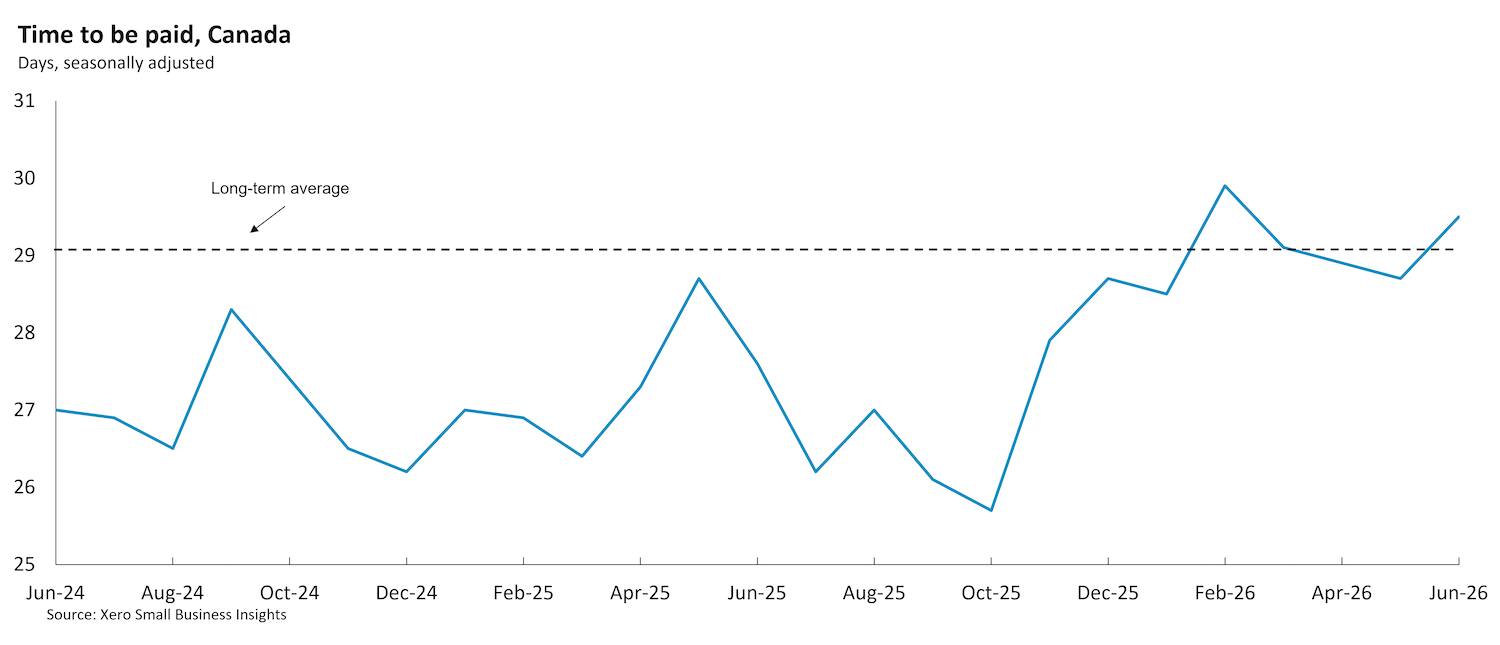
Small business payment times remain elevated compared to 2025. Canadian small businesses were paid on average of 11.3 days late in the June quarter, similar to the March quarter (11.4 days) but worse than in 2025 (10.5 days). In terms of the length of time from when an invoice was issued to when it was paid, this was 29.0 days in the June quarter, compared to 29.2 days in the March quarter and 27.1 days in 2025.
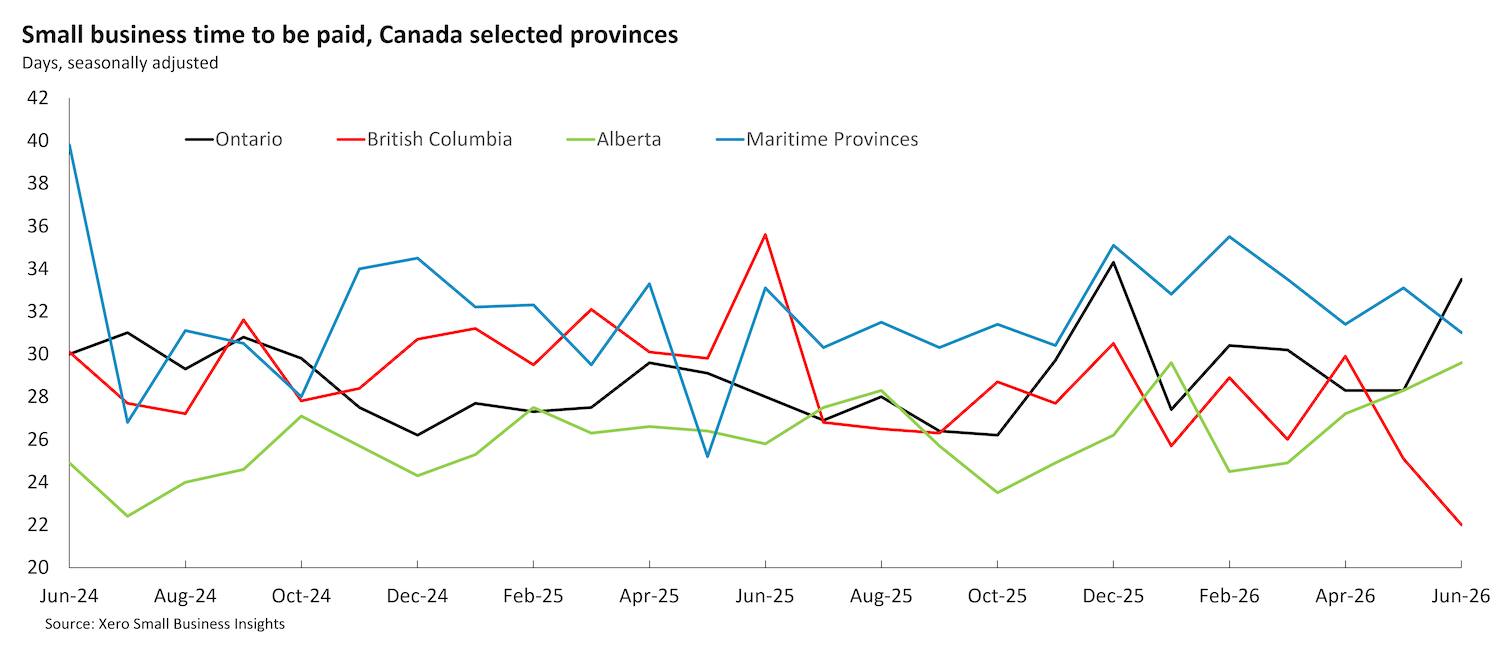
British Columbia struggled with sales, but those invoices that were issued were paid in 25.7 days - the best provincial result and an improvement on the March quarter (26.9 days). The other provincial results for the June quarter were 28.4 days (Alberta), 30.0 days (Ontario) and 31.8 days (Maritime Provinces).
Overall, these latest XSBI results confirm that there was no significant improvement in the performance of small businesses in the June quarter. The hike in gasoline prices are exacerbating what was already a difficult period for Canadian small businesses.
Looking ahead, Canadian small businesses are likely to face ongoing macro challenges over the rest of 2026, as the flow-on effects of the Middle East conflict continue to dominate local, and global, economic trends. Various ceasefire agreements have been unable to hold for more than a few weeks, which has prevented global oil, natural gas and fertilizer markets returning to normal operations. The world is adjusting, including buying more oil from Canada, but retail gasoline prices remain elevated compared to where they were at the start of the year. The importance of gasoline in many goods supply-chains means the risk of flow-on effects to other prices remains elevated, although recent CPI reports suggest this pass-through isn't yet happening in Canada. The OECD expects the Canadian economy to grow just 1.2% in 2026, slower than the 1.7% recorded in 2025. Canada’s position as a net energy exporter means exporters are set to benefit from higher energy prices linked to the Middle East conflict. However, these sales involve large, not small businesses. The OECD also highlighted the adverse effects of higher energy prices on inflation and household consumption - factors which are more relevant for small business sales prospects. In addition, profit margins and cash flow will continue to be under-pressure as Canadian small businesses are squeezed between rising input costs (including, and beyond, gasoline) and increasingly hesitant customers.
For more information on the XSBI metrics, see our methodology page.

Disclaimer
This report was prepared using Xero Small Business Insights data and publicly available data for the purpose of informing and developing policies to support small businesses.
This report includes and is in parts based on assumptions or estimates. It contains general information only and should not be taken as taxation, financial, investment or legal advice. Xero recommends that readers always obtain specific and detailed professional advice about any business decision.
The insights in this report were created from the data that was available as at the date it was extracted. Data used was anonymised and aggregated to ensure individual businesses can not be identified.
Find out more about XSBI
If you have any questions about Xero Small Business Insights, reach out to us.