UK small business growth masks widening divide as agriculture sales fall and high street struggles
New Xero data reveals agriculture sales fell 6.2%, while hospitality and retail barely grew
London — 29 October 2026 - UK small businesses are facing increasingly uneven trading conditions, with stark differences in performance across industries in the three months to September. This is according to the latest Xero Small Business Insights (XSBI) data from Xero, the global small business platform.
Based on anonymised and aggregated data from 440,000 UK small businesses, the findings come just a day after the Autumn Budget and highlight the ongoing pressures facing businesses, especially agriculture which recorded its lowest sales quarter since the series began in 2017, following a very dry summer.
Modest sales growth hides a growing divide between industries
UK small business sales grew 4.0% year-on-year (y/y) in the September quarter, but still down from 5.6% in the June quarter and less than half the historical average of 8.4%.
Sales growth remained subdued throughout the quarter, rising 4.6% in July, 3.5% in August and 3.9% in September, suggesting small businesses are struggling to build momentum. However, the national figures mask significant differences between industries.
Agriculture was the worst-performing sector, with sales falling 6.2% y/y, marking a second consecutive quarterly decline as drought conditions continued to take their toll on farming businesses this summer. High street businesses continued to struggle with hospitality sales growing just 0.7% y/y and retail only 0.8% y/y, as stretched household budgets and higher living costs limited spending.
In contrast, transport and logistics recorded the strongest sales growth at 6.9% y/y, although this was likely driven by businesses passing on higher fuel costs. Administrative services (+6.7% y/y), other services (+5.9% y/y), manufacturing (+5.7% y/y), professional services (+5.2% y/y) and construction (+5.2% y/y) also outperformed the national average.
Across the UK regions, Northern Ireland recorded the strongest sales growth at 5.1% y/y, followed by the East Midlands (+4.6% y/y) and London (+4.4% y/y). Wales saw the weakest growth at 2.3% y/y.
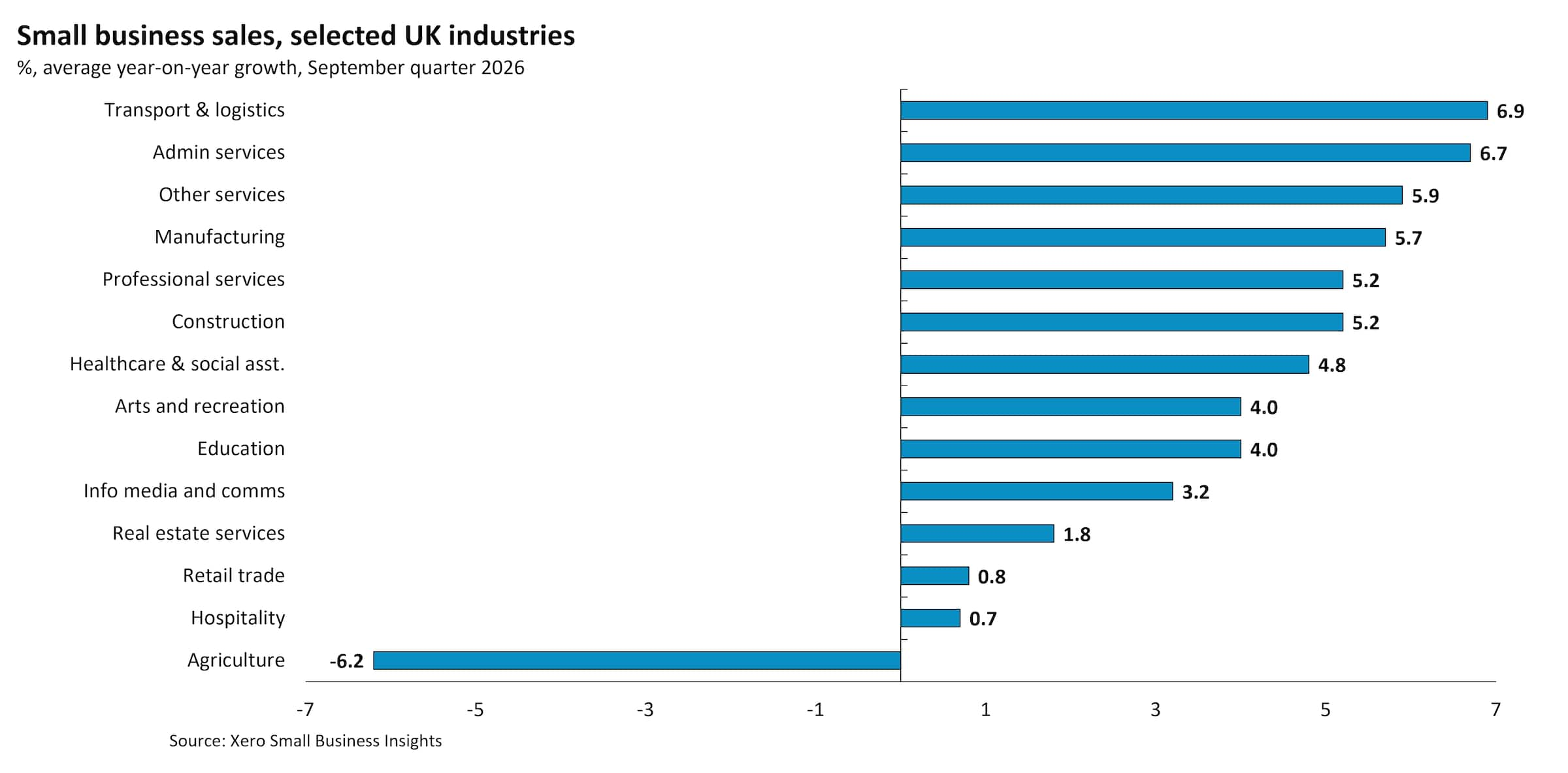
UK small business sales growth by industry
Kate Hayward, UK Managing Director at Xero, said: “This data shows the reality of running a small business at the moment. Since the start of the year, we are seeing sales growth remain slow and below historic averages, leaving businesses in need of more support. Despite all the macroeconomic challenges, UK small businesses have continued to show remarkable resilience.”
“But resilience alone isn't enough. Policy makers need to listen and act quickly on behalf of our amazing small businesses who fight every day for the communities they support and who provide so much to our economy. The Budget is just the start - and we're all looking for the government to deliver.”
Hiring picks up, but small businesses remain under pressure
Despite the sales slowdown, small business hiring showed modest signs of improvement in the September quarter. Job growth rose to 2.6% y/y, up from 1.9% y/y in June, but remained below the historical average of 3.3% y/y.
Retail recorded one of the strongest increases in jobs at 5.2% y/y, despite poor sales, highlighting the contrasting pressures facing businesses. Agriculture (+4.6% y/y) and healthcare and social assistance (+4.4% y/y) also recorded strong jobs growth.
However, hiring remained subdued in hospitality, where jobs increased just 1.5% y/y. The continued weakness in hospitality and retail sales raises concerns about the pressures facing two sectors that play an important role in providing employment opportunities for young people.
Northern Ireland once again stood out, recording the strongest regional jobs growth at 4.2% y/y, followed by the North West (+3.6% y/y) and London (+3.4% y/y).
Payment times edge up as wage growth slows
The latest data also reveals that small businesses are waiting longer to be paid, adding to the financial pressures they already face.
The average time small businesses waited to be paid increased to 29.5 days in the September quarter, up from 28.8 days in June. Average late payment times also edged up from 7.6 days to 8.0 days, putting additional strain on cash flow. Both measures remain broadly in line with or better than 2025 averages.
Meanwhile, small business wage growth slowed to 2.5% y/y down from 2.8% y/y in the June quarter and below the historical average of 3.2% y/y. With UK inflation at 3.1%, wage growth is failing to keep pace with rising prices.
You can read the full UK Xero Small Business Insights (XSBI) data here.
ENDS
Media Contact
Xero UK Communications | Hannah Collett | ukpress@xero.com
About Xero
Xero is a global small business platform and a trusted financial operating system for the AI era. Xero’s purpose is to make life better for people in small business, their advisors, and communities around the world. By unifying core financial operations (including accounting, payroll and payments) underpinned by insights and a robust ecosystem into autonomous workflows, we empower 5 million small businesses and accountants and bookkeepers across 180+ countries to move from managing records to making informed decisions. For further information, please visit xero.com.
Related media and enquiries
For all media enquiries, please contact the Xero media team.
- Media release
Britain’s £868 billion blind spot: the millions of small businesses this country takes for granted
Xero calls for a jobs boost and fairer rates system to back 20 ‘overlooked’ small business sectors
- Media release
Xero research reveals UK’s top accounting and bookkeeping firms are twice as profitable – with AI adoption at the core
New research from Xero finds top performing firms embedding AI into daily workflows save up to 10.6 hours a week
- Media release
UK small businesses struggle as sales and jobs slow for a third consecutive quarter
New Labour government facing growing pressure to prove its pro-small business rhetoric with strong action for SMEs
Get one month free
Purchase any Xero plan, and we will give you the first month free.