Profit
Profit is what your business keeps after expenses. Learn the types of profit and how to work out yours.
Published Wednesday 30 September 2026
Table of contents
Key takeaways
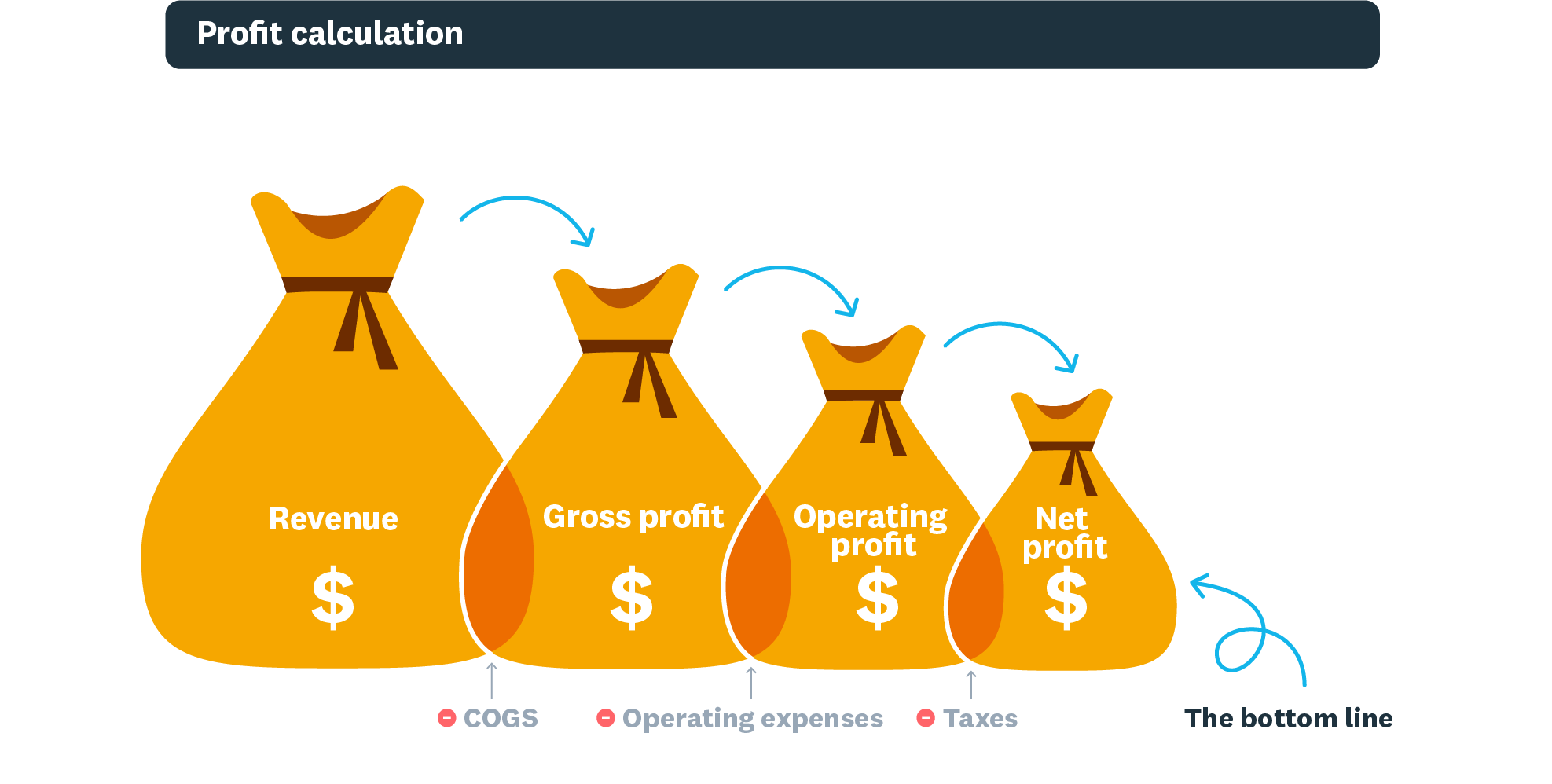
There are three types of profit. Net profit is what you get to keep.
- Profit is the money your business keeps after paying its expenses, worked out as revenue minus expenses
- Gross, operating and net profit each show a different layer of performance, and net profit is what you keep after interest and tax
- A profitable business can still run short of cash, so track cash flow alongside profit
- Your profit and loss statement shows your profit for any period, and profit margin turns it into a percentage you can compare
What is profit?
Profit is the money your business has left after paying its expenses. If you bring in more than you spend, you’ve made a profit; if you spend more, you’ve made a loss.
The basic formula is:
Profit = Revenue − Expenses
Picture a hawker stall selling chicken rice. Every plate sold brings in money, but the stall also pays for chicken, rice, rent, gas and a helper’s wages. Whatever remains once all those costs are covered is the stall’s profit.
Profit vs revenue
Revenue is the total money your business earns from sales before any costs come out. Profit is the part of that revenue you keep once your expenses are paid.
A business can have high revenue and low profit when its costs are high. A renovation contractor might win plenty of big jobs, yet spend most of that money on materials and labour. Xero’s guide to how sales are counted and recorded explains the top line in more detail.
Types of profit
Businesses usually measure profit at three levels, and each one subtracts more costs than the last. Comparing them shows you where your money goes.
Gross profit
Gross profit is what’s left after you subtract the direct costs of making or buying what you sell, known as cost of goods sold (COGS). It’s the biggest of the three and shows whether your products or services earn more than they cost to deliver.
Gross profit = Revenue − COGS
Find out which costs count as direct in this explainer on what gross profit includes.
Operating profit
Operating profit is what remains after you also pay the everyday costs of running the business, such as rent, utilities, phone bills and staff wages. It shows whether your core business makes money before interest and tax.
Operating profit = Gross profit − Operating expenses
Because it leaves out financing costs, operating profit is handy for comparing your performance across periods, even when your loans change.
Net profit
Net profit comes last. It’s what’s left after you deduct every cost, including interest on loans and tax, and it’s the profit you get to keep.
Net profit = Operating profit − Interest − Tax
Owners often call it the bottom line, since net profit sits on the final line of the profit and loss statement.
How to calculate profit
You can work out each level of profit in order, starting with your revenue for a set period such as a month or a year. Follow these steps:
- Add up all your revenue from sales for the period.
- Subtract your COGS to find your gross profit.
- Subtract your operating expenses to find your operating profit.
- Subtract interest on any loans to find your profit before tax.
- Work out the tax you owe and subtract it to find your net profit.
Here’s how that looks for a Singapore café over one financial year. The café earns S$200,000 in revenue and spends S$80,000 on coffee beans and milk. It also pays S$70,000 in operating expenses such as rent and wages, plus S$5,000 in interest on a business loan.
Working through the steps gives these results:
- S$200,000 revenue − S$80,000 COGS = S$120,000 gross profit
- S$120,000 gross profit − S$70,000 operating expenses = S$50,000 operating profit
- S$50,000 operating profit − S$5,000 interest = S$45,000 profit before tax
From there, the café works out corporate income tax on its chargeable income, which can differ from its accounting profit once tax adjustments are made. Subtracting that tax from S$45,000 gives the café’s net profit.
Why profit matters
Each level of profit answers a different question about your business. Together, they show how it’s performing:
- Gross profit shows your business is capable of making money from what it sells
- Operating profit shows your core business is making money day to day
- Net profit shows how much you keep after every cost, including interest and tax
- Comparing all three over time shows which costs are growing fastest
Profit also shapes your tax bill. Singapore companies pay corporate income tax on chargeable income at a flat corporate income tax rate of 17%, so a clear view of profit helps you plan for that bill early.
Profit vs cash flow
Profit measures whether you earn more than you spend over a period, while cash flow tracks the money moving in and out of your bank account. The two can look very different, which is how a profitable business can run short of cash.
Your profit and cash can drift apart when:
- customers take weeks or months to pay invoices you’ve already counted as revenue
- you buy stock upfront that sells later
- you pay for equipment outright, even though its cost is spread across several years in your accounts
- you repay the principal on a loan, which uses cash but isn’t an expense
Keeping an eye on your cash coming in and going out alongside profit helps you plan ahead for quieter months.
Where to find your profit
Your profit appears on your profit and loss (P&L) statement. It lists your revenue, then subtracts each layer of costs to show gross, operating and net profit for a chosen period.
To compare periods or businesses of different sizes, turn profit into a percentage called profit margin:
Profit margin = (Profit ÷ Revenue) × 100
In the café example, the operating margin is S$50,000 ÷ S$200,000 × 100 = 25%. This walkthrough of margin calculations covers each type in more detail.
Track your profit with Xero
Knowing your profit at every level helps you price with confidence and plan for tax. Xero’s financial reports turn your data into a P&L you can check any time, so you always know where you stand.
See how it works for your business when you get one month free on a Xero plan.
FAQs on profit
Here are quick answers to common questions about profit.
Is profit the same as income?
Income is the money your business earns from all sources before any deductions, while profit is what remains after you subtract expenses.
What is a loss?
A loss happens when your expenses are greater than your revenue for a period, so your profit figure is negative. Singapore companies may be able to carry forward unused trade losses to offset future chargeable income, subject to IRAS conditions.
Is profit taxed in Singapore?
Yes, companies pay corporate income tax on chargeable income, which is accounting profit adjusted for items such as non-deductible expenses and capital allowances. Sole proprietors and partners pay personal income tax on their share of the business profit instead.
What’s a healthy profit margin?
It varies by industry, since a retailer and a consulting firm have very different cost structures. Compare your margin with similar businesses and with your own past results to see how you’re tracking.
Should I track profit monthly?
Monthly tracking lets you spot rising costs or slipping margins while there’s still time to act. Accounting software that updates your P&L as transactions come in makes this quick to do.
Related terms
Learn more about profit
Handy resources
Advisor directory
You can search for experts in our advisor directory
Financial reporting
Keep track of your performance with accounting reports
Disclaimer
This glossary is for small business owners. The definitions are written with their requirements in mind. More detailed definitions can be found in accounting textbooks or from an accounting professional. Xero does not provide accounting, tax, business or legal advice.