New Xero data: Aussie small businesses report highest labour productivity in nearly four years
Small businesses record two consecutive quarters of productivity levels above long-term average
Melbourne, Australia — 2 June 2026 — Australian small business labour productivity has climbed to its highest level since 2022, according to Xero Small Business Insights (XSBI) productivity data released for the first time in Australia today.
Productivity levels have spent two consecutive quarters above their long-term average, at a time when national productivity remains weak. In nominal terms, productivity rose 5.3% year-on-year (y/y) in the March quarter, following a 5.7% y/y increase in the December quarter.
The XSBI productivity report analyzes anonymised and aggregated data on sales, hours worked and number of employees from 154,000 Australian small businesses, producing a measure of small business labour productivity. It highlights the continuation of gradual productivity improvements collectively being made by Australian small businesses.
At a glance - in the six months to March 2026:
- Australian small business labour productivity increased to $84.30/hour worked in the March quarter 2026, up from $83.80/hour worked in the December quarter 2025 - above the average for the six months prior ($82.40/hour worked) and the long-term average ($83.50/hour worked).
- Real estate services (+7.8% y/y) and construction (+6.9% y/y) recorded the strongest nominal productivity growth in the past six months, while arts & recreation (+3.6% y/y) and education (+3.8% y/y) had the smallest growth over the same period.
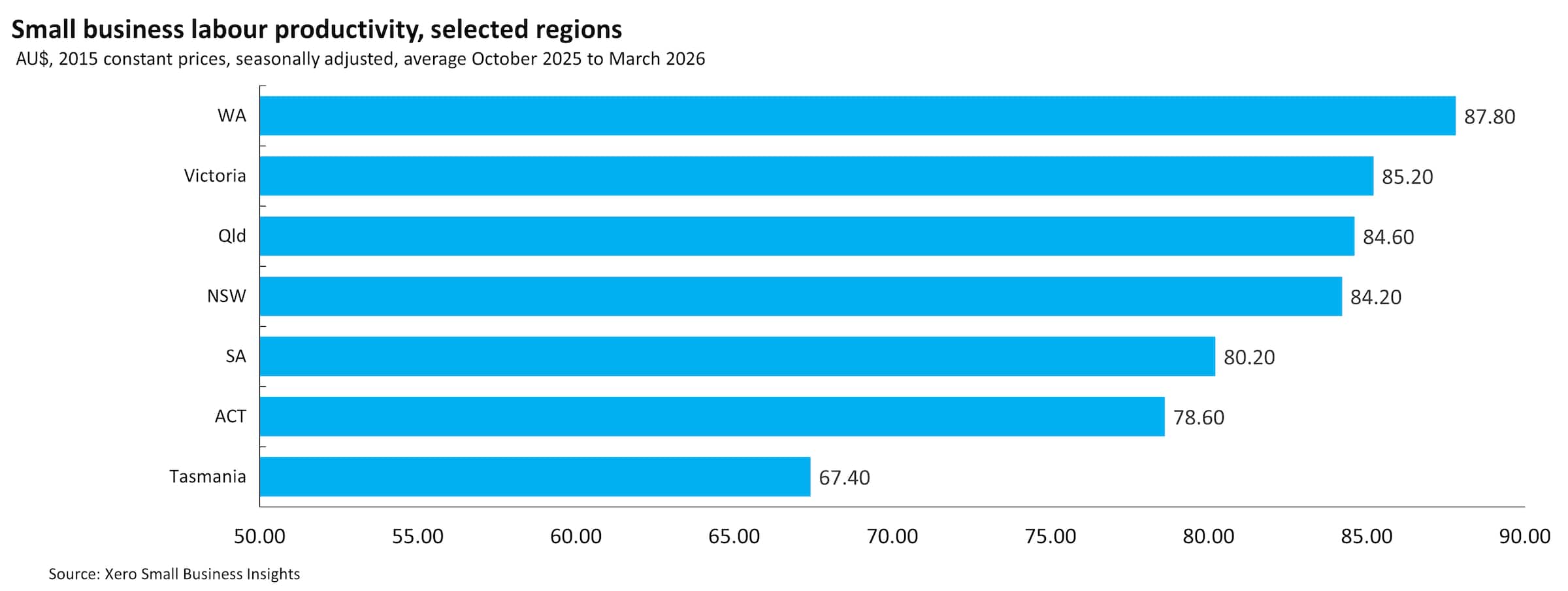
- Western Australia led all states and territories with $87.80/hour, ahead of Victoria ($85.20/hour), Queensland ($84.60/hour) and NSW ($84.20/hour). Tasmania reported the lowest at $67.40/hour.
Louise Southall, Economist at Xero, said the findings show that not all businesses are experiencing the same productivity story. Small businesses, which account for more than 90% of Australian businesses, are building momentum yet are often underrepresented in national figures.
Southall said: “Our data provides a more representative picture of how Australian small businesses are actually performing. Small businesses have been building productivity momentum for two years, with gains over multiple quarters indicating sustained growth rather than a short-term cyclical spike. That matters for the broader economy because productivity growth allows businesses to expand and hire more staff, without adding to the inflation pressures Australians are already feeling.”
Construction and real estate lead growth, education falling behind
In terms of the level of productivity, wholesale trade ($174.40/hour), transport ($120.40/hour) and construction ($118.70/hour) were the strongest performing industries in the six months to March. This contrasts sharply with sectors like hospitality ($27.00/hour) and education ($31.30/hour), which were the least productive and generated the slowest growth momentum over the same period.
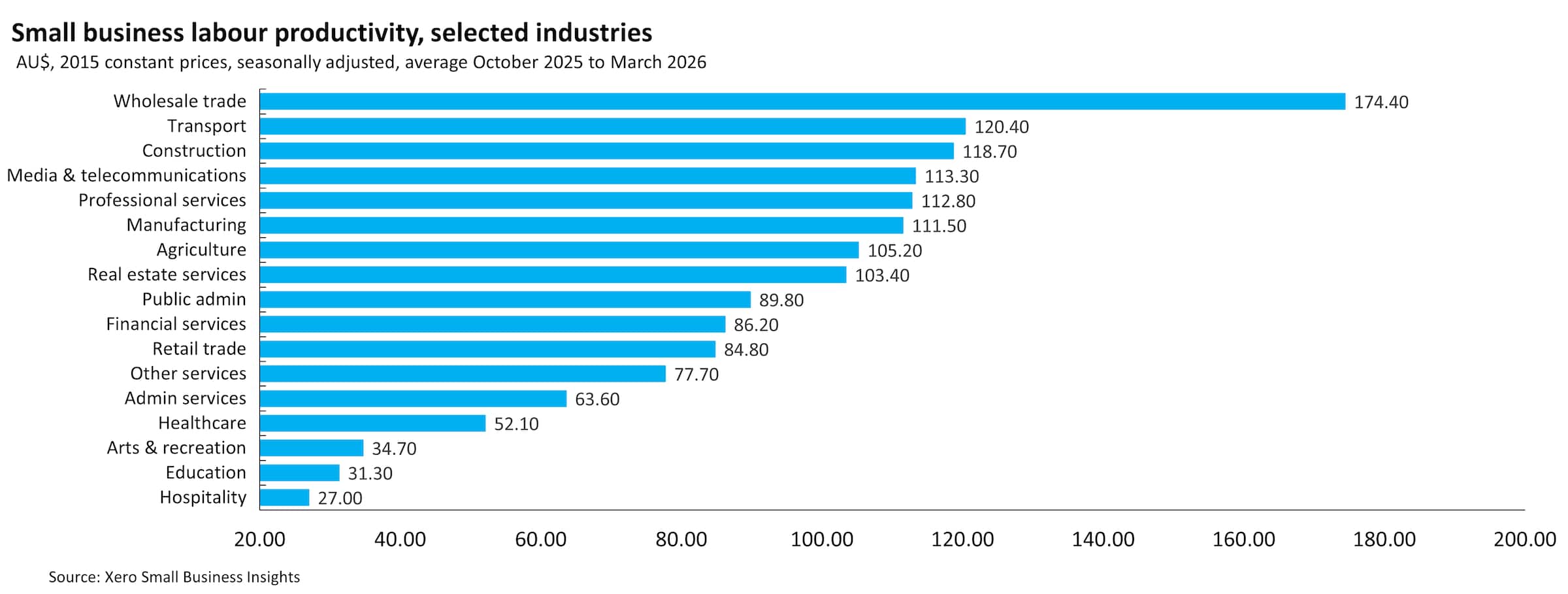
However, it was real estate services (+7.8% y/y) and construction (+6.9% y/y) that recorded the highest nominal growth rates over this period.
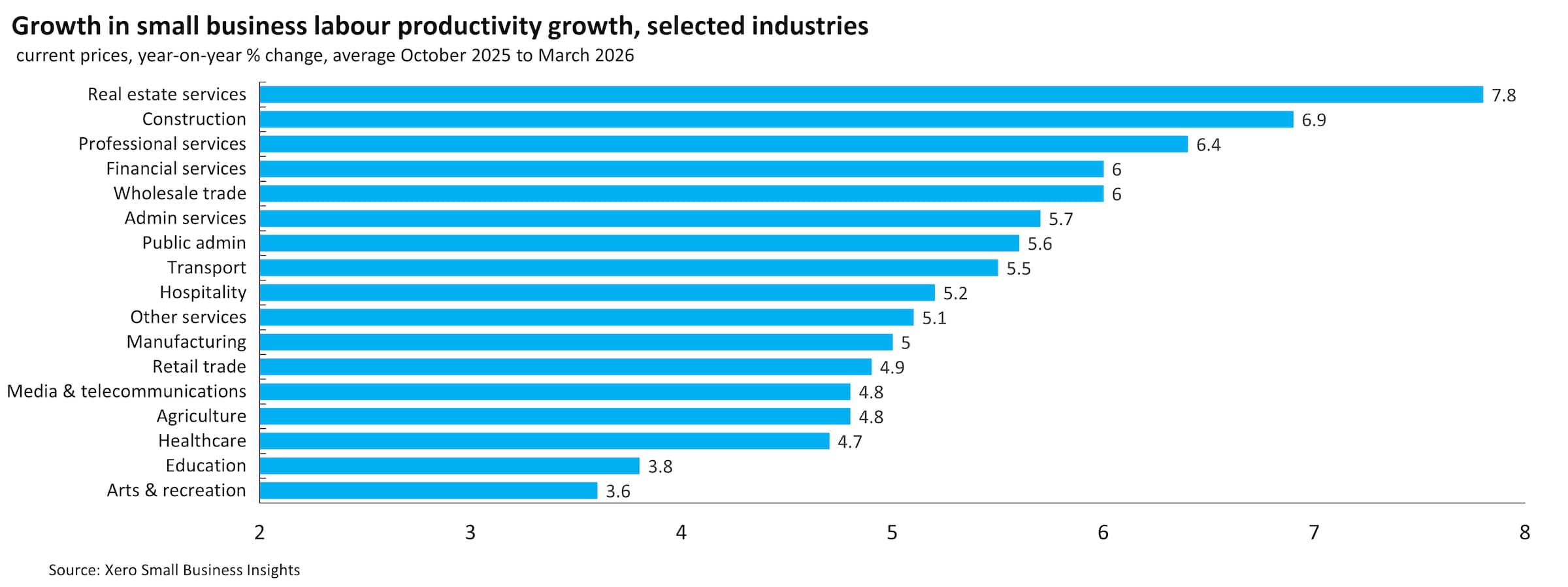
Southall said state and industry differences were to be expected:
“Different industries and regions will naturally record different productivity outcomes - that’s what makes this data useful. It helps show policymakers and business leaders where productivity gains are emerging or where momentum may be slower. Construction’s growth, for example, shows what targeted reform can achieve, with government efforts to cut red tape appearing to be impactful. Education, however, is an area where the government can have considerable direct influence - and the data suggests there is real room to move.”
Western Australia is Australia’s most productive state
Western Australia ($87.80/hour) recorded the highest small business labour productivity of all states and territories, most likely driven by the mining sector. Victoria ($85.20/hour), Queensland ($84.60/hour) and NSW ($84.20/hour) were closely grouped and all recorded strong growth over the period. South Australia ($80.20/hour), the ACT ($78.60/hour) and Tasmania ($67.40/hour) sit materially lower, with the data showing the four leading states achieved faster growth over the six months to March.
“Small businesses are the vast majority of Australian businesses but don’t always get the credit they deserve in the national economic conversation. This data shows that they have been improving productivity gains quietly and consistently - and unlocking more of that potential is one of the most powerful levers for sustainable economic growth. Digital tools, including those powered by AI, can support this by freeing up small business owners to focus on what actually drives business growth: generating sales, serving customers and growing their business,” said Southall.
Anne Aly MP, Minister for Small Business, said:
“These results speak strongly to the increasing contribution of small businesses to our economy. Small businesses have had to work hard through cost pressures, global uncertainty and some challenging economic shifts. This data shows their hard work is paying off. Even with these external factors, 180,000 new small businesses have been started by Australians since July 2022. What is clear, is small businesses are building the kind of momentum the Australian economy needs.”
To find out more about how Xero Small Business Insights is constructed, see the methodology.
Media Contact
Xero Australia | Jess Brophy | +61 431 268 549 | jess.brophy@xero.com
About Xero
Xero is a global small business platform that helps customers supercharge their business by bringing together the most important small business tools, including accounting, payroll and payments — on one platform. Xero’s powerful platform helps customers automate routine tasks, get timely insights, and connect them with their data, their apps, and their accountant or bookkeeper so they can focus on what really matters. Trusted by millions of small businesses and accountants and bookkeepers globally, Xero makes life better for people in small business, their advisors, and communities around the world. For further information, please visit xero.com.
Disclaimer
This media release includes and is in parts based on assumptions or estimates. It contains general information only and should not be taken as taxation, financial, investment or legal advice. Xero recommends that readers always obtain specific and detailed professional advice about any business decision. The insights in this release were created from the data that was available as at the date it was extracted. Data used was anonymised and aggregated to ensure individual businesses can not be identified.
Related media and enquiries
For all media enquiries, please contact the Xero media team.
- Media release
Nearly one in three Aussie small businesses have considered walking away due to stress
New research commissioned by Xero reveals the hidden emotional cost of running a small business
- Media release
Xero Delivers Claude Integration to Advance AI-Powered Financial Intelligence
Partnership allows millions of small businesses and their advisors worldwide to leverage Xero wherever they work
- Media release
New Xero data: No slowdown for Aussie small businesses as Q1 growth maintains two-year high
Sales, jobs, and wages all continued to rise in the three months of 2026 to March, despite macroeconomic pressures
Start using Xero for free
Access Xero features for 30 days, then decide which plan best suits your business.