Gearing ratio: definition, types, and how to calculate it
Learn what a gearing ratio is, how to calculate it, and what it means for your small business.

Written by Shaun Quarton—Accounting & Finance Content Writer and Growth Marketer. Read Shaun's full bio
Published Tuesday 19 May 2026
Table of contents
Key takeaways
- Calculate your gearing ratio by dividing total debt by total equity and multiplying by 100 to understand how much of your business relies on borrowed money versus your own investment.
- Maintain a gearing ratio between 25% and 50% for most small businesses to balance growth potential with manageable financial risk.
- Review your gearing ratio quarterly or before making major financial decisions to spot potential problems early and assess your borrowing capacity.
- Use high gearing strategically when you have stable cash flow and growth opportunities, but switch to low gearing during uncertain market conditions to prioritize financial stability.
Gearing ratio definition
A gearing ratio measures how much of your business is funded by debt compared to equity. It's one of the most important indicators of your company's financial structure and risk level.
Gearing refers to the balance between debt and equity a company uses to fund its operations. A gearing ratio compares these two funding sources to show how reliant your business is on borrowed money.
Understanding the components helps you interpret your ratio. The key terms are:
- Debt: Borrowed money, such as loans and lines of credit, that must be repaid with interest
- Equity: The owner's investment in the business, including retained earnings and share capital
A higher ratio signals greater reliance on debt, which increases financial risk but can boost returns. A lower ratio suggests a stronger equity position, reducing risk but potentially limiting growth.
Why does your gearing ratio matter?
Your gearing ratio reveals your business's financial health and risk level. Tracking it helps you make smarter decisions about borrowing, growth, and cash flow.
Your gearing ratio helps you:
- Assess borrowing capacity: Determine whether you can take on more debt without straining cash flow or increasing financial risk
- Attract investors and lenders: Signal financial stability to potential funders with a balanced ratio
- Align growth strategy: Match your debt-to-equity structure with your goals, whether expanding quickly or growing steadily
- Protect cash flow: Understand how much of your income goes toward debt repayments versus reinvestment
- Spot risks early: Identify financial vulnerabilities before they become problems
Types of gearing ratios
Several gearing ratios help measure how much your business relies on debt. Each offers a different view of your business's stability.
- Debt-to-equity ratio: Compares total debt to total equity, showing how much creditors fund versus owners
- Debt-to-capital ratio: Measures the proportion of total capital funded by debt, with higher ratios indicating greater reliance on borrowing
- Equity ratio: Shows the share of total assets financed by equity, with higher ratios indicating stronger stability
- Times interest earned (TIE) ratio: Assesses your ability to cover interest payments with pre-tax earnings, reassuring lenders you can meet obligations
How to calculate the gearing ratio
Calculating your gearing ratio takes just a few steps. You'll need your total debt and total equity figures from your balance sheet.
Follow these steps to calculate your gearing ratio:
- Calculate total debt: Add all financial liabilities, including loans, bonds, and credit lines
- Determine total equity: Add retained earnings and share capital to find the owner's total investment
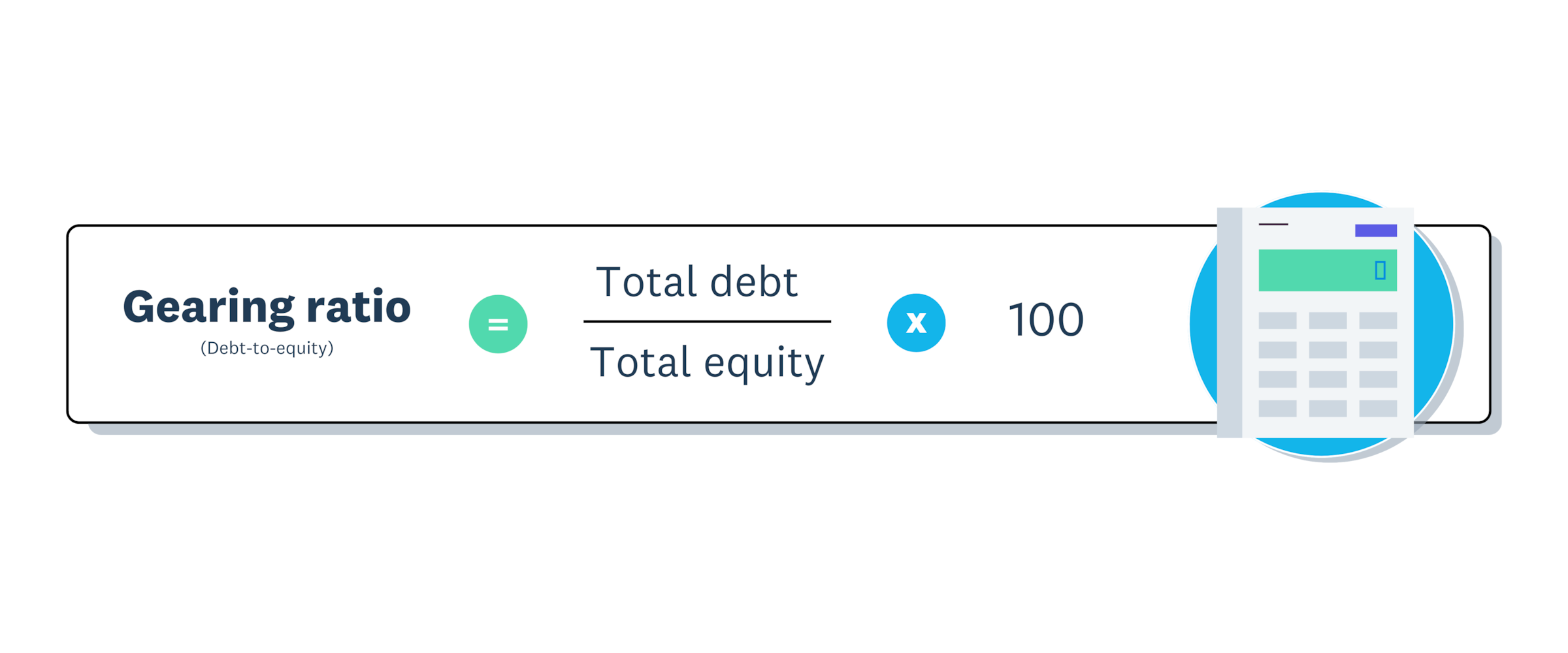
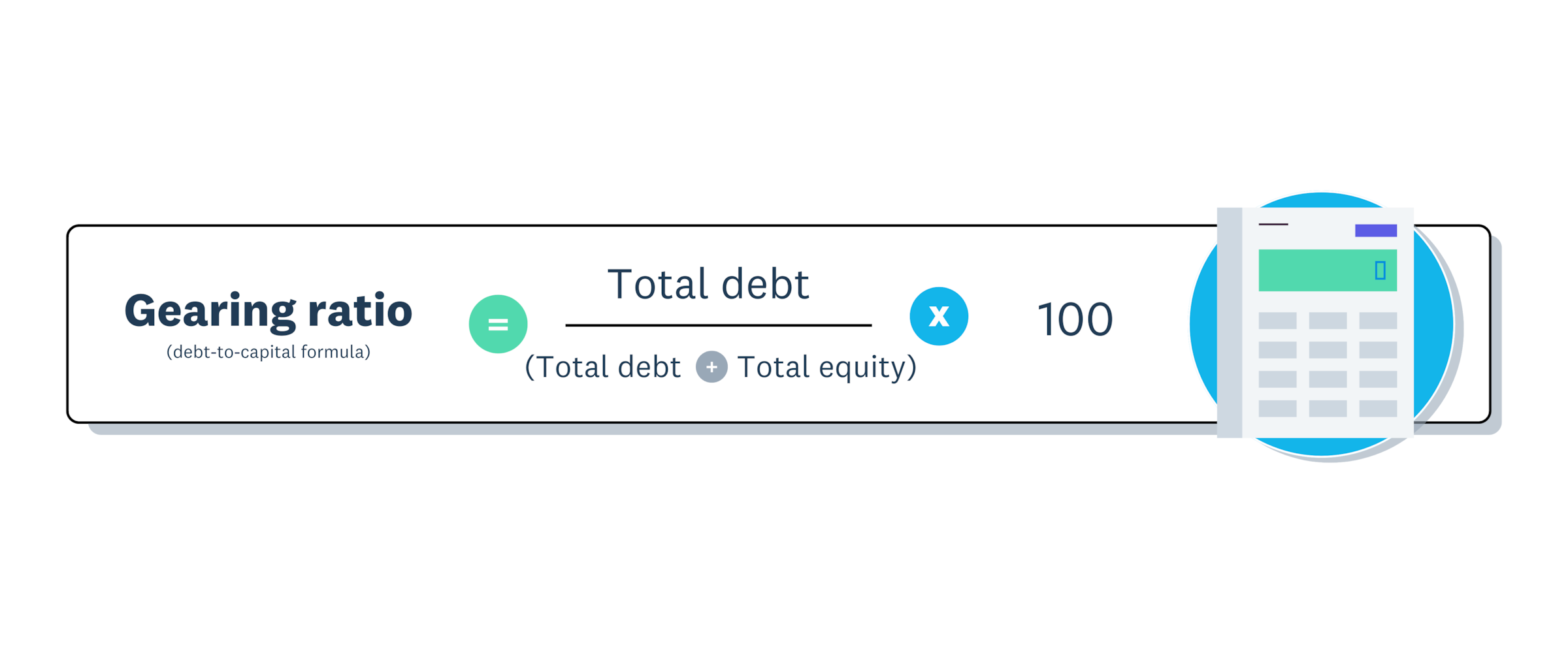
- Apply a gearing ratio formula: Use the debt-to-equity formula: Gearing ratio = (Total debt / Total equity) x 100. Alternatively, use the debt-to-capital formula: Gearing ratio = (Total debt / (Total debt + Total equity)) x 100.
- Interpret your result: A higher percentage means greater reliance on debt, while a lower percentage indicates a stronger equity position.
Example gearing ratio calculations
See how a small business might calculate its gearing ratio with real numbers.
Example scenario:
- Total debt: $50,000
- Total equity: $100,000
Using the debt-to-equity formula
This is the most common way to calculate your gearing ratio.
Gearing ratio = ($50,000 / $100,000) x 100 = 50%
This means half of the business is funded by debt.
Using the debt-to-capital formula
The debt-to-capital formula gives you another perspective on your financial structure.
Gearing ratio = ($50,000 / $150,000) x 100 = 33.3%
This shows debt makes up one-third of total capital.
Gearing ratio analysis
Once you've calculated your gearing ratio, you need to understand what it means for your business. Context matters, because the right ratio depends on your industry, growth stage, and risk tolerance.
A good gearing ratio for most small businesses falls between 25% and 50%. This range balances growth potential with manageable risk.
Interpret your result based on these ranges:
- Low gearing (below 25%): Strong equity position with lower risk, but may limit growth potential
- Moderate gearing (25% to 50%): Balanced approach suitable for most small businesses
- High gearing (above 50%): Greater reliance on debt with increased financial risk
Acceptable ratios vary by industry. Construction and manufacturing businesses often operate comfortably at higher gearing ratios (50% to 70%) because they need significant capital for equipment and materials. Service-based businesses like consulting firms typically maintain lower gearing (below 30%) since they have fewer capital-intensive needs. Retail businesses usually fall somewhere in between, depending on inventory requirements.
High vs low gearing: what's the difference?
The difference between high and low gearing comes down to how you fund your business.
High gearing means relying more on debt than equity. A retail store taking out a large loan to buy inventory and renovate would have a high gearing ratio.
This approach works well when:
- Your business has stable cash flow to service debt
- You're in a high-growth industry needing capital to expand quickly
- Sales are strong and interest rates are favourable
Monitor your cash flow carefully. If revenues drop or interest rates rise, make sure you can still meet debt payments.
Low gearing means using more equity and less debt. A family-owned cafe expanding with saved profits would have a low gearing ratio.
This approach suits businesses that:
- Prioritize long-term security over rapid growth
- Operate in unstable market conditions
- Want to protect their credit rating
The benefit is greater stability, though growth may be more gradual when you're not using borrowed funds to expand.
How to reduce your gearing ratio
If your gearing ratio is higher than you'd like, there are practical steps you can take to bring it down. Reducing your ratio strengthens your financial position and can make your business more attractive to lenders and investors.
Consider these strategies:
- Pay down existing debt: Focus on repaying high-interest loans first. Even small extra payments can lower your total debt over time and reduce your ratio. Learn more about how to manage debt effectively
- Increase equity through retained profits: Reinvest profits back into your business instead of distributing them. This builds your equity base and naturally lowers your gearing ratio
- Bring in additional equity investment: Consider taking on a business partner or seeking equity funding. New equity investment directly reduces the proportion of debt in your capital structure
- Renegotiate loan terms: Speak with your lender about restructuring existing debt. Extending repayment periods or securing lower interest rates can free up cash flow to pay down principal faster
- Sell non-core assets: If your business holds assets that aren't essential to operations, selling them can generate funds to reduce debt. This works especially well for clearing short-term liabilities
Choose the approach that fits your situation best. Many businesses combine two or three of these strategies for a faster result.
Factors that influence your gearing ratio
Your gearing ratio doesn't exist in isolation. Several factors can push it higher or lower over time, and understanding them helps you plan ahead.
- Industry norms: Capital-intensive industries like construction and manufacturing typically carry higher gearing ratios than service-based businesses. Compare your ratio against businesses in your sector for a more meaningful benchmark
- Business lifecycle stage: Start-ups and high-growth businesses often have higher gearing because they need capital to scale. Established businesses with steady revenue tend to carry less debt relative to equity
- Economic conditions: Interest rate changes directly affect your cost of borrowing. When rates are low, businesses may take on more debt. When rates rise, servicing that debt becomes more expensive, putting pressure on your ratio
- Capital allocation decisions: How you choose to fund new projects, whether through debt, retained earnings, or new equity, directly shifts your gearing ratio. Each option comes with trade-offs for control, cost, and risk
- Cash flow stability: Businesses with predictable, recurring revenue can generally support higher gearing ratios than those with seasonal or inconsistent income
Review these factors regularly, especially before making major financial commitments.
Debt-to-equity ratio vs gearing ratio
Debt-to-equity ratio and gearing ratio both measure how your business uses debt, but they serve different purposes. Knowing when to use each gives you a clearer picture of your financial position.
- Debt-to-equity ratio: Specifically compares long-term debt to shareholders' equity for quick financial snapshots
- Gearing ratio: A broader measure that considers different types of debt relative to your overall capital structure
When to use each:
Use the debt-to-equity ratio for quick assessments and standardized comparisons across businesses. Use the gearing ratio for deeper analysis when planning long-term strategy or evaluating different types of debt.
Benefits and limitations of gearing ratios
Gearing ratios are a useful tool, but like any financial metric, they work best when you understand what they can and can't tell you.
Benefits of gearing ratios
Here's what makes gearing ratios valuable for your business.
- Quick risk assessment: A single calculation shows how much your business relies on debt versus equity, giving you a fast read on financial risk
- Better borrowing decisions: Knowing your ratio helps you decide whether taking on more debt is sensible or whether it would stretch your finances too far
- Useful for comparisons: You can compare your ratio against industry benchmarks or competitors to see where your business stands
- Supports investor confidence: A healthy gearing ratio signals to investors and lenders that your business manages its finances responsibly
Limitations of gearing ratios
Keep these limitations in mind when interpreting your results.
- No universal benchmark: What counts as a "good" ratio varies widely by industry, business size, and growth stage. A ratio that works for one business may not suit another
- Point-in-time snapshot: Gearing ratios reflect your financial position at a single moment. They don't capture trends, seasonal changes, or upcoming obligations
- Doesn't show cash flow health: A low gearing ratio doesn't guarantee strong cash flow. Your business could have low debt but still struggle with day-to-day expenses
- Can be affected by accounting methods: Different ways of valuing assets and liabilities can change your ratio, making comparisons less straightforward
For the most complete picture, use your gearing ratio alongside other financial metrics like cash flow statements and profitability ratios.
Track your financial health with Xero
Monitoring your gearing ratio helps you make confident decisions about borrowing, growth, and risk. With the right tools, you can track this metric alongside your other financial indicators.
Xero's real-time financial reports let you see your debt and equity positions at a glance. Automated calculations save time, while clear dashboards help you spot trends and share updates with stakeholders.
Ready to take control of your business finances? Get one month free and see how Xero simplifies financial management.
FAQs on gearing ratios
Here are answers to frequently asked questions about gearing ratios and how they apply to your business.
What is a good gearing ratio for a small business?
A good gearing ratio for most small businesses falls between 25% and 50%. This range balances growth potential with manageable financial risk. Compare your ratio against others in your industry for a more meaningful benchmark.
Is 50% gearing considered high?
A 50% gearing ratio sits at the upper end of the moderate range. It's not considered high, but you should monitor it closely and make sure your cash flow can comfortably cover debt repayments.
How often should I check my gearing ratio?
Review your gearing ratio quarterly, or whenever you're considering taking on new debt or making significant financial decisions. Regular monitoring helps you spot trends before they become problems.
Can a gearing ratio be too low?
Yes. While low gearing reduces risk, a ratio below 25% may mean you're missing growth opportunities. Using some debt strategically can help expand your business faster than relying solely on equity.
What's the difference between gearing ratio and debt-to-equity ratio?
The debt-to-equity ratio specifically compares long-term debt to shareholders' equity. The gearing ratio is a broader measure that can include different types of debt relative to your overall capital structure.
How can you reduce your gearing ratio?
You can lower your gearing ratio by paying down existing debt, retaining more profits in the business, bringing in equity investment, or selling non-core assets. Most businesses see the best results by combining two or three of these approaches.
Start using Xero for free
Access Xero features for 30 days, then decide which plan best suits your business.