What is working capital? Formula, ratio and examples
Working capital helps you cover day to day costs. Learn how to calculate it for your small business.

Written by Lena Hanna—Trusted CPA Guidance on Accounting and Tax. Read Lena's full bio
Published Monday 20 April 2026
Table of contents
Key takeaways
- Calculate your working capital by subtracting your current liabilities from your current assets to get a clear picture of whether your business can cover its short-term costs and still have funds left over for growth.
- Aim for a working capital ratio between 1.2 and 2.0, as a ratio below 1.0 means you may not have enough assets to cover your debts, while a ratio above 2.0 suggests you have idle cash that could be put to better use.
- Improve your working capital position by sending invoices promptly, negotiating longer payment terms with suppliers, and keeping inventory at optimal levels to avoid tying up cash in unsold stock.
- Distinguish between working capital and cash flow, as working capital shows what remains after accounting for upcoming costs, while cash flow tracks how money moves in and out of your business over time — and you need to monitor both regularly.
What is working capital?
Working capital is the difference between your current assets and current liabilities. It shows whether your business has enough liquid resources to cover short-term obligations over the next 12 months, which is generally assumed to be a normal operating cycle when not clearly identifiable.
The result is measured in dollars and can be positive (surplus) or negative (deficit).
Current assets and liabilities
Current assets include anything you can convert to cash within 12 months:
- cash and bank account funds
- accounts receivable from customers
- inventory and stock
- prepaid expenses and short-term investments
- tax refunds owed to your business
Current liabilities include all debts and obligations due within 12 months, though some trade payables and accruals remain classified as current even if settled later. These include:
- accounts payable to suppliers
- current portion of long-term borrowings due within 12 months
- interest payable due within 12 months
- accrued expenses like wages and fees
- deferred revenue from customers

The importance of working capital in business
Working capital reveals your business's short-term financial health. It helps you understand three key areas:
- Operational viability: your ability to cover day-to-day expenses
- Market resilience: your capacity to handle seasonal fluctuations and unexpected changes
- Growth potential: your available funds for reinvestment and expansion
Lenders and investors assess your working capital to gauge financial stability before making funding decisions. New transparency disclosures around supplier finance arrangements are helping this process.
Positive vs negative working capital
Your working capital result tells you where your business stands:
- Positive working capital: current assets exceed current liabilities, meaning you can pay bills and have surplus funds for reinvestment
- Negative working capital: current liabilities exceed current assets, signalling a need to address cash flow and short-term obligations
- Neutral working capital: assets and liabilities are roughly equal, meaning you have limited flexibility for unexpected expenses or growth opportunities
How to calculate working capital
Calculate your working capital to find out how much short-term financial cushion your business has. Follow these three steps:
- Add up your current assets: include all assets convertible to cash within 12 months
- Total your current liabilities: include all debts due within 12 months
- Subtract liabilities from assets: the result is your working capital
If you use accounting software, pull this information directly from your balance sheet and financial reports. Classifying current items helps distinguish the net assets continuously circulating as working capital.
The working capital formula
The working capital formula is: Current Assets – Current Liabilities = Working Capital.
A working capital formula example
A retail florist wants to measure their working capital:
- Current assets: $100,000 (cash, inventory, accounts receivable)
- Current liabilities: $75,000 (supplier payments, loan payments, wages)
- Working capital: $100,000 – $75,000 = $25,000
This positive result means the florist has $25,000 available to cover operations and invest in growth.
Working capital vs working capital ratio
Working capital and working capital ratio measure the same components but express the result differently:
- Working capital: the dollar amount left after subtracting current liabilities from current assets
- Working capital ratio: the relationship between assets and liabilities expressed as a ratio, showing how many dollars of assets you have for every dollar of liabilities

Both metrics serve different purposes in assessing your business's financial health. Learn more about the working capital ratio formula.
What is net working capital?
Net working capital (also called operating working capital) excludes cash and debt from the calculation. This isolates the efficiency of your daily operations.
Net working capital is useful when:
- assessing longer-term financial health
- evaluating businesses that are expanding
- analysing industries like retail, manufacturing, and distribution where margins are small and profitability depends on operational efficiency
The net working capital formula
Consider the florist example again. Suppose their current assets include a cash amount of $20,000, and their current liabilities include loan debts of $10,000. The new formula for their net working capital is $80,000 ($100,000 – $20,000) – $65,000 ($75,000 – $10,000) = $15,000.
Working capital vs cash flow: what's the difference?
Working capital and cash flow measure different aspects of your finances:
- Working capital: shows how much money remains after covering upcoming costs
- Cash flow: shows how money moves in and out of your business over time
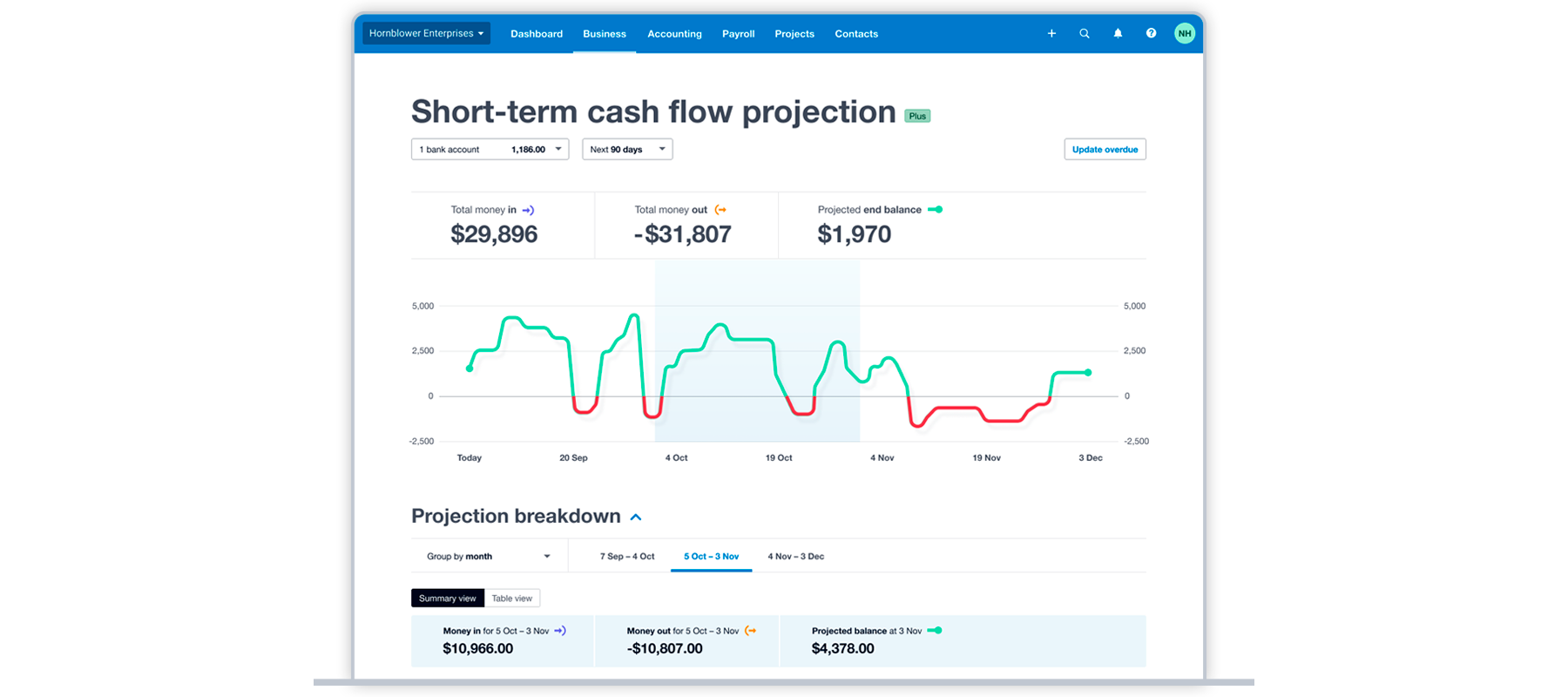
Cash flow projections, like Xero's short-term forecast, show total money in and out for the next 90 days. Working capital provides a more complete picture by including liquid assets and showing your business's overall health and adaptability.
How to manage your working capital
Effective working capital management ensures you have enough funds for daily operations while freeing up cash for growth. Here's how to manage the key areas.
Manage your inventory
Manage your inventory with these three strategies:
- Balance stock levels: keep cash flowing freely by maintaining optimal inventory levels that meet demand
- Speed up turnover: use promotions to move slow-selling items, but monitor the impact on revenue (one case study found discounts amounted to 9.4 per cent of total income)
- Track stock in real time: use inventory management software to monitor levels and automate reordering to prevent costly discrepancies, as physical stocktakes can sometimes reveal significant total shrinkage of stock
Check out Xero's inventory management guide for more advice.
Control your expenses
Control your expenses to free up working capital:
- Audit your spending: compare costs to industry benchmarks to identify areas for reduction without affecting quality
- Redirect non-essential spending: focus resources on growth initiatives
- Streamline processes: use lean business practices to reduce operational waste
Monitor your cash flow
Check your cash inflows and outflows regularly to anticipate shortages or surpluses. Set aside some profits as a buffer for lean periods.
Learn more about forecasting cash flow and managing your finances.
Working capital examples in different businesses
A good working capital level varies by industry due to different operating cycles, cash flow patterns, and asset structures. A café might need only 10–15% of working capital per dollar of sales. A heavy machinery manufacturer with slower turnover may require 20–25%.
Working capital in construction and manufacturing
Construction and manufacturing businesses often have irregular cash flow due to long project timelines. Working capital funds upfront costs for materials, subcontractors, and labour that the business can't recover until a project is finished.
A building materials manufacturer wants to assess their position:
- Current assets: $600,000 (cash $100,000 + accounts receivable $200,000 + inventory $300,000)
- Current liabilities: $300,000 (accounts payable $150,000 + short-term loans $100,000 + accrued expenses $50,000)
- Working capital: $600,000 – $300,000 = $300,000
This positive result means the business has enough assets to cover its liabilities.
Working capital in service businesses
Service businesses like consultancies and agencies don't hold inventory, so they typically need less working capital than product-based industries. They may have higher accounts receivable from client invoicing and still need enough working capital to cover payroll, office expenses, and project costs.
Working capital in retail
Retail, wholesale, and hospitality businesses hold significant inventory and need working capital to buy stock in advance for peak seasons. Balancing stock levels and sales is essential to keeping working capital healthy.
Improve your working capital with Xero
Xero accounting software helps you manage your working capital by tracking assets and liabilities and streamlining invoicing and payments.
With Xero you can:
- automate invoicing and payments
- track inventory in real time
- view real-time financial insights
- monitor expenses easily
- forecast your cash flow
Get one month free to get started.
FAQs on working capital
Here are some common questions and answers about working capital.
What is a good working capital ratio for small businesses?
A good working capital ratio for small businesses is typically between 1.2–2.0:
- Below 1.0: indicates insufficient assets to cover debts, requiring immediate attention
- 1.2–2.0: indicates a healthy range for most small businesses
- Above 2.0: indicates possible excess cash not being used for growth
Service businesses typically need lower ratios than retailers or manufacturers because they hold less inventory.
How can I improve working capital ratio?
Start improving your working capital ratio today:
- send invoices immediately to reduce payment turnaround time (find out how Xero makes invoicing easy)
- negotiate longer payment terms with suppliers to slow your cash outflows
- offer early payment discounts to encourage customers to pay sooner
- redirect non-essential spending to boost your assets
What happens if my working capital ratio is too low?
A low working capital ratio signals that your business needs more assets to comfortably cover short-term debts. Address this early to stay solvent.
What is a working capital loan?
A working capital loan provides short-term funding to cover day-to-day operations when you need additional working capital. Seek advice from a financial advisor before taking on new debt.
Is working capital the same as liquidity?
They're related but different. Liquidity measures how easily your business can convert assets to cash to cover upcoming costs. Working capital measures how much money remains after covering those costs.
Disclaimer
Xero does not provide accounting, tax, business or legal advice. This guide has been provided for information purposes only. You should consult your own professional advisors for advice directly relating to your business or before taking action in relation to any of the content provided.
Get one month free
Purchase any Xero plan, and we will give you the first month free.