Proforma invoice: what it is, when and how to use it
Learn what a pro forma invoice is, when to use one, and how it differs from a tax invoice.

Written by Jotika Teli—Certified Public Accountant with 24 years of experience. Read Jotika's full bio
Published Monday 15 June 2026
Table of contents
Key takeaways
- A pro forma invoice is a preliminary document you send before completing a sale, confirming pricing and details without creating a legal payment obligation.
- Pro forma invoices are preliminary documents only. Buyers need an official tax invoice to claim a GST credit, so always follow up with one once the sale is confirmed.
- Label the document clearly as "Pro forma invoice" and keep it out of your accounts receivable ledger, since no sale has occurred and recording it could create tax and reporting issues.
- Including your ABN, a validity period, and clear item descriptions on every pro forma invoice helps set expectations and supports a smooth transition to the final tax invoice.
What is a pro forma invoice?
A pro forma invoice is a preliminary document you send to a buyer before completing a sale. It outlines products, services, and estimated pricing without requesting payment or creating a legal obligation.
Think of it as a detailed preview of what the final invoice will look like. It gives both you and your buyer a chance to confirm quantities, pricing, and terms before anything is locked in.
For example, an Australian furniture maker might send a pro forma invoice to a New Zealand retailer before shipping a batch of dining chairs. This lets the retailer arrange financing and prepare customs paperwork while the order is being finalised. Similarly, a Sydney-based caterer could send a pro forma invoice to a corporate client outlining estimated costs for an event menu, allowing the client to get internal procurement approval before confirming the booking.
Unlike regular invoices, pro forma invoices have a few key characteristics:
- They serve as a preliminary estimate only, with no payment obligation attached.
- They use a reference number rather than an official invoice number, and carry no due date.
- They remain separate from your accounting books, since no sale has taken place.
How is a pro forma invoice different from other invoices (and quotes)?
Pro forma invoices are often confused with other business documents that look similar but serve different purposes. Understanding the differences helps you use the right document at the right time.
Pro forma invoice vs commercial invoice
A commercial invoice is a formal sales document exchanged between importers and exporters. It includes details about buyer and seller responsibilities, tariffs, and regulatory information required for international trade.
The key difference: a commercial invoice confirms a sale is final, while a pro forma invoice doesn't. Both documents help estimate customs duties and fees, but only the commercial invoice creates a binding transaction.
Pro forma invoice vs tax invoice
A tax invoice is the official document you issue after a sale is complete. It includes your Australian Business Number (ABN), the exact goods and services tax (GST) amount, and meets the requirements set by the Australian Taxation Office (ATO).
A pro forma invoice serves a different purpose from a tax invoice. Because no sale has occurred, buyers need an official tax invoice to claim a GST credit. You'll always need to issue a proper tax invoice once the transaction is confirmed.
Pro forma invoice vs quote
Quotes and pro forma invoices both help you agree on pricing with a customer. The difference is timing and purpose.
You typically send a quote during negotiations, before terms are settled. A pro forma invoice comes after you've agreed on the deal, and it's used to support tasks like customs clearance, financing applications, or internal procurement approvals. A pro forma invoice also tends to include more detail than a quote, such as shipping costs, delivery timelines, and payment terms.
Benefits of pro forma invoices for buyers and sellers
Pro forma invoices create value on both sides of a transaction. Here's how they help buyers and sellers separately.
Benefits for buyers
Buyers benefit from having a clear, detailed preview of costs before committing to a purchase.
- Use the document to secure financing or internal budget approval before the sale is finalised.
- Compare pricing and terms across multiple suppliers without any payment obligation.
- Prepare customs paperwork for international orders in advance, reducing delays at the border.
- Review itemised costs, shipping fees, and payment terms so there are no surprises on the final invoice.
Benefits for sellers
For sellers, pro forma invoices help set clear expectations and reduce disputes after the sale.
- Confirm pricing and scope with your buyer before committing resources to production or delivery.
- Provide documentation that supports your buyer's procurement or financing process, helping move the deal forward.
- Reduce the risk of payment disputes by aligning on terms upfront.
- Keep preliminary estimates separate from your official accounting records, avoiding tax and reporting errors.
When to use a pro forma invoice
You'll typically issue a pro forma invoice after agreeing on terms with a buyer but before finalising the sale. It's the step between accepting a quote and issuing the official invoice.
Here are the most common scenarios where a pro forma invoice is useful:
- Your buyer needs formal documentation to arrange financing or secure a loan before committing to a large purchase.
- Your shipment is heading overseas and customs authorities need detailed pricing information to clear the goods.
- Your buyer is a corporate client who needs a formal cost estimate to get internal procurement approval.
- Your buyer wants to confirm final quantities, pricing, and delivery terms before you start production.
According to Xero Small Business Insights, Australian small businesses waited an average of 23.9 days to be paid in the December quarter of 2025, the fastest result since tracking began in 2017. Clear preliminary documentation like pro forma invoices can help set expectations and keep payment timelines on track.
What should a pro forma invoice look like?
A pro forma invoice follows a familiar invoice format but makes it clear that it's not a payment request. Including the right details from the start makes it easier to convert to a final tax invoice later.
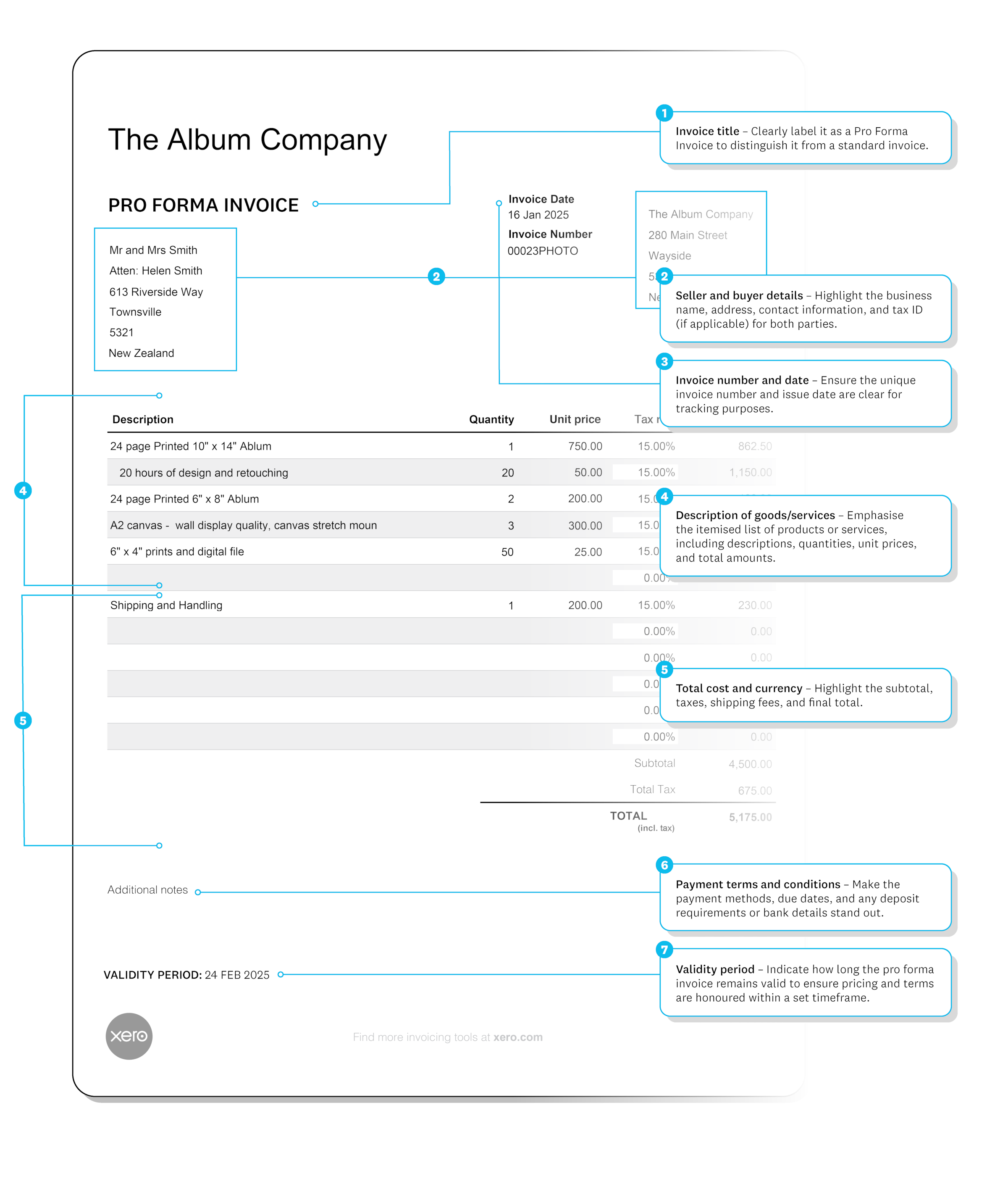
Every pro forma invoice should include:
- The words "Pro forma invoice" displayed prominently at the top of the document.
- Your business name, address, contact details, and ABN.
- The buyer's name, address, and contact information.
- A description of each product or service, including quantities and unit prices.
- Payment terms and conditions of sale.
- A reference or tracking number (not an official invoice number).
- A validity period stating how long the quoted pricing is available, for example, 30 days from the date of issue.
For international shipments, you should also include product weights and dimensions, shipping costs and methods, and the country of origin for each item. Customs authorities need this information to assess duties and clear goods.
Pro forma invoices and GST: what you need to know
This is one of the most important distinctions for Australian businesses. A pro forma invoice is not a tax document for GST purposes, because no sale has taken place yet.
Buyers must have an official tax invoice to claim a GST credit for purchases over A$82.50 (including GST). A pro forma invoice doesn't meet this requirement, no matter how detailed it is.
Here are the key GST considerations to keep in mind:
- Record tax liability only after you issue the final sales invoice.
- Include estimated GST amounts on a pro forma invoice for planning purposes, but show the exact amount, rounded to the nearest cent, on the final tax invoice.
- Limit GST recording to actual sales invoices if you're GST-registered.
- Provide a tax invoice within 28 days if a customer requests one, unless the sale is for A$82.50 (including GST) or less.
How to create a pro forma invoice
Creating a pro forma invoice is straightforward. You can adapt your existing invoice template with a few key adjustments.
1. Start with your standard invoice template
Use your usual invoice layout and fill in all the relevant fields: your business details, the buyer's details, item descriptions, quantities, unit prices, and any applicable shipping costs. Include your ABN even though this isn't a tax invoice, as it identifies your business and builds trust.
2. Label the document as a pro forma invoice
Replace any "Tax invoice" or "Invoice" heading with "Pro forma invoice" so there's no confusion about the document's purpose. This prevents the buyer from treating it as a payment request and stops it from being recorded as a sale in anyone's books.
3. Keep it out of your accounts receivable
Keep the pro forma invoice out of your accounting ledger. Since no sale has occurred, including it in accounts receivable would overstate your income and could create GST reporting issues. Use a reference number rather than an official invoice number to track it.
4. Send the pro forma invoice and follow up
Send the document as a PDF attachment via email, or use your invoicing software to deliver it directly. Include a brief note explaining that this is a preliminary document and that a final tax invoice will follow once the sale is confirmed. If the buyer requests changes to quantities, pricing, or terms, update the pro forma invoice and resend it before proceeding.
Timely follow-up matters. Xero Small Business Insights data shows Australian small businesses were paid an average of 6.6 days late in the December quarter of 2025. Converting a pro forma invoice to a final sales invoice promptly after confirmation can help reduce delays in the payment cycle.
Best practices for pro forma invoices in Australia
Following a few consistent practices helps you stay organised, meet your compliance obligations, and make it easier to convert pro forma invoices into final tax invoices.
- Include your ABN on every pro forma invoice, even though it isn't a tax document. This identifies your business clearly and makes the transition to a final tax invoice smoother.
- Set a validity period (for example, 30 days) on each pro forma invoice so the buyer knows how long the quoted pricing stands. This protects you from cost increases on materials or shipping.
- Keep copies of all pro forma invoices in a separate folder or filing system. Even though they aren't official accounting records, having them on file supports your audit trail if the ATO queries a related transaction.
- Record the GST treatment clearly. Note any estimated GST amounts on the pro forma invoice, then make sure the final tax invoice reflects the exact figures.
- Be aware of Peppol e-invoicing. The Australian Government is expanding e-invoicing through the Peppol network. While pro forma invoices aren't part of the formal e-invoicing framework, understanding how your invoicing process connects to Peppol can help you prepare for future requirements.
- Use a consistent numbering or reference system for pro forma invoices that's clearly separate from your official invoice numbers. This prevents any mix-up between preliminary and final documents.
Simplify your invoicing with Xero
Pro forma invoices don't need to add complexity to your invoicing process. With the right tools, you can create them from existing quotes, send them directly to your customers, and convert them to official tax invoices when the sale is confirmed.
Xero keeps your pro forma invoices separate from your official accounting records, so your books stay accurate and GST reporting stays clean. Ready to make invoicing simpler? Get one month free.
FAQs on pro forma invoices
Here are answers to frequently asked questions about pro forma invoices.
Is a pro forma invoice legally binding?
A pro forma invoice is a preliminary document that outlines expected costs and terms. It functions as a good-faith estimate rather than a formal contract, so it creates no legal obligation for either party.
Can a pro forma invoice be cancelled?
Yes, you can discard a pro forma invoice at any time without a formal cancellation process. Since it isn't a legal document or official accounting record, there's nothing to reverse if the sale doesn't go ahead.
Can you turn a pro forma invoice into a commercial invoice?
A pro forma invoice and a commercial invoice serve different purposes and need to be created separately. While they share similar pricing details, a commercial invoice includes additional legal and regulatory information required for finalising international trade transactions.
How long is a pro forma invoice valid for?
There's no standard rule, but most businesses set a validity period of 30 to 90 days. Stating the expiry date on the document protects you from cost changes and gives the buyer a clear deadline to confirm the order.
Is it OK to pay a pro forma invoice?
It's best to wait for the official sales invoice before making payment. A pro forma invoice isn't a binding agreement, and the final price, quantities, or terms may still change before the sale is confirmed.
What are the advantages of pro forma invoices?
Pro forma invoices let both buyer and seller confirm pricing and terms before the sale is final, reducing the risk of disputes. They also provide the documentation needed for customs clearance, financing applications, and internal procurement approvals.
Related content
What is an invoice?
Get the lowdown on invoices.
How to send an invoice
Find out when and how to send an invoice.
How to make an invoice
Let’s walk through the process of making an invoice.
Disclaimer
Xero does not provide accounting, tax, business or legal advice. This guide has been provided for information purposes only. You should consult your own professional advisors for advice directly relating to your business or before taking action in relation to any of the content provided.
Get one month free
Purchase any Xero plan, and we will give you the first month free.