Gross profit vs net profit
See how gross profit and net profit differ, how to calculate each and what they reveal about your business.
Published Wednesday 30 September 2026
Table of contents
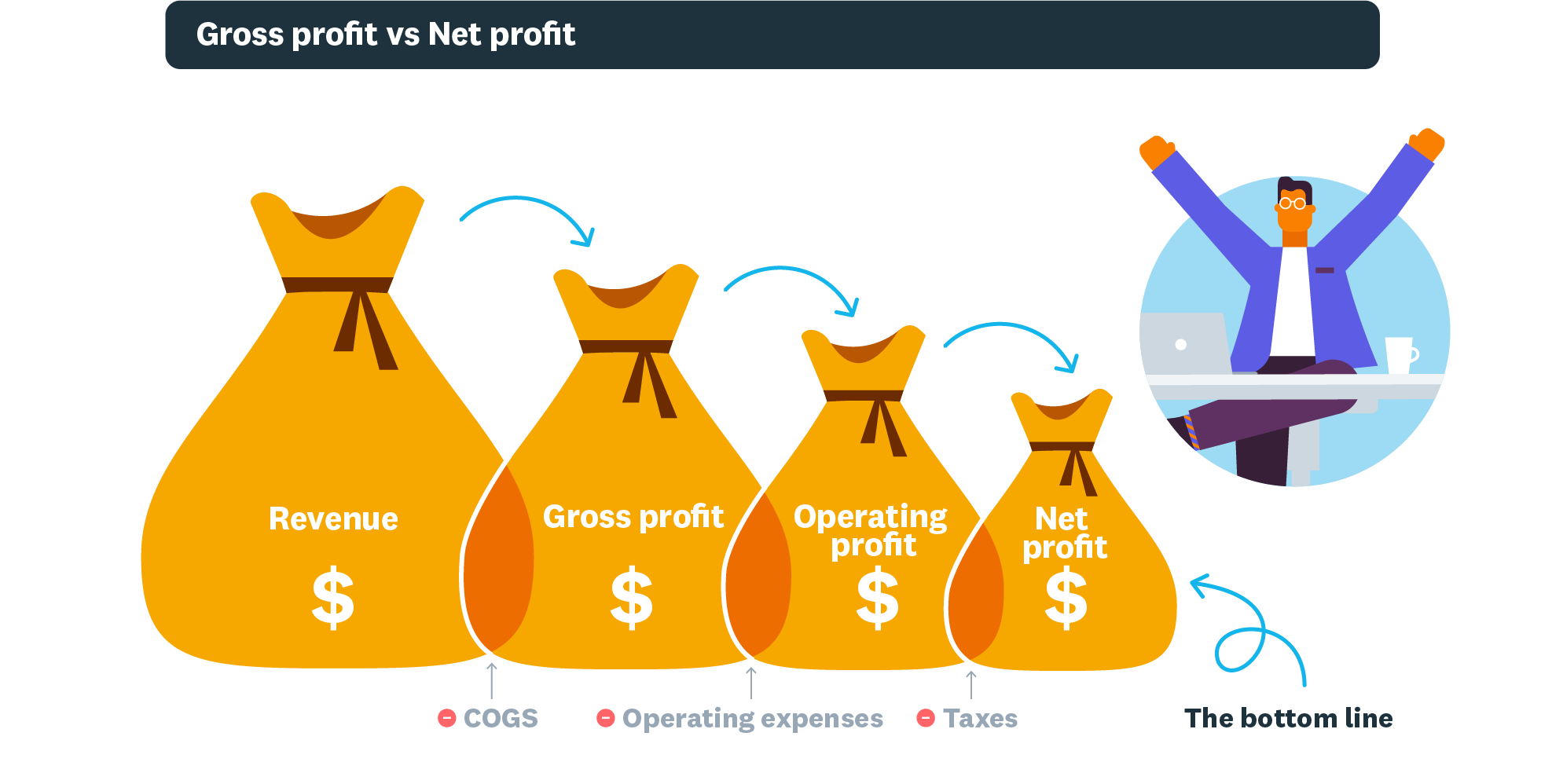
The difference between gross profit and net profit is operating expenses and taxes
Key takeaways
- Gross profit is revenue minus the direct costs of what you sell, while net profit is what’s left after every expense
- Operating profit sits between the two and shows what your core business earns before interest and tax
- A healthy gross profit can still lead to a thin net profit when overheads, debt or tax take a big share
- You can work out both figures in five steps or read them straight from your profit and loss report
What is gross profit?
Gross profit is your revenue minus your cost of goods sold. It shows whether each sale earns enough to cover your other costs and still leave a profit.
It’s called “gross” because it’s the total before your other business costs are deducted. The direct costs you subtract are known as cost of goods sold (COGS).
COGS covers expenses tied directly to what you sell. For a retailer, that’s the wholesale price of stock, and for a bakery, it’s flour, butter and packaging. For a service business, it could be the labour spent delivering the service.
Gross profit leaves out the rest of what it takes to run your business, such as rent, utilities, marketing and insurance. So a healthy gross profit is only the first part of the story.
Gross profit formula
Working out gross profit takes one subtraction. Here’s the formula, followed by an example.
Gross profit = Revenue − Cost of goods sold (COGS)
Say you run a small bakery in Singapore. This month, your sales revenue is S$25,000, and your COGS, including ingredients, packaging and baking staff wages, is S$10,000.
Your gross profit is S$25,000 − S$10,000 = S$15,000. That S$15,000 has to cover all your other business expenses, with net profit being whatever remains.
What is net profit?
Net profit is what remains after you subtract all your business expenses from your total revenue. It’s also called net income or the bottom line, because it sits at the bottom of your financial statements.
Those expenses include COGS plus operating expenses such as rent, utilities, marketing and insurance, along with loan interest and tax. Repaying the loan amount itself reduces what you owe, so it doesn’t count as an expense.
Lenders and investors look closely at net profit. It’s also the starting point for working out the chargeable income that the Inland Revenue Authority of Singapore (IRAS) taxes.
A positive net profit means your business earns more than it spends. A negative figure means you’re running at a loss, whatever your gross profit shows.
Net profit formula
Net profit takes your revenue and subtracts every cost, including COGS. Here’s the formula.
Net profit = Revenue − Total expenses (COGS + operating expenses + interest + tax)
Your Singapore bakery made S$25,000 in revenue with S$10,000 in COGS, leaving a gross profit of S$15,000. These are its other costs for the month:
- S$3,000 in rent
- S$500 in utilities
- S$800 in marketing
- S$400 in insurance
- S$4,000 in admin wages
- S$600 in loan interest
- S$1,200 in tax
That’s S$10,500 in additional expenses, so your net profit is S$15,000 − S$10,500 = S$4,500. This S$4,500 is what the bakery actually earned for the month.
What’s included in gross profit vs net profit
The two figures differ only in which costs you subtract. Knowing where each cost belongs keeps both numbers accurate.
These costs sit in COGS and reduce gross profit:
- raw materials and ingredients
- wholesale stock bought for resale
- packaging and shipping tied to each product
- wages for staff who make the product or deliver the service
These costs only reduce net profit:
- admin, sales and management salaries
- rent and utilities
- marketing and advertising
- software subscriptions
- depreciation on equipment
- interest on loans
- company tax
Wages can fall on either side. Your bakers’ wages are COGS, while your bookkeeper’s wages are an operating expense.
Key differences between gross profit and net profit
Both figures start from the same revenue, but each one answers a different question. Here’s how they compare.
- Gross profit measures how efficiently you make or deliver what you sell, while net profit measures the profitability of the whole business
- Gross profit subtracts only COGS, while net profit also subtracts operating costs, interest and tax
- Gross profit shows whether your prices cover your direct costs, while net profit shows whether the business makes money overall
- Gross profit appears partway down your profit and loss statement, while net profit is the final line
Gross profit vs operating profit vs net profit
Operating profit is the middle step between gross and net profit. It’s gross profit minus operating expenses, before you subtract interest and tax.
Operating profit = Gross profit − Operating expenses
For the bakery, operating expenses are rent, utilities, marketing, insurance and admin wages, which total S$8,700. Its operating profit is S$15,000 − S$8,700 = S$6,300.
Net profit then subtracts S$600 in loan interest and S$1,200 in tax, leaving S$4,500. A related measure, net operating profit after tax (NOPAT), takes tax off operating profit but leaves financing costs out.
Why gross profit can be high while net profit is low
A strong gross profit tells you your pricing works, but costs further down the statement can absorb most of it. These are the usual causes:
- high rent and other overheads
- heavy spending on marketing and promotions
- interest on business loans or credit lines
- company tax on your chargeable income
Picture a café in a busy Orchard Road mall. Its coffee and pastries cost little to make, so gross profit looks healthy. Mall rent can then take a large share of it each month.
Why gross profit and net profit both matter for your business
Each figure guides a different kind of decision. Tracking both shows you exactly where your money goes.
Gross profit helps you judge your pricing and production costs. If it’s shrinking, your suppliers may have raised prices, your product mix may have shifted, or your prices may need a review.
Net profit shows whether your business model is sustainable over time. Watching it each month helps you spot rising overheads early and act before they eat into your earnings.
Lenders and investors check both numbers when you apply for a loan or raise funds. Gross profit shows the strength of your core offer, and net profit shows whether the whole operation holds up. You can also measure profitability with other ratios to round out the picture.
How to calculate gross and net profit
You can work out both figures from your own records in five steps. Use the same period, such as a month or quarter, for every number.
1. Add up your total revenue
Start with all the income your business earned in the period, including product sales, service fees and other business income. If you’re unsure what to count, get clear on what revenue means for your business first.
2. Calculate your cost of goods sold
Add up the direct costs of making or delivering what you sell. This usually covers raw materials, direct labour, and packaging or shipping tied to your products.
3. Subtract COGS from revenue to get gross profit
The result is what’s left before operating expenses. If it’s low or negative, review your pricing or production costs.
4. Add up all remaining expenses
List every other cost for the period. That includes rent, utilities, marketing, insurance, non-production wages, depreciation, loan interest and tax.
5. Subtract total expenses from revenue to get net profit
Take COGS plus all remaining expenses away from revenue, and the result is what your business earned after every cost. In Xero, your profit and loss report shows revenue, COGS, expenses and both profit figures automatically.
Gross profit margin vs net profit margin
Profit figures show the amount you earn, while margins show it as a percentage of revenue. Percentages make it easier to compare periods or businesses of different sizes.
Gross profit margin = (Gross profit ÷ Revenue) × 100
For the bakery, that’s (S$15,000 ÷ S$25,000) × 100 = 60%. So 60 cents of every dollar earned goes towards the rest of your business costs.
Net profit margin = (Net profit ÷ Revenue) × 100
For the bakery, that’s (S$4,500 ÷ S$25,000) × 100 = 18%. So 18 cents of every dollar is profit after all expenses.
The gap between the two margins is usually wide. NYU Stern’s January 2026 margins dataset puts the average gross margin across US-listed companies at 37.76% and the average net margin at 9.74%.
These are large US public companies, so treat the figures as a reference point rather than a target for a Singapore small business. To set goals for your own industry, learn how to calculate and improve profit margins, and compare other profitability ratios over time.
How to improve your gross profit
You can lift gross profit by earning more per sale or spending less on each product. These steps help with both.
- Review your prices regularly so they keep pace with your current COGS
- Negotiate bulk discounts with suppliers or compare quotes from new ones
- Cut waste and spoilage with tighter stock control
- Speed up how you make or deliver products to save on direct labour
- Shift your sales mix towards higher-margin products and services
How to improve your net profit
Net profit depends on many expenses, so small savings across several areas add up. These steps can help you increase your profits at the bottom line.
- Cancel or downgrade subscriptions and services you rarely use
- Automate bookkeeping tasks like bank reconciliation and invoicing to save admin time
- Review your expenses monthly instead of waiting for the financial year end
- Work with a tax agent or accountant to claim every eligible deduction, and check whether IRAS tax exemption schemes can lower your company tax
- Grow revenue through upselling, smart price rises or new markets without adding matching costs
Track your gross and net profit with Xero
Gross and net profit are most useful when you check them often. Xero gives you real-time profit and loss reports, so you can see where your money goes and make confident decisions about pricing and spending.
Start tracking both figures today when you get one month free.
FAQs on gross profit vs net profit
Here are quick answers to common questions about gross profit and net profit.
Can gross profit be higher than net profit?
Yes, gross profit is almost always higher than net profit. The two are equal only if your business has no expenses beyond COGS.
Is net profit the same as net income?
Yes, the two terms are generally interchangeable. Both describe what’s left after all expenses, which is why people also call it the bottom line.
Do you pay tax on gross or net profit in Singapore?
Singapore companies pay corporate income tax at 17% of chargeable income, which is worked out from net profit after tax adjustments. For Year of Assessment (YA) 2026, IRAS gives a 50% Corporate Income Tax Rebate capped at S$40,000. The IRAS basic guide to corporate income tax explains how chargeable income is worked out.
What is a good gross profit margin?
It depends on your industry, and NYU Stern’s January 2026 data puts restaurants at a 32.24% average gross margin and general retailers at 33.18%. To work out and compare your own figure, use this gross profit margin guide.
Can gross profit be negative?
Yes, gross profit is negative when your COGS is higher than your revenue. It means each sale costs more to produce than it brings in, so pricing or supplier costs need to change.
Related terms
Learn more about gross profit vs net profit
Handy resources
Advisor directory
You can search for experts in our advisor directory
Xero Small Business Guides
Discover resources to help you do better business
Financial reporting
Keep track of your performance with accounting reports
Disclaimer
This glossary is for small business owners. The definitions are written with their requirements in mind. More detailed definitions can be found in accounting textbooks or from an accounting professional. Xero does not provide accounting, tax, business or legal advice.