Solvency vs liquidity: Key differences and how to measure both for your small business
See how solvency vs liquidity drives better cash flow decisions and keeps your business resilient.

Written by Lena Hanna—Trusted CPA Guidance on Accounting and Tax. Read Lena's full bio
Published Friday 5 December 2025
Table of contents
Key takeaways
• Monitor both solvency and liquidity ratios regularly to assess your business's ability to meet long-term debts (solvency ratio of 20% or above is healthy) and short-term obligations (current ratio of 1.5 or higher indicates good liquidity).
• Improve solvency by attracting investors to increase equity, restructuring debt for better terms, and optimising operations to reduce costs, while enhancing liquidity by tracking cash flow, speeding up invoice collections, and maintaining cash reserves.
• Recognise that strong solvency and liquidity enable you to secure better borrowing terms, attract investors, negotiate bulk purchase discounts with suppliers, and seize growth opportunities when they arise.
• Utilise accounting software like Xero to track your cash, assets, and liabilities in real time, allowing you to make informed decisions about daily operations and long-term financial planning.
What does liquidity mean in business?
Liquidity measures your business's ability to pay bills and loan repayments in the short term — typically within 12 months.
Liquidity ratios compare (debts due within a year) against current assets (cash, inventory, receivables, and quickly sellable assets). Common ratios include the cash ratio and quick ratio.
Other liquidity ratios
Small businesses commonly use three liquidity ratios:
- Uses only assets convertible to cash within three months — cash, short-term investments, and receivables divided by current liabilities. Many advisers treat a quick ratio below 1.0 as a warning signal because current liabilities exceed easily convertible assets.
- Cash ratio: Cash and cash equivalents divided by current liabilities
- Current ratio: All current assets divided by current liabilities (most commonly used)
Learn more in our guide on liquidity ratios
How liquid are your assets?
Asset liquidity refers to how quickly you can convert assets to cash.
Most liquid assets:
- Cash: Physical currency and immediately accessible bank funds
Less liquid assets:
Liquidity vs other financial concepts
Liquidity measures your ability to cover short-term costs. Related concepts include:
- Cash flow: Money moving in and out of your business
- Working capital: Money remaining after covering short-term obligations
- Free cash flow: Cash remaining after capital investments
How does liquidity affect business growth?
Strong liquidity supports business growth by helping you:
- Seize opportunities: Launch new products or hire staff with available cash
- Handle unexpected costs: Cover emergency repairs or equipment failures
- Maintain operational stability: Avoid scrambling for cheaper suppliers or alternative financing
The main differences between solvency and liquidity
Table of the difference between solvency and liquidity
Solvency takes a long-term view of your financial health, while liquidity focuses on the short term. This table outlines other differences.
Keep a steady eye on both your business's liquidity and solvency to stay on top of its financial picture.
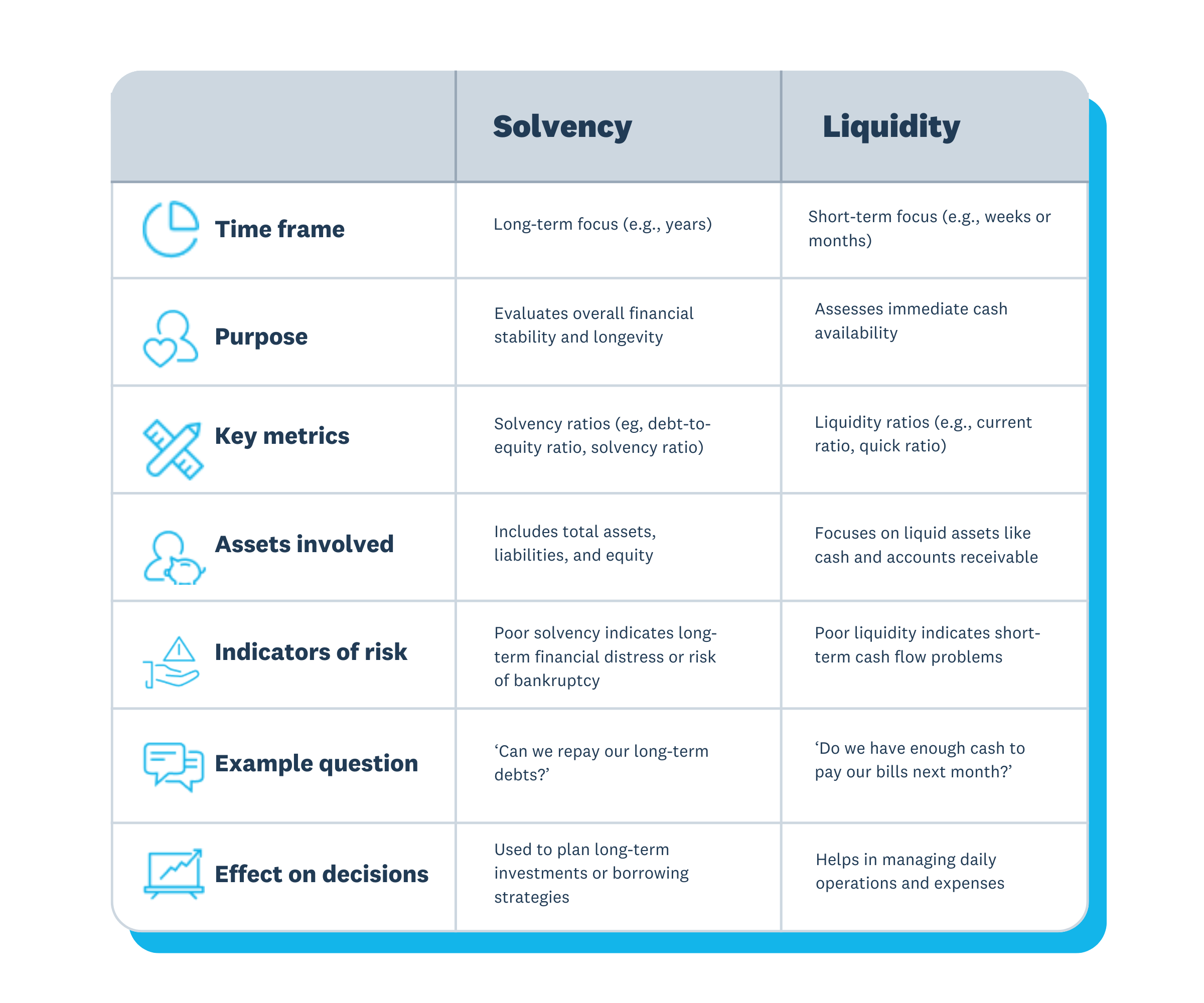
Table of the difference between solvency and liquidity
How to measure solvency and liquidity in your business
Measuring solvency and liquidity helps you track your financial health and make informed business decisions. Use these key ratios to assess your position.
Solvency ratio formula
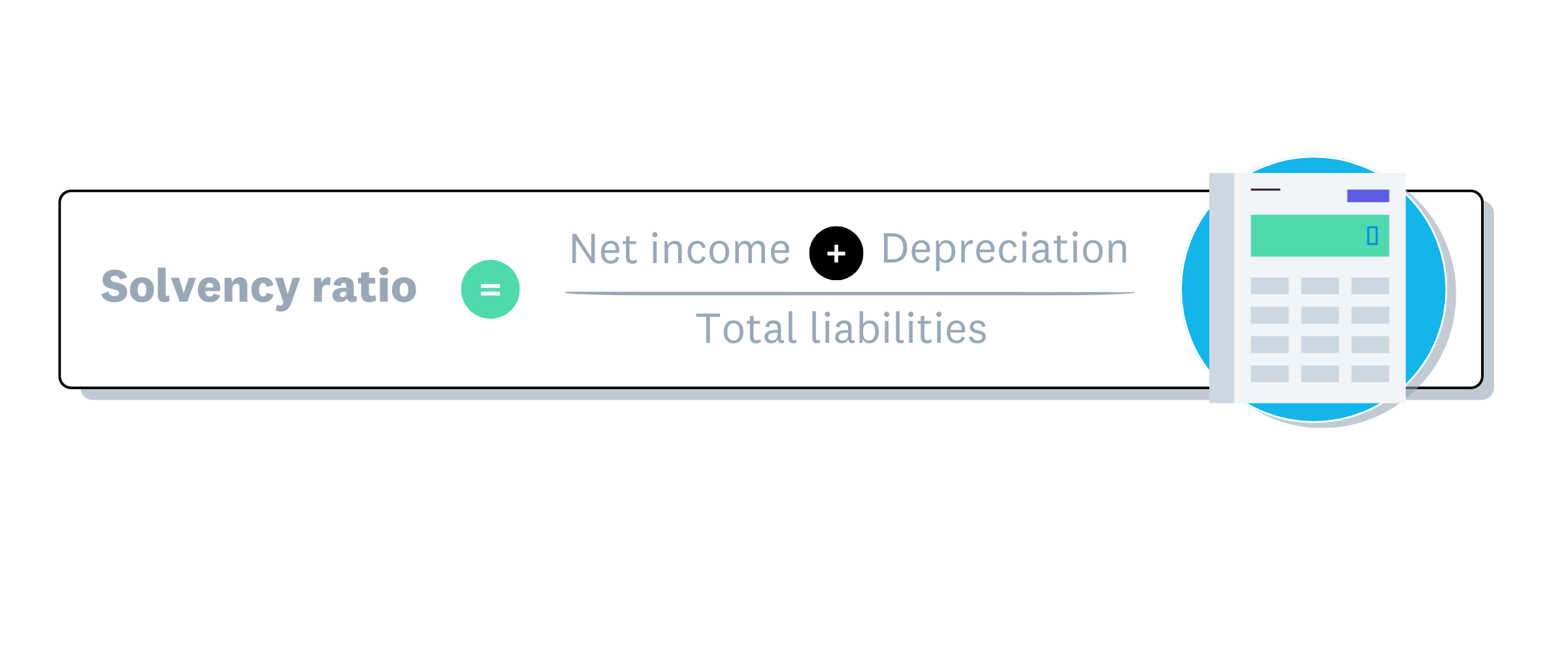
Solvency ratio formula
Solvency ratio formula
A solvency ratio calculation example
Martha owns a cafe that has:
- A net income of $50,000
- Asset depreciation* of $10,000
- Total liabilities of $300,000
To work out her solvency, she divides 60,000 (50,000 + 10,000) by 300,000, which equals 20%. Many lenders and advisers see a ratio of 20% or above as healthy, so Martha's business has a good chance of paying its debts over the years.
*Depreciation is the decrease of the value of your assets over time from normal wear and tear, which is entered on your balance sheet as a deduction from the assets value.
Liquidity ratio formula
There are several liquidity ratios, like the cash ratio, quick ratio, and the working capital ratio, which is a useful long-term measure of liquidity.

Here's the formula for the working capital ratio:
A liquidity ratio calculation example
Sadiq runs a sports shop that has:
- Current assets of $120,000
- Current liabilities of $80,000
To work out his liquidity (using the current ratio), he must divide 120,000 by 80,000 to equal 1.5. While a generally acceptable current ratio is 2:1, Sadiq's 1.5 is still a good result, showing it's likely he can meet his short-term financial commitments.
Why solvency and liquidity matter for your small business
Poor liquidity creates immediate payment problems — you can't pay staff or suppliers on time, often due to slow customer payments.
Poor solvency indicates long-term financial trouble. Insolvent businesses face bankruptcy risk when total debts exceed assets. See Australian government information on insolvency.
Strong liquidity provides cash to pay suppliers and staff while protecting against unexpected costs, market changes, or productivity disruptions.
By watching your solvency and liquidity, you'll make better decisions for both your daily operations and your long-term financial planning.
Tips to improve your financial solvency and liquidity
Improve your solvency:
- Attract investors: Increase equity to improve your asset-to-liability ratio
- Restructure debt: Renegotiate, refinance, or consolidate loans for better terms
- Optimise operations: Reduce costs through strategic restructuring
Improve your liquidity:
- Track cash flow: Monitor and plan payments based on cash availability (here's how to track your cash flow)
- Speed up collections: Make invoice payments easier for customers (pay their invoices)
- Build reserves: Maintain cash buffers for unexpected expenses
- Benchmark performance: Compare your ratios against industry standards
Managing solvency and liquidity with Xero
With Xero accounting software, you know exactly what's happening with your numbers. Scrutinise your daily spending with real-time information, or get an overview of your long-term solvency with financial reports. Xero gives you the full financial picture so you can make confident decisions.
Access all Xero features for 30 days to see which plan best suits your business.
FAQs on solvency and liquidity
Here are answers to common questions about solvency and liquidity.
Can my business have good solvency but poor liquidity?
Yes, this scenario is common. Your business can have valuable fixed assets like property that ensure long-term solvency, while still experiencing short-term cash flow problems that affect liquidity.
Is solvency good or bad?
Solvency is positive for your business. It means you can meet your long-term financial obligations.
What is a good solvency ratio for my small business?
It depends on your industry, as what is considered a high ratio can vary. For example, industry guidance suggests a gearing ratio of 70% can be high for the industry in a sector like plant nurseries. In general, a solvency ratio of 20% or more indicates you can meet your long-term financial obligations.
Start using Xero for free
Access Xero features for 30 days, then decide which plan best suits your business.