Australian dropshipping suppliers guide for your business
Learn how to choose Australian dropshipping suppliers that fit your business, protect margins, and support growth.
Written by Lena Hanna—Trusted CPA Guidance on Accounting and Tax. Read Lena's full bio
Published Monday 20 April 2026
Table of contents
Key takeaways
- Prioritise Australian-based suppliers over overseas alternatives to offer customers faster delivery times of 2–5 days instead of 2–4 weeks, which directly improves customer satisfaction and repeat business.
- Verify every supplier's legitimacy before committing by checking their Australian Business Number (ABN), ordering product samples, and testing their response times to avoid scams and protect your reputation.
- Work with multiple suppliers at once to reduce risk, widen your product range, and maintain a backup option if one supplier runs out of stock or becomes unresponsive.
- Track your profit margins, cash flow, and GST obligations from the start, as dropshipping margins typically sit between 10–30% and you must register for GST within 21 days of your turnover exceeding the relevant threshold.
What are dropshipping suppliers and companies?
Dropshipping suppliers are businesses that store products and ship them directly to your customers on your behalf. This means you can sell products online without holding any inventory yourself.
Here's how the roles break down:
- Suppliers: store products and ship orders directly to your customers
- Dropshipping companies: connect you to multiple suppliers through one platform
- Your role: focus on marketing and customer service while suppliers handle fulfilment
This model lets you start selling without upfront inventory costs or storage space.
The dropshipping process works in four steps:
- Customer orders: A customer purchases from your online store
- Order forwarding: You send order details to your supplier automatically
- Supplier fulfilment: The supplier packages and ships products directly to your customer
- Delivery: The customer receives the product with your branding
This automated system means you never handle physical inventory.
Dropshipping suppliers operate worldwide. Overseas suppliers often mean longer delivery times for Australian customers, typically 2–4 weeks compared to 2–5 days from local suppliers.
Why dropshipping in Australia
Dropshipping in Australia offers a low-risk way to start an ecommerce business without holding inventory. The Australian ecommerce market continues to grow, creating opportunities for new sellers.
Working with Australian suppliers offers key advantages:
- Faster shipping: 2–5 days compared to 2–4 weeks from overseas
- Easier communication: Same timezone, language, and business hours
- Simpler verification: Check supplier legitimacy through ABN lookup
- Better customer satisfaction: Local delivery improves reviews and repeat business
Profit margins in dropshipping typically range from 10–30%, depending on your niche and pricing strategy. Lower margins mean you'll need consistent sales volume to build a sustainable business.
The low startup costs make dropshipping attractive for testing product ideas before committing to larger inventory investments.
How to find dropshipping suppliers
Finding reliable dropshipping suppliers requires searching across multiple channels, including supplier directories, marketplaces, and reaching out to manufacturers directly.
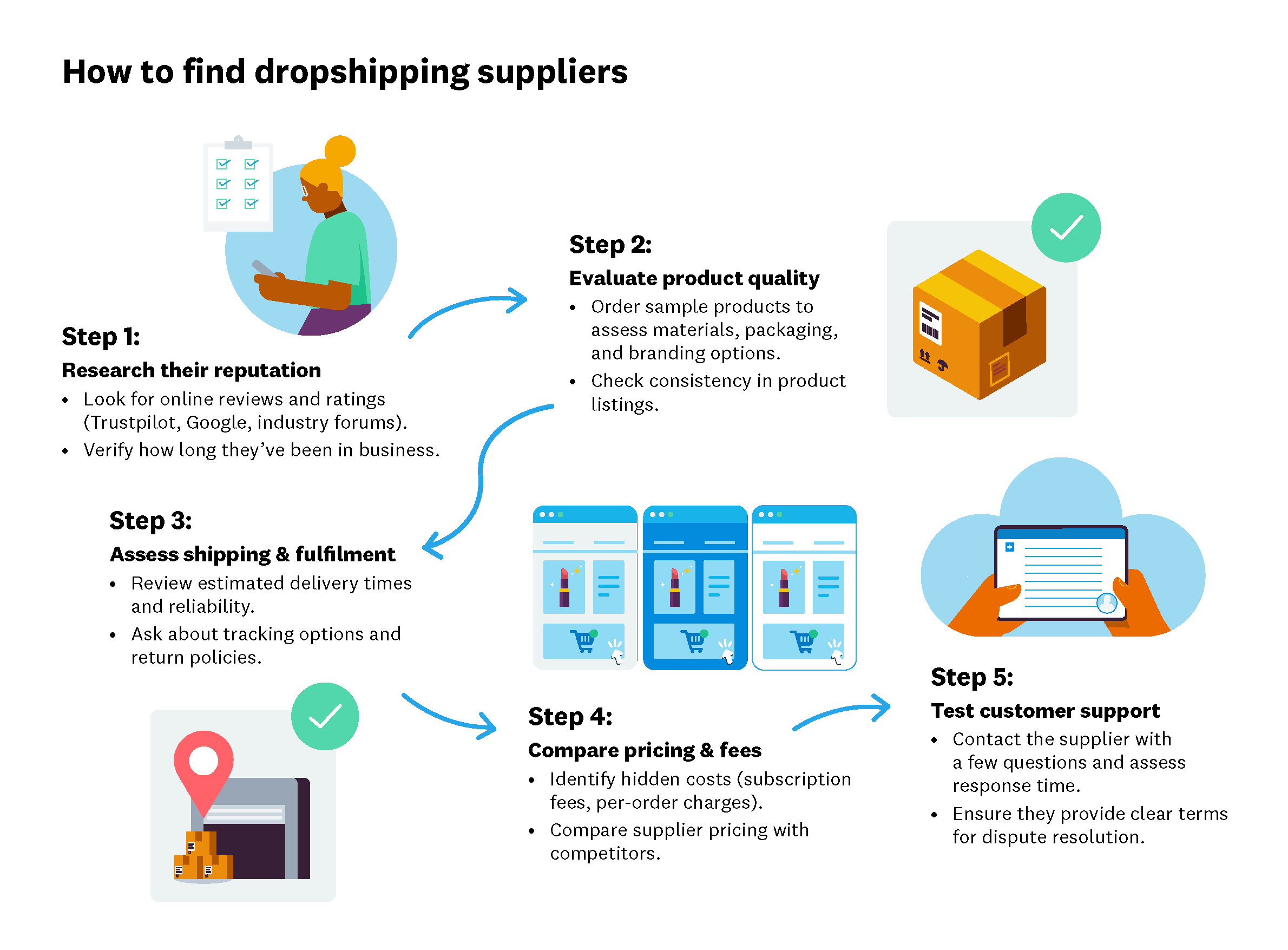
Start with these proven methods:
Online directories:
- Supplier platforms: Search SaleHoo, Spocket, or Alibaba for pre-vetted suppliers.
- Search terms: Use "wholesale dropshipping Australia", "dropshipping suppliers", or "[product] wholesale".
Marketplace research:
- Reverse engineering: Buy from suspected dropshippers and trace return addresses.
- Price sorting: Search Amazon or eBay for lowest prices to identify wholesalers.
- Direct contact: Reach out to high-volume sellers about their suppliers.
Direct outreach:
- Manufacturer websites: Contact companies directly about dropshipping programs.
- Trade shows: Meet suppliers face-to-face to negotiate better terms.
- Industry networks: Join dropshipping communities and forums for recommendations.
Social media research:
- LinkedIn: Search for "wholesale [product]" and "[product] manufacturer".
- Facebook groups: Join dropshipping communities for supplier recommendations.
Tips for contacting and negotiating with dropshipping suppliers
Follow these tips when contacting dropshipping suppliers:
- Research the supplier: Check online reviews for product quality, shipping times, and pricing before entering any deal. This research helps you negotiate better terms.
- Communicate clearly: State your expectations, concerns, and requirements upfront. Ask questions to ensure you create a fair agreement that keeps your customers satisfied.
- Be flexible: Your vision might not align with what's possible for the supplier. Stay firm on core expectations but open-minded about capabilities to find a mutually beneficial solution.
- Build a long-term relationship: Ongoing business can encourage suppliers to offer discounts or additional benefits. In return, recommend their products or refer customers. If you're not ready to commit, suggest a trial period first.
- Consider the supplier's perspective: Acknowledge their profit margins and business model before negotiating. Think about how you can help them reach their goals while meeting your own.
- Be professional: Come prepared with key business figures and information. Be fair and polite with all suppliers, whether you choose to work with them or not.
How to evaluate dropshipping suppliers
Evaluating dropshipping suppliers protects your reputation and keeps customers satisfied. Thorough vetting helps you avoid scams and find reliable partners.
Use this checklist:
Financial verification:
- Business registration: Verify the supplier's legal status by checking their Australian Business Number (ABN), a unique 11-digit identifier.
- Payment terms: Understand fees, minimums, and payment schedules.
- Insurance coverage: Confirm the supplier has liability and product insurance.
Quality assessment:
- Product samples: Order samples to test quality before committing.
- Return policy: Review their process for defective or damaged items.
- Quality certifications: Check for relevant industry standards and certifications.
Operational reliability:
- Response time: Test how quickly they respond to enquiries.
- Shipping speed: Verify actual delivery times to Australian customers.
- Inventory management: Confirm they maintain adequate stock levels.
Red flags to avoid:
- No business address: Avoid suppliers without verifiable physical locations.
- Unrealistic promises: Question claims of extremely low prices or instant shipping.
- Poor communication: Watch for delayed responses or language barriers affecting order accuracy.
Best dropshipping companies in Australia
The best dropshipping companies in Australia offer reliable product quality, fast shipping, and responsive customer service. Below are top options for Australian sellers, with pros and cons for each.
Before choosing, research each supplier by:
- Reading reviews: Check feedback on product quality and delivery times.
- Testing samples: Order products yourself to assess quality.
- Verifying integration: Ensure compatibility with your ecommerce platform.
Here are several dropshipping suppliers and platforms commonly used by Australian sellers:
SaleHoo
SaleHoo is a supplier directory and dropshipping platform based in New Zealand. It offers two main services: a directory of over 8,000 vetted suppliers and a Shopify integration for direct product imports.
Pros
- Access to 2.5 million products
- Over 8,000 pre-vetted suppliers
- Import 500 products on the Basic plan or unlimited on Premium
However, there are some limitations to consider:
Cons
- Limited to two pricing plans: Basic or Premium
- No dedicated onboarding account manager on Basic
- No free trial available
Spocket
Spocket is a dropshipping platform connecting sellers to suppliers filtered by location. You pay only for products sold plus a monthly subscription, with no commission fees.
Pros
- Product samples available to test quality
- Integrations with Shopify, BigCommerce, WooCommerce, and Wix
- Vetted and verified suppliers
- 24/7 chat support on all plans
Keep these limitations in mind:
Cons
- Starter plan limited to 25 unique products
- No direct supplier communication through the platform
AliExpress
AliExpress is a global marketplace owned by Alibaba, offering over 100 million products. It's popular with dropshippers for its product variety and low wholesale prices.
Pros
- No subscription or membership fees
- Compatible with Shopify, WooCommerce, and DSers
- Low wholesale prices for higher profit margins
Be aware of these potential challenges:
Cons
- Significant time needed to research product quality and trends
- Longer delivery times (2–4 weeks) with standard shipping from Asia
- Supplier legitimacy requires individual verification
Colourblocker
Colourblocker is an Australian dropshipping platform based in Sydney, shipping to Australia and New Zealand. Product categories include kitchen and homeware, electronics, and accessories.
Pros
- Quick account approval (within 48 hours)
- No monthly subscription or fulfilment fees
- 48-hour order processing time
- Easy integration with Shopify, WooCommerce, and Amazon
Consider these potential drawbacks:
Cons
- Delivery times up to 10 business days depending on location
- Express shipping limited to wholesale orders
- Restocking fee charged on returns, with return shipping at your cost
DropshipZone
DropshipZone is a Melbourne-based wholesale and dropshipping supplier offering thousands of products across popular categories. It integrates with major ecommerce platforms.
Pros
- Australian-based trusted suppliers
- Free to join with no subscription fees
- Orders processed within 1–3 days
- No minimum order quantities
Here are some limitations to note:
Cons
- Delivery times up to 14 days (19 days in peak season)
- Commission fee charged on successful orders
- More limited product range than some directories
Companies that dropship
Dropshipping companies are online platforms that connect you with verified suppliers and integrate their products with your online store. Popular Australian options include SaleHoo, Spocket, and DropshipZone.
You'll work with two main supplier types:
- Manufacturers: Make products directly but often require bulk orders
- Wholesalers: Buy from manufacturers and offer smaller quantities at higher per-unit costs
Wholesalers typically offer more flexibility for new dropshippers testing products.
Wholesale dropshipping in Australia
Wholesale dropshipping means working directly with wholesalers instead of using supplier directories. Wholesalers buy in bulk from manufacturers and stock large catalogues across multiple brands. This approach offers better profit margins but requires proven product demand.
Consider wholesale dropshipping when you've:
- validated product demand through initial sales
- committed to meeting minimum order quantities
- identified established products where you want higher margins
Wholesale dropshipping offers several advantages:
Benefits:
- Lower costs: Bulk pricing reduces per-unit expenses.
- Better margins: Direct relationships eliminate platform fees.
- No storage needed: Wholesaler handles inventory and shipping.
However, there are some challenges to consider:
Drawbacks:
- Minimum orders: Bulk purchases often required upfront.
- Higher risk: More capital tied up in unproven products.
Managing your dropshipping business finances
Managing your dropshipping finances requires tracking profit margins, managing cash flow, and meeting tax obligations.
Key financial tasks include:
- Tracking margins: Monitor the gap between your selling price and supplier costs.
- Managing cash flow: Balance timing between customer payments and supplier fees.
- Meeting GST obligations: The ATO notes imported goods valued at A$1,000 or less generally don't incur GST at import, but be aware that you must register within 21 days of your turnover exceeding the relevant threshold.
Xero accounting software helps you see sales, costs, and financial performance in real time. Connect your bank accounts and integrate with popular ecommerce apps from the Xero App Store.
Automated bookkeeping means less time on admin and more time growing your business.
Start your dropshipping business with confidence
Finding reliable Australian suppliers sets the foundation for a successful dropshipping business. Start by researching multiple suppliers, ordering samples to test quality, and verifying their business credentials.
Working with more than one supplier reduces risk and gives you flexibility as your business grows. Once you've validated product demand, consider wholesale relationships for better margins.
Strong financial management is just as important as finding good suppliers. Track your margins, manage cash flow between customer payments and supplier costs, and stay on top of GST obligations.
Xero accounting software helps you monitor your dropshipping finances in real time. Connect your bank accounts, integrate with your ecommerce platform, and automate bookkeeping so you can focus on growing sales. Get one month free to see how Xero simplifies your business finances.
FAQs on dropshipping suppliers
Common questions about working with dropshipping suppliers:
How much does it cost to work with dropshipping suppliers?
Costs vary by supplier type. Directory fees range from free (DropshipZone, AliExpress) to $27–$97 per month (SaleHoo, Spocket). You'll also pay product costs and potentially shipping or processing fees.
How long does it take to set up with a supplier?
Setup time depends on the supplier. Some platforms offer instant access, while others take 1–3 business days for account approval. Colourblocker, for example, typically approves accounts within 48 hours.
Can I work with multiple suppliers at once?
Yes, working with multiple suppliers is common and recommended. Benefits include:
- wider product range
- backup options if one supplier runs out of stock
- reduced risk from relying on a single source
What should I do if my supplier stops responding?
Try contacting them through different channels, such as email and phone. If you still get no reply, pause orders from that supplier to protect your customers' experience. This is why working with multiple suppliers is recommended.
Do I need business insurance for dropshipping in Australia?
Business insurance isn't legally required to start dropshipping, but it's highly recommended. Public and product liability insurance protects your business from financial loss if a product causes harm or damage, with industry-wide data monitored through the National Claims and Policies Database.
Is it legal to dropship in Australia?
Yes, dropshipping is legal in Australia. You'll need to register for an ABN, comply with Australian Consumer Law, and collect GST if your GST turnover exceeds $75,000. You're responsible for customer service and returns, even though suppliers handle shipping. Products must meet Australian safety standards.
Disclaimer
Xero does not provide accounting, tax, business or legal advice. This guide has been provided for information purposes only. You should consult your own professional advisors for advice directly relating to your business or before taking action in relation to any of the content provided.
Get one month free
Purchase any Xero plan, and we will give you the first month free.