Marginal cost: how to calculate it (with formula and examples)
Learn the marginal cost formula, how to calculate it step by step, and how to use it to make smarter production and pricing decisions.

Published Monday 11 May 2026
Table of contents
Key takeaways
- Calculate marginal cost by dividing the change in total costs by the change in quantity produced to find out whether expanding output will increase or decrease your profits
- Use marginal cost analysis when evaluating bulk orders, considering production changes, or responding to competitive pricing so you can make informed decisions about profitability
- When your marginal cost is lower than your average cost per unit, you have room to grow profitably, but when marginal cost exceeds average cost, expanding production will likely reduce your overall profit margin
- Compare marginal cost to marginal revenue to find your optimal production level, since your profit is highest when these two figures are equal
What is marginal cost?
Marginal cost is the additional expense of producing one more unit of a product or service. This metric reveals whether expanding production will increase or decrease your profits.
Understanding your marginal cost helps you answer key growth questions:
- How will additional production affect your cash flow?
- How will costs for materials, labour, and overhead shift as output changes?
- Should you adjust your pricing strategy to stay profitable at higher volumes?
Knowing your direct costs is the starting point for any marginal cost calculation, since these costs change with every unit you produce.
What is the marginal cost formula?
The marginal cost formula divides the change in your total production costs by the change in quantity produced. It tells you exactly how much one additional unit costs to make.
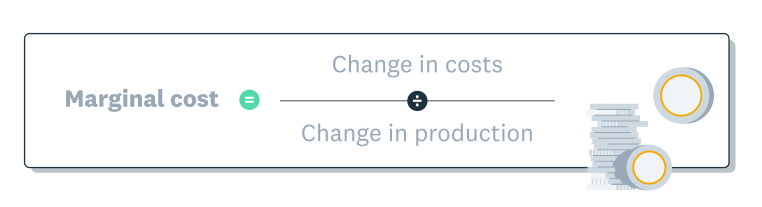
Marginal Cost = Change in Total Cost / Change in Quantity
To use this formula, you need two numbers:
- Change in total cost: how much more it costs to produce additional units
- Change in quantity: the number of extra units you're producing (often one)
For service businesses, "one unit" might mean one additional hour of work or one extra client served.
Marginal cost formula explained
The formula has two parts. Here's what each one means:
- Change in costs: this is the difference between your total production cost at the new quantity versus the original quantity
- Change in quantity: this is the number of additional units you produce
Marginal cost example
Mohammed's bakery illustrates how the formula works in practice.
Mohammed currently makes 100 cakes at a total cost of $1,000 ($10 per cake). If he makes one additional cake, his total costs rise to $1,005.
Step 1: Calculate the change in total cost. $1,005 minus $1,000 = $5.
Step 2: Calculate the marginal cost. $5 / 1 = $5 per additional cake.
Mohammed's marginal cost ($5) is lower than his average cost ($10). Producing one more cake costs less than his typical per-unit expense, so expanding production could increase his profit.
How to calculate marginal cost
Calculating your marginal cost takes four steps. You'll need access to your cost records to pull accurate figures.
Step 1: Determine your current total production costs
Add up all expenses for your current output level, including materials, labour, and variable overheads. This gives you the baseline figure you'll measure changes against.
Step 2: Calculate total costs at increased production
Estimate what your costs would be if you produced additional units. Factor in any changes to material prices, labour hours, or energy consumption at the higher output level.
Step 3: Find the change in total cost
Subtract your current costs from your projected costs at the higher production level. This difference represents the additional expense of producing more units.
Step 4: Divide by the change in quantity
Divide the cost difference by the number of additional units to get your marginal cost per unit. This final figure tells you whether expansion makes financial sense.
Worked example: t-shirt printing business
Here's a second example to show how the steps work together.
A t-shirt printing business currently produces 200 shirts at a total cost of $1,600. The owner wants to know the marginal cost of increasing production to 250 shirts, where total costs rise to $1,925.
- Current total cost: $1,600 for 200 shirts
- New total cost: $1,925 for 250 shirts
- Change in total cost: $1,925 minus $1,600 = $325
- Change in quantity: 250 minus 200 = 50 shirts
Marginal cost = $325 / 50 = $6.50 per shirt.
Each additional shirt beyond 200 costs $6.50 to produce. If the selling price is above $6.50 per shirt, increasing production to 250 units adds to the business's profit.
What are the main components of marginal cost?
Marginal cost components fall into two categories: variable costs that change with output and fixed costs that stay constant regardless of how many units you produce.
Variable costs increase as you produce more units:
- Raw materials and supplies
- Hourly wages and overtime pay
- Energy and utility bills tied to production
- Packaging and shipping per unit
Fixed costs remain the same regardless of output:
- Equipment and machinery
- Building rent or mortgage
- Salaried employee wages
- Insurance and loan repayments
When you increase production, your fixed costs spread across more units. This reduces your average cost per unit, which is why marginal cost often falls below average cost at higher volumes.
Why marginal cost matters to your business
Marginal cost directly affects your pricing, production, and profitability decisions. Without this number, you're guessing whether growth will help or hurt your bottom line.
Understanding your marginal cost helps you:
- set optimal prices by finding the point where customers will pay while you still maximise revenue
- decide production levels by knowing exactly when producing more units increases profit versus when it erodes margins
- evaluate special orders by determining whether accepting a bulk order at a discount makes financial sense
- allocate resources efficiently by identifying which products deserve more investment based on their marginal profitability
- avoid costly mistakes by preventing scenarios where higher production actually increases your average costs
When your marginal cost is lower than your average cost, you have room to grow profitably. When marginal cost exceeds average cost, expanding production will likely reduce your overall profit margin.
When to use marginal cost analysis
Marginal cost analysis is most valuable when you're facing specific business decisions about production, pricing, or growth. For day-to-day pricing on stable product lines, your average cost may be sufficient, but for growth decisions and special opportunities, marginal cost gives you the precision you need.
Use marginal cost analysis when you:
- evaluate bulk orders: a customer wants 500 units at a 15% discount and you need to know if you'll still profit
- consider expanding: you're thinking about increasing regular production and need to know if extra units will cost more or less than your current average
- compare product lines: you want to determine which products generate the best return when you scale up
- respond to competition: a competitor dropped prices and you need to know if you can match them and still make money
- plan for seasonal changes: demand spikes in December and you need to decide whether to ramp up production or outsource
Marginal revenue vs marginal cost
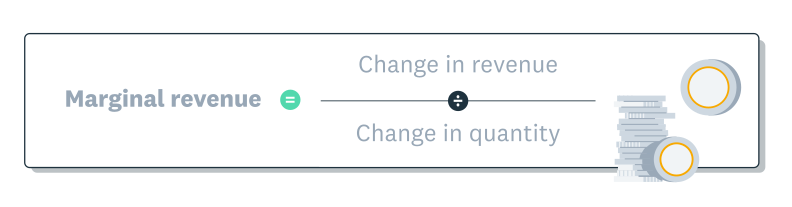
Marginal revenue is the additional income from selling one more unit, while marginal cost is the additional expense of producing it. Together, these two metrics show whether expanding production will increase your profit.
The marginal revenue formula is:
Marginal Revenue = Change in Total Revenue / Change in Quantity
Your profit is highest when marginal cost equals marginal revenue. Beyond this point, each additional unit costs more to make than it earns, reducing your overall profit. This happens because increased supply can lower demand, forcing you to reduce prices to sell more units.
Example: Alison's wallet business
Alison sells wallets at a market stall for $30 each. She has surplus stock she could sell to another vendor across town for $20 per wallet.
Her marginal revenue would be $20 per wallet. If her marginal cost is $22 (including transport), she loses $2 on each sale.
She has several options to make this profitable:
- negotiate a higher wholesale price for a larger order
- find a vendor closer to her location to reduce transport costs
- switch to a cheaper delivery method
By comparing marginal revenue to marginal cost, Alison can see exactly what needs to change to make the deal worthwhile.
The marginal cost curve
The marginal cost curve is a U-shaped graph that shows how the cost of producing one additional unit changes as total output increases. Understanding its shape helps you identify the most efficient level of production for your business.
Why marginal cost initially falls
At lower production levels, marginal cost tends to decline. This happens because of economies of scale:
- Fixed costs like rent, equipment, and salaried staff spread across more units
- Workers become more skilled and efficient through repetition
- You can buy raw materials in larger quantities at lower per-unit prices
- Production processes become smoother as you refine workflows
During this phase, each additional unit costs less to produce than the one before it. The downward slope of the curve reflects these efficiency gains.
The turning point
At a certain output level, marginal cost reaches its lowest point. This is the most efficient level of production, where you're getting the most value from your resources.
Beyond this point, the curve begins to rise. The turning point signals that your current resources are being stretched to their capacity.
Why marginal cost rises at higher output
As production continues to increase past the efficient point, diminishing returns set in and costs climb:
- Machinery runs at full capacity, requiring overtime or additional shifts
- Workers become fatigued, reducing productivity
- You may need to source materials from more expensive suppliers
- Facilities become crowded, slowing down workflows
- Quality control becomes harder to maintain, increasing waste
The upward slope of the curve shows that each additional unit now costs more than the previous one. Recognising where your business sits on this curve helps you decide when to expand production and when to hold steady.
Limitations of marginal cost analysis
Marginal cost analysis is a useful tool, but it relies on assumptions that don't always hold in practice. Being aware of these limitations helps you use the analysis more effectively.
The main limitations include:
- Clean separation of costs is rarely straightforward: the formula assumes you can neatly divide costs into fixed and variable categories, but many real-world expenses fall somewhere in between. Utility bills, for example, have a fixed base charge plus a variable component that rises with production
- Demand isn't always predictable: marginal cost analysis assumes you can sell every additional unit you produce. In practice, market demand fluctuates based on seasonality, competition, and consumer preferences, meaning producing more doesn't always lead to more sales
- Costs don't always behave in a straight line: the formula works best when cost increases are proportional to output changes. At scale, costs can jump in steps rather than rising smoothly, such as when you need to lease a second warehouse or hire an entire new shift of workers
- Short-run results may not reflect long-run reality: marginal cost calculations capture a snapshot of current conditions. Over time, factors like supplier pricing, wage growth, and technology changes can shift your cost structure significantly
Treat marginal cost as one input in your decision-making, not the only one. Pair it with other financial metrics and your knowledge of market conditions to get a fuller picture.
Simplify your cost tracking with Xero
Tracking the costs you need for marginal cost calculations is easier with the right tools. Xero accounting software automatically records your expenses and revenue in real time, so you always have accurate numbers for your calculations.
With cloud-based access and customisable reports, you can monitor your costs from anywhere and share insights with your accountant instantly. Get one month free and see how simpler cost tracking can support smarter production decisions.
FAQs on marginal cost
Here are answers to frequently asked questions about marginal cost.
What is the marginal cost curve?
The marginal cost curve is a U-shaped graph that plots the cost of producing each additional unit against total output. It declines at first due to economies of scale, then rises as diminishing returns push per-unit costs higher.
How does marginal cost relate to economies of scale?
As production increases from a low base, economies of scale reduce your marginal cost because fixed expenses spread across more units and bulk purchasing lowers material prices. Once you exceed your efficient capacity, these benefits fade and marginal cost begins to rise.
What causes marginal cost to increase?
Marginal cost increases when you hit capacity limits, pay overtime wages, or source materials from more expensive suppliers. Major jumps often occur when you need new equipment, additional facilities, or extra staff to sustain higher output.
What's the difference between marginal cost and average cost?
Marginal cost measures the expense of producing one additional unit, while average cost divides your total costs by all units produced. When marginal cost sits below average cost, each new unit pulls the average down; when it sits above, each new unit pushes the average up.
How does marginal cost relate to my profit margin?
Each unit you produce adds to your profit as long as the selling price exceeds the marginal cost. Monitoring the gap between selling price and marginal cost alongside your gross profit margin shows you exactly how much each extra sale contributes to your bottom line.
Learn more about marginal cost
Explore these related guides for more on managing costs and pricing:
Disclaimer
Xero does not provide accounting, tax, business or legal advice. This guide has been provided for information purposes only. You should consult your own professional advisors for advice directly relating to your business or before taking action in relation to any of the content provided.
Get one month free
Purchase any Xero plan, and we will give you the first month free.