Financial statements: what they are and how to read
Learn how financial statements help you track performance and make better business decisions.
Written by Jotika Teli—Certified Public Accountant with 24 years of experience. Read Jotika's full bio
Published Monday 20 April 2026
Table of contents
Key takeaways
- Review all four financial statements together (balance sheet, income statement, cash flow statement, and statement of changes in equity) rather than focusing on profit alone, as a profitable business can still fail if it runs out of cash to pay bills and suppliers.
- Distinguish between revenue recorded on your income statement and actual cash in your bank account, as unpaid invoices can create dangerous cash flow gaps even when your business looks profitable on paper.
- Calculate key financial ratios like the current ratio, quick ratio, and debt-to-equity ratio using your balance sheet data to assess your business's ability to cover short-term obligations and maintain long-term financial stability.
- Compare your financial statements across multiple periods to spot trends in revenue growth, expense patterns, and cash flow cycles, so you can identify problems early and make decisions based on facts rather than guesswork.
Key takeaways
• Review all four financial statements together (balance sheet, income statement, cash flow statement, and statement of changes in equity) rather than focusing solely on profit. A profitable business can still fail if it runs out of cash to pay bills and suppliers.
• Calculate key financial ratios like the current ratio, quick ratio, and debt-to-equity ratio using your balance sheet data. These ratios help you assess your business's liquidity and ability to cover short-term obligations and long-term financial stability.
• Compare your financial statements across multiple periods to identify trends in revenue growth, expense patterns, and cash flow cycles. This enables you to spot opportunities for improvement and make data-driven strategic decisions.

• Distinguish between revenue recorded on your income statement and actual cash in your bank account. Customers may not have paid their invoices yet, which can create dangerous cash flow gaps even when your business appears profitable on paper.
What is a financial statement?
Financial statements are formal reports that summarise your business's financial activities over a specific period. The Australian Taxation Office (ATO) requires you to keep most records like these for at least five years. They show how much money came in, where it went, and what's left. Use them to track profitability, monitor cash flow, and make informed decisions about your business.
Prepare financial statements for different periods depending on your needs:
- monthly: monitor day-to-day performance and catch issues early
- quarterly: analyse seasonal patterns and update investors
- annually: meet tax obligations and review overall business health
Lenders and investors use these statements to evaluate your business's financial health and growth potential. Depending on the company type, regulators may enforce a strict lodgement deadline for these reports.
Types of financial statements
Understanding the different types of financial statements helps you see how they work together to give you a complete picture of your business.
The four main types of financial statements work together to give you a complete picture of your business's financial health. Official standards dictate that a complete set also includes comparative information from preceding periods:
- balance sheet: compares what you own against what you owe at a specific point in time
- income statement (profit and loss): tracks revenue and expenses to calculate your profit or loss
- cash flow statement: monitors cash moving in and out of your business
- statement of changes in equity: shows how much profit stays in the business after costs and dividends
Each statement provides specific insights into different aspects of your financial position.
Balance sheet
A balance sheet shows your business's financial position at a specific moment in time. It compares what you own against what you owe to calculate your equity. You can download a free balance sheet template to get started.
What you own (assets):
- cash and bank accounts
- inventory and stock
- equipment and machinery
- property and buildings
- intellectual property and patents
What you owe (liabilities):
- loans and mortgages
- accounts payable
- credit card debt
- tax obligations
Equity is the difference between assets and liabilities. It shows your business's true value and helps you assess financial stability.
Income statement / profit and loss statement
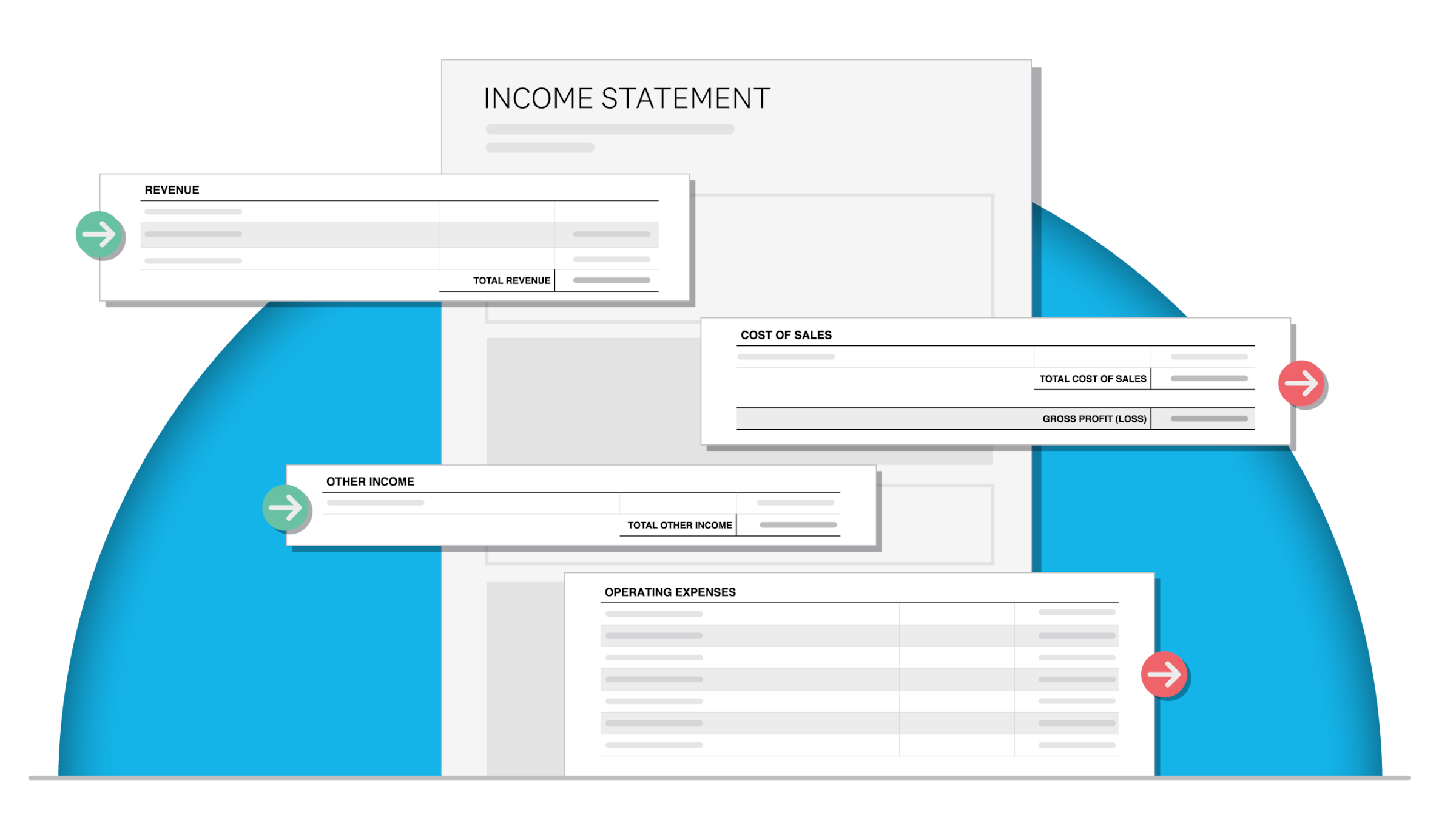
The income statement shows your revenue and expenses over a specific period. Upcoming accounting standards will require these to be classified into defined categories like operating, investing, and financing. Subtract total expenses from revenue to find your net income (profit or loss). Download a free income statement template to see how it works.
For example, a manufacturing business might report:
- $150,000 in revenue
- $50,000 in operating expenses (office hire, utilities)
- $70,000 in cost of sales (materials, labour)
Net income: $150,000 − $50,000 − $70,000 = $30,000 profit
Cash flow statement
The cash flow statement tracks cash moving in and out of your business over a specific period. It shows whether you have enough cash to cover short-term expenses like bills and payroll. Use a free cash flow statement template to structure yours.
The statement records three types of activity:
- operating activities: cash from customer sales and day-to-day business
- investing activities: cash spent or received from buying or selling assets like equipment
- financing activities: cash from loans, investments, or dividend payments
Statement of changes in equity

The statement of changes in equity (also called owner's equity, shareholder's equity, or retained earnings) shows how much profit your business keeps after paying costs and dividends.
-calculation-2.1708626946541.png)
You might retain earnings to:

- repay debt
- reinvest in growth
- build a cash reserve
How to read financial statements
Reading financial statements helps you understand what the numbers actually mean for your business. Follow these four steps to interpret your reports with confidence.
- Start with the income statement to see profitability
The income statement answers one question: did you make money this period? Look at the bottom line first. If net income is positive, you made a profit. If it's negative, you made a loss.
Work backwards from there:
- revenue: total money earned from sales
- cost of goods sold: direct costs to deliver your product or service
- gross profit: revenue minus cost of goods sold
- operating expenses: rent, wages, utilities, marketing
- net income: what's left after all expenses
- Review your balance sheet to understand financial position
The balance sheet shows what you own, what you owe, and what's left over (equity) at a specific point in time. Check three things:
- assets: do you have enough cash and receivables to cover upcoming bills?
- liabilities: how much do you owe, and when is it due?
- equity: is your business worth more or less than last period?
If liabilities exceed assets, your business has negative equity. That's a warning sign.
- Check your cash flow statement to see liquidity
The cash flow statement shows whether you have enough cash to operate. A profitable business can still run out of cash if customers pay late or you've invested heavily in stock.
Focus on operating cash flow first. If it's consistently negative, your core business isn't generating enough cash to sustain itself, regardless of what your income statement shows.
- Compare statements across periods to spot trends
Single statements show a snapshot. Comparing statements over time reveals trends. Look for:
- rising revenue with flat profit: costs may be growing faster than sales
- positive profit with negative cash flow: you may have collection or inventory issues
- declining equity: the business may be using reserves to cover losses
Review at least three periods side by side to identify patterns worth investigating.
Why financial statements are important for small businesses
-calculation-2.1708626946541.png)
Financial statements matter because they show you your business's financial health clearly. Without them, you're making decisions in the dark.
When you understand your statements, you can:
- assess financial health: track profitability, cash flow, and equity in one place
- attract funding: provide lenders and investors with the financial proof they need to back your business
- make informed decisions: base your strategy on facts rather than guesswork
- identify problems early: spot cash flow gaps or rising costs before they become critical
- plan for growth: understand what resources you have available to invest in expansion
FAQs on financial statements
Here are answers to common questions about financial statements and how to use them effectively.
What's the difference between a balance sheet and an income statement?
A balance sheet shows what you own and owe at a specific point in time, while an income statement shows your revenue and expenses over a period. The balance sheet is like a snapshot, whereas the income statement is like a film showing performance over time.
How often should I review my financial statements?
Review your financial statements monthly to monitor day-to-day performance and catch issues early. For strategic planning, compare quarterly and annual statements to identify trends and seasonal patterns.
Can a profitable business run out of cash?
Yes. Profit on your income statement doesn't always mean cash in the bank. If customers haven't paid their invoices yet or you've invested heavily in inventory, you can show a profit but still struggle to pay bills.
Do I need all four financial statements?
Yes. Each statement provides different insights into your business. The balance sheet shows your position, the income statement shows profitability, the cash flow statement shows liquidity, and the statement of changes in equity shows what you're retaining for growth.
What financial ratios should I calculate from my statements?
Start with the current ratio (current assets divided by current liabilities) to assess short-term liquidity, the quick ratio to measure immediate cash availability, and the debt-to-equity ratio to understand your financial leverage.
Disclaimer
Xero does not provide accounting, tax, business or legal advice. This guide has been provided for information purposes only. You should consult your own professional advisors for advice directly relating to your business or before taking action in relation to any of the content provided.
Get one month free
Purchase any Xero plan, and we will give you the first month free.