Margin vs markup
Understand the difference between margin and markup to price your products with confidence.
Published Thursday 23 July 2026
Table of contents
Key takeaways
- Margin measures profit as a percentage of revenue (the selling price), while markup measures profit as a percentage of cost.
- A 50% markup does not equal a 50% margin; a 50% markup actually gives you a 33.3% margin.
- Markup is typically used when setting prices, while margin is used for financial reporting, benchmarking, and tracking profitability.
- For the same sale, the markup percentage is always higher than the margin percentage because cost is always less than revenue.
What is margin?
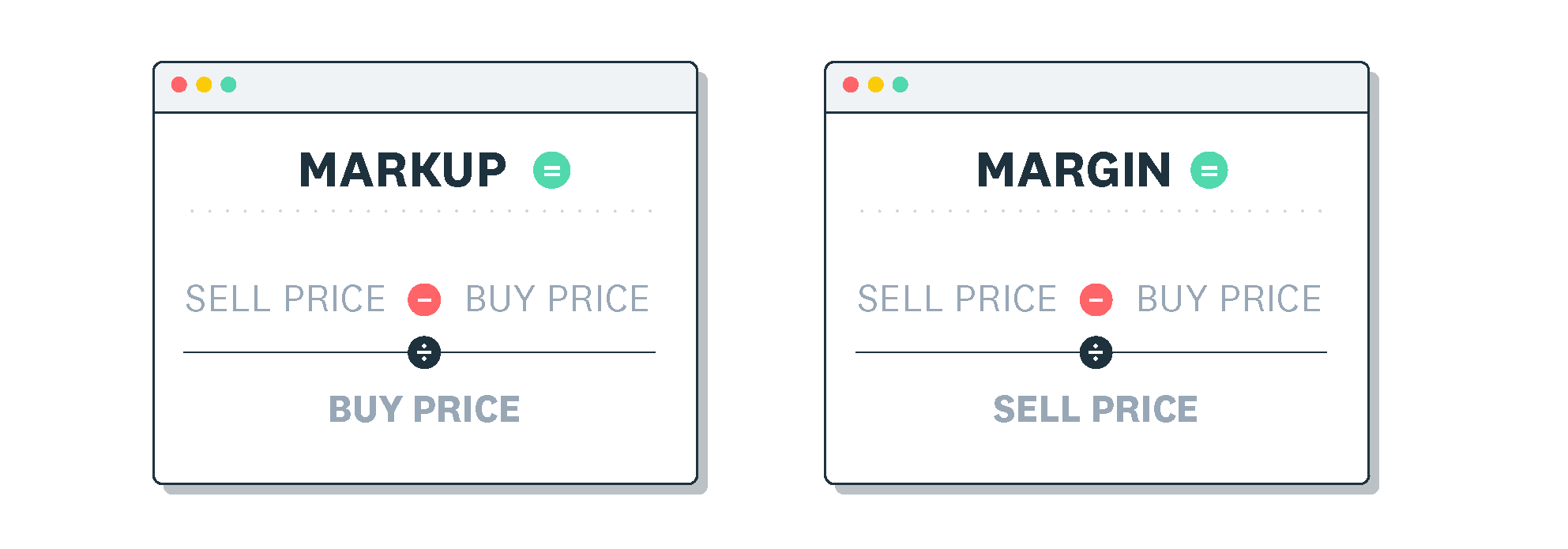
Margin, often called gross profit margin, is the percentage of your selling price that counts as profit after covering the cost of goods sold (COGS). It tells you how much of every dollar in revenue you actually keep.
The formula for margin is:
- Margin = (Revenue - COGS) / Revenue x 100
Here is how it works with real numbers. Say you buy a product for $100 and sell it for $130. Your profit is $30. To find the margin, divide $30 by the selling price of $130 and multiply by 100.
- Margin = ($130 - $100) / $130 x 100 = 23.1%
That means 23.1% of your revenue from this sale is profit.
What is markup?
Markup is the percentage you add on top of your cost to arrive at a selling price. It shows how much more you charge compared to what you paid.
The formula for markup is:
- Markup = (Revenue - COGS) / COGS x 100
Using the same example, you buy a product for $100 and sell it for $130. Your profit is still $30. To find the markup, divide $30 by the cost of $100 and multiply by 100.
- Markup = ($130 - $100) / $100 x 100 = 30%
That means you marked up the product by 30% above your cost.
Margin vs markup: what is the difference?
Both margin and markup describe profit, but they use a different base for the calculation. The core difference is the denominator: margin divides by revenue, while markup divides by cost. This single distinction is why the two percentages are never the same for a given sale.
Here is how margin and markup compare:
- Margin uses the selling price (revenue) as the base; markup uses the cost as the base
- Margin tells you what portion of revenue is profit; markup tells you how much you added on top of cost
- Margin is always lower than markup for the same sale, because revenue is always larger than cost
- A 30% markup on a $100 cost gives a $130 price and a 23.1% margin
- Markup is typically used for pricing decisions; margin is used for financial reporting
The key takeaway: markup is always higher than margin for the same sale. If someone quotes a single percentage without specifying which measure they mean, you could end up with very different profit expectations.
How to calculate margin and markup
Calculating both margin and markup is straightforward once you know the cost and selling price. Walk through these steps to get comfortable with each formula.
How to calculate margin
Follow these steps to find your gross profit margin on any product or service.
- Start with your selling price (revenue). For this example, use $150.
- Subtract your cost of goods sold (COGS). If the product costs $100, your gross profit is $150 - $100 = $50.
- Divide the gross profit by the selling price: $50 / $150 = 0.333.
- Multiply by 100 to get the percentage: 0.333 x 100 = 33.3% margin.
How to calculate markup
Follow these steps to find the markup on the same product.
- Start with your cost of goods sold (COGS). In this example, that is $100.
- Subtract the cost from the selling price to get the gross profit: $150 - $100 = $50.
- Divide the gross profit by the cost: $50 / $100 = 0.50.
- Multiply by 100 to get the percentage: 0.50 x 100 = 50% markup.
Notice how the same $50 profit produces a 33.3% margin but a 50% markup. The difference comes entirely from the denominator you use.
Markup to margin conversion chart
Converting between markup and margin saves you from recalculating every time you set a price or review a financial report. Use the common conversions below as a quick reference.
- 15% markup = 13% margin
- 20% markup = 16.7% margin
- 25% markup = 20% margin
- 33.3% markup = 25% margin
- 50% markup = 33.3% margin
- 75% markup = 42.9% margin
- 100% markup = 50% margin
You can also convert between the two using these formulas:
- Margin = Markup / (1 + Markup)
- Markup = Margin / (1 - Margin)
In these formulas, enter the percentage as a decimal. For example, to convert a 50% markup to margin: 0.50 / (1 + 0.50) = 0.333, or 33.3% margin.
When to use margin vs markup
Knowing when to apply markup vs margin helps you make better pricing and reporting decisions. Each serves a different purpose in your business.
When to use markup
Markup is your go-to for setting prices. When you know what a product costs and want to determine a selling price that hits your profit target, start with markup. It answers the question: "How much do I add on top of my cost?"
For example, if your cost is $80 and you want a 50% markup, your selling price is $80 + ($80 x 0.50) = $120.
When to use margin
Margin is the standard for financial reporting and profitability analysis. Investors, lenders, and accountants evaluate your business using margin because it shows how efficiently you turn revenue into profit.
Use margin when comparing your profitability to industry benchmarks, preparing financial statements, or evaluating whether your current pricing strategy is sustainable.
Common mistakes when using margin and markup
Mixing up margin and markup is one of the most common pricing errors small business owners make. Here are the mistakes to watch for.
Confusing margin and markup
The most frequent mistake is treating margin and markup as interchangeable. If you set a price using a 30% markup but believe you have a 30% margin, you actually have a 23.1% margin. Over time, this error can significantly reduce your expected profit.
Assuming equal percentages mean equal profit
A 25% margin and a 25% markup do not produce the same dollar profit. A 25% margin on a $100 sale means $25 in profit. A 25% markup on an $80 cost also means a $100 sale and $20 in profit. Always clarify which percentage you are working with before making decisions.
Forgetting overhead when calculating net margin
Gross margin only accounts for the direct cost of goods sold. It does not include rent, salaries, utilities, marketing, or other operating expenses. If you rely solely on gross margin to judge profitability, you might overlook overhead costs that eat into your actual earnings. Factor in all expenses to get a clearer picture of your net profit margin.
Simplify your finances with Xero
Tracking margin, markup, and overall profitability is easier when your financial data is organized in one place. Xero's cloud-based accounting software gives you real-time visibility into your revenue, costs, and profit margins so you can make confident pricing decisions.
With customizable reports and automatic bank reconciliation, you can spend less time on manual calculations and more time growing your business. Get one month free.
FAQs on margin vs markup
Here are answers to some of the most common questions about margin and markup.
Is a 50% markup the same as a 50% margin?
No. A 50% markup means you add half the cost on top of your cost price, resulting in a 33.3% margin. A 50% margin means half of your selling price is profit, which requires a 100% markup.
How do you convert markup to margin?
Divide the markup percentage (as a decimal) by 1 plus the markup. For example, a 25% markup converts to 0.25 / 1.25 = 0.20, or a 20% margin.
Why is markup always higher than margin?
Markup divides profit by cost, and margin divides profit by revenue. Since revenue is always greater than cost (assuming a profitable sale), dividing by the smaller number (cost) produces a larger percentage.
What is a good profit margin for a small business?
It depends on your industry. Retail businesses often see gross margins between 25% and 50%, while service-based businesses can reach 50% to 70%. Check industry benchmarks to see how your margins compare.
Should I use markup or margin for pricing?
Use markup when you are setting prices, because it builds directly on your cost. Use margin when you are reviewing profitability, comparing performance, or preparing financial reports.
Related terms
Explore related accounting and financial terms in the Xero glossary.
Learn more about margin vs markup
Dive deeper into pricing, profitability, and financial management with these Xero resources.
Handy resources
Advisor directory
You can search for experts in our advisor directory
Xero Small Business Guides
Discover resources to help you do better business
Financial reporting
Keep track of your performance with accounting reports
Disclaimer
This glossary is for small business owners. The definitions are written with their requirements in mind. More detailed definitions can be found in accounting textbooks or from an accounting professional. Xero does not provide accounting, tax, business or legal advice.