What is an accounting period?
Learn what accounting periods are, their types, and how to pick the right one for your business.
Published Thursday 23 July 2026
Table of contents
Key takeaways
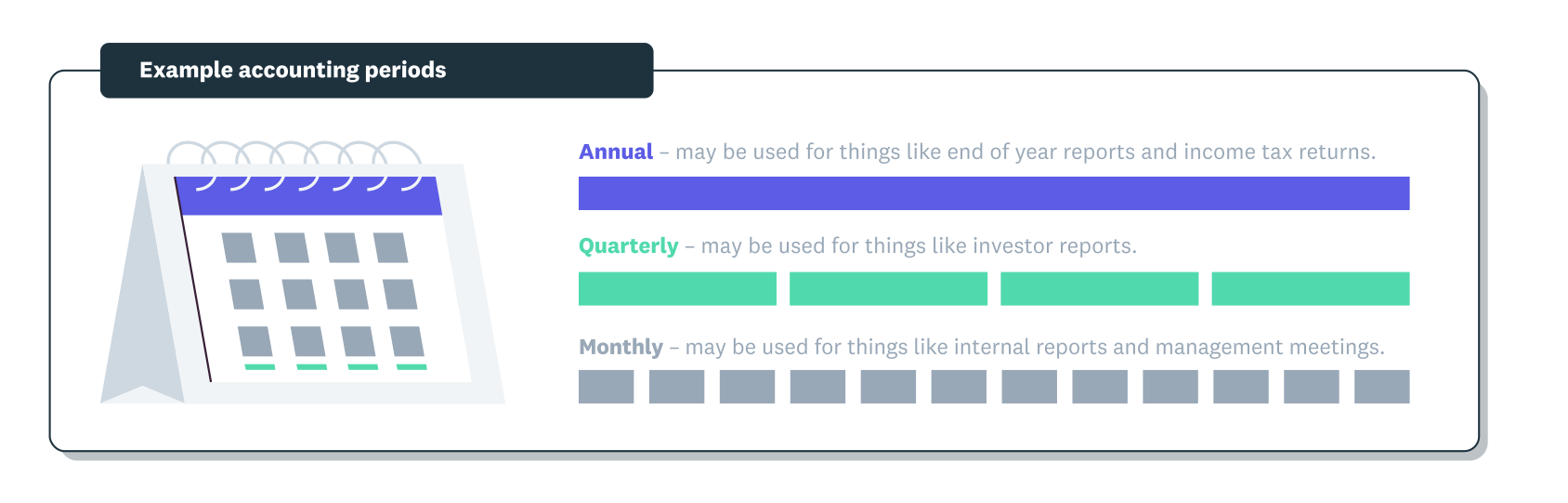
Annual accounting periods don’t have to start in January. Nor do monthly accounting periods have to start on the first of the month.
- An accounting period is a set timeframe your business uses to record, report, and analyze financial activity, typically covering a month, quarter, or year.
- The most common types are the calendar year (January to December), fiscal year (any 12-month cycle), quarterly periods, and monthly periods.
- Choosing the right accounting period depends on your industry's seasonal patterns, tax filing requirements, and how often you need financial updates.
- At the end of each accounting period, you'll close your books, prepare financial statements, and use those results to plan your next steps.
What is an accounting period?
An accounting period is a specific timeframe during which your business records and reports all of its financial transactions. It creates a consistent window for measuring revenue, expenses, and overall performance as part of your small business accounting process.
Most businesses use 12-month accounting periods, but shorter intervals like quarters or months also count. The key requirement is consistency: once you select an accounting period, you should use the same cycle each year so your financial data stays comparable over time.
Accounting periods form the foundation of your financial statements, including your income statement, balance sheet, and cash flow statement. Without a defined period, there's no reliable way to track whether your business is growing, shrinking, or staying steady.
Why accounting periods matter for your business
Accounting periods give your financial data structure and meaning. They let you compare performance from one period to the next, spot trends, and make informed decisions about spending, pricing, and growth.
Here are some of the reasons accounting periods matter for small businesses:
- Track performance by comparing revenue and expenses across consistent timeframes
- Prepare accurate tax returns by aligning your records with IRS filing deadlines
- Satisfy lender and investor requirements for organized financial reporting
- Identify seasonal patterns in your cash flow so you can plan ahead
- Simplify budgeting and forecasting by working with predictable reporting cycles
If you're applying for a loan, seeking investors, or filing taxes, having clearly defined accounting periods shows that your finances are well organized. Lenders and tax authorities expect to see financial statements tied to specific date ranges.
Types of accounting periods
Businesses can choose from several types of accounting periods depending on their reporting needs. Here are the 4 most common options for small businesses.
Calendar year
A calendar year accounting period runs from January 1 through December 31. It's the most straightforward option and the default for most small businesses in the US.
This period works well if your business doesn't have strong seasonal cycles. It also aligns with the standard IRS tax year, which simplifies filing. Most sole proprietors and partnerships use the calendar year because the IRS requires it unless you apply for a fiscal year exception.
Fiscal year
A fiscal year is any 12-month period that doesn't follow the standard January-to-December calendar. For example, a fiscal year might run from July 1 through June 30 or from October 1 through September 30.
Businesses with strong seasonal revenue often prefer a fiscal year. A ski resort, for instance, might end its fiscal year in spring after peak season wraps up, giving a clearer picture of annual performance. If you want to use a fiscal year for tax purposes, you'll need to file IRS Form 1128 to request the change.
Quarterly period
A quarterly accounting period divides the year into 4 equal segments of 3 months each. Many businesses use quarters for internal reporting even if they file taxes annually.
Quarterly periods are especially useful if you make estimated tax payments to the IRS. They also help you catch financial problems early, since you're reviewing your numbers every 3 months instead of waiting until year-end.
These quarterly snapshots can reveal meaningful shifts. According to Xero Small Business Insights, US small business sales growth reached +4.1% year-over-year in Q3 2025 before slowing to +0.9% in Q4; a pattern only visible when comparing one accounting period to the next.
Monthly period
A monthly accounting period closes your books every month, giving you the most frequent view of your financial position. This is common for businesses with high transaction volumes or tight cash flow.
Monthly periods work best when you need to track expenses closely or report to stakeholders regularly. The tradeoff is more administrative work each month, but cloud accounting software can automate much of the closing process.
How to choose the right accounting period
Selecting the right accounting period comes down to matching your reporting cycle with your business's rhythm. There's no single best option; the right choice depends on a few practical factors.
Consider these when deciding on your accounting period:
- Seasonality: if your revenue peaks at a certain time of year, choose an accounting period that captures a full business cycle so your results aren't skewed
- Tax requirements: sole proprietors and most partnerships must use the calendar year; corporations have more flexibility to choose a fiscal year
- Reporting frequency: if you need regular financial updates for investors or lenders, quarterly or monthly periods add more checkpoints
- Industry norms: some industries have standard fiscal years; retail businesses often end in January after the holiday rush, and government contractors commonly use an October-to-September cycle
- Administrative capacity: shorter periods mean more frequent closings, so make sure you have the time or tools to manage the workload
If you're just starting out, the calendar year is usually the simplest choice and pairs well with a straightforward accounting system. You can always request a change later by filing the appropriate forms with the IRS, though switching mid-stream takes some extra paperwork.
Key accounting principles for accounting periods
Several core accounting principles shape how you record transactions within each accounting period. Understanding these helps you keep your books accurate and compliant.
Accrual method of accounting
The accrual method records revenue when you earn it and expenses when you incur them, regardless of when cash changes hands. This approach gives you a more complete picture of your financial position within each accounting period.
For example, if you deliver a service in March but don't receive payment until April, the accrual method records that revenue in March. This matters because it keeps your income statement aligned with the period where the work actually happened.
Revenue recognition
The revenue recognition principle says you should record revenue in the accounting period when you've fulfilled your obligation to the customer. You don't wait until the cash arrives, and you don't record it before you've delivered.
This principle is especially relevant if you offer subscriptions, long-term contracts, or milestone-based projects. Each accounting period should reflect only the revenue you've actually earned during that window.
Matching principle
The matching principle requires you to record expenses in the same accounting period as the revenue they helped generate. This gives you an accurate view of profitability for each period.
If you spend $2,000 on materials in June to complete a project that earns $8,000 in June, both the cost and the income belong in the same period. Mismatching them would distort your profit margins and make it harder to see how your business is really performing.
What happens at the end of an accounting period?
At the end of each accounting period, you close your books by recording final adjustments and preparing your financial statements. This process ensures your records are accurate and ready for analysis or filing.
End-of-period tasks typically include:
- Reconciling your bank accounts to confirm all transactions are recorded
- Making adjusting entries for prepaid expenses, depreciation, and accrued revenue
- Closing temporary accounts like revenue and expenses so they reset for the next period
- Preparing your income statement, balance sheet, and cash flow statement
- Reviewing your results to inform budgets and plans for the upcoming period
For small businesses, the closing process doesn't have to be overwhelming. Automated reporting tools can help handle much of the heavy lifting, from bank reconciliation to generating financial statements.
Simplify your accounting with Xero
Managing your accounting periods is simpler when your financial data is organized in one place. Xero's cloud accounting software helps automate bank reconciliation, tracks expenses in real time, and generates customizable financial reports so you can close each period with confidence.
Whether you're running monthly, quarterly, or annual accounting periods, Xero helps you stay on top of your numbers without the manual busywork. Get one month free.
FAQs on accounting periods
Here are some frequently asked questions about accounting periods.
Is an accounting period always 12 months?
No, an accounting period can be any consistent timeframe. While 12 months is the most common choice for annual reporting and tax filing, businesses also use quarterly (3-month) and monthly periods for internal tracking.
What is the difference between a fiscal year and a calendar year?
A calendar year always runs from January 1 to December 31. A fiscal year is any 12-month period you choose, such as April 1 to March 31, and it doesn't need to follow the calendar.
Can a business change its accounting period?
Yes, but you'll typically need IRS approval. You can request a change by filing Form 1128, and you may need to file a short-period return covering the gap between your old and new cycle.
Disclaimer
This glossary is for small business owners. The definitions are written with their requirements in mind. More detailed definitions can be found in accounting textbooks or from an accounting professional. Xero does not provide accounting, tax, business or legal advice.