How to calculate net profit margin
Learn what net profit margin is, how to calculate it and what a good margin looks like for your business.
Published Tuesday 14 July 2026
Table of contents

How to calculate net profit margin
Key takeaways


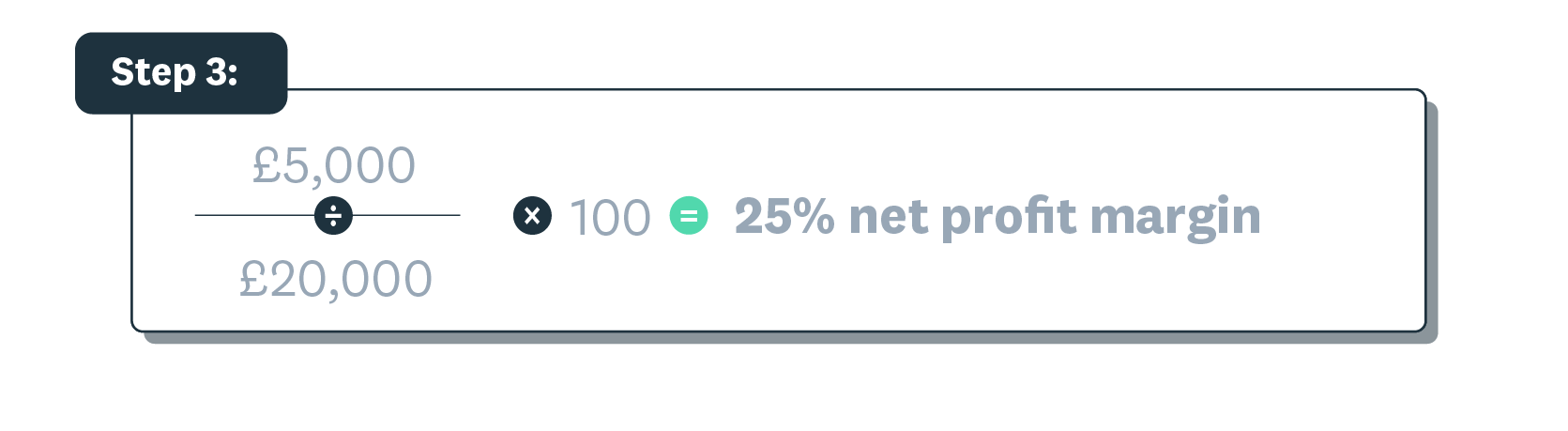
- Net profit margin shows the percentage of revenue left after all expenses, taxes and interest have been deducted. It tells you how much of every pound your business earns actually becomes profit.
- The formula is simple: divide your net profit by your total revenue, then multiply by 100. A higher percentage means your business is more efficient at turning sales into profit.
- The average net profit margin for UK private non-financial businesses is roughly 9.3%, but healthy margins vary widely by industry, from around 2% in retail to over 20% in software.
- Tracking your net profit margin regularly helps you spot trends, benchmark against competitors and make informed decisions about pricing, spending and growth.
What is net profit margin?
Understanding your net profit margin is one of the clearest ways to measure whether your business is financially healthy. It goes beyond revenue to show how much profit you actually keep.
Net profit margin is the percentage of your total revenue that remains as profit after you subtract all expenses. That includes operating costs, wages, rent, materials, interest on loans and taxes. It is often called the bottom line because it sits at the bottom of your profit and loss statement.
Handy resources
Advisor directory
You can search for experts in our advisor directory
Profit & Loss template
Download Xero’s profit and loss statement template to show how much money your business is making
Financial reporting
Keep track of your performance with accounting reports
Disclaimer
This glossary is for small business owners. The definitions are written with their requirements in mind. More detailed definitions can be found in accounting textbooks or from an accounting professional. Xero does not provide accounting, tax, business or legal advice.
For example, if your business earns £100,000 in revenue and your total expenses come to £85,000, your net profit is £15,000. Your net profit margin would be 15%. This tells you that for every £1 of revenue, you keep 15p as profit.
Net profit margin formula
The net profit margin formula is straightforward. Once you know your net profit and total revenue, you can work it out in seconds.
Net profit margin = (Net profit / Revenue) x 100
Here is what each part means:
- Net profit is your total revenue minus all expenses, including cost of goods sold (COGS), operating expenses, interest and taxes
- Revenue is the total income your business earns from sales before any deductions
- The result is expressed as a percentage
If your net profit is £30,000 and your revenue is £200,000, your net profit margin is (£30,000 / £200,000) x 100 = 15%.
How to calculate net profit margin step by step
Calculating your net profit margin is a 4-step process. Follow these steps using your own figures from your profit and loss report.
1. Calculate your total revenue
Start by adding up all the income your business has earned over the period you want to measure. This includes all sales of products and services before any costs are deducted. If you use Xero accounting software, you can pull this figure directly from your profit and loss report.
2. Work out your total expenses
Next, add up every cost your business has incurred during the same period. This means cost of goods sold, operating expenses such as rent and utilities, employee wages, marketing costs, loan interest, depreciation and taxes. Be thorough here, because missing even 1 expense category will skew your result.
3. Find your net profit
Subtract your total expenses from your total revenue. The figure you are left with is your net profit. If your expenses exceed your revenue, you have a net loss rather than a net profit, and your margin will be negative.
4. Apply the net profit margin formula
Divide your net profit by your total revenue and multiply by 100. The result is your net profit margin as a percentage. You can also use the Xero net profit margin calculator to check your figures. For instance, if your net profit is £12,000 and your revenue is £80,000, your net profit margin is (£12,000 / £80,000) x 100 = 15%.
Net profit margin example
Seeing the formula in action makes it easier to apply to your own business. Here is a worked example using realistic figures for a small UK cleaning business. For a broader look at all 3 margin types, read the guide on how to calculate profit margin.
Imagine you run a cleaning company. Over the past year, your figures look like this:
- Total revenue: £120,000
- Cost of goods sold (cleaning supplies, equipment): £18,000
- Operating expenses (rent, utilities, insurance, marketing): £36,000
- Employee wages: £40,000
- Loan interest: £2,400
- Taxes: £4,600
Your total expenses are £18,000 + £36,000 + £40,000 + £2,400 + £4,600 = £101,000. Your net profit is £120,000 - £101,000 = £19,000.
Applying the formula: (£19,000 / £120,000) x 100 = 15.8%. This means you keep roughly 16p of profit for every £1 your business earns.
What is a good net profit margin?
What counts as a good net profit margin depends on your industry, business size and stage of growth. There is no single number that works for every business, but there are useful benchmarks.
According to the Office for National Statistics (ONS), the average net profit margin for UK private non-financial businesses is approximately 9.3%. As a general rule of thumb:
- 5% is considered low but may be acceptable in high-volume, low-margin industries
- 10% is healthy and typical for many small businesses
- 20% or above is strong and suggests your business is highly efficient
A new business might have a lower margin while it invests in growth. A mature business in a competitive market might sit around 5-10%. The most useful comparison is against businesses in your own industry and of a similar size.
Net profit margin by industry
Net profit margins vary significantly across industries. Knowing where your sector typically sits helps you set realistic goals and spot opportunities to improve.
Here are typical net profit margin ranges for UK industries:
- Software and SaaS: 20% or above
- Professional services (consulting, legal, accounting): 15-30%
- Construction: 5-10%
- Retail: 2-5%
- Hospitality (restaurants, cafes, hotels): 3-9%
Service-based businesses tend to have higher margins because they carry lower material costs. Product-based businesses, particularly in retail, operate on thinner margins due to higher costs of goods sold and inventory.
According to Xero Small Business Insights, margins for UK small businesses are currently under pressure from rising energy and finance costs. Keeping a close eye on your own margin and benchmarking it against your industry helps you respond to these pressures early.
Net profit margin vs gross profit margin
Net profit margin and gross profit margin both measure profitability, but they tell you different things. Understanding both gives you a fuller picture of your business finances.
Gross profit margin only deducts the direct costs of producing your goods or services (cost of goods sold) from your revenue. It shows how efficiently you produce or deliver what you sell. The formula is: (Gross profit / Revenue) x 100.
Net profit margin goes further. It deducts all expenses, including operating costs, interest and taxes. It shows the overall profitability of your entire business, not just production.
For example, a business with £200,000 revenue and £80,000 in COGS has a gross profit of £120,000 and a gross profit margin of 60%. If total expenses (including COGS) come to £170,000, the net profit is £30,000 and the net profit margin is 15%.
Learn more about how to calculate gross profit margin. Use gross profit margin to assess your pricing and production costs. Use net profit margin to assess your overall business efficiency and financial health. If your gross margin is strong but your net margin is weak, your overheads or operating costs may need attention.
How to improve your net profit margin
Improving your net profit margin means either increasing your revenue, reducing your costs, or both. Here are practical steps you can take.
- Review your pricing: small price increases can significantly improve your margin without losing customers, especially if your costs have risen
- Cut unnecessary expenses: audit your subscriptions, supplier contracts and overheads regularly to find savings
- Negotiate with suppliers: even modest reductions in material or stock costs add up over a year
- Automate repetitive tasks: using tools like Xero to automate invoicing, bank reconciliation and expense tracking reduces admin time and labour costs
- Focus on high-margin products or services: analyse which offerings deliver the best margin and invest more in those
- Reduce late payments: chasing overdue invoices ties up cash and increases finance costs. Xero's online invoicing helps you send invoices promptly and track payments in real time
Even small improvements in each of these areas can compound into a meaningfully higher net profit margin over time.
Common mistakes when calculating net profit margin
Getting your net profit margin calculation wrong can lead to poor business decisions. Here are the most common pitfalls to watch out for.
- Confusing gross profit with net profit: gross profit only accounts for direct production costs, while net profit includes all expenses. Using gross profit in the formula will overstate your margin.
- Forgetting to include all expenses: missing items such as depreciation, loan interest, bank charges or tax liabilities gives you an artificially high net profit figure.
- Ignoring seasonal variations: calculating your margin over a single strong month can be misleading. Always look at a full quarter or year for a more accurate picture.
- Not benchmarking against your industry: a 10% margin might be excellent in retail but below average in professional services. Always compare like with like.
- Using inconsistent time periods: make sure your revenue and expense figures cover exactly the same dates, or your calculation will be unreliable.
Keeping your books up to date and using accurate financial reports helps you avoid these errors.
Track your net profit margin with Xero
Calculating your net profit margin by hand is useful for understanding the concept, but tracking it consistently is what helps you grow. Xero brings your income, expenses and profit figures together in real time so you can see exactly where your business stands.
With Xero's profit and loss reports, you can view your net profit at a glance and compare it across months, quarters or years. Automated bank feeds and expense tracking mean your figures stay current without manual data entry. You can also share reports directly with your accountant or bookkeeper.
Whether you are looking to improve your margins, prepare for tax season or plan your next investment, having clear and up-to-date financials makes every decision easier. Get one month free.
FAQs on net profit margin
Here are answers to some of the most common questions about net profit margin.
What is the difference between net profit and net profit margin?
Net profit is a currency amount, for example £19,000. Net profit margin expresses that figure as a percentage of revenue, making it easier to compare performance across time periods and against other businesses of different sizes.
Can net profit margin be negative?
Yes. A negative net profit margin means your total expenses exceed your revenue, so your business is making a loss. This can happen during early-stage growth, seasonal downturns or unexpected cost increases.
How often should you calculate net profit margin?
Reviewing it monthly gives you the clearest view of trends, but at minimum you should calculate it quarterly. Regular tracking helps you spot problems early and measure the impact of any changes you make to pricing or costs.
Does net profit margin include tax?
Yes. Net profit margin is calculated after all expenses have been deducted, including taxes. This is what distinguishes it from other profit metrics that may exclude tax, such as earnings before interest and taxes (EBIT).