What is payroll?
Learn what payroll is, how it works in Singapore and what you need to pay staff correctly.
Published Wednesday 30 September 2026
Table of contents
Key takeaways
- Payroll is how you pay employees correctly and on time, including Central Provident Fund (CPF) contributions and the records behind each payment
- For staff aged 55 and below, you contribute 17% and your employee contributes 20% of wages to CPF, up to an $8,000 monthly ceiling
- Singapore residents are taxed annually, so your income tax role is reporting employee pay to the Inland Revenue Authority of Singapore (IRAS)
- The Employment Act sets deadlines for salary, overtime, payslips and records, so a steady monthly routine keeps you compliant
What is payroll?
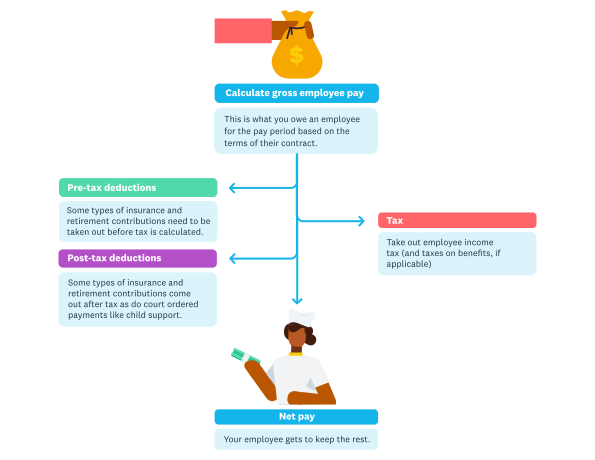
Payroll is what happens each payday and involves sending the right amounts of money to the employee, but also to a number of other locations.
Payroll is the process of paying your employees: working out what each person earns, taking off deductions and paying them on time. It also covers the records and reports you keep for CPF Board, the Ministry of Manpower (MOM) and IRAS.
Picture a café with four staff. At the end of each month, you total each person’s salary and overtime, then subtract their CPF share. You pay the net amount into their bank accounts and send the CPF contributions to CPF Board.
That monthly routine is payroll. It starts with your first hire, and getting it right builds your team’s trust from the first pay day.
How does payroll work in Singapore?
Payroll in Singapore follows a monthly cycle shaped by the Employment Act and CPF rules. Each cycle moves through three stages:
- pre-payroll, when you gather timesheets, leave records, new hires and any pay changes
- payroll processing, when you calculate gross pay, CPF and other deductions to reach net pay
- post-payroll, when you pay employees, issue payslips, pay CPF Board and update your records
Here’s how processing looks for one employee. Say you pay a $5,000 monthly wage to an employee aged 35. Under the current CPF contribution rates, you contribute 17%, or $850, and your employee contributes 20%, or $1,000.
You deduct the employee’s $1,000 from their pay, so they take home $4,000 before any self-help group deduction. You then pay $1,850 to CPF Board: your $850 plus the $1,000 you deducted.
What is included in payroll?
Payroll includes every payment and deduction linked to an employee’s pay. For a typical small business, that means:
- basic salary for the salary period
- fixed allowances, such as transport or meal allowances
- overtime pay for eligible employees
- bonuses and commissions
- CPF contributions from you and your employee
- self-help group fund deductions
- agreed deductions, such as unpaid leave
An employee’s residency status decides whether CPF appears on their payslip. You pay CPF for Singapore Citizens and permanent residents (PRs) earning more than $50 a month. Foreign employees on work passes are paid without CPF.
Payroll deductions and contributions explained
Deductions come out of your employee’s gross pay, while contributions are amounts you add on top. In Singapore, the main items are CPF and self-help group funds.
CPF contributions
CPF is Singapore’s compulsory savings scheme, and both you and your employee pay into it each month. For employees aged 55 and below, the total rate is 37%: 17% from you and 20% from them. Rates for employees aged above 55 to 65 rose from 1 January 2026.
Contributions apply to wages up to the Ordinary Wage (OW) ceiling, which is $8,000 a month from 1 January 2026. An annual salary ceiling of $102,000 also applies, and it includes bonuses. New PRs pay graduated CPF rates for their first two years, then move to full rates.
Self-help group funds
Self-help group (SHG) funds are community contributions that you deduct from employee wages through payroll. There are four funds. They’re the Chinese Development Assistance Council (CDAC), Eurasian Community Fund (ECF), Mosque Building and Mendaki Fund (MBMF) and Singapore Indian Development Association (SINDA).
Each employee contributes to the fund for their community. Anyone who’d rather opt out, or give a different amount, can contact their SHG directly.
Other deductions
Other deductions depend on what you and your employee agree, such as unpaid leave or salary advances. Show each one on the payslip so your employee can see how you reached their net pay.
What payroll costs you as an employer
Your payroll bill is higher than the salaries you pay. On top of wages, you cover your own CPF share and at least one levy.
Employer CPF is usually the biggest extra cost. In the worked example, it adds $850 to a $5,000 salary.
The Skills Development Levy (SDL) applies to every employee, including foreign staff. It’s 0.25% of monthly wages, with a minimum of $2 and a maximum of $11.25 per employee.
If you hire Work Permit or S Pass holders, you also pay a monthly Foreign Worker Levy. The amount varies by sector and skill level, so check MOM’s current rates before you budget for a new hire.
These costs add up. In the Singapore National Employers Federation’s 2026/2027 wage and employment survey, 83% of employers named rising manpower costs as their top manpower challenge, up from 79% in 2025. Budgeting for the full cost of each role helps you plan hiring with confidence.
Income tax and payroll in Singapore
Singapore residents settle their own income tax each year after IRAS assesses their income. Your role as an employer is to report what you paid each employee.
Resident income tax rates are progressive, with a top rate of 24%. Because IRAS taxes residents annually, monthly payroll covers CPF and SHG deductions only.
With five or more employees, you must submit income details through the Auto-Inclusion Scheme (AIS). The window runs from 1 February to 1 March each year, and IRAS then includes the details in your employees’ tax returns.
Departing staff need one extra step. When a non-citizen employee is leaving, file Form IR21 for tax clearance at least one month before their last day.
How to set up payroll for the first time
Setting up payroll takes some groundwork, but most of it happens once. Work through these five steps before your first pay day.
1. Collect employee details and issue Key Employment Terms
Collect each employee’s full name, National Registration Identity Card (NRIC) or work pass details, date of birth and bank account. Age and residency status decide their CPF rate, so check both carefully.
Give each new hire their Key Employment Terms (KETs) in writing within 14 days of starting work. If you’re still recruiting, read up on hiring employees in Singapore first.
2. Set your salary period and pay rules
Choose a salary period, usually a calendar month, and a fixed pay day that gives you time to process pay. Write down your rules for overtime, allowances, bonuses and unpaid leave so every calculation follows the same logic.
3. Choose a payroll method
Decide whether you’ll run payroll yourself, hand it to an accountant or use payroll software. The next section compares each option.
4. Set up CPF payments
Get your business set up with CPF Board and decide how you’ll pay each month. CPF contributions are due by the 14th of the following month, and SHG deductions and SDL for CPF-covered staff are usually paid in the same submission.
5. Run your first payroll
Move through the pre-payroll, processing and post-payroll stages for your first pay run. Check each payslip against the employee’s KETs before you pay.
Ways to run payroll
Most small businesses run payroll in one of three ways. The best fit depends on how many people you pay and how much time you have.
Run payroll manually
Running payroll by hand in a spreadsheet costs little and suits a business with one or two employees. The trade-off is time, and every rate change or new hire adds room for error.
Use an accountant or bookkeeper
An accountant or bookkeeper can process payroll for you and keep an eye on compliance. Outsourcing payroll frees your time, and you stay responsible for paying staff correctly.
Use payroll software
Payroll software calculates CPF, SDL, SHG and other deductions for you, then produces payslips and reports. Find out how online payroll works if you want to spend less time on manual calculations.
Payroll compliance and legal requirements
The Employment Act, administered by MOM, sets the rules for when and how you pay staff. Under the Act, you need to:
- pay salary at least monthly, within seven days after each salary period ends
- pay overtime within 14 days after the salary period ends
- keep employee and salary records covering the latest two years for current staff
- keep the last two years of records for ex-employees, for one year after they leave
The overtime rules cover workmen earning up to $4,500 and non-workmen earning up to $2,600 in basic monthly salary. Eligible staff get at least 1.5 times their hourly basic rate, for up to 72 overtime hours a month.
If you’d like a second opinion on your setup, you can find an accountant or bookkeeper near you in the Xero Advisor Directory.
Key payroll documents
A handful of documents keep payroll clear for your employees and the authorities. These are the four you’ll use most.
Key Employment Terms
KETs set out the written terms of each job, such as the salary period, basic salary, allowances and working hours. They’re the reference point for every payroll calculation, so update them in writing when pay changes.
Itemised payslips
An itemised payslip shows each employee how you reached their net pay, including basic salary, allowances, overtime and deductions. Give it with the payment or within three working days.
Form IR8A
Form IR8A records each employee’s income for the year. Employers on AIS send this information to IRAS electronically, while others give employees their Form IR8A by 1 March.
Form IR21
Form IR21 covers foreign and PR employees who stop working for you, go on an overseas posting or leave Singapore for more than three months. It gives IRAS the income details it needs to assess their tax.
Leave and statutory payments through payroll
Paid leave still runs through payroll, so record it accurately each month. The main types are sick leave and parental leave.
Eligible employees get up to 14 days of paid outpatient sick leave entitlement and 60 days of hospitalisation leave, depending on length of service. The 60 days include the 14 outpatient days.
For parents of Singapore Citizen children, working mothers can take 16 weeks of Government-Paid Maternity Leave (GPML). Fathers of children born from 1 April 2025 get four weeks of Government-Paid Paternity Leave, as the extra two weeks became mandatory from that date.
Parents of children born or adopted from 1 April 2026 can also share 10 weeks of Shared Parental Leave. Record each leave period in payroll so pay stays accurate and any claims match your records.
Common payroll mistakes to avoid
Payroll errors often start small and repeat every month. These are the ones to watch for.
- Paying CPF after the 14th of the following month, which adds late interest of 1.5% a month
- Using the wrong CPF rate after an employee moves into a new age band
- Filing Form IR21 late, or missing it, when a foreign or PR employee leaves
- Treating an employee as a contractor and skipping the CPF they’re owed
- Paying overtime to eligible staff after the 14-day deadline
Accurate, on-time pay is one of the simplest ways to build trust, and it supports your wider employee retention strategy.
Simplify your payroll with Xero
Payroll gets easier with a clear monthly routine and your records in one place. Xero brings your accounting together and connects with payroll apps from the Xero App Store, so wage costs can flow straight into your books.
Try Xero and get one month free to see how much admin you can take off your plate.
FAQs on payroll
Here are quick answers to other common payroll questions from small business owners.
How often do you need to run payroll in Singapore?
You need to pay salary at least once a month, and you can pay weekly or fortnightly if that suits your team. Whichever schedule you choose, set it out in each employee’s KETs.
What’s the difference between payroll and HR?
Human resources (HR) covers hiring, training, performance and workplace policies, while payroll focuses on paying staff and meeting CPF and tax obligations. The two overlap on records such as salary changes and leave.
Who is responsible for payroll?
As the employer, you’re responsible for correct and on-time pay, even when an accountant or software handles the work. In small teams, the owner often runs payroll or signs off each pay run.
Can you run payroll for just 1 employee?
Yes, and the same salary and CPF rules apply from your first hire. With fewer than five employees, AIS isn’t mandatory, so you can give your employee a Form IR8A by 1 March instead.
Do company directors need to be on payroll?
Directors who draw a salary and are Singapore Citizens or PRs generally receive CPF on their salary like other employees. Director’s fees may be treated differently for CPF, so check with CPF Board or your accountant before you set up their pay.
Can you change your payroll frequency?
Yes, as long as you still pay at least monthly and within seven days of each salary period ending. Update each employee’s KETs in writing and tell them before the first pay run on the new schedule.
Related terms
Learn more about payroll
Handy resources
Advisor directory
You can search for experts in our advisor directory
Your guide to hiring
Learn tips for hiring, onboarding and paying an employee, while keeping everyone happy
Payroll with Xero
Learn how Xero can help with your payroll requirements
Disclaimer
This glossary is for small business owners. The definitions are written with their requirements in mind. More detailed definitions can be found in accounting textbooks or from an accounting professional. Xero does not provide accounting, tax, business or legal advice.