Accounting period
Learn what an accounting period is and how to set yours for Singapore tax, GST and reporting.
Published Friday 24 July 2026
Table of contents
Key takeaways
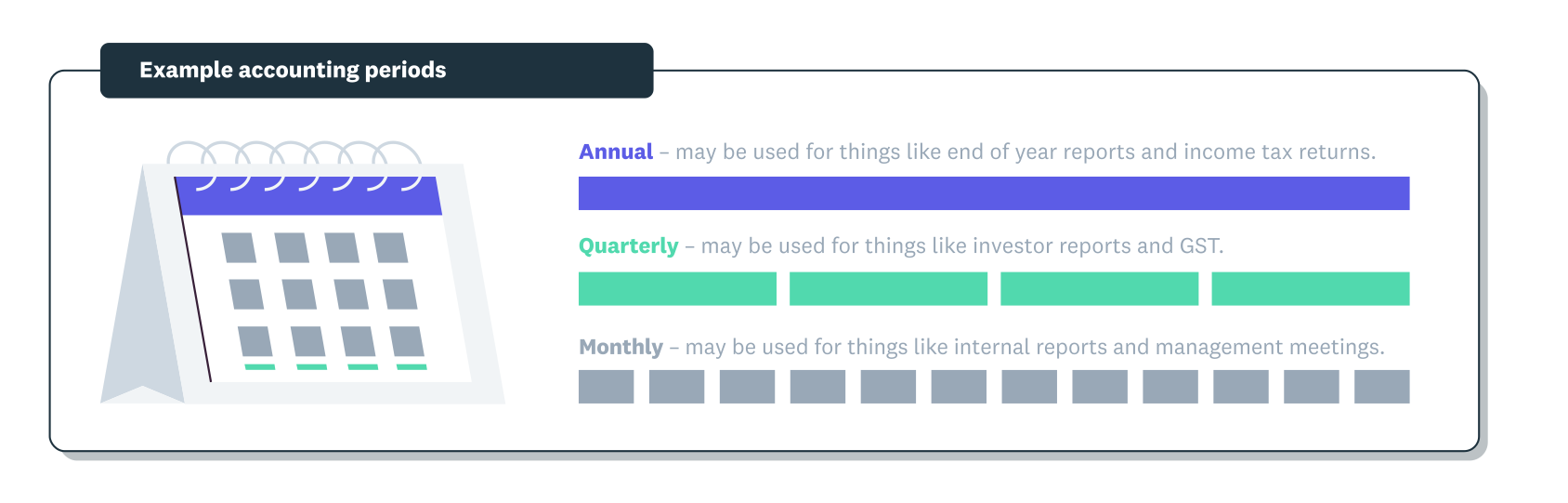
Annual accounting periods don’t have to start in January. Nor do monthly accounting periods have to start on the first of the month.
- An accounting period is the span of time your business groups its transactions into for reporting, often a quarter or a year.
- In Singapore you pick a financial year end (FYE), which sets when each period closes and your books are drawn up.
- Your accounting period drives your corporate tax year of assessment with IRAS and the timing of your GST filing.
- You can choose a period that fits how your business actually runs, then keep it consistent year on year.
What is an accounting period?
An accounting period is the fixed span of time your business groups its financial transactions into so you can report on them. It's the window you use to work out revenue, expenses and profit.
A period is often 12 months, but it can be monthly or quarterly, and it doesn't have to start in January. Each period gives you a clean window for preparing financial statements and comparing performance over time.
Handy resources
Advisor directory
You can search for experts in our advisor directory
Xero Small Business Guides
Discover resources to help you do better business
Try Xero for free
Try Xero’s fast, simple, powerful online accounting software for your small business
Disclaimer
This glossary is for small business owners. The definitions are written with their requirements in mind. More detailed definitions can be found in accounting textbooks or from an accounting professional. Xero does not provide accounting, tax, business or legal advice.
Why accounting periods matter
Handy resources
Advisor directory
You can search for experts in our advisor directory
Xero Small Business Guides
Discover resources to help you do better business
Try Xero for free
Try Xero’s fast, simple, powerful online accounting software for your small business
Consistent periods turn a stream of transactions into numbers you can act on. They matter for several reasons:
- Comparability, so you can measure one period against another like for like
- Trend analysis that reveals growth, seasonality and cash flow patterns
- Meeting ACRA and IRAS reporting deadlines with organised, up-to-date records
- Investor and lender confidence, built on timely and reliable reporting
Types of accounting periods
Businesses use a few common period lengths, depending on how closely they track results and what regulators expect. The main types are:
- Calendar year, running 1 January to 31 December
- Fiscal or financial year, any 12-month period a business chooses
- Quarterly periods, covering 3 months at a time
- Monthly periods, useful for close tracking and GST filing
- 4-4-5 or 52-53 week periods, which split the year into set weekly blocks
Accounting periods in Singapore: your financial year end
In Singapore your accounting period is anchored to your financial year end, the date your financial year closes. A company sets its own FYE when it incorporates, and it shapes every reporting and tax deadline that follows.
Under ACRA rules, a company's first financial year can run up to 18 months from incorporation, while later financial years are normally 12 months. Many businesses pick a common FYE such as 31 March, 30 June, 30 September or 31 December.
Changing your financial year end
You can change your financial year end as your business evolves, though it isn't purely an internal decision. You can't change it at all if the statutory deadlines for holding your annual general meeting, filing your annual return, or sending out your financial statements have already passed.
ACRA approval is needed in 2 cases: where the change would make your financial year longer than 18 months, or where you last changed your FYE on or after 31 August 2018 and now want to change it again within 5 years of that change. Outside those situations you can usually update the FYE directly.
Accounting periods and your corporate tax filing
Your accounting period, known as the basis period, maps to a year of assessment (YA) for corporate tax. IRAS assesses the income from that basis period in the matching YA.
You file your Estimated Chargeable Income (ECI) within 3 months of your financial year end. Your Corporate Income Tax Return, using Form C-S, Form C-S (Lite) or Form C, is then due by 30 November each year.
GST accounting periods and filing
GST works on its own accounting periods, which set how often you report to IRAS. Getting these dates right keeps your filing on time and your records clean.
GST-registered businesses usually file a GST F5 return each quarter, so the accounting period is quarterly. The return and payment fall due 1 month after the period ends. You can apply to IRAS to file monthly instead, and this guide covers filing your GST return.
Accrual basis and the matching principle
How you assign transactions to a period depends on your accounting method. Most businesses use the accrual basis, which gives a fuller view of each period.
Under accrual accounting you record revenue when it's earned and expenses when they're incurred within the period, rather than when cash changes hands. The matching principle then lines up expenses with the revenue they helped earn, giving a truer picture of each period's profit.
How to choose the right accounting period
The right period fits how your business actually runs and reports. A few practical factors help you decide:
- Your operating cycle and any seasonality in sales or stock
- When stakeholders or lenders need to see your reports
- Alignment with your corporate tax and GST deadlines
- Consistency, so you can compare results year on year
Simplify your accounting periods with Xero
Xero keeps every transaction organised by period, so your books stay tidy as each financial year, quarter or month closes. That makes it quicker to produce financial statements, prepare GST F5 returns and meet IRAS deadlines, and you can Get one month free.
FAQs on accounting periods
Here are answers to some frequently asked questions about accounting periods for Singapore businesses.
Is an accounting period always 12 months?
No, a period can be monthly, quarterly or annual, depending on how you report. Your first financial year in Singapore can even run up to 18 months.
What's the difference between a calendar year and a financial year?
A calendar year always runs 1 January to 31 December. A financial year is any 12-month period you choose, ending on the financial year end date you set.
How long can my first financial year be in Singapore?
Under ACRA rules, your first financial year can run up to 18 months from incorporation. Later financial years are normally 12 months.
How does my accounting period relate to the year of assessment?
Your accounting period is the basis period that IRAS assesses in the matching year of assessment. Income earned in a basis period is taxed in its corresponding YA.
How often do I file GST in Singapore?
Most GST-registered businesses file a GST F5 return each quarter, 1 month after the period ends. You can apply to IRAS to file monthly instead.