Gross profit vs net profit
Learn how gross profit and net profit differ, how to calculate each, and what they mean for your Indonesian business.
Published Wednesday 30 September 2026
Table of contents
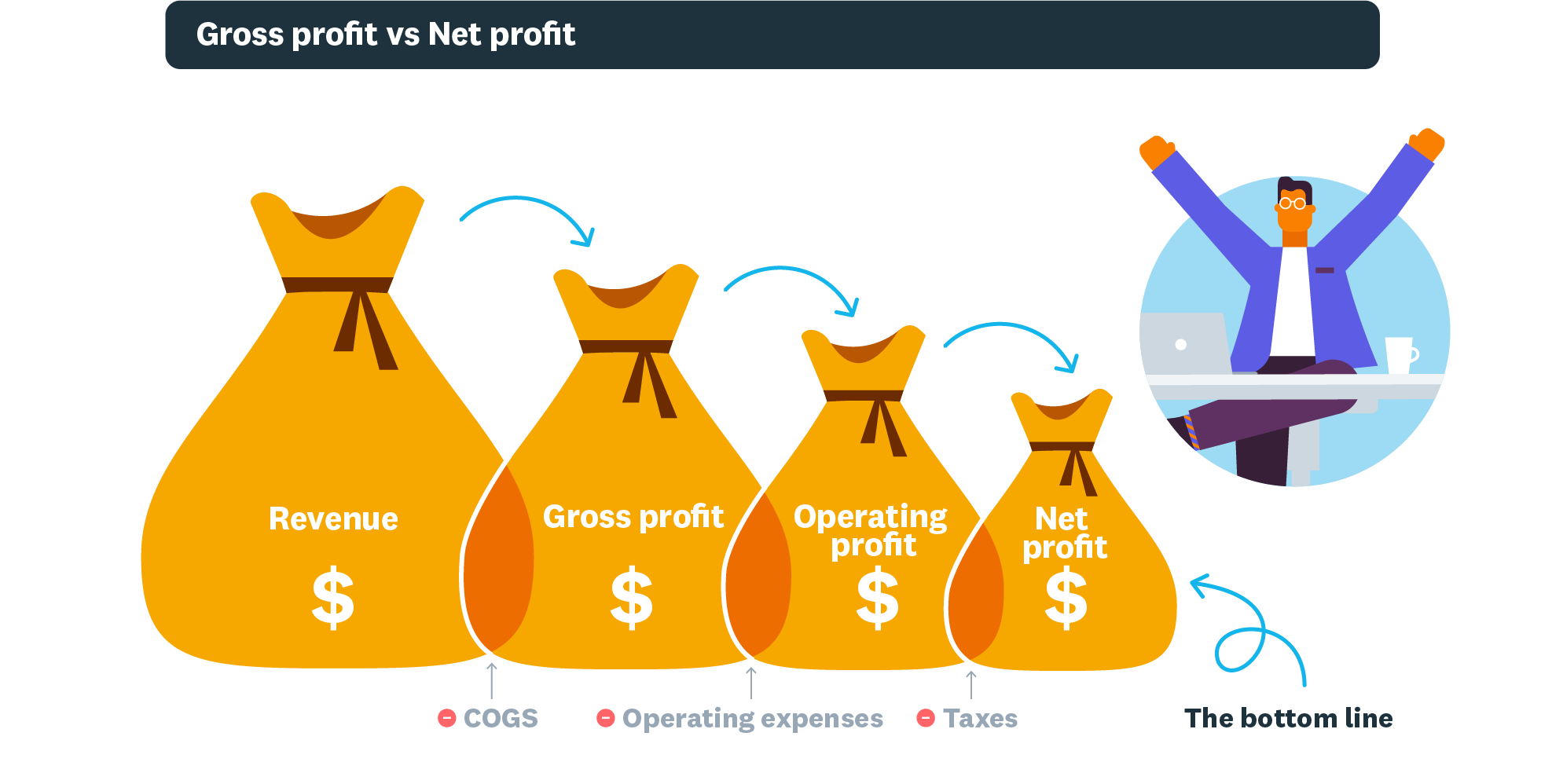
The difference between gross profit and net profit is operating expenses and taxes
Key takeaways
- Gross profit is revenue minus cost of goods sold, so it shows how much you make from what you sell
- Net profit is what’s left after every expense, including overheads, loan interest and tax
- A healthy gross profit with thin net profit points to overheads or interest; a falling gross profit points to pricing or product costs
- In Indonesia, companies are taxed on taxable income, which is closer to net profit, while businesses on the final tax pay on turnover
What is gross profit?
Gross profit is your revenue minus your cost of goods sold (COGS). It shows how much your products or services earn before you pay for running the rest of the business.
COGS covers the direct costs of producing what you sell. If a cost would disappear when you stopped making or selling a product, it’s usually part of COGS.
What counts as COGS depends on the kind of business you run. Here’s how it looks for four different businesses.
- A clothing shop’s COGS is the stock it buys to resell, plus the freight to get it into the shop
- A bakery’s COGS includes flour, butter, packaging and the wages of the bakers who make each batch
- A furniture maker’s COGS covers timber, hardware and the direct labour of workshop staff
- A consultancy’s COGS is mostly the time of the people who deliver client work, plus any subcontractors
Rent, admin salaries and advertising sit outside COGS. You’ll find them lower down your statement as operating expenses.
Gross profit formula
The gross profit formula takes one group of costs away from your sales. Here it is:
Gross profit = revenue − cost of goods sold
Say you run a small bakery in Bandung. In a given month, your total revenue from sales is Rp250,000,000.
Your COGS for the month is Rp100,000,000, covering ingredients, packaging and the wages of your baking staff. Here’s the sum:
Gross profit = Rp250,000,000 − Rp100,000,000 = Rp150,000,000
That Rp150,000,000 is what your bakery has left to pay for everything else. For more worked examples, see this guide to calculating gross profit.
What is net profit?
Net profit is your revenue minus all your expenses: COGS, operating expenses, loan interest and tax. It’s also called net income or the bottom line, because it’s the last line on your profit and loss statement.
Operating expenses are the costs of running the business, such as rent, utilities, marketing, insurance and admin wages. When you repay a loan, only the interest counts as an expense, because the principal reduces your loan balance instead.
Lenders and investors pay close attention to net profit. For most companies, it’s also the starting point for working out corporate income tax with the Direktorat Jenderal Pajak (DJP), Indonesia’s tax office.
Net profit formula
The net profit formula takes every expense away from revenue. Here it is:
Net profit = revenue − total expenses
Because gross profit already has COGS taken off, you can also start from gross profit and subtract everything else. Here are the Bandung bakery’s other costs for the month.
- Rent of Rp30,000,000
- Utilities of Rp5,000,000
- Marketing of Rp8,000,000
- Insurance of Rp4,000,000
- Admin wages of Rp40,000,000
- Loan interest of Rp6,000,000
- Tax of Rp12,000,000
Those costs add up to Rp105,000,000. Take them away from gross profit:
Net profit = Rp150,000,000 − Rp105,000,000 = Rp45,000,000
So from Rp250,000,000 in sales, your bakery keeps Rp45,000,000. This guide to working out profit covers other ways to run the numbers.
Key differences between gross profit and net profit
Gross profit and net profit come from the same statement but answer different questions. Here’s how they compare.
- Gross profit subtracts only COGS, while net profit subtracts every expense
- Gross profit tells you whether your pricing and product costs work, and net profit tells you whether the whole business makes money
- Gross profit sits near the top of your statement, while net profit is the final line
- You shape gross profit through prices and supplier costs, and net profit through overheads, borrowing and tax planning as well
- Lenders and investors look hardest at net profit, while you’ll use gross profit to check individual products
To see both figures in context, look at this profit and loss statement example.
How gross profit and net profit appear on your profit and loss statement
Your profit and loss statement works like a staircase, with each step down subtracting another group of costs. Using the bakery’s month, the steps look like this.
- Revenue of Rp250,000,000 sits at the top
- COGS of Rp100,000,000 comes off first
- Gross profit of Rp150,000,000 is what’s left after COGS
- Operating expenses of Rp87,000,000 cover rent, utilities, marketing, insurance and admin wages
- Operating profit of Rp63,000,000 shows what the day-to-day business earns
- Loan interest of Rp6,000,000 and tax of Rp12,000,000 come off next
- Net profit of Rp45,000,000 is the bottom line
Operating profit is a useful middle step. It shows how your core business performs before financing and tax, so you can compare months even when your borrowing changes.
The profit and loss statement sits alongside the balance sheet among your main financial statements. Reading them together shows what you earned and what you own.
Why gross profit and net profit both matter for your business
Each figure answers its own question, so reading them together tells you where your money goes. Gross profit tells you whether each sale earns enough to cover what it costs to make.
Net profit tells you whether the business as a whole makes money after every bill. It decides how much you can reinvest, pay yourself or set aside for tax.
Tracking both each month helps you in practical ways. For example, you can:
- spot a rising supplier cost before it eats into a whole quarter
- set prices with a clear view of what each sale contributes
- plan hiring or new premises based on what’s left after overheads
- show lenders the profit trend they’ll ask about
Why a business can have high gross profit but low net profit
A business can sell at a healthy margin and still keep very little. This happens when costs below the gross profit line take most of what each sale earns.
The usual causes are overheads that grow faster than sales, such as extra rent or admin staff, and interest on borrowing. Tax then comes out of whatever profit remains.
Say a café in Yogyakarta has monthly sales of Rp200,000,000 and COGS of Rp60,000,000, giving a gross profit of Rp140,000,000. Rent, wages and other overheads come to Rp125,000,000, and loan interest is Rp9,000,000. That leaves Rp6,000,000 before tax, even though 70% of sales became gross profit.
To find the cause, compare your gross profit margin with previous months. If it’s falling, look at pricing and COGS first; if it’s steady while net profit shrinks, the issue sits in overheads or interest.
How to calculate gross and net profit
You can work out both figures from your sales and expense records in five steps. Follow them in this order.
1. Add up your total revenue
Include every sale of products and services in the period. Loans and money you put in yourself sit outside revenue, so leave them out.
2. Work out your cost of goods sold
Add up the direct costs of what you sold, such as materials, stock and production wages. Count only the costs linked to items sold in the period.
3. Subtract COGS from revenue to get gross profit
Take your COGS away from your revenue. The result is your gross profit for the period.
4. Add up all your other expenses
List every other cost, including rent, utilities, marketing, admin wages, loan interest and tax. Leave out loan principal, since it reduces your loan balance.
5. Subtract total expenses from revenue to get net profit
Take COGS and all other expenses away from revenue, or subtract your other expenses from gross profit. Either way, the answer is your net profit.
A Xero profit and loss report does these sums for you, showing gross profit and net profit for any period you choose.
Gross profit margin vs net profit margin
Margins turn gross and net profit into percentages of revenue, so you can compare periods of different sizes. Each profit margin tells you how much of every sale you keep at that stage.
Here are the two formulas:
Gross profit margin = (gross profit ÷ revenue) × 100
Net profit margin = (net profit ÷ revenue) × 100
For the Bandung bakery, gross profit margin is (Rp150,000,000 ÷ Rp250,000,000) × 100 = 60%. That means Rp60 of every Rp100 in sales is left after COGS.
Net profit margin is (Rp45,000,000 ÷ Rp250,000,000) × 100 = 18%. So Rp18 of every Rp100 in sales is yours to keep after all expenses.
To check your own figures quickly, try this net profit margin calculator.
Gross profit, net profit and tax in Indonesia
Your business structure and turnover decide whether your tax bill follows net profit or sales. Here’s how the main options work.
Companies pay corporate income tax (Pajak Penghasilan Badan, or PPh Badan) at 22% of net taxable income. Taxable income is closer to net profit than gross profit, so your operating costs lower the bill.
Companies with turnover up to Rp50 billion get a 50% discount on the tax on taxable income from the first Rp4.8 billion of turnover.
Government Regulation (Peraturan Pemerintah) 20 of 2026 limits the 0.5% final tax on gross turnover up to Rp4.8 billion a year. Only individuals, one-founder PT Perorangan and cooperatives can use it. Newly registered limited partnerships (CV), general partnerships (firma) and limited liability companies (PT) use the general corporate rate instead.
If you’re an individual owner, your first Rp500 million of annual turnover is tax-free under the final tax.
Under the final tax, you’re taxed on turnover, so your bill follows your sales whatever your costs. Check which option fits your business with a registered tax consultant before you file.
How to improve your gross profit
Gross profit grows when you earn more per sale or spend less to make each one. Try these approaches.
- Review your prices regularly, using the difference between margin and markup to set them
- Negotiate better terms with suppliers or buy in larger quantities
- Reduce waste in production, such as unsold stock or spoiled ingredients
- Focus on the products or services with the highest gross margin
How to improve your net profit
Net profit grows when overheads, interest and tax take a smaller share of your gross profit. Start with these steps.
- Review your overheads each quarter and cancel services you rarely use
- Pay down expensive debt to lower your interest costs
- Keep your records organised so you claim every deductible business expense
- Ask your tax consultant whether the corporate tax discount for smaller businesses applies to your CV, firma or PT
- Automate routine admin to free up staff time for paid work
Track gross and net profit with Xero
Gross profit shows what your sales earn, and net profit shows what your business keeps once every cost is paid. Checking both each month helps you act early when costs start rising.
Xero keeps your income and expenses organised and turns them into up-to-date profit and loss reports. To see how it works for your business, get one month free.
FAQs on gross profit vs net profit
Here are quick answers to common questions about gross and net profit.
Does gross profit include wages?
Gross profit is worked out after paying staff who directly make your product or deliver your service, because their wages are part of COGS. Admin, sales and management wages are operating expenses, so they only affect net profit.
Can gross profit be negative?
Yes, gross profit is negative when your COGS is higher than your revenue, for example when items sell for less than they cost to make. Treat it as a signal to review your prices and supplier costs straight away.
What is a good gross profit margin?
A good margin depends on your industry, so compare yours with your own past results and with similar businesses. This guide to working out gross profit margin explains how to track it over time.
Is gross profit always higher than net profit?
Gross profit equals net profit only if you have no other expenses. Net profit can be higher only when non-operating gains, such as selling equipment for more than its book value, outweigh your other expenses.
Do you pay tax on gross or net profit in Indonesia?
Companies on the general rate pay tax on taxable income, which is closer to net profit. Businesses on the final tax pay on turnover, which is closer to revenue than either profit figure.
Related terms
Learn more about gross profit vs net profit
Handy resources
Advisor directory
You can search for experts in our advisor directory
Xero Small Business Guides
Discover resources to help you do better business
Financial reporting
Keep track of your performance with accounting reports
Disclaimer
This glossary is for small business owners. The definitions are written with their requirements in mind. More detailed definitions can be found in accounting textbooks or from an accounting professional. Xero does not provide accounting, tax, business or legal advice.