Margin vs markup: what is the difference?
Learn how margin and markup differ, how to calculate each, and how to convert one into the other.
Published Wednesday 30 September 2026
Table of contents
Key takeaways
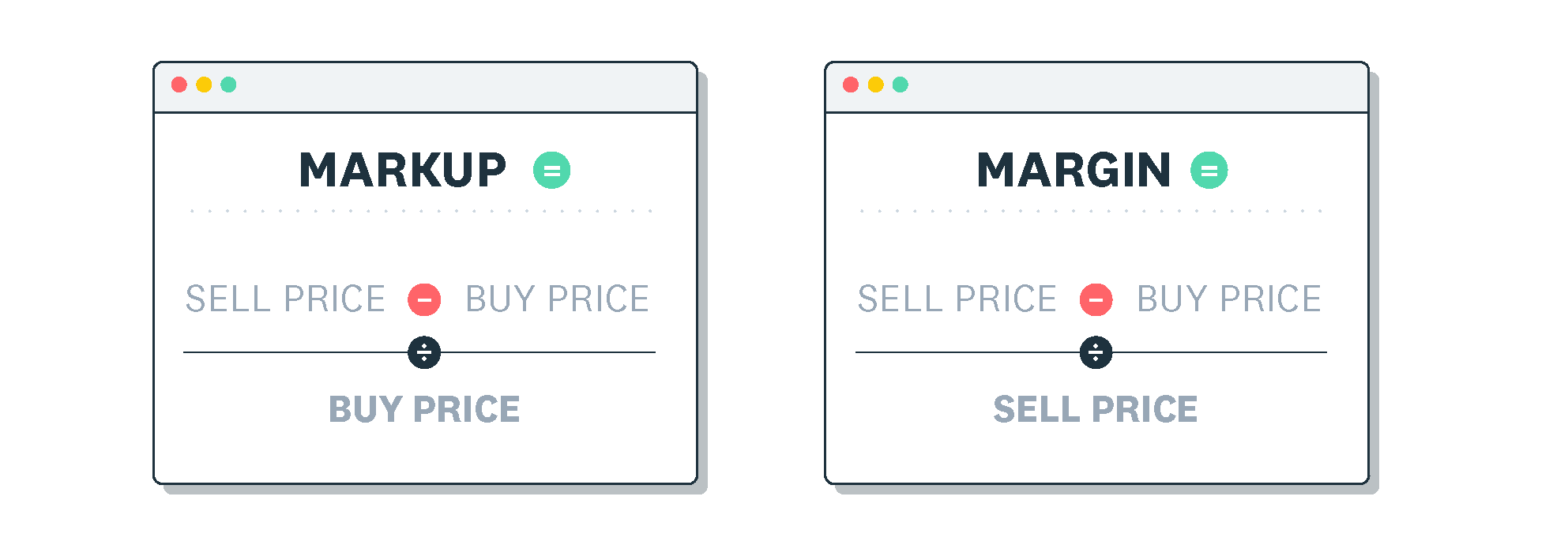
- Margin is profit as a percentage of the selling price, while markup is profit as a percentage of cost
- The same sale always gives a higher markup than margin, so a 50% markup equals a 33.3% margin
- Markup helps you set prices, while margin helps you check profitability against benchmarks
- To hit a target margin, divide your cost by (1 − target margin) to find your price
What is margin?
Margin is the share of your selling price you keep as profit after paying for the goods you sold. It’s often called gross profit margin, and it shows how much of each rupiah in sales you keep.
You work out margin with this formula:
- Margin = (Selling price − Cost) ÷ Selling price × 100
Say you buy a product for Rp100,000 and sell it for Rp130,000, so your profit is Rp30,000. Divide that profit by the Rp130,000 selling price, then multiply by 100.
- Margin = (Rp130,000 − Rp100,000) ÷ Rp130,000 × 100 = 23.1%
So 23.1% of the revenue from this sale is profit.
What is markup?
Markup is the percentage you add on top of your cost to reach a selling price. It shows how much more you charge than you paid.
The formula for markup is:
- Markup = (Selling price − Cost) ÷ Cost × 100
Take the same product: you pay Rp100,000, sell it for Rp130,000 and keep Rp30,000 profit. This time, divide the profit by the Rp100,000 cost and multiply by 100.
- Markup = (Rp130,000 − Rp100,000) ÷ Rp100,000 × 100 = 30%
That means you marked up the product by 30% above what it cost you.
Margin vs markup: what is the difference?
Margin divides profit by the selling price, while markup divides profit by cost. Because the base changes, the two percentages always differ for the same sale.
Here’s how the two measures compare:
- Margin uses the selling price as its base, while markup uses cost
- Margin shows what share of revenue is profit, while markup shows how much you added to cost
- Margin is always lower than markup for the same sale, because the price is higher than the cost
- Margin on a Rp130,000 price with a Rp100,000 cost is 23.1%, while markup is 30%
If someone quotes a single percentage, ask which measure they mean. On a Rp100,000 cost, a 30% markup gives a Rp130,000 price, while a 30% margin needs a price of about Rp142,857.
Key terms behind margin and markup
Margin and markup draw on the same small set of accounting terms. Knowing what each one means keeps your calculations consistent.
- Your cost of goods sold (COGS) is the direct cost of making or buying what you sell, such as materials and direct labour
- Your revenue is the total money you earn from sales before any costs come out
- Your selling price is the amount a customer pays for one unit of your product or service
- Your gross profit is revenue minus COGS
- Your net profit is gross profit minus all other operating expenses, interest and taxes
Margin and markup both use gross profit, so they show how well your prices cover your direct costs.
How to calculate margin and markup
You need two figures to work out either measure: your cost and your selling price. The steps below use a product that costs Rp100,000 and sells for Rp150,000.
How to calculate margin
Follow these steps to find the gross profit margin on any product or service.
- Start with your selling price, which is Rp150,000 in this example
- Subtract your COGS of Rp100,000 to get a gross profit of Rp50,000
- Divide the gross profit by the selling price: Rp50,000 ÷ Rp150,000 = 0.333
- Multiply by 100 to get a 33.3% margin
How to calculate markup
Use the same product to find its markup.
- Start with your COGS, which is Rp100,000
- Subtract the cost from the selling price to get the gross profit: Rp150,000 − Rp100,000 = Rp50,000
- Divide the gross profit by the cost: Rp50,000 ÷ Rp100,000 = 0.5
- Multiply by 100 to get a 50% markup
The same Rp50,000 profit gives a 33.3% margin and a 50% markup. The only change is the number you divide by.
How to set a price from a target margin
If you know the margin you want, you can work backwards to the price. Use the formula Price = Cost ÷ (1 − target margin).
- Write your target margin as a decimal, so 25% becomes 0.25
- Subtract it from 1: 1 − 0.25 = 0.75
- Divide your cost by the result: Rp100,000 ÷ 0.75 = Rp133,333
- Check the markup: Rp33,333 ÷ Rp100,000 × 100 = 33.3%
A Rp133,333 price gives you a 25% margin, which is the same as a 33.3% markup. Adding 25% to cost would give only Rp125,000 and a 20% margin.
Markup to margin conversion chart
A conversion list saves you recalculating each time you set a price or read a report. The gap between markup and margin grows as the percentages rise.
- 10% markup = 9.1% margin
- 15% markup = 13% margin
- 20% markup = 16.7% margin
- 25% markup = 20% margin
- 33.3% markup = 25% margin
- 40% markup = 28.6% margin
- 50% markup = 33.3% margin
- 66.7% markup = 40% margin
- 75% markup = 42.9% margin
- 100% markup = 50% margin
- 150% markup = 60% margin
You can also convert between the two with these formulas:
- Margin = Markup ÷ (1 + Markup)
- Markup = Margin ÷ (1 − Margin)
Enter each percentage as a decimal. For example, a 50% markup converts to 0.5 ÷ (1 + 0.5) = 0.333, or a 33.3% margin.
When to use margin vs markup
Markup and margin answer different questions, so each suits a different job. Markup helps you set a price, while margin shows how profitable that price is.
When to use markup
Markup is the quickest way to set a price when you know your cost. It answers one question: how much do you add on top of what you paid?
For example, if a product costs Rp80,000 and you want a 50% markup, your selling price is Rp80,000 + (Rp80,000 × 0.5) = Rp120,000.
When to use margin
Margin is the standard measure for financial reporting. Lenders and accountants use it to measure profitability because it shows how well you turn revenue into profit.
Use margin to compare your results with industry benchmarks or to check whether your pricing strategy is sustainable. Benchmarks vary widely by sector.
NYU Stern’s January 2026 margins dataset covers US publicly traded companies. It shows average gross margins of about 26% for grocery and food retail, 33% for general retail and 72% for system and application software. Indonesian small business margins may differ, so treat these figures as a reference point rather than a target.
Common mistakes when using margin and markup
Mixing up margin and markup is an easy pricing error, and it can cost you profit on every sale. These are the mistakes to watch for.
Confusing margin and markup
The most common mistake is treating the two as interchangeable. A 30% markup gives a 23.1% margin, and a 40% markup gives only a 28.6% margin.
On a Rp100,000 cost, that 40% markup gives a Rp140,000 price, so your Rp40,000 profit is 28.6% of the price. If you planned around a 40% margin, you may need to raise your prices to close the gap.
Assuming equal percentages mean equal profit
A 25% margin and a 25% markup produce different profits. A 25% margin on a Rp100,000 sale is Rp25,000 profit. A 25% markup on a Rp80,000 cost also gives a Rp100,000 sale, but only Rp20,000 profit.
Confirm which percentage you’re working with before you make a pricing decision.
Forgetting overhead when calculating net margin
Gross margin covers only the direct cost of goods sold. It leaves out operating expenses such as rent and salaries.
To see what you really keep, subtract all other operating expenses, interest and taxes from gross profit, then divide by revenue to find your net profit margin. Tracking it alongside other profitability ratios gives you a fuller picture of your business.
Checking the wrong measure in your reports
Reports, price lists and supplier quotes can show either measure, and labels can be vague. Before you compare figures, check whether each one divides profit by price or by cost.
Track your margins and pricing with Xero
Margin and markup are easiest to manage when your sales and cost data sit in one place. Xero brings your accounting data together in clear, customisable financial reports, so you can see your margins and adjust prices with confidence.
Automated bank feeds keep your figures up to date and cut hours of manual calculation. Choose a plan and get one month free to start tracking your margins with Xero.
FAQs on margin vs markup
Here are quick answers to common questions about margin and markup.
Is a 50% markup the same as a 50% margin?
They’re different measures. A 50% markup on a Rp100,000 cost gives a Rp150,000 price, while a 50% margin needs a Rp200,000 price, which is a 100% markup.
Is 20% margin the same as 25% markup?
Yes, they describe the same sale from two angles. A Rp200,000 price on a Rp160,000 cost gives Rp40,000 profit, which is 20% of the price and 25% of the cost.
How much margin is 40% markup?
A 40% markup equals a 28.6% margin. For a true 40% margin, you’d need a 66.7% markup, so a Rp100,000 item would sell for about Rp166,667.
Why is markup always higher than margin?
Markup divides profit by cost, which is smaller than the selling price on any profitable sale, so the same profit gives a bigger percentage. That’s also why margin always stays below 100%, while markup can climb well past it.
What is a good profit margin for a small business?
NYU Stern’s January 2026 data puts average gross margins for US listed companies at about 33% for general retail and 26% for grocery retail. Use these as a starting point, then compare yourself with businesses in your own sector in Indonesia.
Should I use markup or margin for pricing?
Use markup to set the price and margin to check the result. If you start with a target margin, convert it to a markup first so your price delivers the profit you planned.
Related terms
Learn more about margin vs markup
Handy resources
Advisor directory
You can search for experts in our advisor directory
Xero Small Business Guides
Discover resources to help you do better business
Financial reporting
Keep track of your performance with accounting reports
Disclaimer
This glossary is for small business owners. The definitions are written with their requirements in mind. More detailed definitions can be found in accounting textbooks or from an accounting professional. Xero does not provide accounting, tax, business or legal advice.