Dropshipping suppliers Canada: costs, shipping, vetting
Discover how to find trusted dropshipping suppliers in Canada, cut costs, and keep orders moving on time.
Written by Jotika Teli—Certified Public Accountant with 24 years of experience. Read Jotika's full bio
Published Thursday 26 February 2026
Table of contents
Key takeaways
- Evaluate potential suppliers by ordering product samples, testing actual shipping times, and assessing communication speed to ensure they meet your quality and service standards before committing to a partnership.
- Choose dropshipping platforms based on your specific needs—use SaleHoo or Spocket for faster North American shipping, AliExpress for the widest product selection at low costs, or Wholesale2B for Canadian market focus.
- Budget $500 to $2,000 for initial startup costs including platform subscriptions ($29-$299 monthly), ecommerce platform fees ($39-$399 monthly), and marketing expenses ($100-$1,000+ monthly).
- Register your business and obtain a GST/HST number if your revenue exceeds $30,000 in gross taxable sales, while ensuring all products comply with Canadian import and safety regulations.
What are dropshipping suppliers and companies?
Dropshipping suppliers fulfill orders by storing, packaging, and shipping products directly to your customers. Dropshipping companies are platforms or directories that connect you to multiple suppliers and product catalogues.
Think of suppliers as your backstage team, handling everything from storage to delivery. You'll work with one or both depending on your business model.
Most dropshipping companies work as supplier directories, connecting you to products from manufacturers and wholesalers:
- Manufacturers: Make and sell products directly. They often require bulk purchases upfront, which can be risky when testing new products.
- Wholesalers: Buy from manufacturers and resell to retailers. Per-unit costs are higher, but you avoid bulk purchase requirements.
Platforms like SaleHoo, Spocket, and Wholesale2B give you access to both types of suppliers in one place.
The dropshipping process works from purchase to delivery:
- A customer purchases your product
- You receive an order confirmation and forward it to the supplier
- The supplier packages and ships the product directly to the customer
- The customer receives the product
Dropshipping suppliers operate worldwide. Canadian suppliers typically deliver within 3 to 7 business days, while overseas suppliers may take 15 to 30 days or longer. Factor shipping times into your customer expectations when choosing suppliers.
How much does dropshipping cost in Canada?
Starting a dropshipping business in Canada typically costs less than traditional retail, but you'll need to budget for several expenses.
Platform and directory fees vary by provider:
- Free options: AliExpress charges no subscription fees.
- Monthly subscriptions: Range from $29 to $299 per month depending on platform and plan.
- One-time fees: Worldwide Brands charges US$299 for lifetime access.
Ecommerce platform costs depend on which platform you choose:
- Shopify: $39 to $399 per month
- WooCommerce: Free plugin, but hosting costs $10 to $50 per month
- BigCommerce: $39 to $399 per month
You'll also need to budget for additional costs:
- Domain name: $15 to $50 per year
- Marketing and advertising: $100 to $1,000+ per month depending on strategy
- Product samples: $50 to $200 for quality testing
- Apps and integrations: $0 to $100+ per month
Most dropshippers can start with $500 to $2,000 in initial investment. Your ongoing costs will depend on your platform choices, marketing spend, and sales volume.
Best dropshipping companies in Canada
The best dropshipping companies in Canada include SaleHoo, Spocket, AliExpress, Wholesale2B, and Worldwide Brands. Each platform offers different strengths in product selection, shipping speed, and pricing.
Before choosing a platform, check that it integrates with your ecommerce store. Review customer feedback on product quality, shipping times, and service to find the right fit.
SaleHoo
SaleHoo offers two tools for dropshippers: a supplier directory and Shopify integration for direct product imports.
Pros of using SaleHoo include:
- Access to 2.5 million products
- Over 8,000 pre-vetted suppliers
- Up to 500 product imports on Basic plan, unlimited on Premium
Cons to consider:
- Only two pricing plans available (Basic or Premium)
- No dedicated onboarding manager on Basic plan
- No free trial offered
Spocket
Spocket connects sellers to a product library and supplier directory filterable by location. Sellers pay only for products sold plus a monthly subscription, with no commission fees.
Pros of using Spocket include:
- Product samples available for quality testing
- Integrations with Shopify, BigCommerce, WooCommerce, and Wix
- Vetted and verified suppliers
- 24/7 chat support on all plans
Cons to consider:
- Starter plan limited to 25 unique products
- No direct supplier communication through the platform
AliExpress
AliExpress is owned by Alibaba and offers over 100 million products at wholesale prices. It provides variety and simplicity for dropshippers worldwide.
Pros of using AliExpress include:
- No subscription or membership fees
- Compatibility with Shopify, WooCommerce, and DSers
- Low wholesale prices with potential for higher margins
Cons to consider:
- Significant time required for product and quality research
- Longer delivery times from Asia-based suppliers (15 to 30 days typical)
- Variable supplier legitimacy requiring careful vetting
Wholesale2B
Wholesale2B provides dropshipping tools and a supplier directory. You can integrate with your existing ecommerce store or build one within the platform.
Pros of using Wholesale2B include:
- Access to 1 million products
- Up to 10,000 product imports depending on plan
- Multi-platform and marketplace management from one account
Cons to consider:
- Suppliers primarily based in Canada and the US (faster local shipping, but limited global reach)
- Shipments supported only to Canadian and US markets
- Support via ticket only, no live customer service
Worldwide Brands
Worldwide Brands is a supplier directory established in 1999, offering verified wholesalers and products. Many dropshippers use it to find vetted suppliers.
Pros of using Worldwide Brands include:
- Verified suppliers for added assurance
- Access to 16+ million verified wholesale products
- Lifetime membership with one-time payment
Cons to consider:
- Upfront fee of US$299 for membership
- No direct integration with ecommerce platforms
- Additional shipping fees possible for deliveries outside the US
How to find dropshipping suppliers
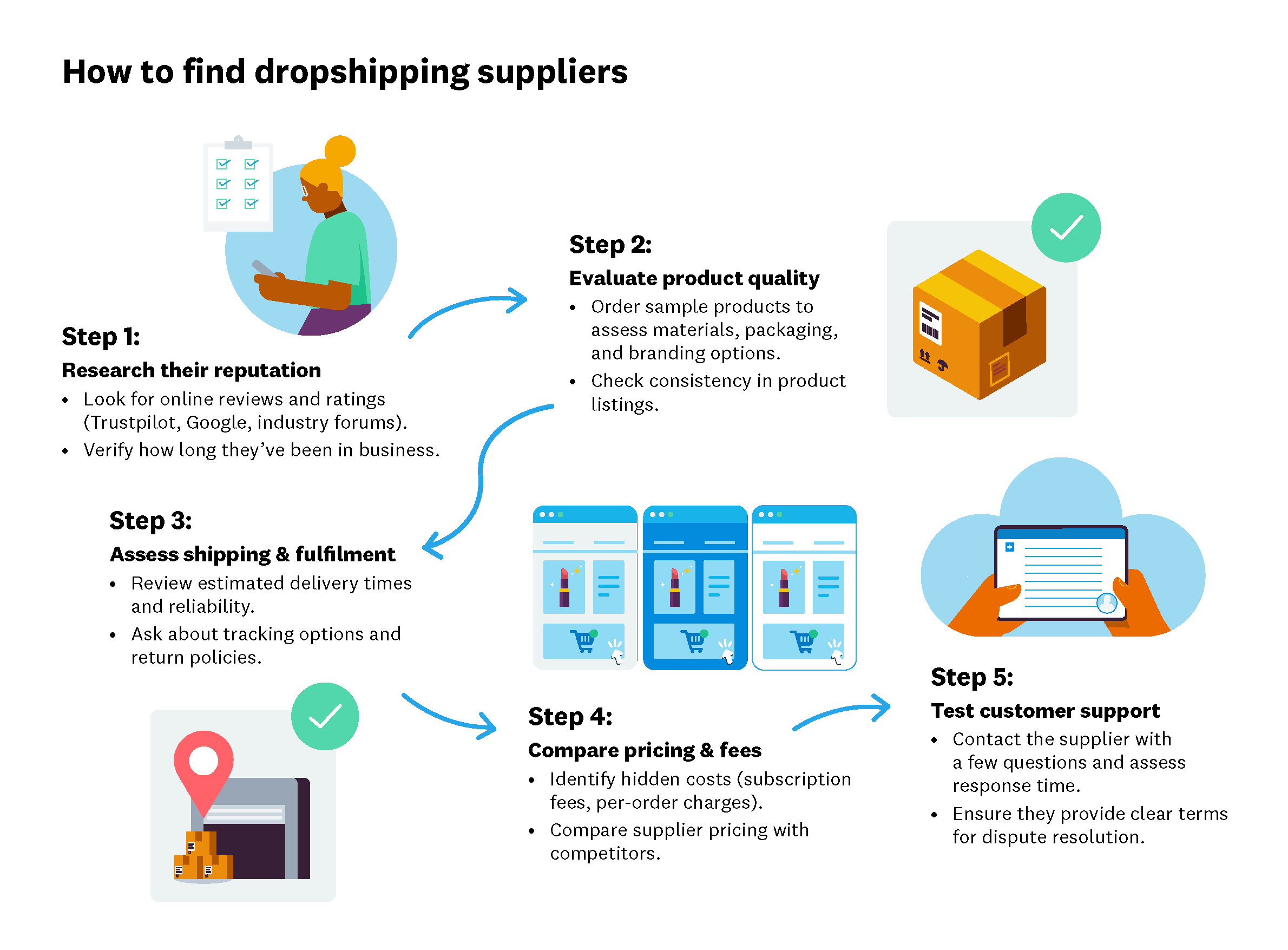
Finding dropshipping suppliers goes beyond the major platforms. Use these methods to discover reliable partners:
- Search supplier directories: Use platforms like SaleHoo, Spocket, or Wholesale2B to browse pre-vetted suppliers and products.
- Contact manufacturers directly: Reach out to product makers who may offer dropshipping arrangements.
- Use search engines: Try terms like "wholesale dropshipping Canada," "dropshipping service," or your product category plus "supplier."
- Browse marketplaces: Search Amazon, eBay, or Etsy for products, then research sellers to establish direct relationships.
- Reverse-engineer competitors: Purchase from suspected dropshippers and check the return address to identify their supplier.
- Attend trade shows: Meet suppliers in person at industry events to build relationships and negotiate terms.
You can also work directly with wholesalers once you've established a customer base. This approach may offer better bulk pricing, though many wholesalers require upfront purchases.
Tips for contacting and negotiating with dropshipping suppliers
Building strong supplier relationships requires clear communication and professionalism.
- Research thoroughly: Check online reviews for product quality, shipping times, and pricing, even for suppliers from trusted directories.
- Communicate expectations: State your requirements, concerns, and expectations clearly to create a fair agreement.
- Stay flexible: Be firm on your standards but open to supplier capabilities and constraints.
- Build long-term relationships: Offer ongoing business in exchange for discounts or benefits, or suggest a trial period before committing.
- Consider their perspective: Understand supplier profit margins and targets before negotiating price.
- Remain professional: Come prepared with business information and treat all suppliers fairly, whether you partner with them or not.
How to evaluate dropshipping suppliers
Dropshipping suppliers vary in quality and reliability. Before committing to a partnership, assess these key factors:
- Order product samples: Test quality firsthand before listing products in your store
- Check shipping times: Place test orders to verify actual delivery speeds match advertised times
- Assess communication speed: Send enquiries and note response times, as this reflects how they'll handle customer issues
- Review pricing transparency: Confirm all fees upfront, including shipping, handling, and any hidden charges
- Verify platform integration: Ensure the supplier connects with your ecommerce platform for automated order processing
- Understand return policies: Clarify who handles returns and refunds, and how the process works for customers
- Research supplier history: Check how long they've been operating, read third-party reviews, and look for verified certifications
A supplier that performs well across these criteria will help you deliver consistent customer experiences and protect your business reputation.
Is dropshipping worth it in Canada?
Dropshipping is worth it if you're prepared for the work involved. You can set up quickly and cost-effectively, but success requires managing multiple moving parts, especially when working with overseas suppliers.
According to market analysis, Canada's dropshipping market generated a revenue of USD 7,485.3 million in 2023 and is projected to grow to over $26 billion by 2030. Increased competition means tighter margins. You'll need strong customer service and efficient operations to succeed.
Dropshipping is legal in Canada, provided you meet business registration requirements and comply with Goods and Services Tax/Harmonized Sales Tax (GST/HST) regulations. You must also check that your products can be legally sold in Canada, as some items are prohibited from manufacturing, importing, or selling—such as polycarbonate baby bottles containing BPA—particularly when sourcing from overseas suppliers.
Canadian dropshippers need to consider several legal and regulatory requirements:
- Register your business: Obtain a GST/HST number if your revenue exceeds a small supplier threshold of $30,000 in gross taxable sales over four consecutive quarters.
- Verify product compliance: Confirm products meet Canadian import and safety regulations, which includes the responsibility to maintain certain records for at least six years.
- Comply with tax requirements: Charge and remit appropriate sales taxes.
- Factor in shipping times: Consider delivery expectations when choosing suppliers.
Find out more in What is dropshipping and How to dropship.
Managing your dropshipping business finances
Tracking income and expenses across multiple suppliers requires the right tools and processes. Without clear financial visibility, it's hard to know which products are actually profitable.
Dropshippers face several key financial challenges:
- Track cost of goods sold (COGS): Calculate true profit margins when supplier costs vary.
- Manage cash flow gaps: Handle timing differences between customer payments and supplier invoices.
- Multi-currency transactions: Convert and track payments when working with international suppliers.
- GST/HST compliance: Charge, track, and remit the correct sales taxes for Canadian customers.
Accounting software can help you manage these challenges:
- Automate bank reconciliation: Match transactions automatically instead of manual entry.
- Integrate with ecommerce platforms: Sync sales data from Shopify, WooCommerce, or other stores.
- Generate real-time reports: See profitability by product, supplier, or time period.
- Simplify tax filing: Track GST/HST collected and prepare for filing.
Cloud-based accounting software lets you monitor your finances from anywhere and spend less time on bookkeeping. This frees you to focus on growing your business rather than managing spreadsheets.
Start your dropshipping business with confidence
Finding the right dropshipping supplier is crucial for your business success. Research thoroughly, test with samples, and build relationships that support your growth.
As your dropshipping business scales, keeping track of finances across multiple suppliers becomes essential. Cloud-based accounting software can automate income tracking, manage cash flow, and simplify GST/HST compliance.
Get one month free to see how Xero can help manage your ecommerce finances. Find out more about starting an online business, explore Xero's ecommerce accounting software, or browse ecommerce apps in the Xero App Store.
FAQs on dropshipping suppliers in Canada
Find answers to common questions about finding and working with dropshipping suppliers in Canada.
What is the best dropshipping platform in Canada?
The best platform depends on your priorities. SaleHoo and Spocket offer Canadian and North American suppliers with faster shipping. AliExpress provides the widest product selection at low costs. Wholesale2B focuses on the Canadian and US markets with multi-platform integration.
Is dropshipping still profitable in 2025 in Canada?
Yes, dropshipping can be profitable in 2025. Success requires focused effort on niche products and customer service. Canada's dropshipping market is projected to reach $26 billion by 2030 and is expected to grow at a compound annual growth rate (CAGR) of 19.7%. Increased competition means tighter margins and the need for strong customer service and efficient financial management.
Do I need a business licence to dropship in Canada?
Yes, you'll typically need to register your business and may require additional licences. Requirements vary by province. They generally include business registration and a GST/HST number if revenue exceeds $30,000. You may also need municipal business licences. Consult your provincial business registry for specific requirements.
How long does shipping take with Canadian dropshipping suppliers?
Canadian suppliers typically deliver within 3 to 7 business days domestically. North American suppliers ship within 5 to 10 business days. Overseas suppliers, particularly from Asia, can take 15 to 30 days or longer with standard shipping.
Can I use multiple dropshipping suppliers at once?
Yes, many successful dropshippers work with multiple suppliers to diversify products and reduce risk. This approach works best when your systems can handle varying shipping times and supplier communications. Make sure your systems can handle inventory tracking and customer service processes.
Disclaimer
Xero does not provide accounting, tax, business or legal advice. This guide has been provided for information purposes only. You should consult your own professional advisors for advice directly relating to your business or before taking action in relation to any of the content provided.
Start using Xero for free
Access Xero features for 30 days, then decide which plan best suits your business.