Redundancy compliance requirements for 15+ employee businesses
Learn what a genuine redundancy is and how to meet legal, payroll, and reporting requirements for multiple employees.

Written by Chelsea Heywood—Small business growth and marketing writer. Read Chelsea's full bio
Published 11 March 2026
Table of contents
Key takeaways
- For a genuine redundancy under the National Employment Standards, you must implement real operational change, consult with employees, and assess redeployment options fairly.
- Most businesses with 15 or more employees must provide redundancy pay based on an employee's continuous service and any extra conditions in their award or enterprise agreement.
- If many roles are affected, notify Services Australia and any relevant unions as soon as possible to comply with redundancy legislation in Australia.
- Payroll software like Xero helps you calculate notice and redundancy payments accurately, classify employment termination payments, and report through Single Touch Payroll Phase 2.
Why redundancy compliance matters for businesses
Running a redundancy affects people and their finances, and your legal obligations. You need to comply with redundancy legislation in Australia. For businesses with 15 or more employees, the Fair Work Act sets minimum standards for consultation, notice, and payment.
A clear, well-documented redundancy process protects your business and gives employees clarity and respect during a difficult time.
What is a genuine redundancy under the NES?
A genuine redundancy under the National Employment Standards (NES) means the job itself is no longer needed. This could happen because of workforce restructuring, new technology, cost pressures, or the closure of a business unit.
In this process you must consult with affected employees, consider alternative roles that could be suitable for them (redeployment), and follow the rules set out in their award or enterprise agreement.
Notice and redundancy pay
Employees are generally entitled to both notice (or pay in lieu of notice) and redundancy pay. The amount of redundancy pay depends on the employee’s length of service and whether they meet certain conditions.
NES redundancy pay scale by service length
Redundancy pay increases with continuous service. Under the NES, employees receive between 4 and 16 weeks redundancy pay:
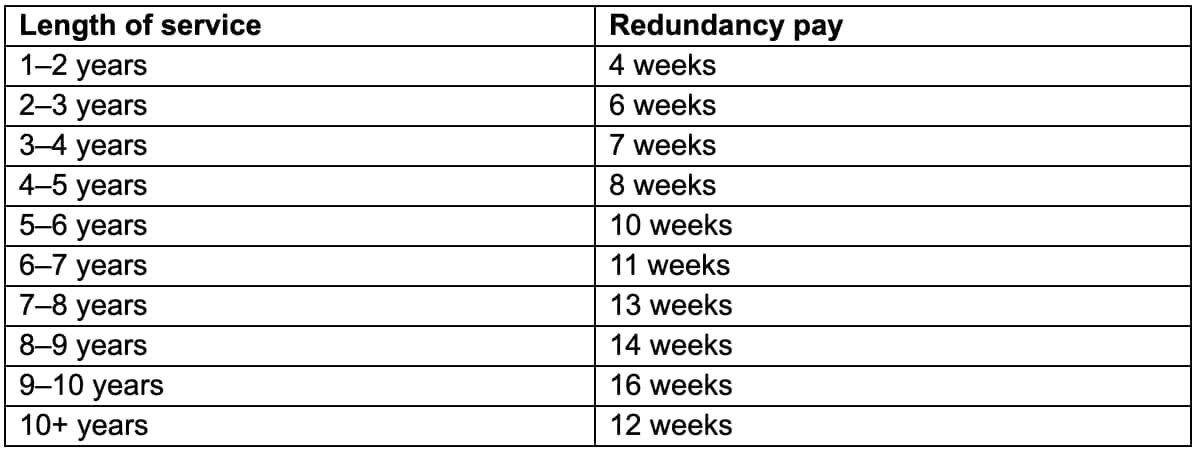
Service is counted from the employee’s start date, excluding breaks not counted as service under the Fair Work Act (for example, unpaid leave that doesn’t count as service).
Here’s more information on redundancy notice periods and pay from the Fair Work Ombudsman.
Cases where redundancy pay does not apply
As set out by the Fair Work Ombudsman, redundancy pay doesn’t apply to:
- employees with less than 12 months’ service
- employees working for a specific project or time period (including seasonal)
- casual workers
- apprentices
- trainees working for a specific training period only
- employees of 'small business employers' (fewer than 15 staff members)
- employees who reject a reasonable redeployment offer
Some modern awards or enterprise agreements have their own redundancy rules in Australia. These may override requirements in the Fair Work Act, so check the awards and enterprise agreements for each of your employees when preparing for redundancy.
Check awards or agreements for instances of:
- different redundancy pay amounts
- different consultation requirements, such as longer notice periods, extra meetings or formalities
- extra steps before redundancy, such as training, re-skilling, or more extensive redeployment efforts
- industry-specific exemptions – for example, building and construction and cleaning awards
- shutdown or seasonal clauses
Notice period vs pay in lieu
If you need to terminate multiple employee contracts, you must give written notice of termination, with a notice period based on their years of service.
Here are the the notice periods you need to give an employee according to their length of continuous service:
- up to 1 year: 1 week
- 1–3 years: 2 weeks
- 3–5 years: 3 weeks
- more than 5 years: 4 weeks
For any employee over 45 and with more than 2 years of service, you must give them an extra week’s notice.
You can choose to let employees work out the notice period, or pay them in lieu of notice (pay their wages for the notice period) instead of having them work.
Payment during the notice period and redundancy pay are separate payments.
Tax on redundancy and employment termination payments
A genuine redundancy payment gets concessional tax treatment – meaning that part of the payment is tax- free up to a limit. This limit increases with age and service.
Any extra payments, like pay in lieu of notice or unused leave, are taxed at special rates by the ATO as employment termination payments (ETPs). These rates depend on the employees’ ages and how big the payments are:
- If employees are old enough to access their super, the taxable part of their ETP is usually taxed at up to 17%, up to a yearly cap.
- For younger employees, ETPs are usually taxed at up to 32%, up to the same cap.
For the 2024/25 financial year, the cap is $245,000. Anything above that is taxed at the top rate. There’s also a second ‘whole-of-income’ cap of $180,000. This can reduce how much of an ETP receives the lower tax rate if an employee has earned other income in the same year.
You’ll need to give employees a written breakdown of how this applies to their redundancy payments, so they can understand how each part is taxed. You must also report ETPs to the ATO separately from normal wages, with each component (like notice, unused leave, or other taxed amounts) shown under the correct ETP code.
How to run a compliant redundancy process in Australia
A lawful redundancy process is more than just calculating payments. You must show the role is no longer needed, consult employees and unions properly, explore redeployment options, and document every step.
1. Plan the restructure and confirm business reasons
Start by clearly documenting why your business no longer needs the affected roles. Explain this in terms of reduced demand, new systems, cost-saving measures, or organisational changes, for example.
Your document should outline which teams or functions are changing and how these changes affect certain roles.
2. Consult with employees and unions
You’re legally required to consult with employees under the NES and most awards.
Make sure to:
- tell employees in writing that their role is at risk
- explain the business reasons
- give them a chance to respond and to offer alternatives
- consider their feedback before making a decision
If an employee is covered by a union or an enterprise agreement, you may also need to consult the union.
3. Assess redeployment across the business
Check whether there are any suitable roles for your employees within your business or any associated entities. This would be a job your staff could reasonably do with their skills and experience, even with some training or adjustments.
Keep written records of roles considered and why employees were or weren't suitable.
4. Select roles fairly and document criteria
If you have several employees in similar roles, you need a fair and consistent selection method. Consider:
- the specific skills needed in the new structure
- performance of each of your staff members
- qualifications needed for the alternative job
- the effect on operations
Avoid subjective or discriminatory criteria. Write down how each role was assessed to support your decision in case it’s challenged.
5. Notify Services Australia if 15 or more employees are affected
If you’re making 15 or more employees redundant, you must give Services Australia written notification as soon as possible. This helps your staff access help for future employment, income support, and financial advice.
Use the Services Australia guidance and include the number and types of employees affected. Services Australia also provides information sessions during this process.
6. Issue a termination notice and calculate final pay
Provide a written notice of termination to every affected employee. The notice should set out their:
- final day of employment
- notice period or pay in lieu
- redundancy payment amount
- accrued leave pay, if any
- award or enterprise agreement entitlements, if any
The employees’ final pay must include:
- the redundancy payment
- pay in lieu of notice (if applicable)
- accrued annual leave
- accrued or pro-rata long service leave, if needed
- outstanding wages, allowances, or commissions
7. Report terminations through STP Phase 2
Single Touch Payroll (STP) Phase 2 requires employers to report termination details directly to the ATO. Some include:
- Reason for termination for each employee (redundancy)
- Lump sum payments like unused leave
- ETP payments
- Tax-free redundancy amounts
Accurate information ensures employee tax is calculated correctly and helps you simplify end-of-financial-year income statements.
Redundancy and unfair dismissal
If an employee lodges an unfair dismissal claim after a redundancy, the Fair Work Commission will review whether the redundancy was genuine and confirm your business followed correct procedures.
They will look at consultation, redeployment efforts, notice, and redundancy pay – so keep clear records of each step to help your business demonstrate compliance and defend the decision.
Keep records in case of Fair Work or ATO audits
Good records help you prove the redundancy process was fair, consistent, and not discriminatory. They protect your business and make Fair Work or ATO audits easier to manage.
Your records should include documentation of your consultation process, redeployment efforts, and payroll details.
Consultation notes and letters
Documenting your conversations shows you’ve handled redundancies fairly and transparently. Save all documents relating to your consultation process, including:
- meeting notes
- letters to employees
- emails
- feedback provided by employees on your redundancy proposals
- your responses to employee suggestions
Selection criteria and redeployment evidence
When you’re deciding whether and how to redeploy staff to suitable alternative roles, keep a detailed record of:
- how you chose roles for redeployment
- any scoring tools or criteria you used to decide which employees should take the alternative jobs
- redeployment checks and outcomes
- any reasons a role was or was not suitable
Payroll calculations and STP Phase 2 reports
Accurate payroll records make final payments clear. Keep copies of:
- redundancy calculations
- notice and leave payments
- evidence of tax treatment
- your STP Phase 2 submissions and confirmations like submission receipts and error or exception reports
Storing these calculations and reports ensures you can easily answer employees' questions or support your decisions during an audit.
Xero simplifies your redundancy compliance
Xero helps you manage redundancies by automating calculations, storing records, and reporting through STP Phase 2.
Xero reduces manual work for your business and lowers the risk of error by centralising payroll, employee data, and reporting. It lets you run payroll, generate termination pay, and produce the correct lump sum and ETP reporting codes – all in one place.
And Xero helps you prepare for any audits by securely storing digital records of payslips, final pay runs, and STP submissions, so everything is clear and accurate.
FAQs on redundancy compliance
Below are answers to the most common questions employers ask when managing redundancies.
What are the rules for redundancy in Australia?
The Fair Work Act sets the rules for redundancy. As an employer you must show the job is no longer required, consult with employees and unions (if any), consider redeployment for the affected employee, give them proper notice, and pay redundancy unless an exemption applies.
Make sure you check the relevant awards and enterprise agreements for any extra steps or relevant factors that apply to your employees.
How much is redundancy pay?
Redundancy pay under the NES depends on how long an employee has worked continuously for the business. Staff with 1–2 years of service receive 4 weeks’ pay, and this increases with longer service up to a maximum of 16 weeks for 9–10 years of service.
Some employees may be excluded, such as those with less than 12 months’ service, casual staff, or small business employees, so check the NES and any relevant award or enterprise agreement for your staff.
What is the ‘4-week rule’ for redundancy?
This rule refers to the minimum redundancy payment an employee is entitled to under the National Employment Standards (NES), after their first year of service.
What are the requirements for a large-scale redundancy?
A large-scale redundancy happens when 15 or more employees are being made redundant at the same time.
If you’re making a significant number of employees redundant, you must notify Services Australia in writing. This helps staff access government support like employment services and financial guidance. Some awards or enterprise agreements may also require extra steps, such as consulting unions or following specific internal processes.
Can I reduce redundancy pay?
Redundancy pay can only be reduced if the employee rejects a reasonable redeployment offer, or if the employer applies to the Fair Work Commission to vary the redundancy pay (due to financial hardship, for example). Employers with fewer than 15 employees may be exempt from paying redundancy pay entirely.
Does redundancy pay include super?
No – redundancy pay itself doesn’t require super contributions.
However, other elements of final pay – such as pay in lieu of notice or unused annual leave – may require super, depending on the relevant award or enterprise agreement. So check the awards and your employees’ enterprise agreements before processing final pay in payroll.
How do I treat long-service leave on redundancy?
Some employees that are being made redundant may be owed long-service leave. Even if they haven’t worked long enough to get their full long-service leave entitlement, they could still get a proportion of it based on how long they’ve worked.
The exact rules differ depending on your state or territory, so check the law where your business is.
Do probationary employees get redundancy pay?
Employees with less than 12 months’ service are not entitled to redundancy pay under the NES, even if they are still on probation. But you must still give them formal notice or pay in lieu.
Disclaimer
Xero does not provide accounting, tax, business or legal advice. This guide has been provided for information purposes only. You should consult your own professional advisors for advice directly relating to your business or before taking action in relation to any of the content provided.
Get one month free
Purchase any Xero plan, and we will give you the first month free.