Gearing ratio: what it is, why it matters, how to calculate
Learn how gearing ratio helps you assess your business debt and calculate it with confidence.

Written by Shaun Quarton—Accounting & Finance Content Writer and Growth Marketer. Read Shaun's full bio
Published Monday 20 April 2026
Table of contents
Key takeaways
- Calculate your gearing ratio using the debt-to-equity formula (total debt ÷ total equity × 100) to understand how much of your business is funded by borrowed money versus owner investment.
- Aim for a gearing ratio between 25% and 50%, as this range balances access to growth funding with financial stability, though your ideal ratio will vary depending on your industry and business goals.
- Monitor your gearing ratio at least quarterly so you can spot early signs of financial strain, make smarter borrowing decisions, and show lenders and investors that your business is financially sound.
- Reduce a high gearing ratio by paying down high-interest debt, reinvesting profits to build retained earnings, and selling assets you no longer need to free up cash.
Gearing ratio definition
A gearing ratio is a financial metric that measures how much of your business is funded by debt compared to equity. This balance directly impacts your financial risk and growth potential.
To calculate your gearing ratio, you need to understand two components:
- Debt: Borrowed money such as loans and lines of credit that you must repay with interest
- Equity: The owner's investment in the business, including retained earnings and share capital
Lenders, investors and stakeholders use gearing ratios to assess financial stability and determine the level of risk associated with your business, especially since an unsecured loan to a small business carries a significantly higher risk weight for banks than residential mortgages. Banks, for example, calculate a capital adequacy ratio as the amount of capital relative to its 'risk-weighted assets' to determine the level of risk associated with lending to a business.
- Higher ratio: Greater reliance on debt, increased financial risk but potential for higher returns
- Lower ratio: Stronger equity position, reduced risk but potentially limited growth opportunities
Your gearing ratio provides essential insights into your business's financial structure and helps you plan sustainable growth.
Why does your gearing ratio matter?
Tracking your gearing ratio helps you make smarter financial decisions and plan for sustainable growth. Specifically, it helps you:
- Borrowing decisions: Assess whether you can take on more debt without straining cash flow or increasing financial risk
- Investor appeal: Signal financial stability to make your business more attractive to potential funders
- Strategic planning: Align your debt-to-equity mix with growth goals, whether targeting rapid expansion or steady, low-risk growth
- Cash flow management: Free more cash for reinvestment with a lower ratio, or allocate more to debt repayments with a higher ratio
- Risk identification: Spot financial pressures early so you can act before they escalate
Understanding these different gearing ratios can help you choose the right metric for your business needs.
Types of gearing ratios
Four main gearing ratios help small businesses measure financial leverage and risk:
- Debt-to-equity ratio: Compares total debt to total equity, showing how much of the business is funded by creditors versus owners
- Debt-to-capital ratio: Measures the share of total capital funded by debt, where higher ratios indicate greater reliance on borrowing
- Equity ratio: Shows how much of your total assets are financed by equity, where higher ratios indicate stronger financial stability and lower risk
- Times interest earned (TIE) ratio: Shows how easily you can cover interest payments with pre-tax earnings, where higher ratios reassure lenders you can meet debt obligations
Calculating your gearing ratio requires a clear understanding of your business's debt and equity position.
How to calculate the gearing ratio
Follow these four steps to calculate your gearing ratio:
1. Calculate total debt
Add up all financial liabilities your business owes. Include bank loans, credit lines, bonds, equipment financing and any other borrowed funds.
2. Determine total equity
Calculate the owner's total investment in the business. Add together share capital, retained earnings and any additional capital contributions.
3. Apply the formula
Use one of these common formulas:
- Debt-to-equity formula: Gearing ratio = (Total Debt ÷ Total Equity) × 100
- Debt-to-capital formula: Gearing ratio = (Total Debt ÷ (Total Debt + Total Equity)) × 100
4. Interpret the result
- Higher percentage: Indicates greater reliance on debt financing
- Lower percentage: Shows a stronger equity position with less borrowed funds
Seeing how these calculations work in practice makes the concept clearer.
Example gearing ratio calculations
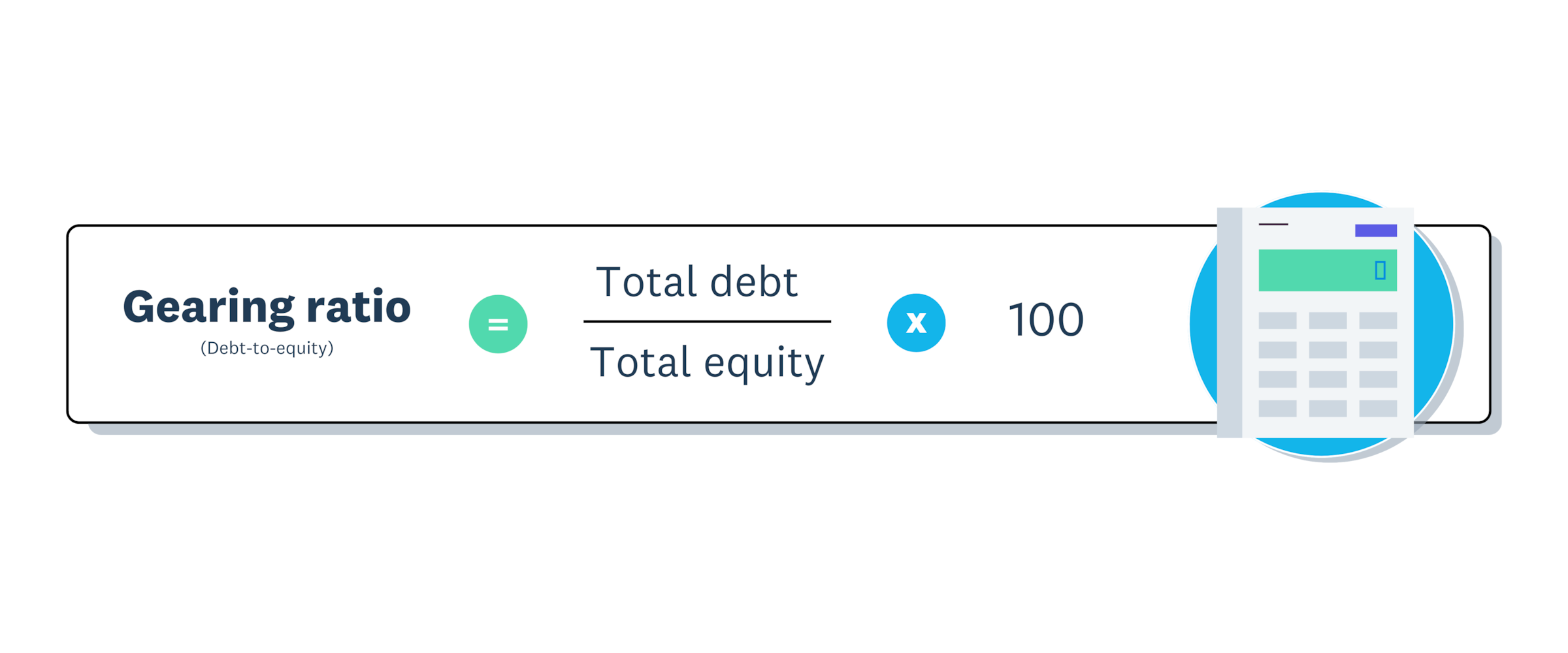

Here's how to calculate gearing ratios using a practical example:
Business figures:
- Total debt: $50,000
- Total equity: $100,000
Debt-to-equity calculation:
Gearing ratio = (Total debt ÷ Total equity) × 100
Gearing ratio = ($50,000 ÷ $100,000) × 100
Gearing ratio = 50%
Debt-to-capital calculation:
Gearing ratio = (Total debt ÷ (Total debt + Total equity)) × 100
Gearing ratio = ($50,000 ÷ $150,000) × 100
Gearing ratio = 33.3%
What is a good gearing ratio?
A good gearing ratio typically falls between 25% and 50% for most small businesses. This range balances growth funding with financial stability. However, the ideal ratio depends on your industry, business size and goals.
Gearing ratio benchmarks:
- Low gearing (below 25%): Indicates lower financial risk but may mean missing growth opportunities through borrowed funds
- Moderate gearing (25% to 50%): Represents a healthy balance between debt-funded growth and financial stability
- High gearing (above 50%): Shows greater reliance on debt, which increases financial risk but can fuel faster expansion
Industry variations matter. Capital-intensive industries like construction or manufacturing often operate comfortably with higher ratios, while highly regulated sectors like insurance must maintain capital ratios of effectively at least 100 per cent. Service-based businesses typically prefer lower ratios due to fewer asset requirements.
Discuss your ratio with an accountant to determine what makes sense for your specific situation.
Understanding the difference between high and low gearing helps you choose the right strategy for your business.
High vs low gearing: what's the difference?
High and low gearing represent different funding strategies with distinct trade-offs.
High gearing means relying more on debt than equity:
- Benefits: Accelerates growth when sales are strong and provides capital for expansion
- Risks: Increases vulnerability to revenue drops and interest rate rises, with projections suggesting speculative-grade corporate default rates could reach 7% in the US
- Best for: Businesses with stable cash flow or high-growth industries requiring rapid expansion
Low gearing means using more equity and less debt:
- Benefits: Minimises financial risk, protects credit rating and ensures long-term stability, much like how banks use an additional 3.5–5.75 per cent in capital buffers to provide an extra cushion against losses
- Risks: Slower growth compared to debt-funded expansion
- Best for: Businesses prioritising security over rapid growth, especially in unstable markets
If you find your gearing ratio is higher than you'd like, you can take practical steps to improve it.
How to improve your gearing ratio
If your gearing ratio is higher than you'd like, take these practical steps to lower it:
- Pay down debt: Focus on repaying existing loans, especially those with high interest rates, to reduce total debt and improve your ratio
- Increase equity: Reinvest profits back into the business to build retained earnings and strengthen your equity position
- Boost profitability:Increase revenue or reduce operating costs so higher profits add to retained earnings over time
- Sell underused assets: Convert assets you don't need into cash to pay down debt or increase equity reserves
FAQs on gearing ratios
Here are answers to common questions about gearing ratios and how they affect your business.
What happens if my gearing ratio is too high?
A high gearing ratio means you rely heavily on debt, which increases financial risk. You may struggle to secure additional loans, face higher interest rates, and experience cash flow pressure from debt repayments. If revenue drops, you could face difficulty meeting your obligations.
Can a gearing ratio be too low?
Yes, a very low gearing ratio means you're not using borrowed funds to accelerate growth. While this reduces risk, it may mean you're missing opportunities to expand faster through strategic debt. The key is finding the right balance for your business goals.
How often should I calculate my gearing ratio?
Calculate your gearing ratio at least quarterly, or monthly if you're actively managing debt levels or seeking financing. Regular monitoring helps you spot trends early and make timely adjustments to your capital structure.
Does my gearing ratio affect my credit rating?
Yes, lenders review your gearing ratio when assessing creditworthiness. A high ratio may signal increased risk and lead to higher interest rates or loan rejections. Maintaining a healthy ratio improves your chances of securing favourable lending terms.
What's the difference between gearing ratio and leverage ratio?
The terms are often used interchangeably, but gearing ratio specifically compares debt to equity, while leverage ratio can refer to various debt-related metrics. Both help assess how much a business relies on borrowed funds versus owner investment.
Get one month free
Purchase any Xero plan, and we will give you the first month free.