Journal entries: a guide with definitions, types and examples
Learn what journal entries are, the different types, and how to record them accurately.

Written by Lena Hanna—Trusted CPA Guidance on Accounting and Tax. Read Lena's full bio
Published Friday 15 May 2026
Table of contents
Key takeaways
- A journal entry is a record of a business transaction that tracks money moving between accounts. Every entry must have equal debits and credits to keep your books balanced.
- Record journal entries by identifying the accounts involved, classifying each as a debit or credit, entering the date and description, and posting to your general ledger.
- Use different types of journal entries for specific needs, such as simple entries for basic transactions, compound entries for complex transactions affecting multiple accounts, and adjusting entries to correct accounts before preparing financial statements.
- Accounting software automates journal entry creation, reduces manual errors, and helps you meet financial reporting requirements.
What is a journal entry?
A journal entry is a detailed record of a business transaction that tracks money moving between accounts. Each entry shows what happened, when it happened, and which accounts were affected.
Journal entries are the foundation of your financial records. They ensure your books balance correctly and provide the accurate data needed for financial statements like your balance sheet and income statement.
Every journal entry follows the double-entry bookkeeping system, meaning each transaction is recorded in at least two accounts. This keeps your accounting equation (assets = liabilities + equity) in balance at all times.
Why are journal entries important?
Journal entries are essential because they create a complete, reliable record of every financial transaction in your business. Without them, your financial statements would be incomplete and potentially inaccurate.
Journal entries help you:
- Keep accurate records. Every transaction is captured, so your financial statements are reliable and up to date.
- Create a clear audit trail. You have documentation ready for tax time and to answer questions from your accountant or the Australian Taxation Office (ATO).
- Make informed decisions. You can see your finances clearly, track patterns, and plan for the future with confidence.
- Meet compliance requirements. The Australian Securities and Investments Commission (ASIC) requires most companies to lodge financial reports within four months after the end of the financial year. Accurate journal entries make this process straightforward.
How journal entries work
Journal entries work by recording every transaction twice: once as a debit and once as a credit. This is known as double-entry bookkeeping, and it ensures your books always balance.
Here is how the system works:
- Every transaction affects at least two accounts. Money moves from one place to another.
- Debits and credits must equal each other. If you debit $100, you must credit $100.
- The system prevents errors. Balanced entries mean your financial reports are reliable.
For example, if your business buys office supplies for $200 in cash, you would debit the office supplies account (increasing expenses) and credit the cash account (decreasing assets) by $200 each. The total debits equal the total credits, keeping your books balanced.
Your bookkeeper or accountant can explain how this applies to your specific transactions.
Understanding debits and credits in journal entries
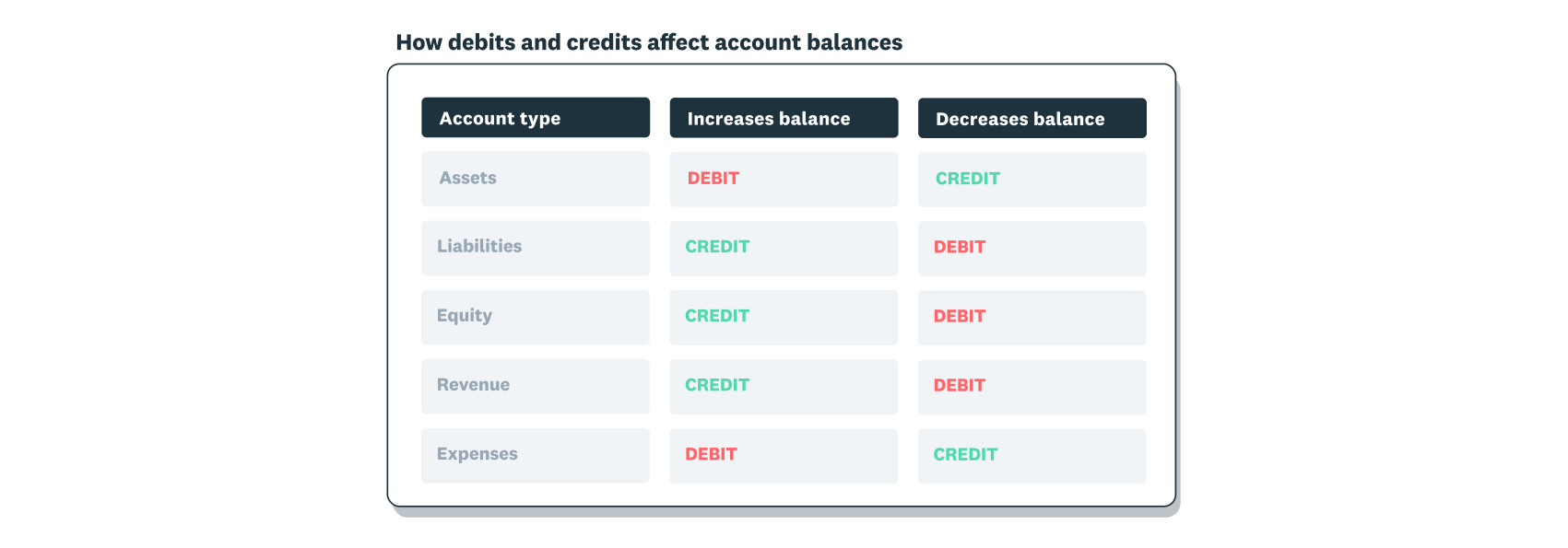
Debits and credits are the two sides of every accounting transaction. Understanding how they work is essential for recording accurate journal entries.
How debits work
Debits increase or decrease different account types depending on their category.
- Increase. Asset accounts (like cash, inventory, equipment)
- Increase. Expense accounts (like rent, supplies, wages)
- Decrease. Liability, revenue, and equity accounts
How credits work
Credits are the opposite of debits and affect accounts in the reverse direction.
- Increase. Liability, revenue, and equity accounts
- Decrease. Asset and expense accounts
The golden rule of journal entries is that every debit must have an equal credit. A $100 debit always requires a $100 credit. This balance is what keeps your financial records accurate and your accounting equation intact.
What to include in a journal entry
Every journal entry needs specific information to be complete and useful. Including all the required details makes your records easier to review and audit.
A complete journal entry includes:
- Date of the transaction. Record the exact date the transaction occurred, not when you entered it.
- Unique reference number. Assign a sequential number so you can easily locate and track each entry.
- Account names. List every account affected by the transaction.
- Debit and credit amounts. Record the dollar amount for each account, ensuring total debits equal total credits.
- Description. Write a brief explanation of the transaction, such as "office supplies purchase" or "monthly rent payment".
Types of journal entries in accounting
You use different types of journal entries for different transactions. Here are the most common types and when to use each one.
Simple journal entry

A simple journal entry affects only two accounts: one debit and one credit. When one account goes up, the other goes down by the same amount. You use this type for straightforward transactions like cash purchases or single payments.
Compound journal entry
A compound journal entry records one business event that affects more than two accounts. This organises related transactions in a single entry rather than splitting them across multiple entries.
Common situations where you would use compound entries:
- Payroll. Wages, taxes, and deductions all recorded in one entry
- Sales with multiple components. Product sales, shipping fees, and taxes
- Asset purchases. Equipment cost, delivery fees, and setup charges
The key rule remains the same: total debits must equal total credits, even when multiple accounts are involved.
Adjusting journal entry
Adjusting journal entries correct your accounts before you prepare financial statements. These entries are a key part of accrual accounting, which has a weighting of 10% on the CPA Australia Foundations of Accounting exam, and ensure your reports show the complete financial picture for the period.
Common adjusting entries include:
- Accrued expenses. Bills you owe but have not received yet
- Prepaid expenses. Services paid for but not yet used
- Deferred revenue. Money received for work not yet completed
- Depreciation. Spreading equipment costs over their useful life
For example, a construction company working on a three-month project would record one-third of the revenue each month, even if they only invoice at completion.
Opening journal entry
An opening journal entry records the balances carried forward from the previous financial period into the new one. You create this entry at the start of each accounting period to establish your beginning balances.
This entry typically debits all asset accounts and credits all liability and equity accounts, using the closing balances from the prior period. It ensures continuity between financial periods.
Transfer journal entry
A transfer journal entry moves amounts from one account to another within your books. You use this when reclassifying expenses, shifting funds between departments, or correcting account allocations.
For example, if you initially recorded an expense under "miscellaneous" but later determined it belongs under "marketing", you would create a transfer entry to move the amount to the correct account.
Reversing journal entry
A reversing entry corrects journal entries recorded in a previous period and simplifies future transactions. You typically reverse accruals at the start of a new period.
For example, if you accrued wages for work done in June but paid in July, you would reverse the accrual in July. This prevents the wages from being counted twice when you record the actual payment.
Recurring journal entry
You use recurring journal entries for regular transactions that happen at the same interval, such as monthly rent, insurance premiums, or subscription fees. Setting these up in your accounting software saves time and reduces the risk of missing routine entries.
Closing journal entry
A closing journal entry transfers balances from temporary accounts (revenue and expense accounts) to permanent accounts (like retained earnings). You create closing entries at the end of each financial period to reset your temporary accounts to zero, ready for the next period.
Correcting journal entry
A correcting journal entry fixes errors in previous entries. This is part of a wider system of financial management; "internal control and reconciliations" has a weighting of 15% on the CPA Australia Foundations of Accounting exam.
You use correcting entries for simple errors, such as recording a transaction in the wrong account. The correcting entry shows the amount was misposted and moves it to the correct account.
Journal entry examples
Seeing journal entries in action makes them easier to understand. Here are three common examples that show how different types of journal entries work in practice.
Example 1: simple journal entry (cash purchase)
The Cosy Cake Shop bought baking supplies worth $300 on 20 January. The bookkeeper increases the baking supplies account and decreases the cash account.
- Debit. Baking supplies: $300 (asset increases)
- Credit. Cash: $300 (asset decreases)
This simple entry shows an increase in baking supplies and a decrease in cash for the same amount.
Example 2: compound journal entry (payroll)
A small business records its monthly payroll of $5,000. After deducting $750 for PAYG withholding tax and $525 for superannuation, the employee receives $3,725.
- Debit. Wages expense: $5,000
- Credit. Cash: $3,725 (net pay to employee)
- Credit. PAYG withholding payable: $750
- Credit. Superannuation payable: $525
Total debits ($5,000) equal total credits ($3,725 + $750 + $525 = $5,000).
Example 3: adjusting journal entry (accrued expense)
At the end of March, a business has received electricity for the month but has not yet received the $400 bill.
- Debit. Electricity expense: $400
- Credit. Accrued expenses: $400
This adjusting entry ensures the expense is recorded in the correct period, even though the bill has not arrived.
How to record journal entries
Recording journal entries correctly keeps your financial records accurate and helps you avoid costly mistakes. Follow these steps for every transaction.
1. Identify the transaction and accounts involved
Start by asking two questions: "What did you receive?" and "What did you give up?" This helps you identify which accounts are affected.
Examples:
- Office supplies purchase. Cash decreases, office supplies increases
- Customer payment. Cash increases, accounts receivable decreases
- Loan payment. Cash decreases, loan payable decreases
2. Classify the transaction as a debit or credit
Decide whether each account will be debited or credited. Use the debit and credit rules outlined earlier: assets and expenses increase with debits, while liabilities, revenue, and equity increase with credits.
3. Record the date and transaction details
Enter the transaction date and a brief description, such as "office supplies purchase" or "quarterly rent payment". This keeps your bookkeeping clear and organised.
4. Enter debit and credit amounts
Enter the amounts in your debit and credit columns. Check that the total debit amount equals the total credit amount before proceeding.
5. Post to your general ledger and review
Once you have confirmed your debits and credits are equal, post them as general ledger entries. Check that the debit and credit amounts balance and your ledger accounts are accurate.
If you discover an error after posting, you can create a correcting journal entry to fix it.
Common journal entry mistakes to avoid
Even experienced bookkeepers can make mistakes with journal entries. Knowing the most common errors helps you catch them before they affect your financial statements.
- Unbalanced entries. Debits and credits do not equal each other. Always verify totals before posting.
- Wrong account classification. Recording a transaction in the wrong account type (for example, classifying an asset purchase as an expense). This distorts your financial reports.
- Missing descriptions. Leaving the description blank makes it difficult to understand the entry later, especially during an audit.
- Forgetting to post to the ledger. Recording the journal entry but not posting it to the general ledger means it will not appear in your financial statements.
- Duplicate entries. Recording the same transaction twice inflates your accounts. Cross-reference your bank statements to catch duplicates.
- Incorrect dates. Recording transactions on the wrong date can place revenue or expenses in the wrong financial period, affecting your reporting accuracy.
Simplify your journal entries with Xero
Accurate journal entries are the foundation of reliable financial records. By understanding the different types and following a consistent process, you can keep your books balanced and your business on track.
Xero accounting software automates your journal entries, keeps your records secure, and produces financial statements to help you track your business's financial health. With features like automatic bank feeds and reconciliation, you spend less time on manual data entry and more time running your business.
Get one month free today to get started.
FAQs on journal entries
Here are answers to frequently asked questions about journal entries.
How do I fill out a journal entry?
To fill out a journal entry, record the transaction date, list the accounts affected, enter the debit and credit amounts in the correct columns, and add a brief description. Verify that total debits equal total credits before posting to your ledger.
What are the 3 rules of journal entries?
The three golden rules are traditional principles for remembering how debits and credits work: debit the receiver and credit the giver; debit what comes in and credit what goes out; debit all expenses and losses, and credit all incomes and gains.
What is the difference between a journal and a ledger?
A journal is where you first record transactions in chronological order, while a ledger organises those entries by account. Think of the journal as your transaction diary and the ledger as your account summary. Entries flow from the journal to the ledger during the posting process.
What is the difference between simple and compound journal entries?
A simple journal entry affects only two accounts: one debit and one credit. A compound journal entry affects more than two accounts in a single entry. Payroll is a common example of a compound entry, involving debits to wage expenses and credits to multiple accounts for cash, tax payable, and superannuation.
Can I use accounting software to track journal entries?
Yes, accounting software automates journal entry creation, tracks all entries in one place, and produces financial reports. This saves time and reduces the risk of manual errors, helping you meet compliance deadlines with confidence.
How do you record a payment as a journal entry?
To record a payment, debit the expense or liability account (what you are paying for) and credit your cash or bank account (where the money comes from). For example, paying $500 rent means debiting rent expense for $500 and crediting cash for $500.
Disclaimer
Xero does not provide accounting, tax, business or legal advice. This guide has been provided for information purposes only. You should consult your own professional advisors for advice directly relating to your business or before taking action in relation to any of the content provided.