Net profit margin
Learn what net profit margin is, how to calculate it, and what a healthy margin looks like for your business.
Published Wednesday 12 August 2026
Table of contents

How to calculate net profit margin
Key takeaways


- Net profit margin measures the percentage of revenue that remains as profit after all expenses, interest and taxes have been deducted.
- The formula is net profit margin = (net profit ÷ revenue) × 100, where net profit is what remains after subtracting cost of goods sold, operating expenses, interest and tax from revenue.
- A healthy net profit margin varies by industry, but roughly 10% is often considered solid and 20% or above is strong.
- You can improve your net profit margin by increasing revenue, reducing operating costs, renegotiating supplier terms or reviewing your pricing strategy.
What is net profit margin?
Net profit margin is the percentage of your revenue that remains as profit after deducting all costs, including cost of goods sold, operating expenses, interest and taxes. To calculate it, divide your net profit by your total revenue and multiply by 100.
This metric matters because it shows how efficiently your business converts revenue into actual profit. Tracking it over time helps you compare performance across different periods and spot trends in your profitability. For a small business owner, understanding your net profit margin gives you a clearer picture of your financial health than looking at revenue alone.
Handy resources
Advisor directory
You can search for experts in our advisor directory
Profit & Loss template
Download Xero’s profit and loss statement template to show how much money your business is making
Financial reporting
Keep track of your performance with accounting reports
Disclaimer
This glossary is for small business owners. The definitions are written with their requirements in mind. More detailed definitions can be found in accounting textbooks or from an accounting professional. Xero does not provide accounting, tax, business or legal advice.
Net profit margin formula
The formula for net profit margin is:
Net profit margin = (net profit ÷ revenue) × 100
To use this formula, you need to understand each component. Revenue is the total amount your business earns from sales before any deductions. Cost of goods sold is the direct cost of producing or delivering your goods or services. Gross profit is revenue minus cost of goods sold.
Operating expenses include costs like rent, salaries, utilities and marketing that keep your business running. Interest refers to any payments on business loans or credit. Tax is the amount you owe to the South African Revenue Service (SARS) on your taxable income. Net profit is what remains after subtracting cost of goods sold, operating expenses, interest and tax from your revenue.
How to calculate net profit margin
Calculating your net profit margin takes a few straightforward steps. Follow this process using figures from your income statement.
- Find your total revenue for the period.
- Subtract your cost of goods sold from revenue to get your gross profit.
- Subtract your operating expenses, interest and tax from gross profit to get your net profit.
- Divide your net profit by your total revenue.
- Multiply the result by 100 to express it as a percentage.
Example of a net profit margin calculation
Consider a cleaning business in South Africa that earns R20,000 in revenue from office cleaning services during the month. The cost of services (cost of goods sold) is R8,000, which gives a gross profit of R12,000.
The business has operating expenses of R3,000 for items like transport and supplies, plus R4,000 in tax. These total R7,000. Subtracting R7,000 from the R12,000 gross profit leaves R5,000 in net profit.
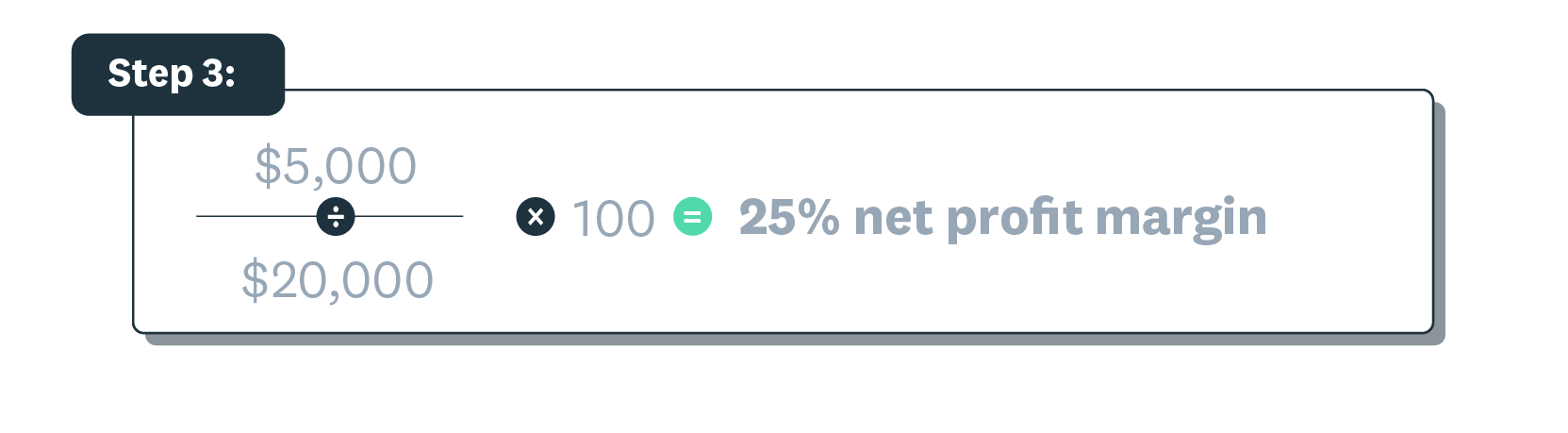
To find the net profit margin: R5,000 ÷ R20,000 = 0.25. Multiply by 100, and the net profit margin is 25%. This means the business keeps 25 cents of every rand earned as profit.
What is a good net profit margin?
There is no single figure that defines a good net profit margin, as it varies widely by industry. A consulting firm might achieve margins of 20% or higher, while a retail business often operates on much thinner margins.
As a general benchmark, a net profit margin around 10% is often considered healthy for many industries, and 20% or above is typically strong. The most useful comparison is against your own past performance and businesses similar to yours. If your margin is improving over time and competitive within your sector, you are on the right track.
How to interpret your net profit margin
Your net profit margin tells you how much of each rand of revenue becomes profit. A 25% margin means that for every R1 you earn, R0.25 remains after all expenses. The higher the percentage, the more efficiently your business converts sales into profit.
Tracking this metric over several months or years reveals trends. A rising margin suggests improving efficiency or pricing power, while a declining margin may signal rising costs or pricing pressure. Regular monitoring helps you catch problems early and measure the impact of changes you make to your business.
Net profit margin vs gross and operating profit margin
Net profit margin is one of several profitability metrics. Each measures a different layer of your business's financial performance, so understanding all of them gives you a fuller picture.
- Gross profit margin: revenue minus cost of goods sold, divided by revenue, times 100. It measures how efficiently you produce or deliver your core product or service.
- Operating profit margin: revenue minus cost of goods sold and operating expenses, divided by revenue, times 100. It shows profitability from core operations before interest and tax.
- Net profit margin: revenue minus all costs (cost of goods sold, operating expenses, interest and tax), divided by revenue, times 100. It reflects your overall profitability after every expense.
How to improve your net profit margin
Improving your net profit margin means either increasing revenue or reducing costs. Here are practical strategies to consider.
- Grow revenue by expanding your customer base, upselling existing customers or adding new products and services.
- Reduce operating costs by reviewing recurring expenses and cutting those that do not contribute to growth.
- Renegotiate supplier terms to lower your cost of goods sold.
- Review your pricing to ensure it reflects the value you deliver and covers your costs adequately.
Limitations of net profit margin
While net profit margin is a valuable metric, it has limitations. One-off items like asset sales or large legal fees can distort your margin in a given period, making it look unusually high or low.
Businesses with different capital structures will have different interest expenses, affecting comparability. Similarly, depreciation methods and tax strategies vary, which can skew comparisons between companies. For the most meaningful insights, compare your net profit margin against businesses in the same industry and use it alongside other financial metrics.
Track your net profit margin with Xero
Xero's accounting software makes it straightforward to monitor your profitability over time. With real-time financial reports, you can see your revenue, expenses and net profit at a glance, without waiting for month-end.
For South African small businesses, Xero brings all your financial data into one place, helping you spot trends and make confident decisions. You can get one month free and see how Xero's reporting tools give you the clarity you need to grow your business.
FAQs on net profit margin
Here are answers to common questions about net profit margin.
What is a good net profit margin?
A good margin depends on your industry. Roughly 10% is often healthy, while 20% or above is strong. Compare against industry peers and your own historical performance for the most useful benchmark.
What is the difference between net profit margin and gross profit margin?
Gross profit margin only deducts cost of goods sold from revenue, while net profit margin deducts all expenses including operating costs, interest and tax. Net profit margin gives a fuller picture of overall profitability.
How can I improve my net profit margin?
Focus on increasing revenue through pricing adjustments or sales growth, and reduce costs by reviewing expenses and negotiating better supplier terms. Small improvements on both sides compound over time.
Can net profit margin be negative?
Yes, a negative net profit margin means your business is operating at a loss. This happens when total expenses exceed revenue, and it signals the need to review costs or pricing urgently.
What does a 20% net profit margin mean?
A 20% net profit margin means you retain R0.20 of every rand earned as profit after all expenses. This is generally considered a strong margin in most industries.