How to calculate operating profit
Learn the operating profit formula and how to calculate it for your business.
Published Thursday 23 July 2026
Table of contents
Key takeaways
- Operating profit shows how much money your business earns from its core activities after subtracting operating expenses, but before interest and tax.
- The operating profit formula is: gross profit minus operating expenses. You can also calculate it as revenue minus cost of goods sold (COGS) minus operating expenses.
- A healthy operating profit margin varies by industry, but tracking yours over time helps you spot trends, control costs and make better financial decisions.
- Cloud accounting software like Xero makes it easier to track your revenue, costs and expenses in real time so you can calculate operating profit without the manual work.
What is operating profit?
Understanding operating profit gives you a clear picture of how well your business performs day to day.
Operating profit is the amount your business earns from its core activities after subtracting operating expenses, but before accounting for interest and tax. It's also called operating income or earnings before interest and tax (EBIT).
Unlike net profit, operating profit focuses purely on your business operations. It strips out financing costs and tax, so you can see whether your core business is actually making money.
For example, if you run a bakery, your operating profit reflects what you earn from selling cakes and bread after paying for ingredients, staff wages, rent and utilities. It doesn't include your loan repayments or corporation tax bill.
Why operating profit matters
Knowing your operating profit helps you make smarter decisions about your business finances.
Operating profit tells you whether your core business model is profitable. A positive operating profit means your day-to-day operations bring in more money than they cost. A negative one means your expenses are too high relative to your revenue.
Here's why it's a useful figure to track:
- It shows how efficiently you're running your business, separate from your financing and tax situation.
- It helps you compare performance across different periods to spot trends.
- Lenders and investors often look at operating profit to assess your business health.
- It highlights whether rising costs or falling revenue are affecting your bottom line.
If you're reporting to HMRC or preparing for Making Tax Digital, understanding your operating profit can also help you keep your records accurate and up to date.
The operating profit formula
The formula for operating profit is straightforward once you know the key components.

How to calculate operating profit
The basic operating profit formula is:
Operating profit = gross profit - operating expenses
You can also express this in expanded form:
Operating profit = revenue - cost of goods sold (COGS) - operating expenses - depreciation - amortisation
Here's what each term means:
- Revenue: the total income your business earns from sales before any deductions.
- Cost of goods sold (COGS): the direct costs of producing or purchasing the goods you sell, such as raw materials and manufacturing labour.
- Operating expenses: the ongoing costs of running your business, including rent, utilities, salaries, insurance and office supplies.
- Depreciation: the gradual reduction in value of physical assets like equipment or vehicles.
- Amortisation: the gradual reduction in value of intangible assets like patents or software licences.
How to calculate operating profit step by step
Follow these steps to calculate your operating profit using real figures from your business.

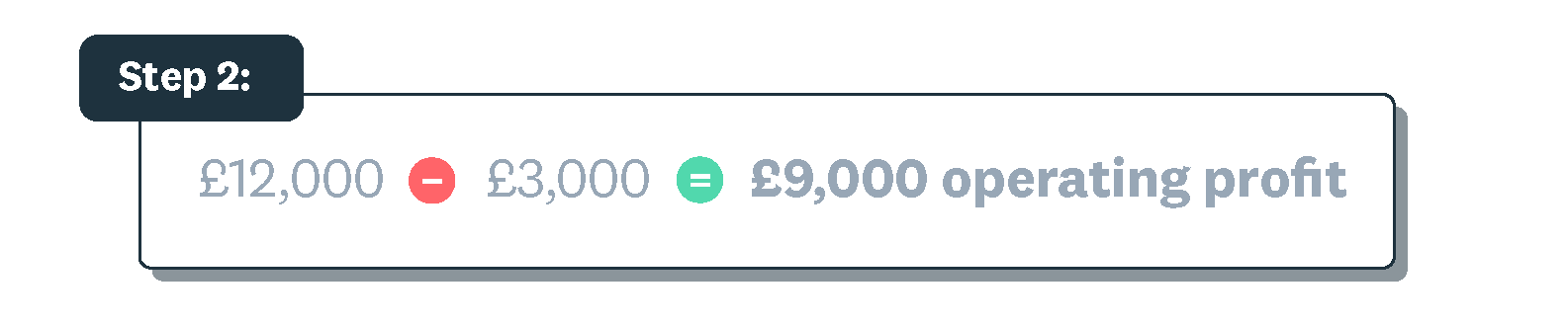
For this example, imagine you run a small retail business in the UK. Here are your figures for the year:
- Revenue: £500,000
- Cost of goods sold: £200,000
- Staff wages: £120,000
- Rent: £36,000
- Utilities: £12,000
- Insurance: £6,000
- Depreciation: £10,000
- Amortisation: £4,000
1. Calculate your gross profit
Start by subtracting your cost of goods sold from your total revenue.
Gross profit = revenue - COGS
Gross profit = £500,000 - £200,000 = £300,000
2. Add up your operating expenses
Next, total all your operating expenses. These are the costs of running your business that aren't directly tied to producing goods.
Operating expenses = wages + rent + utilities + insurance + depreciation + amortisation
Operating expenses = £120,000 + £36,000 + £12,000 + £6,000 + £10,000 + £4,000 = £188,000
3. Subtract operating expenses from gross profit
Now apply the operating profit formula.
Operating profit = gross profit - operating expenses
Operating profit = £300,000 - £188,000 = £112,000
4. Review your result
Your operating profit of £112,000 means your core business operations earned £112,000 before interest and tax. This figure doesn't include loan repayments, investment income or your corporation tax bill.
If you use profit and loss reports in your accounting software, you can pull these figures automatically instead of calculating them by hand.
Operating profit vs gross profit vs net profit
These 3 profit figures each tell you something different about your business finances.
Gross profit is your revenue minus the direct cost of goods sold. It shows how much you earn from sales before accounting for any business running costs. If your gross profit is low, your pricing or production costs may need attention.
Operating profit goes a step further. It subtracts all your operating expenses from gross profit, including rent, wages, depreciation and amortisation. It shows whether your core business operations are profitable.
Net profit is the bottom line. It takes operating profit and subtracts interest payments and tax. Net profit is the amount your business actually keeps after all costs.
Here's a quick summary using the example figures above:
- Gross profit: £300,000 (revenue minus COGS)
- Operating profit: £112,000 (gross profit minus operating expenses)
- Net profit: this would be £112,000 minus any interest and tax your business owes
Each figure has its place. Gross profit helps you assess pricing. Operating profit shows operational efficiency. Net profit gives you the full picture. For a worked example showing all three, see this profit and loss statement example.
Is operating profit the same as EBIT?
These 2 terms are closely related, but there's a subtle difference worth knowing.
EBIT stands for earnings before interest and tax. In most cases, operating profit and EBIT are the same figure. Both measure your business earnings after operating expenses but before interest and tax deductions.
The difference comes down to non-operating income. EBIT can include income from non-core activities, such as investment returns or gains from selling an asset. Operating profit, strictly defined, only covers earnings from your core business operations.
For most small businesses, the 2 figures will be identical. If your business doesn't have significant non-operating income, you can treat operating profit and EBIT as interchangeable.
What is excluded from operating profit?
Certain costs and income streams sit outside the operating profit calculation.
Operating profit only measures earnings from your core business activities. The following items are excluded:
- Interest payments on loans or overdrafts
- Interest income from savings or investments
- Corporation tax and other tax payments
- Gains or losses from selling assets (such as property or equipment)
- Investment income, dividends or foreign exchange gains
- One-off or extraordinary items, such as restructuring costs or legal settlements
These exclusions are deliberate. By removing financing and tax effects, operating profit gives you a cleaner view of how your day-to-day business is performing. It's particularly useful for comparing your performance across periods when your tax or interest obligations might change.
What is operating profit margin?
Operating profit margin tells you what percentage of your revenue turns into operating profit.
The formula is:
Operating profit margin = (operating profit / revenue) x 100
Using the earlier example:
Operating profit margin = (£112,000 / £500,000) x 100 = 22.4%
This means for every £1 of revenue, your business keeps 22.4p as operating profit before interest and tax.
A higher margin generally indicates a more efficiently run business. However, what counts as a 'good' margin varies by industry. Retail businesses often operate on thinner margins than professional services firms, for example.
Tracking your operating profit margin over time is more useful than comparing it against other industries. If your margin is shrinking, it's a sign that your costs are growing faster than your revenue.
How to improve your operating profit
There are practical steps you can take to boost your operating profit over time.
Improving operating profit comes down to 2 things: increasing revenue or reducing operating expenses. Here are some approaches that work for small businesses:
- Review your pricing. Small price increases can have a big impact on profit if your sales volume stays steady.
- Cut unnecessary costs. Audit your recurring expenses and cancel subscriptions or services you no longer need.
- Negotiate with suppliers. Better terms on raw materials or inventory can lower your cost of goods sold.
- Automate repetitive tasks. Using accounting software to handle invoicing, bank reconciliation and expense tracking saves time and reduces errors.
- Monitor your figures regularly. Checking your operating profit monthly rather than annually helps you catch problems early.
Small, consistent improvements add up. Even reducing your operating expenses by a few percent can make a meaningful difference to your bottom line.
Simplify your profit tracking with Xero
Calculating operating profit doesn't have to involve spreadsheets and manual number-crunching.
Xero's cloud accounting software pulls your revenue, costs and expenses into one place automatically. You get real-time profit and loss reports that show your operating profit without the manual work. With automated bank feeds, invoicing and expense tracking, you'll spend less time on bookkeeping and more time running your business.
Whether you're checking your margins before a big decision or preparing your records for Making Tax Digital, Xero gives you the numbers you need, when you need them. Get one month free.
FAQs on operating profit
Here are answers to some common questions about operating profit.
What is the formula for operating profit?
The formula is: operating profit = gross profit - operating expenses. You can also calculate it as revenue minus cost of goods sold minus all operating expenses, including depreciation and amortisation.
What is the difference between operating profit and net profit?
Operating profit measures earnings from core business operations before interest and tax. Net profit subtracts interest and tax from operating profit, giving you the final amount your business keeps.
What is a good operating profit margin?
It depends on your industry. Retail margins are often between 5% and 10%, while service businesses can see 15% to 25% or higher. Tracking your own margin over time is more useful than comparing across sectors.
Is operating profit the same as EBIT?
For most small businesses, yes. Both measure earnings before interest and tax. The main difference is that EBIT can include non-operating income, such as investment returns, while operating profit strictly covers core business earnings.
What expenses are included in operating profit?
Operating profit includes all costs related to running your business: staff wages, rent, utilities, insurance, depreciation, amortisation and cost of goods sold. It excludes interest payments, tax and non-operating income.
Disclaimer
This glossary is for small business owners. The definitions are written with their requirements in mind. More detailed definitions can be found in accounting textbooks or from an accounting professional. Xero does not provide accounting, tax, business or legal advice.
Handy resources
Advisor directory
You can search for experts in our advisor directory
How to manage your finances and cash flow
Learn about money management for your small business
Financial reporting
Keep track of your performance with accounting reports