Profit
Learn what profit is, how to calculate gross, operating and net profit, and how profit is taxed in Indonesia.
Published Wednesday 30 September 2026
Table of contents
Key takeaways
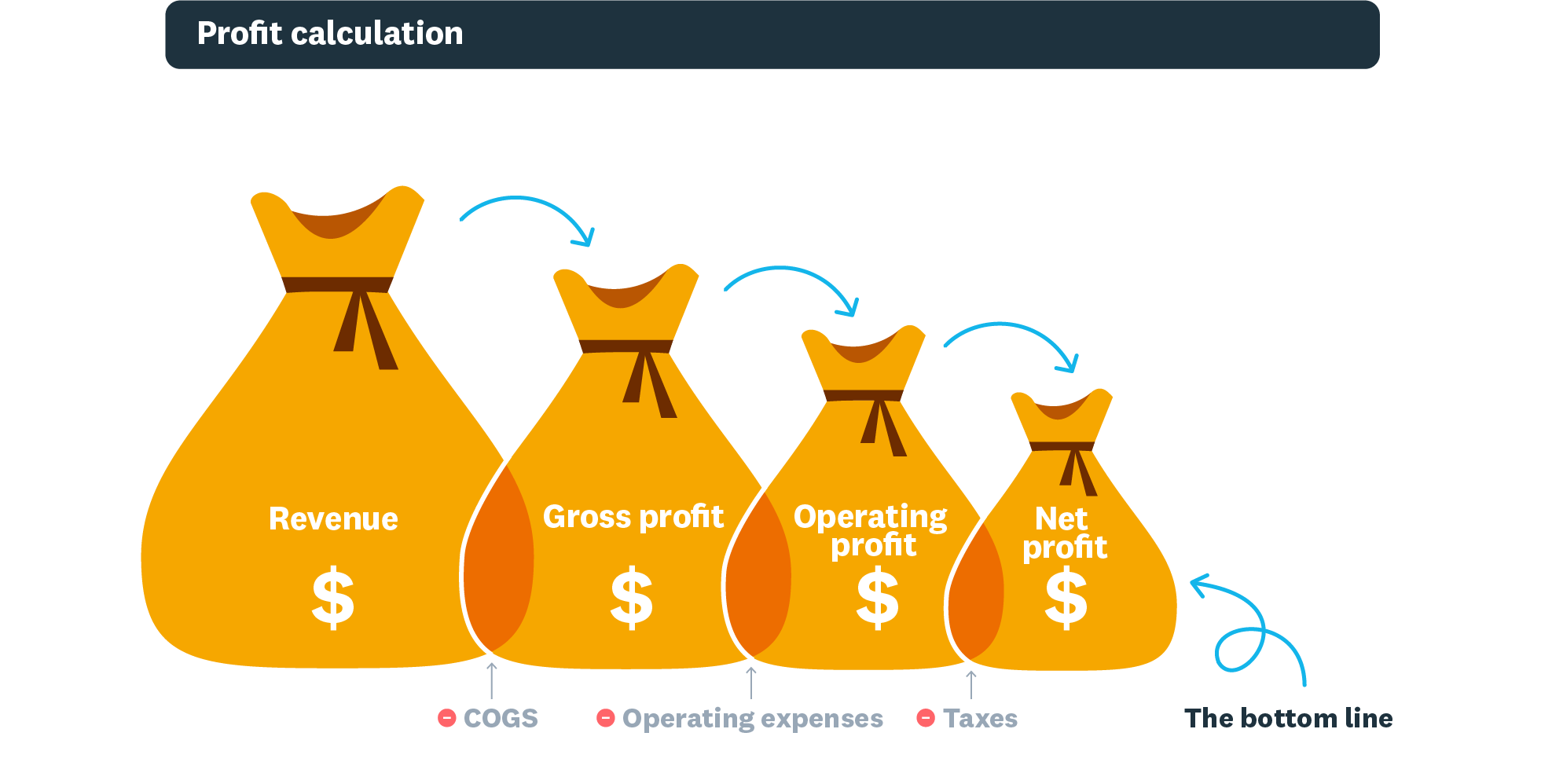
There are three types of profit. Net profit is what you get to keep.
- Profit is the money your business keeps after you subtract expenses from revenue
- Gross, operating and net profit each strip out a different group of costs, and net profit is the bottom line
- A profitable business can still run short of cash when customers take time to pay
- In Indonesia, companies generally pay 22% tax on taxable profit, while some small businesses can pay a 0.5% final tax on turnover
What is profit?
Profit is the money your business has left after you’ve paid all your expenses out of the revenue you’ve earned. It’s also called earnings or the bottom line, because net profit sits on the last line of your profit and loss statement.
Think of it like a household budget: what’s left after the bills are paid is what you can save or spend on something new. For your business, profit shows whether the hours you put in are paying off. When revenue is higher than expenses, you make a profit; when expenses are higher, you make a loss.
How to calculate profit
To calculate profit, subtract your total expenses from your total revenue for the same period. The basic formula is: profit = total revenue − total expenses.
Follow these four steps to work it out.
- Pick a period, such as a month or a year
- Add up all the revenue from sales in that period
- Add up all your expenses for the same period, including stock, rent, wages and bills
- Subtract total expenses from total revenue
Say your catering business brings in Rp60 million in a month and spends Rp45 million on ingredients, wages, rent and other costs. Your profit for the month is Rp15 million. For a single item, profit is the selling price minus the cost price. A shirt you sell for Rp150,000 that cost Rp90,000 earns Rp60,000.
Types of profit
Profit comes in three layers, and each one removes a different group of costs from revenue. The Corporate Finance Institute (CFI) defines gross, operating and net profit as successive deductions, ending with net profit after interest and tax.
Gross profit
Gross profit is what’s left after you subtract the cost of goods sold (COGS) from revenue. COGS covers the direct costs of what you sell, like raw materials or stock bought for resale.
Gross profit = revenue − COGS
It’s usually your largest profit figure. It shows whether your products or services can make money before overheads come out.
Operating profit
Operating profit is gross profit minus your operating expenses, which are the costs of running the business day to day. These include rent, electricity, phone bills, marketing and staff wages.
Operating profit = gross profit − operating expenses
A positive operating profit shows your core business is making money from its everyday activity.
Net profit
Net profit is what remains after you deduct every expense, including interest on loans and tax. It’s the final figure on your profit and loss statement.
Net profit = operating profit − interest − tax
Net profit tells you how much the business has earned that you can reinvest or pay out to owners.
Worked example: profit for a batik shop in Solo
Here’s how the three profit types work for one business over a year. Imagine a batik shop in Solo, set up as a limited liability company (PT), with Rp1.2 billion in annual sales.
The shop spends Rp720 million on fabric, dye and finished stock. Its Rp330 million in operating expenses covers Rp96 million rent, Rp180 million staff wages, Rp24 million electricity and internet, and Rp30 million marketing. It also pays Rp10 million in interest on a business loan.
Here’s the calculation, step by step.
- Subtract COGS from revenue to get gross profit of Rp480 million (Rp1.2 billion − Rp720 million)
- Subtract operating expenses to get operating profit of Rp150 million (Rp480 million − Rp330 million)
- Subtract interest to get profit before tax of Rp140 million (Rp150 million − Rp10 million)
- Subtract tax of Rp15.4 million to get net profit of Rp124.6 million
The tax figure assumes taxable profit matches the Rp140 million profit before tax. Because turnover is under Rp4.8 billion, the Article 31E discount covers all of it, halving the 22% rate to 11%.
The shop’s net profit margin is Rp124.6 million ÷ Rp1.2 billion × 100, or about 10.4%. Its gross profit margin is 40% and its operating profit margin is 12.5%.
Profit vs revenue
Revenue is the total money you bring in from sales, while profit is what’s left once your costs come out. CFI calls revenue the top line and notes that a business with strong sales can still be unprofitable if its costs run too high.
In the batik shop example, Rp1.2 billion of revenue became Rp124.6 million of net profit. Knowing what counts as revenue helps you see how much of each sale you keep.
Profit vs cash flow
Profit is an accounting figure, while cash flow tracks the money moving in and out of your bank account. You record a sale when you make it, even if the customer hasn’t paid yet.
Say you invoice a hotel Rp50 million for batik uniforms in December, with payment due in February. The sale adds to December’s profit, but the cash doesn’t reach your account for two months. This timing gap is why a profitable business can still struggle to pay its bills.
Watching unpaid invoices and managing your cash flow helps you cover costs while you wait for payment.
Profit margin
Profit margin shows profit as a percentage of revenue, so you can compare performance across periods or against similar businesses. Each profit type has its own margin, using the formulas CFI sets out.
- Gross profit margin = gross profit ÷ revenue × 100
- Operating profit margin = operating profit ÷ revenue × 100
- Net profit margin = net profit ÷ revenue × 100
A falling gross margin can point to rising supplier costs. If your gross margin holds steady while net margin drops, look at your overheads. You can also read up on calculating gross profit margin in more detail.
How profit is taxed in Indonesia
How your profit is taxed depends on your business structure and turnover. These rules changed in April 2026, so here’s where things stand for the 2026 tax year.
Companies pay corporate income tax (PPh Badan) at a standard rate of 22% of taxable profit, according to PwC’s Indonesia tax summary. Under Article 31E, companies with turnover up to Rp50 billion get 50% off that rate on profit from their first Rp4.8 billion of turnover.
Some small businesses can pay a 0.5% final tax on turnover instead of tax on profit. Under Government Regulation (PP) 20/2026, individuals, single-owner companies (perseroan perorangan) and cooperatives can use it, as the Directorate General of Taxes (DJP) confirms. Turnover must be Rp4.8 billion a year or less, and individuals and perseroan perorangan now have no fixed time limit.
Newly registered limited partnerships (CV), firma and PT businesses can no longer choose this scheme, so they pay standard corporate rates. For individuals, the first Rp500 million of turnover each year stays tax-free under the same regulation.
Whichever scheme applies, you’ll need clear profit records. Indonesia’s accounting standard for micro, small and medium entities is SAK EMKM, issued by the Indonesian Institute of Accountants (IAI). Its required financial statements include a laba rugi (profit and loss) statement.
Your situation may differ, so check the details with the DJP or a tax adviser before you file.
How to increase profit
You can raise profit by growing revenue, cutting costs, or both. Start by checking how profitable you are today, then try these levers.
- Review your prices against your costs and competitors
- Negotiate better rates with suppliers to lower COGS
- Cut overheads you don’t need, like unused subscriptions
- Sell more to existing customers through bundles or repeat offers
For more ideas, explore these ways to boost profit.
Track your profit with Xero
Knowing your gross, operating and net profit helps you set prices with confidence and plan for tax. Xero brings your sales and expenses together in easy-to-read reports, including a profit and loss statement you can check anytime.
With bank feeds keeping your numbers up to date, you’ll see where your profit stands without waiting for month-end. Try Xero today and get one month free.
FAQs on profit
Here are quick answers to common questions about profit.
What is profit in simple terms?
Profit is what you keep after paying for everything it took to make your sales. If you sell nasi goreng for Rp25,000 and the ingredients, gas and packaging cost Rp15,000, you’ve earned Rp10,000 before overheads.
What’s the difference between profit and profit margin?
Profit is an amount in rupiah, while profit margin is that amount as a percentage of revenue. Margin makes it easier to compare a quiet month with a busy one, or your business with a larger competitor.
Why might gross profit be high but net profit low?
Strong gross profit with weak net profit means operating costs, interest or tax are taking up most of your earnings. Review overheads like rent and wages line by line to find where the gap opens.
Can a business be profitable and still run out of cash?
Yes, if customers take a long time to pay while your own bills fall due. Shorter payment terms and sending invoices as soon as the work is done can narrow the gap.
What does it mean if your profit is negative?
A negative result means your expenses were higher than your revenue, which is called a net loss. Seasonal businesses can have loss months, so compare full-year figures before you change pricing or costs.
Related terms
Learn more about profit
Handy resources
Advisor directory
You can search for experts in our advisor directory
Financial reporting
Keep track of your performance with accounting reports
Disclaimer
This glossary is for small business owners. The definitions are written with their requirements in mind. More detailed definitions can be found in accounting textbooks or from an accounting professional. Xero does not provide accounting, tax, business or legal advice.