Profit margin: definition, formulas and ways to improve
Learn what profit margin is, how to calculate it, and how to improve yours.
Written by Lena Hanna—Trusted CPA Guidance on Accounting and Tax. Read Lena's full bio
Published Tuesday 21 April 2026
Table of contents
Key takeaways
- Calculate all three types of profit margin (gross, operating, and net) to get a complete picture of your pricing effectiveness and overall financial health.
- Benchmark your margins against your industry, since what counts as a good margin varies widely, from 2–5% in retail to 20–40% in software.
- Track your margins monthly to spot trends early, as rising, falling, or stable patterns over time reveal far more than any single snapshot.
- Control costs strategically by auditing subscriptions, negotiating with vendors, and improving operational efficiency to protect and grow your margins.
Key takeaways
- Calculate all three margin types (gross, operating, and net) to understand pricing effectiveness and overall financial health.
- Track margins monthly to spot trends early, as patterns reveal more than single snapshots.
- Control costs strategically through subscription audits, vendor negotiations, and efficiency improvements.
- Benchmark against your industry since good margins vary widely, from 2–5% in retail to 20–40% in software.
What is a profit margin?
Profit margin is the percentage of revenue that remains after you subtract business expenses. It shows how much profit you keep from every dollar of sales. For example, a 20% profit margin means you retain $0.20 for each $1.00 in revenue.
A strong profit margin indicates financial health by showing:
- Revenue efficiency: your income covers all expenses with room to spare
- Performance insights: which products or services drive profitability
- Decision guidance: where to cut costs or adjust pricing, a crucial step given that roughly half of businesses report their pricing practices are not yet back to normal, according to the Bank of Canada Business Outlook Survey
Profit margins vs net profit
Net profit is a dollar amount, while profit margin is a percentage. Net profit tells you how many dollars remain after expenses. Profit margin shows what portion of revenue those dollars represent.
For example, $10,000 profit on $50,000 revenue equals a 20% profit margin.
Why do profit margins matter?
Profit margins reveal critical business insights:
- Financial health: measure how efficiently you convert sales into profit
- Strategic decisions: guide pricing strategies, cost reduction, and resource allocation
- Funding success: help banks and investors assess your business viability and loan risk
What is a good profit margin?
A good profit margin depends on your industry and business model. There's no universal target, but these net margin benchmarks offer guidance:
- Retail: 2–5% (high volume, low margin)
- Luxury goods: 15–25% (low volume, high margin)
- Software: 20–40% (scalable, low variable costs)
- Restaurants: 3–7% (high overhead, perishable inventory)
The type of margin matters too. Your gross profit margin will naturally be higher than your net margin because it doesn't account for all costs.
Operating and net profit margins reveal the most about your financial health. Compare your margins to others in your industry to see where you stand.
Benefits of high profit margins for growth
High profit margins typically mean a business:
- attracts investment more easily due to demonstrated financial health
- reinvests in growth with available capital
- experiments with pricing and innovation without financial strain
Review your performance regularly to spot trends and benchmark against competitors to see where you stand.
Do high profit margins guarantee growth?
No, high profit margins don't guarantee growth. Research from Yale Insights found that margins don't necessarily rise as businesses expand.
Rapid growth can actually reduce margins if short-term costs spike. Focus on sustainable growth and factor profit margins into every strategic decision.
Factors affecting profit margins
Several factors affect profit margins, some outside your control:
- Industry type: retail and hospitality have higher overheads and tighter margins than consultancies
- Economic conditions: during the COVID-19 pandemic, nearly one in three Canadian businesses saw revenue drop 30% or more, and overall business sentiment recently reached its lowest level in over a decade outside of that early pandemic period, according to the Bank of Canada Business Outlook Survey
- Interest rates: rising rates increase borrowing costs and squeeze margins, a pressure likely to persist as many expect returning inflation to the Bank of Canada's 2% target will take longer than three years, according to the Bank of Canada Business Outlook Survey
- Location: rent and local taxes vary significantly and affect your pricing strategy
Understanding these factors helps you set realistic margin expectations for your business.
Types of profit margins
Three main types of profit margins help you understand different aspects of your business:
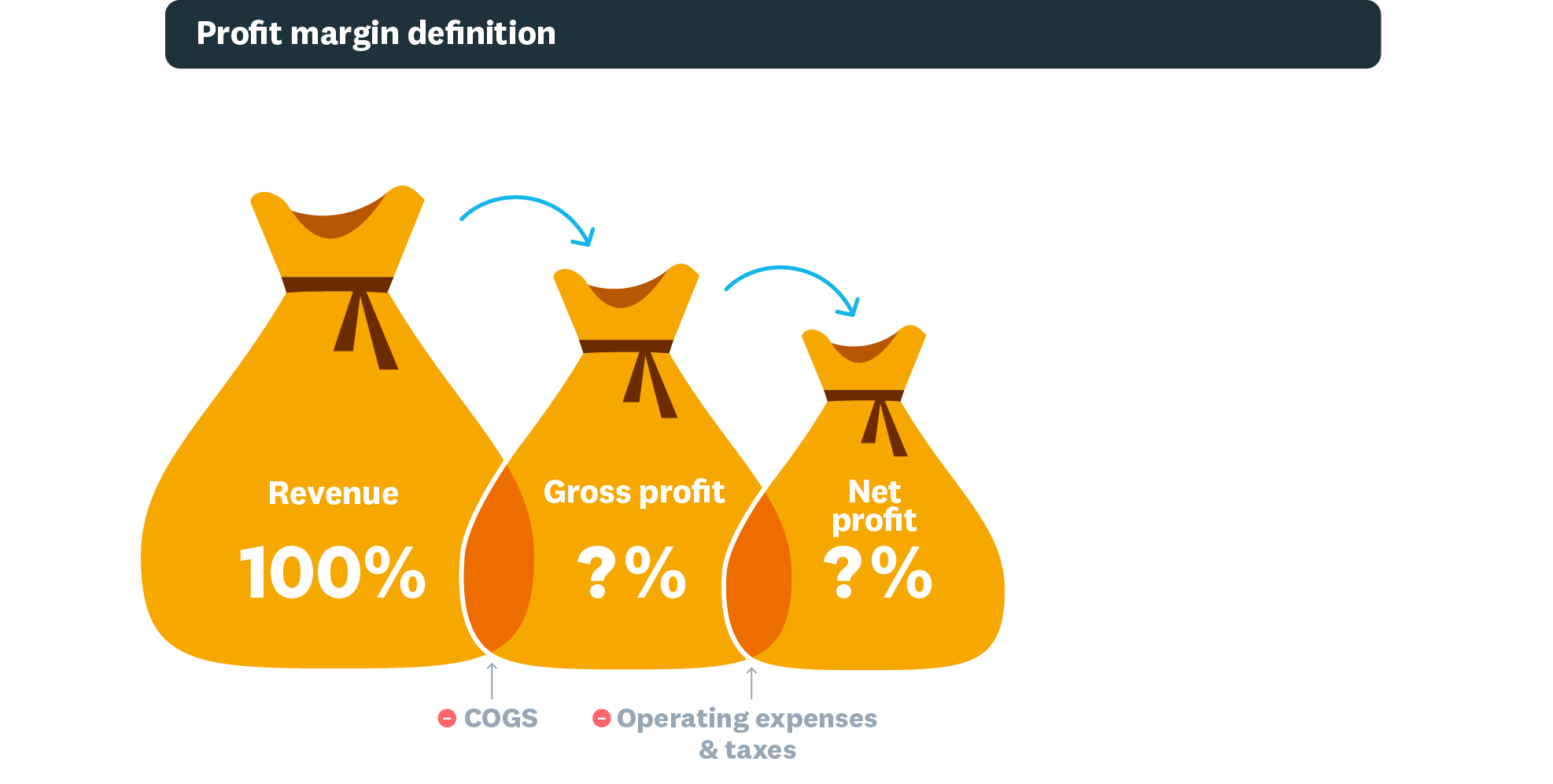
Gross profit margin measures revenue minus the cost of goods sold.
- Purpose: set pricing and compare performance between periods
- Formula: (revenue − cost of goods sold) ÷ revenue × 100
Operating profit margin measures profit after operating costs but before taxes and interest.
- Purpose: show core business profitability to investors and lenders
- Formula: operating income ÷ revenue × 100
Net profit margin measures income after all costs, taxes, and expenses.
- Purpose: indicate overall financial health for comprehensive analysis
- Formula: net income ÷ revenue × 100
Learn more in the net profit margin glossary entry.
How to calculate profit margins
Calculate any profit margin using this formula:
(Profit ÷ Revenue) × 100 = Profit Margin %
The percentage format makes it easy to compare your performance across time periods and against industry benchmarks.
Gross profit margin calculation
Here's a gross profit margin example:
Your cleaning business earns $20,000 in revenue. It costs $8,000 to provide those services, leaving $12,000 in gross profit.
Calculation: $12,000 ÷ $20,000 × 100 = 60% gross profit margin
Try our gross profit margin calculator.
Net profit margin calculation
Continuing the example above, you also pay $4,000 in taxes. Your net profit is $8,000.
Calculation: $8,000 ÷ $20,000 × 100 = 40% net profit margin
Try our net profit margin calculator.
Operating profit margin calculation
Using the same example, you spend $3,000 on operating expenses like rent and utilities. After subtracting these from your gross profit, your operating profit is $9,000.
Calculation: $9,000 ÷ $20,000 × 100 = 45% operating profit margin
How to increase your profit margins
You can increase profit margins by reducing costs, improving efficiency, or raising prices. Most businesses benefit from focusing on all three.
Control your costs
Control your costs through systematic expense reduction:
- Audit subscriptions: cancel unused software and services
- Optimize labour: review staffing levels and productivity metrics
- Negotiate with vendors: renegotiate contracts for better rates
- Reduce energy use: cut utility costs through smarter usage
Make your operations more efficient
Boost operational efficiency with these approaches:
- Deliver excellent customer service to increase repeat business
- Encourage your team to suggest process improvements
- Invest in staff training so everyone performs at their best
- Automate repetitive tasks to free up time for higher-value work
Adjust your pricing
A strong pricing strategy maximises revenue and boosts margins. Consider these approaches:
- Dynamic pricing: adjust prices based on demand and seasonal changes
- Premium offerings: create packages and bundles that increase average order value
- Value-based pricing: charge based on the value you deliver, not just your costs
Analyze your profit margins for better business decisions
Profit margin analysis turns raw numbers into useful information for decisions. Use your margins to inform:
- Pricing decisions: identify high-margin products to guide price adjustments.
- Budget creation: allocate resources toward products with better return on investment (ROI).
- Investment planning: pinpoint profitable areas worthy of expansion.
What profit margin trends reveal
Profit margin trends reveal more than single snapshots. Track your margins over time to spot patterns:
- Rising margins suggest improving efficiency or successful pricing changes.
- Declining margins may signal rising costs or competitive pressure.
- Stable margins indicate consistent operations but may hide missed opportunities.
Track your profit margins with the right tools
The right tools make profit margin tracking easier. Accounting software automates calculations, tracks trends over time, and shows your current profitability.
Monitor your margins and make confident pricing, cost, and investment decisions with Xero's cloud-based platform. Get one month free to see how clear financial data can help your business grow.
FAQs on profit margins
Here are answers to common questions about calculating and using profit margins in your business.
What does a 20% profit margin mean?
A 20% profit margin means your business keeps $0.20 in profit for every $1.00 of sales revenue. The remaining $0.80 covers your costs and expenses.
Is an 80% profit margin good?
An 80% profit margin is exceptionally high. Context matters:
- 80% gross margin: achievable for software or digital products with low production costs
- 80% net margin: extremely rare after accounting for all expenses
Compare your margins to industry averages to gauge whether yours are realistic.
What's the difference between profit margin and markup?
Profit margin and markup measure profitability differently:
- Profit margin: profit as a percentage of revenue (selling price)
- Markup: profit as a percentage of cost
For example, if you buy a product for $50 and sell it for $100, your markup is 100% but your profit margin is 50%.
Can profit margins be too high?
Yes, in some cases. Extremely high margins may signal overpricing that limits your market share or invites competitors. However, higher margins generally provide more financial flexibility and room for investment.
How often should I calculate profit margins?
Calculate profit margins at two intervals:
- Monthly: track trends and catch problems early
- Quarterly: conduct deeper analysis for strategic planning and performance reviews
Disclaimer
Xero does not provide accounting, tax, business or legal advice. This guide has been provided for information purposes only. You should consult your own professional advisors for advice directly relating to your business or before taking action in relation to any of the content provided.