Markup vs margin: what's the difference?
Learn how markup and margin differ, with formulas, examples and a conversion chart.
Published Thursday 23 July 2026
Table of contents
Key takeaways
- Markup is the percentage added to your cost price to set a selling price, while margin is the percentage of the selling price that represents profit.
- Both metrics use the same figures, but markup is always a higher percentage than margin for any given transaction because it's calculated from the smaller number (cost).
- Use markup when setting prices for your products and services, and use margin when analysing your overall profitability and financial health.
- Confusing the 2 can lead to underpricing your products, which directly reduces your profit.
What is markup?
Markup is the percentage you add to the cost of a product or service to arrive at its selling price. It tells you how much more you're charging compared to what you paid.
For any business that sells products, markup is your starting point for pricing. It's calculated using cost as the base, which makes it a useful tool when you know what you've paid for something and need to decide what to charge. You can also explore different markup strategies to find the right approach for your business.
Markup formula
Here's the formula to calculate markup as a percentage:
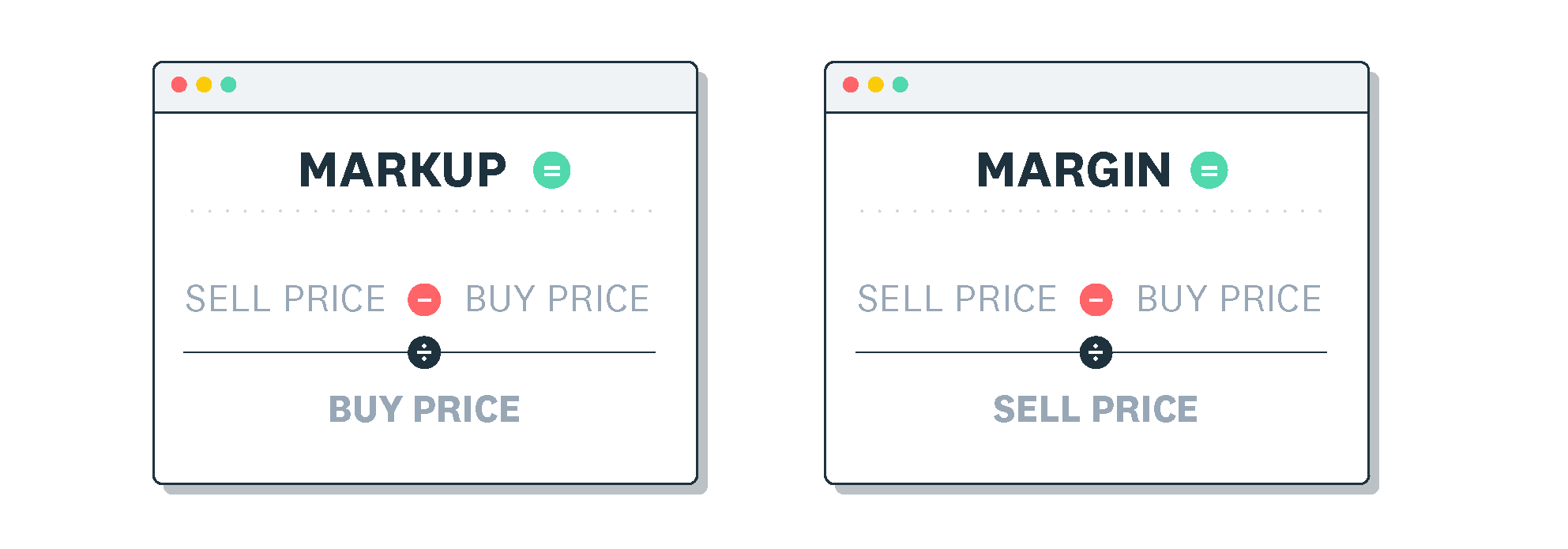
Markup (%) = [(selling price - cost) / cost] x 100
Markup example
Say you buy a product for £70 and sell it for £100. Your markup calculation looks like this:
Markup = [(£100 - £70) / £70] x 100 = 42.86%
That means you've added about 42.86% on top of your cost to reach your selling price. Your profit on this item is £30, but the markup percentage reflects that profit relative to what you originally paid.
What is margin?
Margin (also known as gross profit margin) is the percentage of your selling price that counts as profit after covering the cost of goods sold (COGS). It shows how much of each pound you earn actually stays in your business.
While markup looks at profit relative to cost, margin looks at profit relative to revenue. This makes it the go-to metric for understanding how profitable a sale really is.
Margin formula
Here's the formula to calculate margin as a percentage:
Margin (%) = [(selling price - cost) / selling price] x 100
Margin example
Using the same numbers as above, where you buy a product for £70 and sell it for £100:
Margin = [(£100 - £70) / £100] x 100 = 30%
Your gross profit margin is 30%. Out of every £1 in revenue, £0.30 is gross profit. Notice how the same £30 profit gives you a 42.86% markup but only a 30% margin, depending on whether you divide by cost or selling price.
Key differences between markup and margin
Markup and margin both measure profit, but they approach it from different angles. Understanding where they differ helps you use each one correctly.
- Markup is based on cost; margin is based on selling price.
- Markup focuses on how much you've added to your cost, making it seller-centric and useful for pricing decisions.
- Margin focuses on what portion of revenue is profit, making it better for assessing financial health.
- For the same transaction, markup will always be a higher percentage than margin because cost is always smaller than selling price.
- A 50% markup does not equal a 50% margin; a 50% markup actually translates to a 33.33% margin.
This difference is exactly why the 2 metrics get confused so often. If you set a 30% markup thinking it gives you a 30% margin, you'll end up with less profit than expected.
How to calculate markup and margin
Calculating markup and margin follows a straightforward process once you know your cost and selling price. Here's how to work through both.
How to calculate markup
Follow these steps to calculate your markup percentage:
- Subtract your cost of goods sold from your selling price to find your gross profit (selling price - cost = gross profit).
- Divide that gross profit by your cost.
- Multiply by 100 to get the percentage.
For example, if you sell handmade candles for £24 and each one costs you £15 to make:
Markup = [(£24 - £15) / £15] x 100 = 60%
How to calculate margin
Follow these steps to calculate your margin percentage:
- Subtract your cost from your selling price to find your gross profit.
- Divide that gross profit by your selling price.
- Multiply by 100 to get the percentage.
Using the same candle example:
Margin = [(£24 - £15) / £24] x 100 = 37.5%
So a 60% markup on those candles gives you a 37.5% margin.
How to calculate selling price from a desired margin
If you know the margin you want and your cost, you can work backwards to find the right selling price:
Selling price = cost / (1 - desired margin)
For example, if your product costs £15 and you want a 40% margin:
Selling price = £15 / (1 - 0.40) = £15 / 0.60 = £25
Markup to margin conversion chart
It's helpful to keep a quick reference for converting between markup and margin. You can also use the Xero markup calculator to do conversions instantly. Here are common markup percentages and their margin equivalents:
- 15% markup = 13.04% margin
- 20% markup = 16.67% margin
- 25% markup = 20% margin
- 30% markup = 23.08% margin
- 33.33% markup = 25% margin
- 40% markup = 28.57% margin
- 50% markup = 33.33% margin
- 75% markup = 42.86% margin
- 100% markup = 50% margin
You can also convert between the 2 using these formulas:
- Margin (%) = [markup / (100 + markup)] x 100
- Markup (%) = [margin / (100 - margin)] x 100
When to use markup vs margin
Knowing when to apply each metric helps you make better pricing and financial decisions. Both have a clear role in running your business.
When to use markup
Markup is your tool for setting prices. When you know what a product costs and need to decide what to charge, markup gives you a simple way to add your desired profit on top. It's especially useful for retail, food service, and any business that prices individual items based on cost.
When to use margin
Margin is your tool for evaluating profitability. Use it when reviewing financial reports, comparing product performance, or assessing whether your pricing strategy is delivering enough profit. Investors, lenders, and accountants typically look at margin when evaluating a business.
In practice, most small businesses use both: markup to set prices day to day and margin to check that those prices are generating healthy profits overall.
Why understanding markup and margin matters
Getting markup and margin right has a direct impact on your bottom line. Treating the 2 as interchangeable is one of the most common pricing mistakes small businesses make.
If you apply a 30% markup but assume you're earning a 30% margin, you'll overshoot your profit expectations. Your actual margin would be about 23%, which could leave you short when covering overheads, paying suppliers, or reinvesting in growth.
Accurate calculations help you set competitive prices that still protect your profit. They also give you confidence when reviewing your accounts, preparing forecasts, or discussing finances with your accountant. Understanding both metrics means you can price with precision and track profitability with clarity.
Simplify your finances with Xero
Once you've nailed your markup and margin calculations, keeping track of your costs, revenue, and profitability becomes the next step. Xero's cloud accounting software helps you monitor your financial performance in real time, so you can see exactly how your pricing decisions affect your bottom line. Get one month free.
FAQs on markup vs margin
Here are answers to frequently asked questions about markup vs margin.
Is 100% markup the same as 50% margin?
Yes. A 100% markup means you've doubled your cost price, so half of the selling price is profit. That works out to a 50% margin.
What margin is 25% markup?
A 25% markup gives you a 20% margin. If a product costs £80 and you add a 25% markup, you sell it for £100, and £20 of that £100 (20%) is your gross profit.
How much should I mark up my products?
There's no single answer, as it depends on your industry, competition, and costs. Research what's standard in your sector and factor in all your overheads to find a markup that covers expenses and delivers the profit margin you need.
Should I use markup or margin?
Use both for different purposes. Markup is best for setting prices on individual products, while margin is better for measuring overall profitability and financial performance.
How do I calculate gross profit margin?
Subtract your cost of goods sold from your revenue, then divide that figure by your revenue and multiply by 100. For example, if your revenue is £10,000 and COGS is £6,000, your gross profit margin is [(£10,000 - £6,000) / £10,000] x 100 = 40%.
Handy resources
Advisor directory
You can search for experts in our advisor directory
Xero Small Business Guides
Discover resources to help you do better business
Financial reporting
Keep track of your performance with accounting reports
Disclaimer
This glossary is for small business owners. The definitions are written with their requirements in mind. More detailed definitions can be found in accounting textbooks or from an accounting professional. Xero does not provide accounting, tax, business or legal advice.