Break-even point formula
Learn the break-even point formula, with worked examples for product and service businesses.
November 2023 | Published by Xero
Published Monday 17 August 2026
Table of contents
Key takeaways
- The break-even point is where total revenue equals total costs, so your business makes neither a profit nor a loss.
- There are two formulas: one gives break-even in revenue and one gives break-even in units, and both are built on your contribution margin.
- A lower break-even point means you need fewer sales to cover your costs, which gives you a wider margin of safety.
- You can lower your break-even point by cutting fixed costs, reducing variable costs, raising your price or focusing on higher-margin products.
What is the break-even point?
The break-even point is where your total revenue equals your total costs, meaning your business makes neither a profit nor a loss. It's a key milestone that tells you the minimum sales you need to cover all your expenses. Business owners use it to set realistic sales and productivity targets.
Why the break-even point matters
Knowing your break-even point helps you make smarter decisions about pricing, costs and growth. Here are some practical ways to use it:
- Setting prices that cover your costs and leave room for profit
- Creating realistic sales targets based on actual numbers
- Identifying opportunities to control fixed and variable costs
- Assessing risk before launching new products or expanding
- Supporting funding conversations with lenders or investors by showing when you'll measure your profitability
What is contribution margin?
The contribution margin is the amount left over from each sale after you subtract variable costs. It's the portion that goes toward covering your fixed costs and, eventually, generating profit. You can express it in two ways:
- Contribution margin per unit: selling price minus variable cost per unit
- Contribution margin ratio: contribution margin per unit divided by selling price
How to calculate the break-even point
Calculating your break-even point takes three steps. Once you have the numbers, you can work out break-even in units or in revenue.
- Add up your fixed costs (rent, salaries, insurance and other expenses that stay the same regardless of sales).
- Work out your contribution margin per unit, or your contribution margin ratio if you want break-even in revenue.
- Divide your fixed costs by the contribution margin to get break-even in units, or by the contribution margin ratio to get break-even in revenue.
Break-even in units tells you how many items you need to sell. Break-even in revenue tells you the dollar value of sales you need to reach.
Revenue break-even point formula
Use this formula when you want to know the total sales revenue needed to cover all your costs.
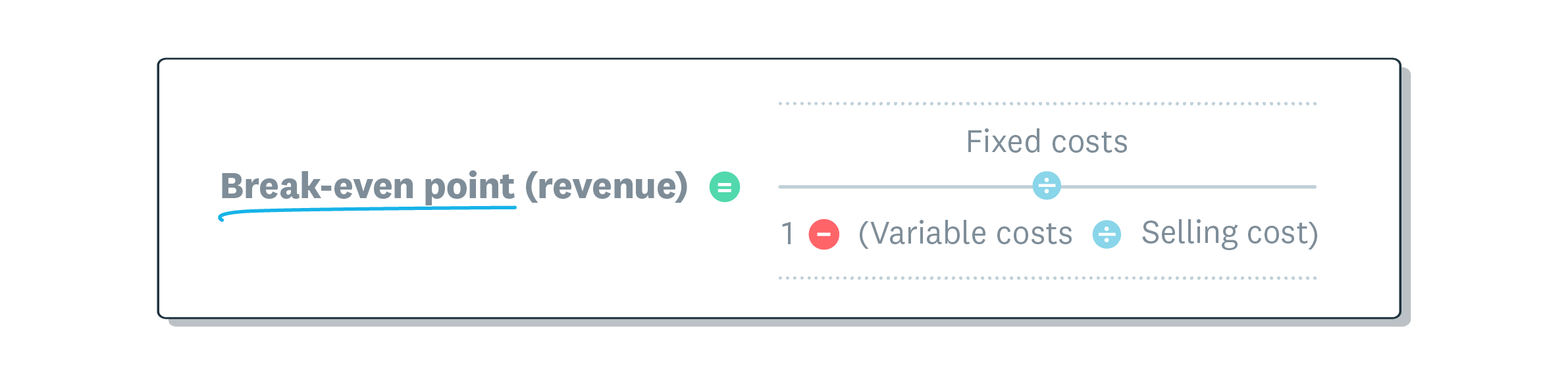
Break-even point (revenue) = Fixed costs ÷ (1 − (Variable costs ÷ Selling price))
Here's what each part means:
- Break-even point (revenue) is the dollar value of sales needed to reach profitability
- Fixed costs are expenses that remain constant regardless of how much you sell
- Variable costs are expenses that change based on the number of units you produce or sell
- Selling price is the amount you charge customers for your goods or services
Volume break-even point formula
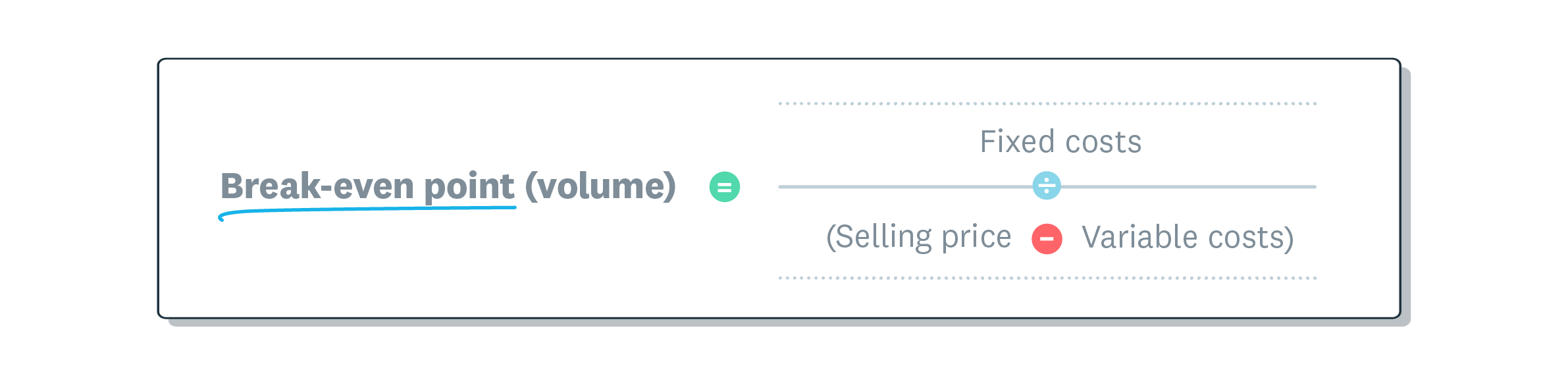
Use this formula when you want to know how many units you need to sell to break even.
Break-even point (units) = Fixed costs ÷ (Selling price − Variable costs)
Example break-even calculations
These worked examples show how the formulas apply to different types of businesses.
Break-even example for a product-based business
A kombucha brewery in Singapore has fixed monthly costs of S$6,000. Variable costs are S$2 per bottle, and each bottle sells for S$7.
Revenue required = S$6,000 ÷ (1 − (S$2 ÷ S$7))
Revenue required = S$6,000 ÷ 0.714 = S$8,403 monthly
Volume required = S$6,000 ÷ (S$7 − S$2)
Volume required = S$6,000 ÷ S$5 = 1,200 bottles monthly
The brewery needs to sell 1,200 bottles, or generate S$8,403 in sales, each month to break even.
Break-even example for a service-based business
A graphic designer has fixed monthly costs of S$2,700. Variable costs are S$35 per hour (paid to a contractor), and the designer charges clients S$75 per hour.
Revenue required = S$2,700 ÷ (1 − (S$35 ÷ S$75))
Revenue required = S$2,700 ÷ 0.533 = S$5,064 monthly
Volume required = S$2,700 ÷ (S$75 − S$35)
Volume required = S$2,700 ÷ S$40 = 67.5 hours monthly
The designer needs to bill around 68 hours, or generate S$5,064 in revenue, each month to break even.
How to lower your break-even point
A lower break-even point means you need fewer sales to cover your costs, which widens your margin of safety. Here are five ways to bring it down:
- Reduce fixed costs by renegotiating rent, switching suppliers or cutting unnecessary subscriptions
- Lower variable costs through bulk purchasing or more efficient production
- Increase your selling price if the market supports it
- Boost sales volume to grow your sales revenue and spread fixed costs over more units
- Improve your product or service mix by focusing on higher-margin offerings
Track your break-even point with Xero
Xero accounting software helps you monitor fixed costs, variable costs and revenue in one place, so you can see exactly where you stand against your break-even point. With real-time reports and dashboards, you'll know when you're on track to hit profitability. To try Xero for your business, get one month free.
FAQs on the break-even point
Here are answers to common questions about the break-even point.
How do you calculate the break-even point?
Divide your total fixed costs by the contribution margin per unit for break-even in units, or by the contribution margin ratio for break-even in revenue. Both methods give you the sales threshold where costs and revenue balance.
What does the break-even point tell you?
It tells you the minimum sales needed to avoid a loss. Any sales beyond this point contribute directly to profit.
Who uses the break-even point?
Business owners, financial analysts and lenders all use it. Startups use it to plan launch costs, while established businesses use it to evaluate new projects or pricing changes.
Why is contribution margin important?
It shows how much each sale contributes toward covering fixed costs. A higher contribution margin means you reach break-even faster with fewer sales.
How can you lower your break-even point?
Cut fixed costs, reduce variable costs or raise your selling price. You can also shift your product mix toward higher-margin items to improve your overall contribution margin.
Can the break-even point be negative?
No. If the formula produces a negative number, it typically means your variable costs exceed your selling price, so each sale loses money. In this case, you'd need to adjust pricing or costs before break-even analysis applies.
Related terms
Learn more about the break-even point
Handy resources
Advisor directory
You can search for experts in our advisor directory
How to increase revenue
Find out how businesses grow their sales income.
Stay on top of your numbers with Xero
Accounting software tracks your performance while you sleep.
Disclaimer
This glossary is for small business owners. The definitions are written with their requirements in mind. More detailed definitions can be found in accounting textbooks or from an accounting professional. Xero does not provide accounting, tax, business or legal advice.