Bookkeeping vs accounting: what's the difference?
Bookkeeping vs accounting explained: what each does and when your South African business needs them.
Published Friday 24 July 2026
Table of contents
Key takeaways
- Bookkeeping records your day-to-day financial transactions, while accounting interprets that data to guide business decisions.
- Bookkeepers keep your records accurate and up to date, and accountants handle analysis, reporting and tax strategy.
- In South Africa, accountants usually hold a BCom plus a designation like CA(SA) or Professional Accountant (SA), while bookkeepers often hold ICB certificates.
- Many small businesses start with a bookkeeper and add an accountant as they grow, using both for complete financial support.
Bookkeeping vs accounting: what's the difference?
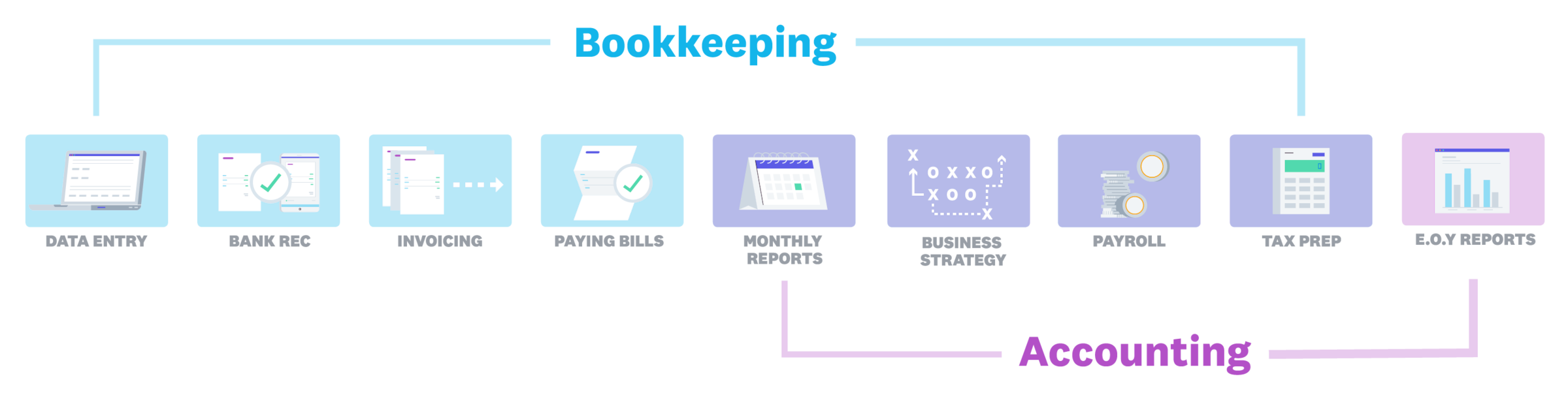
Bookkeeping is the day-to-day recording and organising of your financial transactions. Accounting takes that data further, analysing and interpreting it to guide business decisions.
Put simply, bookkeepers capture what happens with your money, and accountants explain what it means. Both roles matter, but they serve different needs at different stages of managing your finances.
Understanding the split helps you get the right support at the right time. If you're weighing up the two, it's worth reading more on why you need an accountant or bookkeeper.
What is bookkeeping?
Bookkeeping is the process of recording and organising every financial transaction in your business. Bookkeepers keep your records accurate, current and ready for SARS.
Their day-to-day and monthly work usually includes these tasks:
- Managing accounts payable and receivable
- Processing supplier invoices and customer payments
- Keeping VAT and payroll records ready for SARS
- Preparing monthly reports on your financial position
Some bookkeepers also flag trends in your numbers, giving you an early read on how the business is tracking.
What is accounting?
Accounting is the work of analysing, interpreting and reporting on your financial data. Accountants use your records to advise on strategy and keep you compliant.
Their core services usually include these tasks, and you can read more about what an accountant does:
- Preparing financial statements, including your income statement and balance sheet
- Filing tax returns and managing SARS compliance
- Analysing performance and forecasting cash flow
- Advising on budgets, funding and growth plans
- Preparing for audits and statutory reporting
Some accounting firms offer bookkeeping too, so you can manage both sides of your finances in one place.
Bookkeeping vs accounting: key differences at a glance
The two roles overlap, but they focus on different work and different outcomes. Here's how they compare across the areas that matter most to a small business:
- Focus: bookkeeping keeps your daily records accurate, while accounting turns those records into insight
- Tasks: bookkeepers handle data entry and reconciliation, while accountants handle analysis, reporting and tax
- Qualifications: bookkeepers often hold ICB certificates, while accountants usually hold a BCom and a designation such as CA(SA)
- Cost: bookkeepers generally charge less than accountants, so many businesses use both as they grow
- Tools: both work in cloud accounting software, though accountants add strategic reporting on top of the data
Difference between bookkeepers and accountants
Beyond the daily tasks, the two roles differ in how far their service extends and how they shape your business. Knowing where each adds value helps you spend your budget well.
Service scope
Bookkeepers focus on accurate record-keeping and basic reporting, which keeps your finances organised. Accountants build on those records to offer analysis, tax planning and complex advice.
Business impact
A bookkeeper gives you a clear, reliable picture of your numbers each month. An accountant uses that picture to help you plan, reduce risk and make confident decisions as you grow.
Education and qualifications in South Africa
Qualifications in South Africa follow national frameworks and recognised professional bodies. Knowing the typical paths helps you match a professional to your needs and budget.
Bookkeepers usually follow a path where they:
- start with matric, the National Senior Certificate, as an entry point
- complete NQF-level certificates or diplomas, often through the ICB (Institute of Certified Bookkeepers)
- gain certified bookkeeper status with practical experience
- register as a SARS tax practitioner through a recognised controlling body
Accountants usually follow a path where they:
- earn a BCom (NQF Level 7) or a similar degree
- qualify as a CA(SA) through SAICA or a Professional Accountant (SA) through SAIPA
- train as a management accountant through CIMA
- build experience in areas such as tax, audit or advisory work
Higher qualifications usually mean higher fees, but also broader services. Choose a professional whose credentials fit the support you actually need.
How bookkeeping and accounting work together
Bookkeeping and accounting aren't an either-or choice. They work best as a single flow, where accurate records feed sharper analysis and better decisions.
Your bookkeeper keeps transactions clean, reconciled and organised throughout the year. Your accountant then uses that trusted data to prepare statements, plan tax and advise on growth.
When both roles share the same up-to-date numbers, you avoid gaps, rework and surprises at tax time. That's why many owners treat them as partners rather than alternatives.
When to hire a bookkeeper vs an accountant
The right time to hire depends on your workload, complexity and growth, not a fixed revenue figure. There's no set turnover threshold in South Africa that forces the switch.
Consider a bookkeeper when you:
- spend several hours a week on records and admin
- need help with invoicing, bills and reconciliation
- want reliable monthly reports to track performance
Consider an accountant when you:
- face complex tax or multiple income streams
- plan to raise funding, take on loans or expand
- need forecasting and strategic financial advice
Cost often guides the decision, so treat these figures as a guide rather than a rule. Doing your own books with software typically costs about R200 to R800 a month. Hiring a bookkeeper ranges roughly R1,500 to R5,000 a month, depending on volume and service level.
The role of cloud accounting and automation
Cloud accounting software has changed how both roles work day to day. It automates routine bookkeeping and gives accountants cleaner data to analyse.
Automation can handle repetitive work like reconciling bank transactions and sending invoice reminders. That frees a bookkeeper to check accuracy and lets you see your position in real time.
With reliable, up-to-date numbers in one place, your accountant can spend less time chasing records and more time on the insight that helps you grow.
Simplify your bookkeeping and accounting with Xero
Whether you handle your own books or work with a bookkeeper and accountant, the right software keeps everyone on the same page. Xero brings your transactions, reports and reconciliation into one place, so you spend less time on admin and more time running your business. See how it fits your business and get one month free with Xero.
FAQs on bookkeeping and accounting
Here are answers to some frequently asked questions about bookkeeping and accounting for South African small business owners.
Do I need a bookkeeper or an accountant?
Most small businesses start with a bookkeeper for daily records and add an accountant as finances grow more complex. Many use both, since the roles complement each other.
Can one person do both bookkeeping and accounting?
Yes, one person can do both if they have the right qualifications and experience. Many accountants offer bookkeeping, and some bookkeepers train further into accounting work.
Can a bookkeeper complete my SARS tax return?
Only a SARS-registered tax practitioner may complete or submit a tax return for a fee. A bookkeeper can do this if they're registered as a tax practitioner through a recognised controlling body.
What qualifications should a South African accountant or bookkeeper have?
Accountants usually hold a BCom and a designation such as CA(SA) or Professional Accountant (SA). Bookkeepers often hold NQF-level certificates through the ICB and may register as SARS tax practitioners.
Related terms
Learn more about bookkeeping and accounting
Handy resources
Advisor directory
You can search for experts in our advisor directory
Xero dashboard
See your key information on the business dashboard
Free business templates
From invoices to business plans, get every document you need to run a smarter business
Disclaimer
This glossary is for small business owners. The definitions are written with their requirements in mind. More detailed definitions can be found in accounting textbooks or from an accounting professional. Xero does not provide accounting, tax, business or legal advice.