Cash vs accrual accounting
Learn how cash and accrual accounting differ, and how to choose the right method for your Philippine business.
Published Monday 17 August 2026
Table of contents
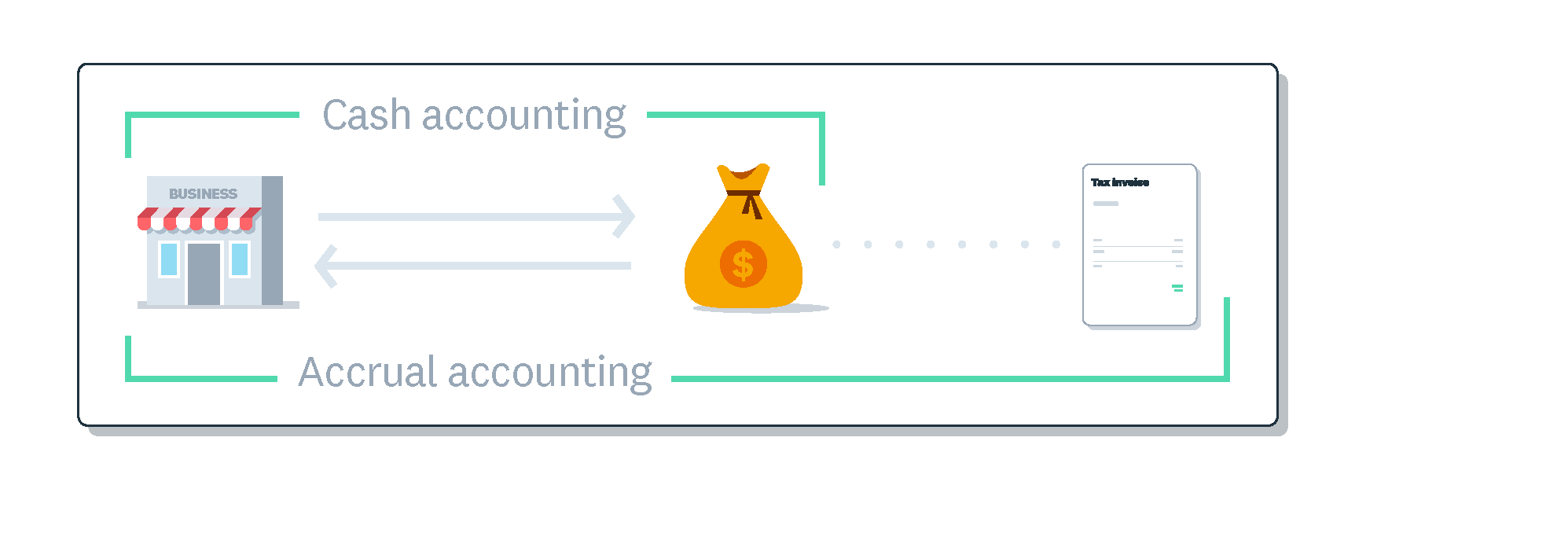
Cash accounting focuses only on cash changing hands, not outstanding bills or invoices.
Key takeaways
- Cash basis accounting records income when you receive payment and expenses when you pay them, while accrual accounting records transactions when they're earned or incurred.
- The Bureau of Internal Revenue (BIR) allows Philippine businesses to use either method, provided it clearly reflects income under NIRC section 43.
- The PHP 3,000,000 threshold determines VAT registration status, not which accounting method your business must use.
- Accrual accounting suits growing businesses, those carrying inventory, or those seeking financing, and is required for financial statements prepared under Philippine Financial Reporting Standards (PFRS).
What is cash basis accounting?
Cash basis accounting records revenue when you receive payment and expenses when you pay them. It tracks the actual movement of money in and out of your business, making it straightforward to understand your available cash at any time.
Consider a freelance graphic designer in Manila who completes a PHP 50,000 project in March. Under cash basis, she records that PHP 50,000 as income only in April, when her client pays. The same applies to expenses: if she buys design software in March but pays the invoice in April, that expense appears in April's records.
This method works well for service-based businesses with simple transactions. For guidance on setting up your records, see Xero's guide to recording accounting transactions.
What is accrual accounting?
Accrual accounting records revenue when you earn it and expenses when you incur them, regardless of when cash changes hands. This approach matches income with the expenses that generated it, giving you a clearer picture of profitability.
Using the same example, our freelance designer would record the PHP 50,000 as income in March, when she completes and invoices the project. If she purchases software in March, she records that expense in March, even if she pays later. Accrual accounting shows the economic reality of your business activities as they happen.
Philippine Financial Reporting Standards (PFRS), which are based on IFRS, require the accrual basis under PAS 1 for financial statements. This makes accrual essential for businesses that need compliant financial reports for banks, investors, or regulators. Learn more about managing your finances with small business accounting practices.
Cash vs accrual accounting: key differences
Understanding the distinctions between these methods helps you choose the right fit for your business. Here are the main areas where they differ.
Timing of revenue and expense recognition
The core difference lies in when transactions appear in your books.
- Cash basis records income when payment arrives and expenses when you pay them
- Accrual basis records income when earned (invoiced) and expenses when incurred
- A sale made in December but paid in January appears in December under accrual, January under cash
Financial accuracy
Each method presents your finances differently.
- Cash basis reflects actual cash on hand but may not show money you're owed or bills you haven't paid
- Accrual basis provides a more complete view of financial position, including receivables and payables
- Profitability analysis is more accurate under accrual because revenue matches related costs in the same period
Complexity
The methods require different levels of bookkeeping effort.
- Cash basis is simpler: fewer adjustments and easier day-to-day record-keeping
- Accrual requires tracking accounts receivable, accounts payable, and adjusting entries
- Accrual typically needs more accounting expertise or software support
PFRS and reporting standards
Reporting requirements may dictate your method.
- PFRS (PAS 1) requires accrual basis for all financial statements
- PFRS for Small Entities is the framework for small entities, while medium entities apply PFRS for SMEs, under the Philippine reporting frameworks
- The Securities and Exchange Commission (SEC) prescribes the PFRS framework for corporations
Pros and cons of cash accounting
Cash accounting has clear strengths for certain businesses, along with limitations to consider.
Advantages of cash accounting
- Simpler to maintain, requiring less bookkeeping expertise
- Shows your actual cash position clearly, helping you avoid overspending
- Lower accounting costs for small operations
- Easier to manage taxes because you record income only when received
Disadvantages of cash accounting
- Doesn't show outstanding invoices or unpaid bills, which can distort your financial picture
- Makes it harder to measure true profitability over time
- May not meet requirements for bank financing or investor reporting
- Not compliant with PFRS for formal financial statements
Pros and cons of accrual accounting
Accrual accounting offers deeper financial insights but requires more effort to maintain.
Advantages of accrual accounting
- Provides a more accurate picture of financial health by matching revenue with expenses
- Shows accounts receivable and payable, so you see the full scope of your finances
- Required for PFRS-compliant financial reporting
- Better for securing loans or investment because banks and investors trust accrual-based statements
- Supports better cash flow forecasting by revealing timing gaps between earning and collecting
Disadvantages of accrual accounting
- More complex, requiring adjusting entries and accrual schedules
- Can show profit even when cash hasn't arrived, which may mislead if not monitored
- Requires more accounting knowledge or professional support
- Higher bookkeeping costs due to added complexity
How to choose the right accounting method
Your choice depends on your business size, structure, and goals. Consider these factors when deciding.
Business size and growth plans
Smaller, simpler operations often start with cash basis for its ease. As your business grows and transactions become more complex, accrual accounting provides the detailed financial view you need to plan, measure performance, and attract partners.
Inventory
If you buy and sell goods, accrual accounting helps you match the cost of goods sold with the revenue they generate. This gives you an accurate gross profit figure. Learn more about managing stock with Xero's inventory guide.
VAT registration and BIR rules
Under the National Internal Revenue Code (NIRC) section 43, the BIR permits either method as long as it clearly reflects income. The Commissioner of Internal Revenue can prescribe a different method if yours doesn't.
The PHP 3,000,000 VAT registration threshold decides whether you register for VAT (12% VAT) or stay non-VAT. Non-VAT businesses generally pay a 3% percentage tax under the NIRC, and many self-employed taxpayers can instead opt into an 8% income tax rate. This threshold doesn't dictate your accounting method. VAT-registered businesses do face stricter record-keeping, and since the Ease of Paying Taxes Act (Republic Act 11976, 2024) the BIR recognises sales of services on an accrual (billing) basis rather than on collection. In practice, this pushes VAT-registered businesses toward accrual.
Financing and investor expectations
Banks and investors typically require accrual-based financial statements. If you plan to seek a loan, line of credit, or equity investment, accrual accounting positions you to provide the reports they expect.
PFRS reporting requirements
If your business prepares formal financial statements, PFRS requires accrual basis. PFRS for Small Entities became mandatory on 1 January 2019 for qualifying businesses. The Financial and Sustainability Reporting Standards Council (FSRSC) sets these standards, and the SEC prescribes the framework for corporations.
When to switch from cash to accrual accounting
Many businesses start with cash accounting for simplicity, then transition to accrual as they grow. Recognising the right time to switch helps you maintain accurate records and meet compliance requirements.
Signs it may be time to move to accrual
- You're carrying significant accounts receivable or payable that don't appear in your cash-basis reports
- Your business holds inventory, and you need to calculate accurate gross profit
- Banks or investors are requesting accrual-based financial statements
- You've crossed the PHP 3,000,000 VAT threshold and need more rigorous record-keeping
- You need PFRS-compliant financial reports for the SEC or other regulators
How to make the switch
To change your accounting method, file BIR Form 1905 at your Revenue District Office. Unlike some other jurisdictions, the Philippines has no equivalent of a catch-up adjustment form. The transition is a notification to the BIR, not an application requiring approval (note: changing your accounting period does require the Commissioner's approval under NIRC section 46).
Plan your switch at the start of a tax year to minimise complications. Work with an accountant to convert opening balances, set up accrual schedules, and ensure your books of accounts remain properly registered with the BIR. Remember, businesses must keep registered books of accounts for 10 years. For day-to-day guidance, see Xero's small business bookkeeping resources.
Track your finances with confidence using Xero
Whether you use cash or accrual accounting, Xero helps you stay on top of your finances with automated bank feeds, real-time reporting, and tools built for Philippine small businesses. Collaborate with your accountant, track receivables and payables, and see where your money goes, all in one place.
Ready to simplify your accounting? You can get one month free and experience how Xero supports your business.
FAQs on cash vs accrual accounting
Here are answers to common questions about cash and accrual accounting in the Philippines.
Is PFRS accrual or cash basis?
PFRS requires the accrual basis. Under PAS 1, financial statements must be prepared using accrual accounting to present an accurate picture of a business's financial position.
Can you switch from cash to accrual accounting in the Philippines?
Yes. File BIR Form 1905 at your Revenue District Office to notify the BIR of the change. There's no separate application or catch-up adjustment required, though changing your accounting period does need Commissioner approval.
What is modified cash basis accounting?
Modified cash basis is a hybrid method that uses cash accounting for most transactions but records certain items (such as fixed assets or long-term liabilities) on an accrual basis. It's not a PFRS-compliant method but may suit some internal reporting needs.
Which method is better for tax in the Philippines?
Neither method is inherently better for tax. The BIR accepts either, provided it clearly reflects income. Cash basis offers simpler tax timing, while accrual aligns income and expenses more precisely across periods.
Do banks prefer cash or accrual accounting?
Banks typically prefer accrual accounting. Accrual-based financial statements show receivables, payables, and a more complete picture of profitability, which banks need to assess creditworthiness and repayment capacity.
Related terms
Learn more about small business accounting
Handy resources
Advisor directory
You can search for experts in our advisor directory
Xero Small Business Guides
Discover resources to help you do better business
Financial reporting
Keep track of your performance with accounting reports
Disclaimer
This glossary is for small business owners. The definitions are written with their requirements in mind. More detailed definitions can be found in accounting textbooks or from an accounting professional. Xero does not provide accounting, tax, business or legal advice.