Trial balance: what it is, types, and how to prepare one
Learn how a trial balance checks your books, spots errors early, and speeds up accurate reporting.

Written by Ebony-Storm Halladay — Freelance accounting copywriter, 10 years. Read Ebony's full bio
Published Thursday 5 February 2026
Table of contents
Key takeaways
- Prepare trial balances regularly—monthly, quarterly, or annually—to catch errors early and maintain accurate financial records before creating formal financial statements.
- Follow the three-step process: list all general ledger accounts, record debit and credit balances in separate columns, then verify that total debits equal total credits to confirm mathematical accuracy.
- Use the three types of trial balances in sequence—start with an unadjusted trial balance to gather initial data, create an adjusted trial balance after making corrections, then prepare a post-closing trial balance to verify your books are ready for the next accounting period.
- Investigate discrepancies immediately by checking for common errors like transcription mistakes, missing entries, or misclassified transactions, as even small errors can lead to poor business decisions based on incorrect financial data.
What is a trial balance?
A trial balance is a financial report that lists the closing balances of all accounts in your general ledger at a specific point in time. It's a simple test to check your books for errors before preparing financial statements or completing an audit.
Many businesses prepare a trial balance as the first step when closing their books at the end of an accounting period.
Components of a trial balance
A trial balance uses a simple three-column layout:
- Account names: Lists all ledger accounts from your chart of accounts on the left
- Debit balances: Shows assets and expense account balances in the middle column
- Credit balances: Shows liabilities, capital, and income balances on the right
You can omit accounts you haven't used during the period. The totals of the debit and credit columns should match.
Trial balance example
Here's an example of the trial balance format that shows the closing balances of all accounts in the general ledger at the end of a financial period.
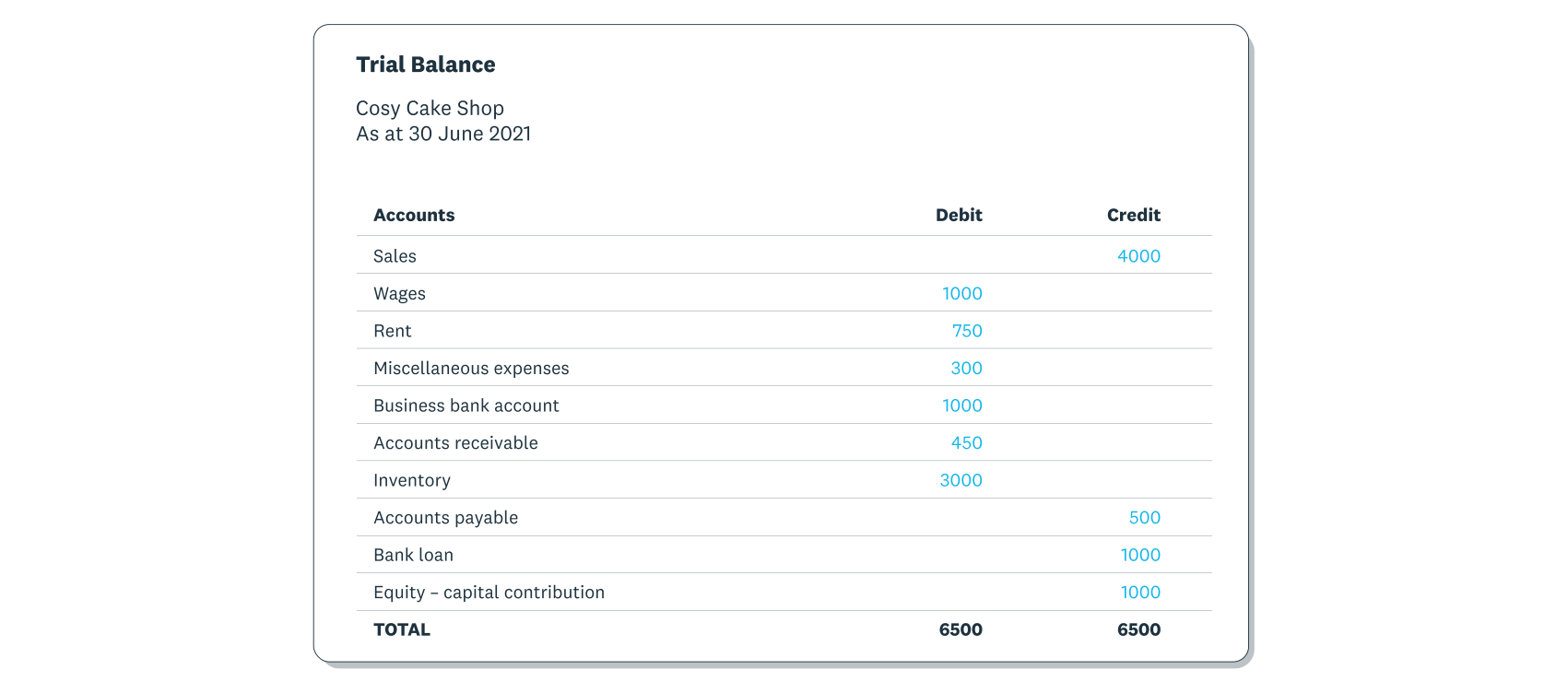
The account names go in the far left column. All debit and credit balances from the general ledger are recorded in the 'Debit' and 'Credit' columns accordingly. The debit and credit columns total the same amount.
Types of trial balances
There are three types of trial balances, each prepared at a different stage of the accounting process:
- Unadjusted trial balance: Prepared first to gather data for closing the books and check for obvious errors
- Adjusted trial balance: Prepared next with corrected entries, used to create your financial statements
- Post-closing trial balance: Prepared last to confirm the ledger is ready for the next accounting period
Unadjusted trial balance
An unadjusted trial balance captures all initial data from your general ledger before any corrections. It records day-to-day transactions that may need adjusting to balance the ledger.
You or your accountant then makes adjustments such as:
- Accruals: Adding unpaid bills
- Deferrals: Recognising income only when earned
- Depreciation: Spreading asset costs over several years
These adjustments give you a clearer view of your business's financial position.
Adjusted trial balance
An adjusted trial balance summarises the final balances in all accounts after you've made corrections. You prepare it after the unadjusted trial balance but before creating your financial statements.
This report serves as the foundation for preparing accurate financial reports like your profit and loss statement and balance sheet.
Post-closing trial balance
A post-closing trial balance verifies that all debit and credit balances are equal after you've closed temporary accounts. You prepare it after finalising your financial statements.
During this stage, several important changes occur:
- Temporary accounts (revenue, expenses, dividends) close to zero
- Those balances move into retained earnings
- Your general ledger is ready for the next accounting period
This creates a clear separation between accounting periods.
Trial balance vs balance sheet
A trial balance and a balance sheet are both financial reports, but they serve different purposes in your accounting process.
A trial balance is an internal bookkeeping tool that lists all account balances from your general ledger. Its purpose is to check that your debits equal your credits before you prepare formal financial statements.
A balance sheet is a formal financial statement that summarises your business's financial position. It shows your assets, liabilities, and owner's equity at a specific point in time.
Here are the key differences between a trial balance and a balance sheet:
- Purpose: Trial balances check for errors; balance sheets report financial position
- Audience: Trial balances are internal; balance sheets are shared with stakeholders
- Detail: Trial balances list every account; balance sheets group accounts into categories
- Timing: Trial balances come first; balance sheets are prepared from trial balance data
Think of the trial balance as a checkpoint. Once you've verified your books are accurate, you use that data to create your balance sheet and other financial statements.
How to prepare a trial balance
Preparing a trial balance helps you verify your bookkeeping before creating financial statements. Follow these steps:
- List all accounts: Gather every account from your general ledger, including assets, liabilities, equity, revenue, and expenses
- Record balances: Enter debit balances in the left column and credit balances in the right column
- Total each column: Add up all debits and all credits separately
- Compare the totals: If they match, your books are mathematically balanced; if they differ, review your ledger for errors
- Investigate discrepancies: Check for transcription errors, omissions, or misclassifications
This process produces an unadjusted trial balance. After making corrections, you'll prepare an adjusted trial balance, then a post-closing trial balance once your financial reports are finalised.
Accounting software like Xero automates this process, reducing clerical errors and letting you produce trial balances whenever you need them.
When to prepare a trial balance
How often you prepare a trial balance depends on your business needs and accounting cycle. Most small businesses prepare trial balances:
- Monthly: to catch errors early and maintain accurate records
- Quarterly: to support quarterly financial reporting and tax estimates
- Annually: as part of year-end closing and financial statement preparation
You might also prepare a trial balance whenever you notice discrepancies in your accounts or before an audit.
With accounting software like Xero, you can generate trial balances at any time without manual calculations. This makes it practical to check your books as often as you need.
Common trial balance errors
Simple mistakes are common when preparing a trial balance. Watch out for these errors:
- Transcription errors: Data entry mistakes like mistyping $500 as $5,000
- Omission errors: Leaving transactions out of the accounts entirely
- Misclassification errors: Recording transactions under the wrong account headings
Even small errors can cause significant problems. Incorrect figures flow through to your financial statements and may lead to poor business decisions based on faulty data.
How to correct trial balance errors
Most trial balance errors are easy to fix with these steps:
- Recheck your numbers: Review your trial balance thoroughly, take a break, and get a second pair of eyes to spot typos
- Verify your ledger: Confirm ledger figures are correct before transferring them to your trial balance
- Use accounting software: Tools like Xero prevent mistyped entries and speed up calculations, giving you more time to review accuracy
The role of trial balances in financial statements
A trial balance helps verify that your general ledger accounts balance correctly before preparing financial statements. Accountants and auditors rely on this report to check for errors.
Your bookkeeper or accountant checks that:
- Debit and credit column totals match
- No entries are missing from the ledger
- Figures were copied correctly from the general ledger
If totals don't match, there may be a missing entry or copying error. Once corrected, the adjusted trial balance becomes the foundation for your balance sheets and other financial statements.
Note that matching totals don't guarantee accuracy. Errors like missing transactions or incorrect account classifications can still exist even when debits equal credits.
The importance of trial balances for small businesses
Trial balances help keep your financial statements accurate and give you confidence that your numbers reflect your business's true financial health. With accurate books, you can achieve several important business goals:
- Meet compliance and tax requirements
- Make better-informed financial decisions
- Prepare for audits with reliable documentation
Xero's accounting software streamlines your accounting practices so you can easily record transactions, prepare trial balances, and produce accurate financial reports. Get one month free to see how Xero simplifies your bookkeeping.
FAQs on trial balances
Here are answers to common questions about trial balances and how they fit into your accounting process.
What are the three rules of trial balances?
- Total debits must equal total credits: This confirms your double-entry bookkeeping is mathematically accurate
- Use the correct chart of accounts: Categorising transactions properly prevents misclassification errors
- Enter data accurately: Careful data entry prevents transcription errors that throw off your totals
What are the three main purposes of a trial balance?
The three main purposes of a trial balance are to verify mathematical accuracy in your bookkeeping, detect errors before preparing financial statements, and provide a summary of all account balances for review. It serves as a checkpoint between recording transactions and creating formal financial reports.
What is the objective of the trial balance?
The objective of a trial balance is to verify your bookkeeping is mathematically accurate. If total debits equal total credits, your ledgers are likely error-free. If they don't match, you'll need to find and fix the mistakes. Trial balances also provide the foundation for preparing accurate financial statements.
Can a trial balance have unequal debits and credits?
Yes, a trial balance can have unequal debits and credits, but this indicates an error in your bookkeeping. Common causes include transcription mistakes, missing entries, or transactions recorded in the wrong column. If your totals don't match, review your general ledger to find and correct the discrepancy before preparing financial statements.
Disclaimer
Xero does not provide accounting, tax, business or legal advice. This guide has been provided for information purposes only. You should consult your own professional advisors for advice directly relating to your business or before taking action in relation to any of the content provided.
Start using Xero for free
Access Xero features for 30 days, then decide which plan best suits your business.