General ledger (GL)
Learn what a general ledger is, how it works and how Malaysian businesses keep one accurate.
Published Wednesday 30 September 2026
Table of contents
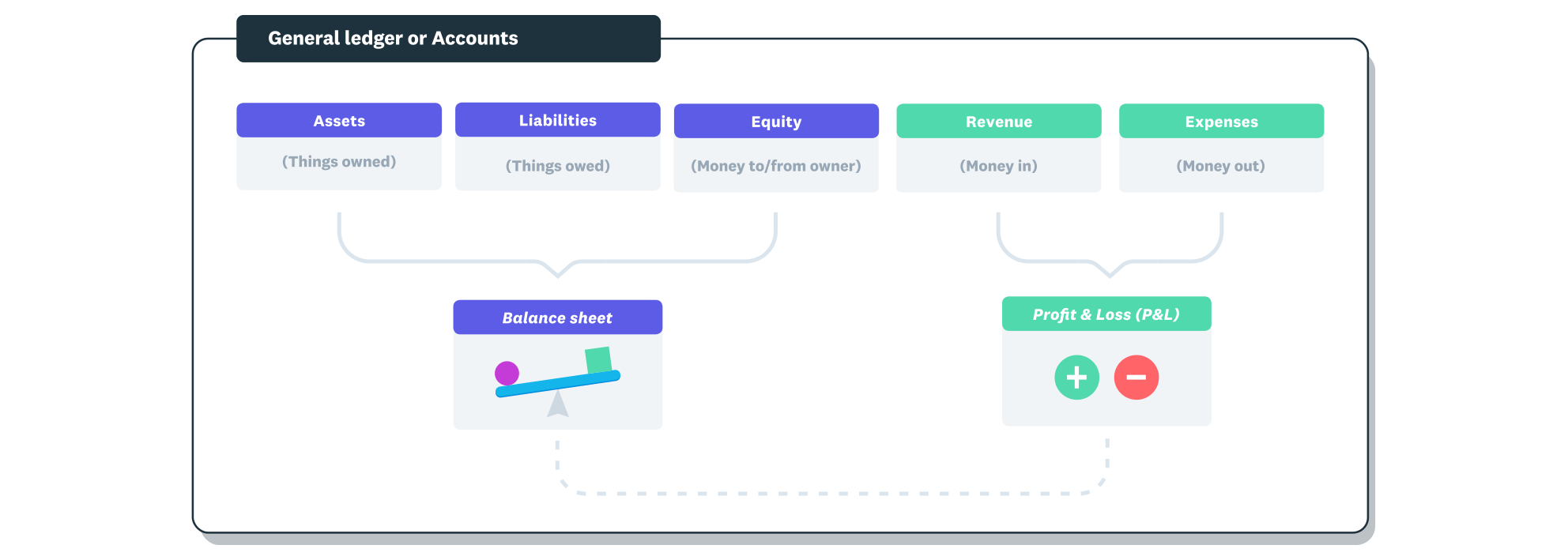
Transactions are entered into the correct account in order to produce the financial reports.
Key takeaways
- A general ledger (GL) is the master record of every financial transaction in your business, sorted by account. Your financial reports are built from it.
- Every GL entry uses double-entry bookkeeping, so each debit has an equal credit and your books stay balanced.
- GL accounts fall into five categories: assets, liabilities, equity, revenue and expenses.
- Malaysian law asks you to record transactions within 60 days and hold records for seven years.
What is a general ledger?
A general ledger (GL) is the master record of every financial transaction in your business, sorted by account. AccountingTools’ definition puts it the same way: one master set of accounts that sums up all your transactions.
Think of it as a filing cabinet with one labelled folder for each account. Every sale, purchase, payroll run and bill lands in the right folder, and your financial reports draw on those folders.
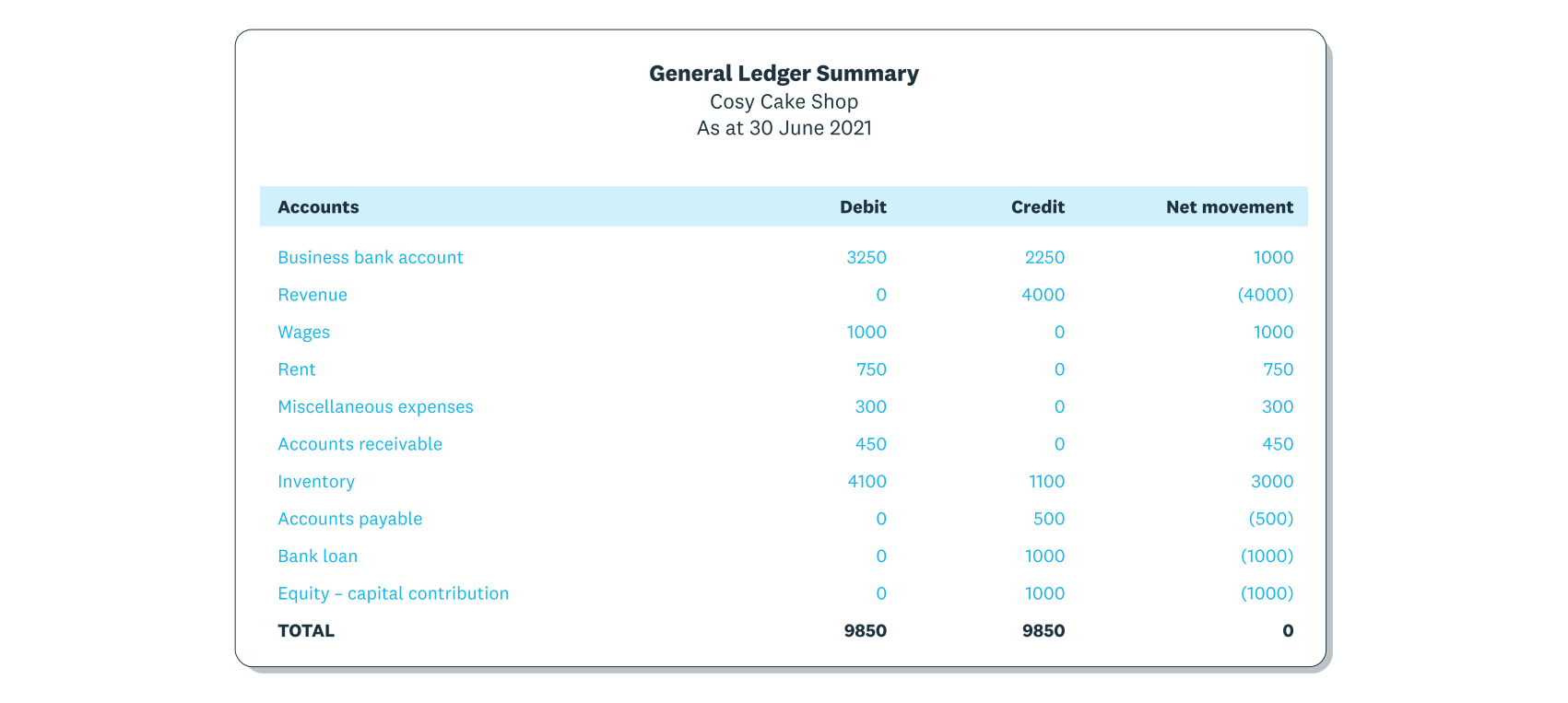
The general ledger summarises the credit and debit transactions for each account.
The folders come from your chart of accounts, which is the list of account names and codes your business uses. That structure means each transaction has a clear home.
How does a general ledger work?
Every transaction follows the same path through your general ledger before it reaches your financial statements. Here’s the sequence.
- A transaction happens, such as a sale or a supplier payment.
- You record it as a journal entry, with a debit to one account and a matching credit to another.
- The entry posts to the right accounts in the GL.
- Each account’s running balance updates to show the new total.
- At period end, you prepare a trial balance from the GL totals to check that debits equal credits.
- Your financial statements, such as the balance sheet and profit and loss statement, are built from the trial balance.
The cycle repeats with every transaction. Over time, your GL becomes a complete financial history of your business.
What gets recorded in a general ledger
Every transaction in your general ledger belongs to one of five categories. Together, they show what your business owns, owes, earns and spends, and each has typical GL accounts you’ll recognise.
- Assets cover what your business owns, such as equipment and money customers owe you, with GL accounts like Cash at bank
- Liabilities cover what your business owes, such as loans and unpaid supplier bills, with GL accounts like Bank loan
- Equity covers the owner’s stake after liabilities are subtracted from assets, with GL accounts like Retained earnings
- Revenue covers what your business earns from its operations, with GL accounts like Sales
- Expenses cover the cost of running your business, such as rent and utilities, with GL accounts like Rent
Types of general ledger accounts
Beyond the five categories, GL accounts also differ in how they behave at the end of an accounting period and how much detail they hold. Knowing the difference helps you read your reports correctly.
Permanent vs temporary accounts
Permanent accounts carry their balances into the next period. Assets, liabilities and equity are permanent, so your cash balance on 31 December becomes your opening balance on 1 January.
Temporary accounts start each period at zero. AccountingTools’ guide to closing entries explains that revenue and expense accounts close to retained earnings at period end. Each period’s results then stand on their own.
Subledgers
A subledger holds the detail behind one GL account. Your accounts receivable subledger, for example, lists every customer invoice, while the GL shows only the total customers owe you.
Corporate Finance Institute’s GL guide calls GL accounts with subledgers controlling accounts. Common subledgers cover accounts receivable and accounts payable, which keeps high-volume detail out of the main ledger.
GL codes
You can number your GL accounts so they’re quick to find and sort. For example, asset accounts might sit in the 1000 range, liabilities in the 2000 range and expenses in the 5000 range.
How to set up a general ledger
Setting up a general ledger means making a few decisions once, then following a routine every period. Work through these steps in order.
1. Choose an accounting method
Decide between cash accounting, which records income and expenses when money moves, and accrual accounting, which records them when you earn or incur them. Ask your accountant which method suits your business structure and reporting framework.
2. Build your chart of accounts
List the accounts you need under each of the five categories, and give each one a name and code. Start with a lean list and add accounts as your business grows, so your reports stay easy to read.
3. Enter opening balances
If your business is already trading, enter the balance of each account on your start date. Use your latest bank statements and your accountant’s closing figures, so the GL starts from reliable numbers.
4. Record and post journal entries
Record each transaction as a journal entry and post it to the matching GL accounts. Follow a consistent process for recording accounting transactions, and enter each one within 60 days to meet Malaysian record-keeping rules.
5. Review with a trial balance
At the end of each period, run a trial balance to confirm total debits equal total credits. If they match, move on to your financial statements; if they differ, trace the gap before you close the period.
General ledger example
Two everyday transactions show how GL entries work in practice. Each one changes two accounts by the same amount.
Buying office supplies
Your business buys RM500 of office supplies and pays from its bank account. The GL entry looks like this.
- Debit Office supplies (expense) by RM500
- Credit Cash at bank (asset) by RM500
The expense account rises because you’ve spent money, and the cash account falls by the same amount. The two sides balance.
Invoicing a customer
You invoice a customer RM1,000 for services. The GL entry looks like this.
- Debit Accounts receivable (asset) by RM1,000
- Credit Sales (revenue) by RM1,000
Accounts receivable rises because the customer now owes you RM1,000, and revenue rises because you’ve earned it. When the customer pays, you debit cash and credit accounts receivable.
General ledger vs journal, chart of accounts, trial balance and balance sheet
Several accounting terms sit close to the general ledger but do different jobs. Here’s how each one relates to the GL.
GL vs general journal
The general journal records transactions in date order, like a diary. As AccountingTools’ journal and ledger comparison explains, the GL then sorts those same entries by account, so you can see each account’s running balance.
GL vs chart of accounts
The chart of accounts is the list of accounts your business uses, with a name and code for each. The GL holds the actual transactions and balances for every one of those accounts.
If the chart of accounts is a book’s contents page, the GL is the chapters themselves. You set up the chart first, and the GL fills each account with activity.
GL vs trial balance
A trial balance is a report drawn from the GL at the end of a period. It lists every account balance and checks that debits equal credits, while the GL keeps the full transaction detail.
GL vs balance sheet
The balance sheet is a financial statement built from GL data. It shows your assets, liabilities and equity on a specific date, while the GL records how those balances got there.
What is double-entry bookkeeping?
Double-entry bookkeeping is the system behind every general ledger. Each transaction affects at least two accounts, with a debit in one and an equal credit in another.
This keeps the accounting equation in balance: assets = liabilities + equity. If you pay RM1,200 in rent, cash drops by RM1,200 and rent expense rises by RM1,200.
The result is a built-in error check. When debits and credits match, your books balance; when they differ, you know to look for a mistake before it reaches your reports.
Why does your business need a general ledger?
A well-kept general ledger gives you the financial clarity to run your business with confidence. It supports you in these ways.
- Produces the financial statements your accountant and bank use to assess your business
- Organises income and expenses, so preparing your tax return is quicker and more accurate
- Reveals errors and unusual activity early, thanks to double-entry checks and regular reconciliation
- Shows all your numbers in one place for decisions on pricing and spending
- Gives auditors organised records if your accounts are reviewed
- Helps you meet record-keeping rules under the Companies Act 2016 and Income Tax Act 1967
With an up-to-date GL, you can pull financial reports, such as a profit and loss statement, whenever you need them.
General ledger record-keeping rules in Malaysia
Malaysian law sets clear rules on how quickly you record transactions and how long you retain them. Two Acts cover timing and retention, while national accounting standards shape how you report.
Companies Act 2016
Under section 245 of the Companies Act 2016, a company must keep accounting records that explain its transactions and financial position. Entries need to be made within 60 days of each transaction, and records retained for seven years.
Income Tax Act 1967
Section 82 of the Income Tax Act 1967 applies to every person carrying on a business, so it covers sole proprietors too. The tax record-keeping period is seven years, as PwC Malaysia’s tax audit guide points out.
Accounting standards: MFRS and MPERS
The Malaysian Accounting Standards Board (MASB) framework makes the Malaysian Financial Reporting Standards (MFRS) mandatory for entities other than private entities. Private entities can use the Malaysian Private Entities Reporting Standard (MPERS) or choose MFRS instead.
MyInvois e-invoicing
MyInvois is the e-invoicing system run by the Inland Revenue Board of Malaysia (LHDN). According to LHDN’s e-invoice FAQ, it’s phased in by annual turnover or revenue for businesses with:
- more than RM100 million, from 1 August 2024
- more than RM25 million and up to RM100 million, from 1 January 2025
- more than RM5 million and up to RM25 million, from 1 July 2025
- up to RM5 million, from 1 January 2026
The same FAQ, updated 4 September 2026, exempts businesses with annual turnover below RM3 million from issuing e-invoices. This threshold has changed several times, so check LHDN for the latest figure.
If you’re in scope, each e-invoice is also a transaction your GL needs to capture. See how e-invoicing in Xero connects your invoices to your books.
How to reconcile a general ledger
Reconciling your general ledger means comparing your records with external documents, such as bank statements, to confirm they match. Doing it monthly keeps any differences small and easy to trace.
- Gather the bank and credit card statements for the period.
- Compare each GL account balance with the matching external record.
- Flag any differences, such as missing or duplicated transactions.
- Post adjusting entries to correct errors or add missed transactions.
- Run a trial balance to confirm debits and credits still match.
A step-by-step reconciliation guide covers each stage in more detail. Accounting software with bank transaction matching pairs statement lines with GL entries, which cuts manual checking.
Common general ledger mistakes
Small GL errors add up quickly and can distort your reports. Watch for these common slips.
- Posting transactions to the wrong account, such as recording a new laptop as office supplies instead of equipment
- Missing or duplicating entries, which pushes account balances out of line with the bank
- Writing vague descriptions like ‘payment’, which make entries hard to check later
- Mixing personal and business spending in the same accounts
- Skipping reconciliations, so errors stay hidden until year end
Regular reconciliation and clear descriptions help you catch these early. Bank feeds help too, because they bring transactions in without retyping.
General ledger and accounting software
Managing a general ledger in spreadsheets or on paper takes time and leaves room for typing errors. Accounting software posts entries for you, so you spend more time on your business and less on your books.
With cloud accounting software like Xero, each transaction you record posts to the right GL accounts automatically. Balances update as you go, and bank feeds bring in transactions so you’re working with current figures.
JAX, Xero’s AI financial superagent, can automatically reconcile bank transactions where there’s high confidence, and you keep the final say. You can also work on the same numbers as your accountant or bookkeeper in real time.
Simplify your general ledger with Xero
A well-kept general ledger makes your reports and tax returns easier to trust. Staying on top of it through the year means you’re ready whenever your accountant or LHDN asks for records.
Xero posts transactions to your GL and helps you reconcile your bank accounts, so your reports stay current with less manual admin. Sign up today and get one month free.
FAQs on general ledgers
These answers cover more questions small business owners ask about general ledgers.
What does GL mean in accounting?
GL stands for general ledger. You’ll also see “GL account”, which means a single account inside the ledger, and “GL code”, which is that account’s number.
What is an example of a GL account?
Rent is a typical GL account: it might carry code 6100 and list each monthly payment of RM2,500 with a running balance. By December, that balance shows your total rent for the year.
How often should you reconcile your general ledger?
Reconcile at least monthly, and more often if you process lots of transactions. Bank feeds make daily or weekly matching practical.
Can you manage a general ledger without accounting software?
You can use a spreadsheet, but it has no built-in check that debits equal credits. Add formulas that total both columns for each account, and review them before you close each period.
How long must Malaysian businesses keep general ledger records?
Plan to keep them for at least seven years, the retention period covered in the Malaysian record-keeping rules section above. Your accountant can confirm when that period starts for each type of record.
Related terms
Learn more about general ledgers
Handy resources
Advisor directory
You can search for experts in our advisor directory
Xero Small Business Guides
Discover resources to help you do better business
Online accounting with Xero
Automate your accounting in the cloud
Disclaimer
This glossary is for small business owners. The definitions are written with their requirements in mind. More detailed definitions can be found in accounting textbooks or from an accounting professional. Xero does not provide accounting, tax, business or legal advice.