General ledger (GL)
A general ledger (GL) is the master record of every transaction in your business, sorted by account.
Published Wednesday 30 September 2026
Table of contents
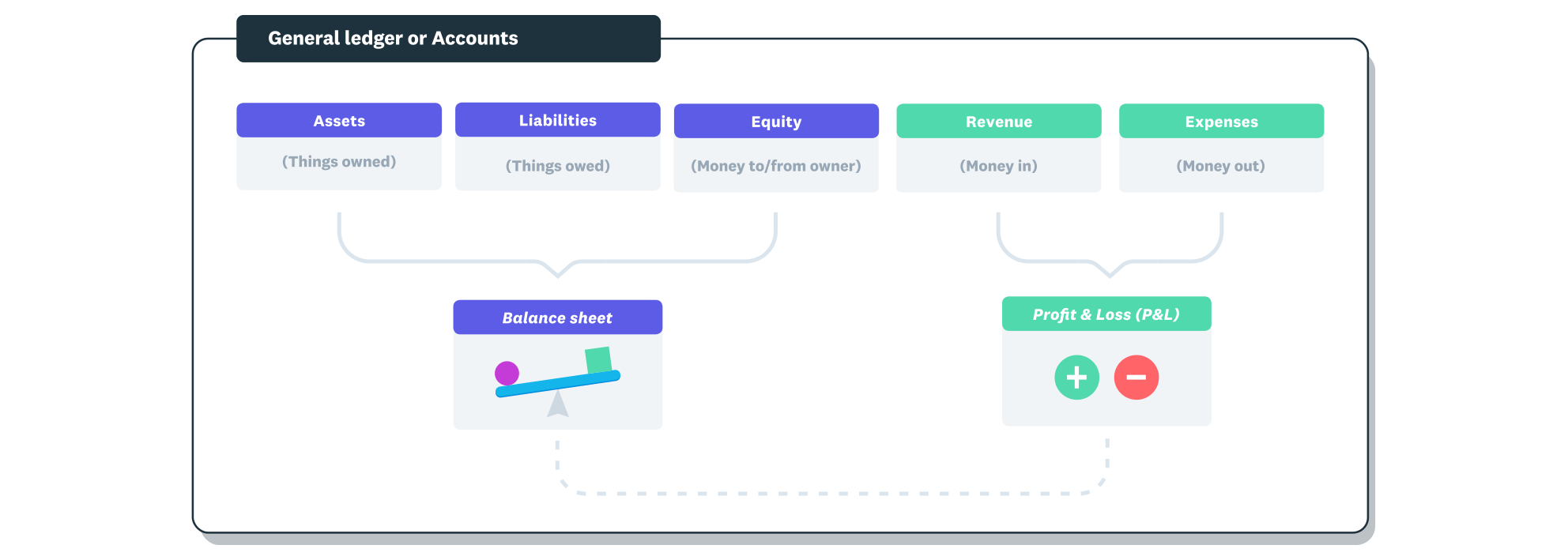
Transactions are entered into the correct account in order to produce the financial reports.
Key takeaways
- A general ledger (GL) is the master record of every financial transaction in your business, organised by account
- Each entry uses double-entry bookkeeping, so every debit in one account has an equal credit in another
- Irish companies must keep adequate accounting records for at least six years, and Revenue expects businesses to keep nominal ledgers for six years
- Accounting software posts entries and updates balances as you work, so your reports are ready whenever you need them
What is a general ledger?
A general ledger (GL) is the master record of all your business's financial transactions, organised by account. It tracks every debit and credit across your assets, liabilities, equity, revenue and expenses.
Think of it as a filing cabinet with one drawer for each account. Every sale, purchase, wage payment and bill you record lands in the right drawer, and the totals become your financial reports.
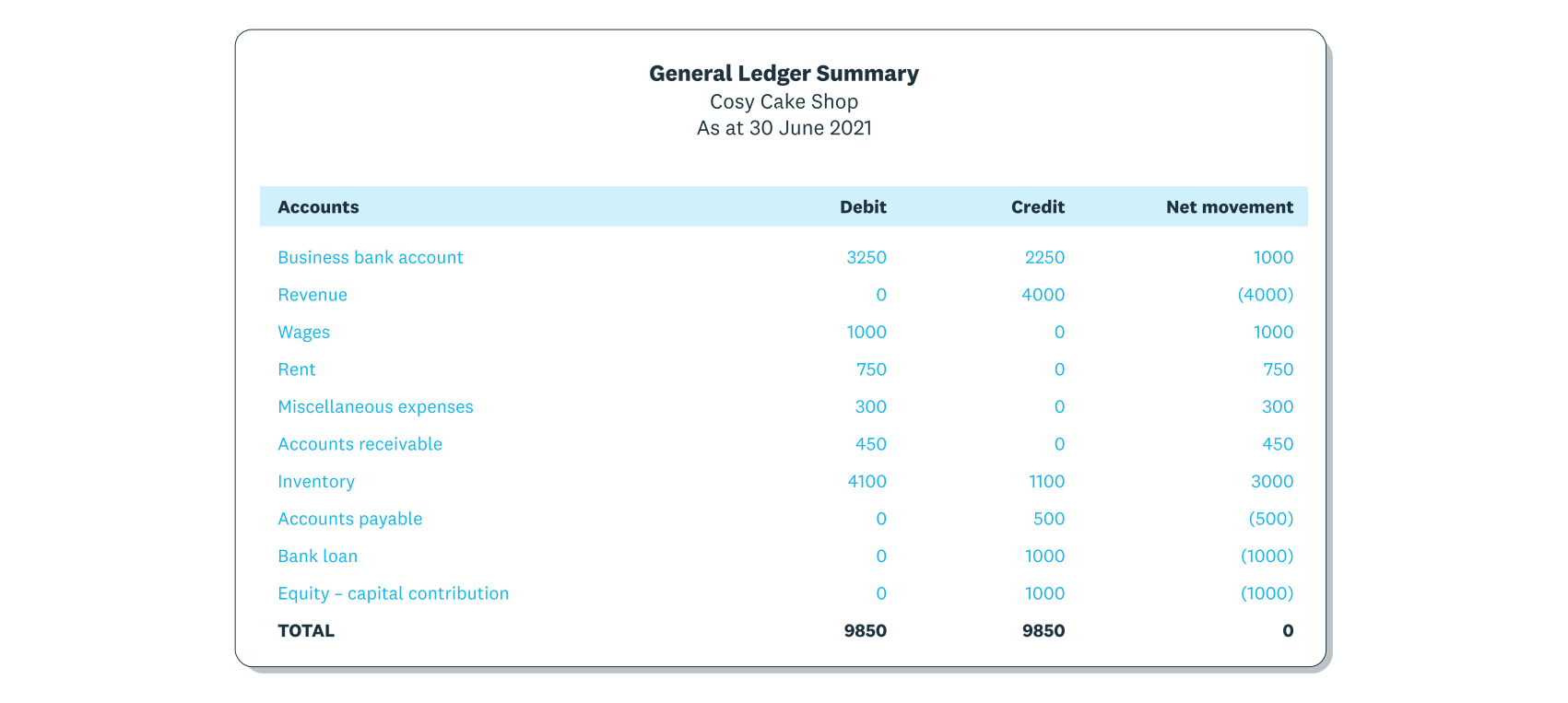
The general ledger summarises the credit and debit transactions for each account.
The drawers are set out in your chart of accounts, the list of every account your business uses. Each account has its own name and code, so every transaction has a clear home.
How does a general ledger work?
Every transaction follows the same path through your general ledger before it reaches your reports. Here's how that flow works.
- A financial transaction happens, such as a sale or a supplier bill
- You record it as a journal entry, with a debit in one account and a credit in another
- The entry is posted to the matching accounts in the general ledger
- Each account balance updates to show the new total
- At the end of each accounting period, you prepare a trial balance to check that total debits equal total credits
- Your financial statements, including the balance sheet and profit and loss account, are produced from the trial balance
This cycle repeats with every transaction. Over time, your ledger builds a complete financial history of your business.
The 5 parts of a general ledger
The five parts of a general ledger are assets, liabilities, equity, revenue and expenses. Together they show what your business owns, owes, earns and spends.
- Assets are things your business owns that have value, such as cash in the bank, equipment, stock and money customers owe you
- Liabilities are amounts your business owes, such as loans, unpaid supplier bills, credit card balances and wages due
- Equity is the owner's stake in the business, worked out by subtracting liabilities from assets
- Revenue is money your business earns from its operations, such as sales of goods and fees for services
- Expenses are the costs of running your business, such as rent, wages, insurance and marketing
Types of general ledger accounts
Beyond the five parts, GL accounts are grouped by how they behave at the end of an accounting period and how much detail they hold. Knowing these types helps you keep your books accurate.
Permanent vs temporary accounts
Permanent accounts carry their balances forward into the next accounting period. Assets, liabilities and equity are permanent, so your bank balance at 31 December becomes your opening balance on 1 January.
Temporary accounts reset to zero at the end of each period. Revenue and expense balances are closed off and transferred to retained earnings, so you can track the new period's sales and costs from a clean start.
Subledgers
Subledgers are detailed records that feed into a single GL account, often called a control account. Your accounts receivable subledger, for example, lists every customer invoice, while the general ledger shows only the total owed to you.
Other common subledgers include payroll and accounts payable, which tracks each supplier bill. They give you day-to-day detail while keeping the general ledger tidy and summarised.
GL codes and chart of accounts
Most businesses give each GL account a number so it's quicker to find and report on. For instance, asset accounts might use codes in the 1000s, liabilities in the 2000s and expenses in the 5000s.
How to post journal entries to the general ledger
A GL account is a single account in your ledger, such as bank or sales, with its own running balance. Posting moves each journal entry into the GL accounts it affects. Follow these steps each time you record transactions by hand.
- Note the transaction date from the source document, such as an invoice or receipt
- Pick the accounts the transaction affects, using your chart of accounts
- Enter the debit amount in one account and the matching credit amount in the other
- Add a short description and a reference number so you can trace the entry later
- Post each side to its GL account and update the running balances
- Review the entry to check that total debits equal total credits
General ledger example
Seeing entries in action makes the idea easier to follow. Here are two common transactions and how they appear in the ledger.
Buying office supplies
Your business buys €500 of office supplies and pays from the business bank account. The GL entry looks like this:
- Debit office supplies (expense) €500
- Credit bank (asset) €500
The expense account goes up by €500 because you've spent money. The bank account goes down by €500 because the money has left it, so both sides balance.
Invoicing a customer
You send a customer an invoice for €1,000 of services. The GL entry is:
- Debit accounts receivable (asset) €1,000
- Credit sales (revenue) €1,000
Accounts receivable rises because the customer now owes you €1,000, and sales rise because you've earned it. When the customer pays, you'll debit bank and credit accounts receivable to clear the balance.
How to balance a ledger account
Balancing a ledger account gives you its closing figure for the period, such as the money left in your bank account. Each account has a debit side on the left and a credit side on the right. Follow these steps to balance any account.
- Add up all the amounts on the debit side
- Add up all the amounts on the credit side
- Insert the difference on the smaller side as the balance carried down (c/d)
- Total both sides so they show the same figure
- Enter the same balance on the opposite side as the balance brought down (b/d) for the next period
Say your bank account shows €5,000 on the debit side and €3,200 on the credit side. You'd insert a balance c/d of €1,800 on the credit side, making both totals €5,000. The €1,800 then appears as the balance b/d on the debit side, showing the money you start the next period with.
General ledger vs journal, trial balance, balance sheet and chart of accounts
Several accounting terms sound close to "general ledger" but mean different things. Here's how each one compares.
GL vs general journal
The general journal is where you first record transactions in date order, like a diary of financial events. The GL then sorts those same entries by account, so you can see each account's running balance.
GL vs trial balance
A trial balance is a report drawn from the GL at the end of an accounting period. It lists every account balance and checks that debits equal credits, while the GL holds the full transaction detail behind those figures.
GL vs balance sheet
The balance sheet is a financial statement built from GL data. It gives a snapshot of your assets, liabilities and equity on a specific date, while the GL is the underlying record of every transaction.
GL vs chart of accounts
The chart of accounts is the list of accounts your business uses, like the index of a book. The general ledger is the book itself, holding every transaction and balance for each of those accounts.
What is double-entry bookkeeping?
Double-entry bookkeeping is the system that makes the general ledger work. You record every transaction in at least two accounts, with a debit in one and a credit of the same amount in another.
This keeps the accounting equation in balance: assets = liabilities + equity. If you pay €1,200 in rent, your bank balance (an asset) falls by €1,200 and your rent expense rises by €1,200. The expense reduces your equity by the same amount, so the equation stays level.
Double entry also gives you a built-in error check. If your debits and credits don't agree, you'll know to look for a mistake before it reaches your reports.
Why does your business need a general ledger?
A well-kept general ledger gives you the financial clarity to run your business with confidence. It also helps you meet your legal record-keeping duties in Ireland.
- It produces the financial statements your accountant and lender need to judge how your business is doing
- It keeps your income and expenses organised, so your tax returns are quicker to prepare
- It helps you catch errors and spot unusual activity early through double entry and regular reconciliation
- It shows all your figures in one place, so you can plan pricing and spending with confidence
- It gives you organised records, ready for your accountant or a Revenue audit
If you run a company, the Companies Act 2014 requires you to keep adequate accounting records, and your general ledger is at the centre of them. Under section 285, you must hold on to those records for at least six years after the end of the financial year they cover.
Tax rules apply to sole traders as well as companies. Revenue expects anyone running a business to keep records such as nominal ledgers and purchase and sales invoices for six years.
Your ledger also feeds your year-end accounts. Unless your company uses International Financial Reporting Standards (IFRS), you'll prepare these under Financial Reporting Standard (FRS) 102, or FRS 105 for micro-entities. Both standards are issued by the Financial Reporting Council (FRC) for the UK and Republic of Ireland.
How to reconcile a general ledger
Reconciling your GL means comparing your records with outside documents, such as bank statements, to confirm they match. Aim to do this at least once a month, following these steps.
- Gather the bank and credit card statements for the period
- Compare each GL account balance with the matching external record
- Look for differences, such as missing or duplicate entries
- Make adjusting entries to correct errors or add missed transactions
- Confirm every balance is accurate and your trial balance agrees
Accounting software can match bank transactions to your ledger entries automatically, which saves time at month-end. You can also learn how bank reconciliation works in more detail.
Common general ledger mistakes to avoid
Small slips in your general ledger flow through to every report you produce. Catching these common mistakes early keeps your figures reliable.
- Keying in amounts by hand and transposing figures, such as entering €450 as €540
- Leaving reconciliations until year-end, when differences are harder to trace
- Coding transactions to the wrong account, which skews your profit and loss figures
- Letting receipts and invoices pile up between bookkeeping sessions
- Skipping adjusting entries for items such as accruals and depreciation
A regular weekly bookkeeping routine keeps most of these in check.
General ledger and accounting software
You can keep a general ledger in spreadsheets or on paper, but every entry has to be posted and totalled by hand. Accounting software takes that repetitive work off your hands.
With cloud-based accounting software like Xero, each transaction you record is posted to the right GL accounts automatically. Balances update as you go, and you can run a trial balance or balance sheet whenever you need one.
You can also check your cash flow from any device and share reports with your accountant or bookkeeper in real time. That way, you know where your business stands every day of the month.
Simplify your general ledger with Xero
An accurate general ledger sits behind every report and tax return your business produces. Xero updates your ledger as you invoice customers and reconcile your bank accounts, so your records stay current with less manual work.
Automated bank feeds bring your transactions straight in, and your accountant can work in the same up-to-date books. Explore the plans and get one month free to see how easy your ledger can be.
FAQs on general ledgers
Here are quick answers to common questions about general ledgers in Ireland.
Is a general ledger the same as an accounting ledger?
Usually, yes: "accounting ledger" can mean any ledger, but it most often refers to the general ledger that holds all your accounts. In Ireland and the UK, you'll also hear the general ledger called the nominal ledger.
What are the other types of ledgers?
The sales ledger (or debtors ledger) tracks what each customer owes you, and the purchases ledger (or creditors ledger) tracks what you owe each supplier. Both are subledgers, and their totals feed control accounts in the general ledger.
Do small businesses need a general ledger?
Yes: sole traders need one to meet Revenue's record-keeping rules, and companies need one to meet the Companies Act 2014. Revenue holds you responsible for those records even if your accountant keeps the books for you.
How often should you reconcile your general ledger?
Monthly suits most small businesses, and reconciling bank transactions weekly keeps month-end short. It's also worth reconciling before you prepare a VAT return or year-end accounts, so the figures you submit match your bank.
How long should you keep general ledger records in Ireland?
Keep them for at least six years, counted for companies from the end of the financial year the record covers. So a ledger for the year to 31 December 2026 should be kept until at least 31 December 2032.
Can you manage a general ledger without accounting software?
Yes, a spreadsheet or paper ledger works, as long as it's complete and kept up to date. Software posts both sides of each entry for you and flags when debits and credits don't match.
Related terms
Learn more about general ledgers
Handy resources
Advisor directory
You can search for experts in our advisor directory
Xero Small Business Guides
Discover resources to help you do better business
Online accounting with Xero
Automate your accounting in the cloud
Disclaimer
This glossary is for small business owners. The definitions are written with their requirements in mind. More detailed definitions can be found in accounting textbooks or from an accounting professional. Xero does not provide accounting, tax, business or legal advice.