Accounting period
What an accounting period is, the main types, and how Irish tax and CRO rules apply.
Published Friday 24 July 2026
Table of contents
Key takeaways
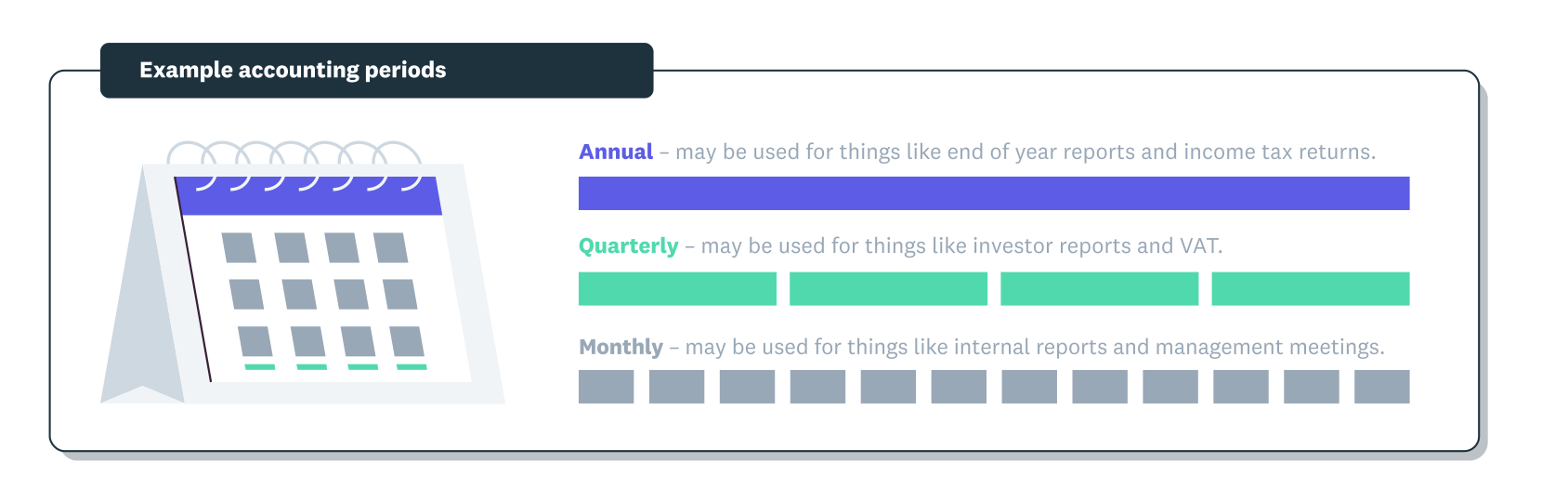
Annual accounting periods don’t have to start in January. Nor do monthly accounting periods have to start on the first of the month.
- An accounting period is any span of time you use to record and report your business finances, often 12 months.
- Common types include the calendar year, financial year, quarterly, monthly, 52/53-week, and short or long transitional periods.
- In Ireland, a Corporation Tax accounting period can't be longer than 12 months, and your financial year end is set through the Companies Registration Office.
- Choosing the right period comes down to seasonality, what lenders and stakeholders expect, and keeping your reporting manageable.
What is an accounting period?
An accounting period is any time frame you use for financial reporting. Every transaction that falls within a given date range forms part of the statements or reports for that period.
An accounting period, sometimes called a reporting period, is often 12 months. You might run different accounting periods for different tasks, such as income tax and business reporting.
Handy resources
Advisor directory
You can search for experts in our advisor directory
Xero Small Business Guides
Discover resources to help you do better business
Try Xero for free
Try Xero’s fast, simple, powerful online accounting software for your small business
Disclaimer
This glossary is for small business owners. The definitions are written with their requirements in mind. More detailed definitions can be found in accounting textbooks or from an accounting professional. Xero does not provide accounting, tax, business or legal advice.
Types of accounting periods
Handy resources
Advisor directory
You can search for experts in our advisor directory
Xero Small Business Guides
Discover resources to help you do better business
Try Xero for free
Try Xero’s fast, simple, powerful online accounting software for your small business
Accounting periods come in a few standard shapes, and the one you pick affects how you plan, report, and file. Here's how the most common types work.
Calendar year vs financial year
A calendar year runs from 1 January to 31 December. A financial year is any 12-month period a business chooses for reporting, so it doesn't have to line up with the calendar.
Quarterly and monthly periods
Many businesses break the year into shorter periods to stay on top of performance. Quarterly periods cover 3 months each, while monthly periods let you review results and cash flow more often.
4-4-5 and 52/53-week periods
Some businesses, especially in retail, split the year into a 4-4-5 pattern, so a quarter has 2 shorter months of 4 weeks and 1 longer month of 5 weeks. This creates a 52-week or 53-week year that keeps weekly sales comparable across periods.
Short and long (transitional) periods
Sometimes a period runs shorter or longer than the usual 12 months, often when you start up, wind down, or change your year end. These transitional periods bridge the gap between one reporting cycle and the next.
The accrual concept and the matching principle
Which accounting period a transaction belongs to depends on the accrual concept and the matching principle. Together they keep your reports accurate rather than just tracking when cash moves.
Revenue recognition
Under accrual accounting, you record revenue when you earn it, not when the money lands. So a sale you invoice in a period counts in that period, even if the customer pays later.
The matching principle
The matching principle says you record expenses in the same period as the revenue they help generate. This gives a truer picture of profit, because costs sit alongside the income they relate to.
Accounting period vs financial year vs fiscal year
These terms overlap, which is why they're easy to mix up. Getting the distinctions clear helps you talk to your accountant, lender, and Revenue with confidence.
An accounting period is the broad term: any time frame used for reporting, whether that's a month, a quarter, or a year. A financial year is the specific 12-month period your company reports on, and fiscal year means the same thing.
Your annual accounting periods don't have to start in January, and monthly periods don't have to start on the first of the month. You choose the start date that suits how you run your business.
Accounting periods and Irish tax
In Ireland, your accounting periods shape when you file and pay. The rules come from Revenue for tax and from the Companies Registration Office for your financial year, so it helps to know how each one treats a period.
Corporation Tax accounting periods
Corporation Tax is charged on the profits of a company's accounting period, and that period can't be longer than 12 months, according to Revenue. If you prepare accounts for a longer span, such as 18 months, Revenue treats them as 2 periods. The first covers 12 months and the second covers the remainder, with a separate Form CT1 filed for each.
You must file your CT1 return and pay any Corporation Tax due within 9 months of the period end. When filing through Revenue's Online Service (ROS), the deadline falls on the 23rd day of that ninth month, per Revenue.
VAT return periods
Value-Added Tax (VAT) works on its own reporting cycle, separate from your Corporation Tax period. Irish VAT returns are usually filed for 2-month (bi-monthly) periods. Some businesses qualify for less frequent filing depending on their liability, as set out by Revenue.
Financial year end and the CRO
Your financial year end is a company law matter handled by the Companies Registration Office (CRO). A company's first financial year begins on incorporation and ends no more than 18 months later, according to the CRO.
After that, each financial year must be no more than 7 days shorter or longer than 12 months. This keeps your reporting steady from one year to the next.
How to choose or change your accounting period
The right accounting period fits the way your business actually trades. A few practical factors point you towards a sensible choice.
- Match your seasonality, so your year end lands after your busiest trading period rather than in the middle of it
- Consider what lenders, investors, and other stakeholders expect to see and when
- Keep it manageable, so filing and reporting fit comfortably around the rest of your workload
If you need to change your company's financial year end, you do it through the CRO by filing a Form B83. You can alter the year end once every 5 years, and the new financial year can't exceed 18 months, according to the CRO.
Keep in mind that a long set of accounts is split into 2 Corporation Tax periods for Revenue, so a change to your year end can affect how and when you file.
Simplify your accounting periods with Xero
Keeping every transaction in the right period is far easier when your records update as you go. Xero brings your finances together in one place, so your reports reflect the correct accounting period without hours of manual admin.
You can reconcile bank transactions, track income and expenses, and pull reports for any date range you need, which makes month-end and year-end far less of a scramble. Try Xero to see how simple your accounting periods can be, and you can get one month free.
FAQs on accounting periods
Here are answers to some frequently asked questions about accounting periods for Irish businesses.
Can a Corporation Tax accounting period be longer than 12 months in Ireland?
No, a Corporation Tax accounting period can't be longer than 12 months. If your accounts cover a longer span, Revenue splits them into 2 periods with a separate return for each.
What's the difference between an accounting period and a financial year?
An accounting period is any time frame used for reporting, such as a month or a quarter. A financial year is the specific 12-month period your company reports on for company law purposes.
When does an accounting period end?
It ends on the closing date of the reporting cycle you've chosen, whether that's month end, quarter end, or year end. At that point you draw up your figures and report on the transactions within it.
How do I change my company's financial year end in Ireland?
You change it by filing a Form B83 with the CRO. You can do this once every 5 years, and the new financial year can't exceed 18 months.