What is cash flow?
Learn what cash flow is, how to calculate it, and how Irish small businesses can keep cash moving.
Published Wednesday 30 September 2026
Table of contents
Key takeaways
- Cash flow is the money moving into and out of your business over a set period. It decides whether you can pay your staff and suppliers on time.
- Profit and cash flow measure different things. A profitable business can still run short if customers pay after your own costs fall due.
- In Ireland, business customers must generally pay within 30 days. If they pay late, you’re entitled to statutory interest of 10.4% a year from 1 July 2026, plus fixed compensation.
- A regular cash flow forecast shows shortfalls weeks ahead. That gives you time to act, whether that means chasing invoices or arranging finance.
What is cash flow?
Cash flow is the movement of money into and out of your business over a given period. It shows whether the money coming in covers what’s going out to suppliers, employees, lenders and yourself.
Think of your bank account as a bath. Customer payments are the tap, bills are the plughole, and cash flow tells you whether the water level is rising or falling.
You can express it with a simple formula:
Net cash flow = total cash inflows – total cash outflows
When more money flows in than out, you have positive cash flow. When more goes out than comes in, you have negative cash flow, which can happen in a month of record sales.
Cash includes notes, coins and bank balances, plus cash equivalents. These are short-term investments you can convert to a known amount of money, typically with a maturity of three months or less.
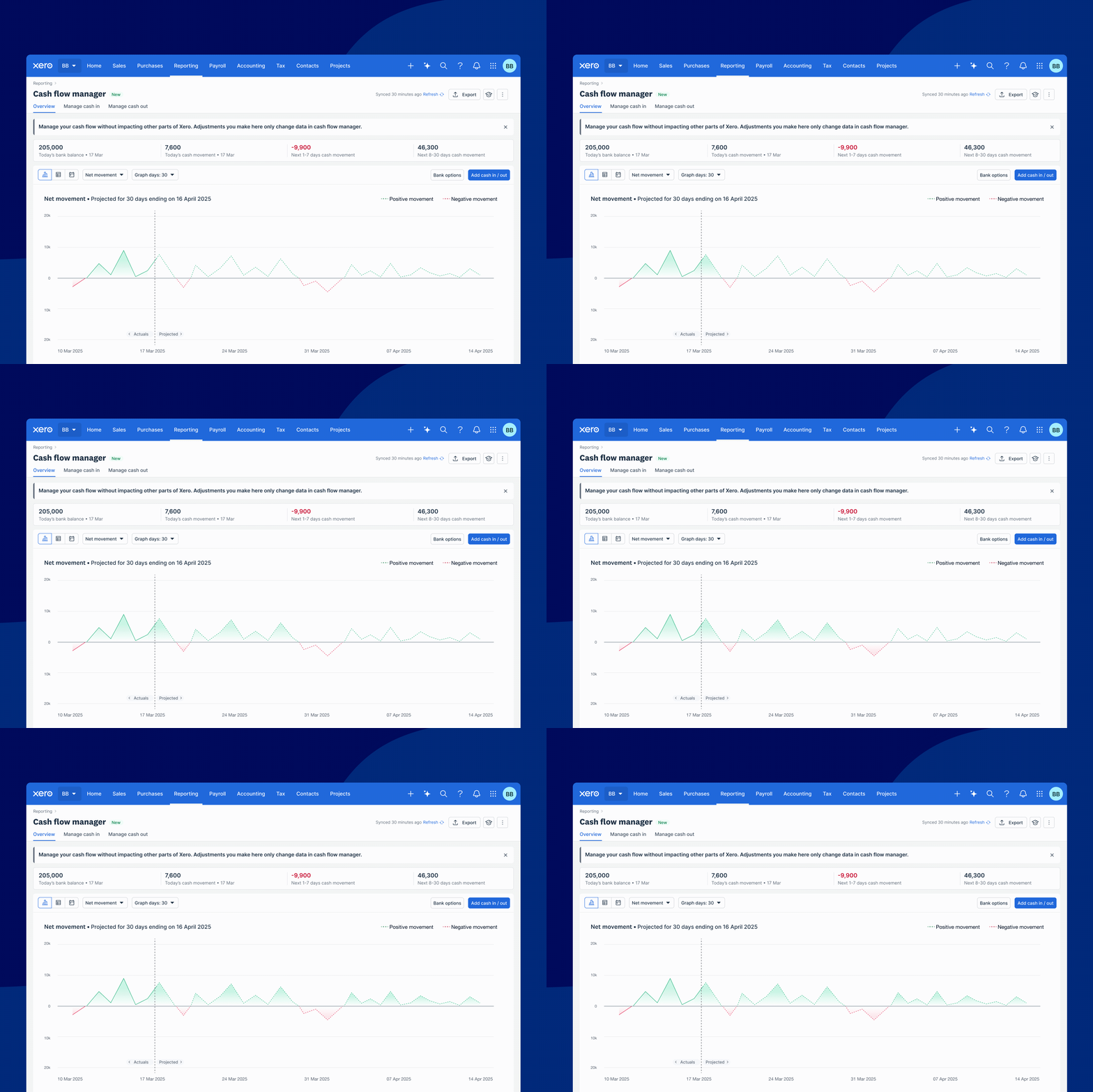
Small businesses can get a picture of future cash flow by accounting for upcoming bills and payments (example from Xero dashboard).
Why is cash flow important?
Cash flow is one of the clearest signs of your business’s financial health. With enough cash at the right time, you can pay wages and keep trading, whatever your profit looks like on paper.
Lenders look closely at your cash flow when you apply for a loan or overdraft. Steady inflows show them your business can meet repayments.
Irish law also gives you tools to protect your cash flow. Under the European Communities (Late Payment in Commercial Transactions) Regulations 2012, business customers must pay within 30 days unless your contract sets another term. Terms longer than 60 days must be expressly agreed and can’t be grossly unfair to you.
If a customer pays late, you’re automatically entitled to statutory interest at the European Central Bank (ECB) main refinancing rate plus 8 percentage points. The Department of Enterprise, Tourism and Employment confirms the late payment interest rate is 10.4% a year from 1 July 2026.
You can also claim fixed compensation for your recovery costs, as law firm William Fry sets out in its summary of the Irish regulations. It’s €40 for debts under €1,000 and €70 for debts of €1,000 or more but under €10,000. For debts of €10,000 or more, it’s €100.
Keeping a close eye on cash flow helps you avoid problems such as:
- overtrading, where you take on more work than your cash reserves can fund
- overspending, where you commit to costs before the money to cover them arrives
- missed payments to suppliers, lenders or Revenue
- stalled growth, where you turn down opportunities because the cash isn’t there
Spare cash gives you room to act when a good opportunity comes along. It also makes day-to-day decisions far less stressful.
Types of cash flow
Cash flow is usually split into three categories. Each one shows a different source or use of your money.
Cash flow from operations
This is the cash your core trading brings in and pays out. It covers sales receipts, supplier payments, wages, rent and other day-to-day costs.
For most small businesses, operating cash flow matters most. It shows whether everyday trading generates enough money to keep the business going.
Cash flow from investing
Investing cash flow covers money spent on or received from long-term assets. Buying equipment, property or vehicles is an outflow, and selling them is an inflow.
A negative figure here often means you’re building future capacity. That’s usually a healthy sign for a growing business.
Cash flow from financing
Financing cash flow tracks money moving between your business and its funders. Inflows include bank loans and investor funding, while outflows include loan repayments and dividends.
Ideally, strong operating cash flow funds your growth. Financing then tops it up rather than keeping the business afloat.
What affects cash flow
Several factors change how much cash you have at any moment. Knowing them helps you spot a shortfall before it arrives.
Payment timing
The gap between paying your costs and receiving customer payments is one of the biggest drivers of cash flow. Long payment terms or slow payers can leave you short, and managing accounts receivable well keeps what you’re owed coming in.
Stock levels
Stock ties up cash until you sell it. Buying too much, or holding slow-moving items, leaves less money in the bank for bills and wages.
Seasonal patterns
Many businesses have quieter months when income drops but rent and wages stay the same. Planning for these dips in advance keeps you covered.
Large or unexpected expenses
Equipment repairs and tax bills can drain cash quickly. A reserve set aside for these moments softens the impact.
Growth
Expanding usually means spending before the extra revenue arrives. Hiring staff or buying extra stock raises your outgoings in the short term.
How to calculate cash flow
You calculate net cash flow by adding up the cash that came in during a period and subtracting the cash that went out. Follow these steps:
- Choose a period, such as a week, month or quarter.
- Add up every cash receipt in that period.
- Add up every cash payment in that period.
- Subtract total payments from total receipts.
Here’s a simple example for a small Irish business over one month. It receives €18,000 in customer payments and a €1,200 VAT refund from Revenue, so total inflows are €19,200.
It pays €7,500 to suppliers, €5,000 in wages, €1,500 in rent and €800 in other costs. Total outflows are €14,800.
Net cash flow is €19,200 – €14,800 = €4,400. The result is positive, so the business brought in more cash than it spent.
A negative result means you spent more than you received, which is worth investigating if it repeats over several months. Xero’s cash flow calculator can run these numbers for you.
Direct and indirect methods
There are two ways to work out operating cash flow. They reach the same answer from different starting points.
The direct method lists your actual cash receipts and payments, as in the example above. It’s easy to follow if you do your own figures.
The indirect method starts with net profit and adjusts for non-cash items like depreciation. It then adjusts for changes in working capital, such as debtors, creditors and stock, to reach operating cash flow.
For example, say your net profit is €6,000 and you recorded €500 of depreciation. If your debtors rose by €1,500, your operating cash flow is €6,000 + €500 – €1,500 = €5,000.
Cash flow statements and forecasts
Statements and forecasts give you two views of your cash. A statement looks back at what happened, while a forecast predicts what’s coming.
What is a cash flow statement?
A cash flow statement reviews a past period, such as a month, quarter or year, to show how cash was generated and spent. It splits the figures into operations, investing and financing, so you can see whether your cash comes from sustainable sources.
It sits alongside your balance sheet and profit and loss as part of your financial reporting. Financial Reporting Standard 102 (FRS 102) is the standard used in the UK and Republic of Ireland. Small companies applying its Section 1A must include a balance sheet, income statement and notes.
According to Deloitte’s IAS Plus summary of FRS 102, these small companies aren’t required to present a cash flow statement. Preparing one is still useful when you apply for finance or plan ahead.
What is a cash flow forecast?
A cash flow forecast maps your expected income and expenses on a timeline. It predicts how much cash you’ll have in the weeks or months ahead.
Forecasting helps you prepare for quieter periods and time big purchases well. Xero’s cash flow tools project your bank balance forward using the bills and invoices already in Xero.
How to manage your cash flow
Good cash flow management means knowing what’s coming in, what’s going out and when. These five steps help keep your cash position healthy.
1. Invoice promptly and follow up
Send invoices as soon as you finish the work or deliver the goods, with clear payment terms. Set up automated invoice reminders so you can chase late payers without extra admin.
2. Monitor your cash flow regularly
Check your cash position weekly rather than waiting for month end. Regular bank reconciliation keeps your records matched to your bank, so you always know where you stand.
3. Build a cash buffer
Set aside a reserve to cover unexpected costs or quiet months. Even a small buffer gives you breathing room when income dips.
4. Review your payment terms
Compare the terms you give customers with the terms suppliers give you. If you pay suppliers in 14 days but give customers 30, you’re funding that gap from your own cash.
Offering a small early-payment discount can encourage customers to settle sooner. Your statutory right to interest on late invoices also gives you a firm footing when you set terms.
5. Forecast ahead
Use your forecast to plan for large outgoings like tax payments and stock purchases, as well as seasonal slowdowns and new hires. Update it whenever your plans or figures change.
Options when cash runs short
Even well-run businesses sometimes face a temporary gap between money in and money out. These options can help you bridge it:
- chasing overdue invoices, since that’s money you’ve already earned
- using invoice financing to release cash tied up in unpaid invoices
- arranging a bank overdraft or short-term loan to cover a temporary dip
- asking suppliers for extended payment terms
- talking to Revenue early if you expect a tax payment to be late
Finance is easier to arrange before a crisis, so talk to your bank while your figures look healthy. Only borrow what your forecast shows you can repay.
Cash flow vs profit
Cash flow and profit are related, but they measure different things. Mixing them up is one of the most common money mistakes small business owners make.
Profit is what’s left after you subtract your expenses from your revenue. It’s usually calculated on an accrual basis, so it includes income you’ve earned but haven’t received and costs you’ve incurred but haven’t paid.
Cash flow tracks the actual money moving through your bank account. It counts cash only when it’s received or spent.
Say you invoice €50,000 in a month, but customers have paid only €20,000 so far. Your profit looks healthy, yet your cash position could be tight.
Depreciation works the other way. It’s a non-cash expense that reduces your profit but leaves your bank balance unchanged, because the cash left when you bought the asset.
Cash flow vs free cash flow, working capital, and liquidity
Cash flow is one of several measures of your business’s spending power. Each captures a slightly different angle.
Here’s how the four compare:
- cash flow, which is the general movement of money into and out of your business over a period
- free cash flow, which is the cash left after operating costs and capital investment, available to repay debt, pay dividends or reinvest
- working capital, which is your current assets minus your current liabilities
- liquidity, which measures how easily you can cover upcoming costs and is usually expressed as a ratio
All four help you understand your financial position. Cash flow is usually the starting point, because it reflects what’s happening in your bank account right now.
Manage your cash flow with Xero
Healthy cash flow comes from knowing your numbers early and acting on them. When you can see a shortfall coming, you have time to plan your response.
Xero brings your bank feeds, invoices, bills and cash flow forecasts into one place, so your cash position updates as transactions come in. Try it for yourself and get one month free.
FAQs on cash flow
Here are quick answers to common questions about cash flow for Irish small businesses.
What are the 3 types of cash flow?
The three types are operating, investing and financing cash flow. Together they make up the full picture on a cash flow statement.
How often should you update a cash flow forecast?
Update it at least monthly, and weekly if your margins are tight or your income varies. Rolling it forward each time keeps the same number of weeks or months ahead in view.
What is the difference between cash flow and revenue?
Revenue is the total you’ve earned from sales, whether or not customers have paid. Cash flow counts only money actually received or spent, so high revenue can sit alongside low cash flow.
What is the cash conversion cycle?
The cash conversion cycle is the time between paying for stock or materials and collecting cash from the customers who buy from you. A shorter cycle means your cash is tied up for less time.
What is the easiest way to track cash flow?
Accounting software with bank feeds imports your transactions automatically, so your cash position stays current without manual data entry. You can then check it from your phone or laptop whenever you need to.
Related terms
Learn more about cash flow
Handy resources
Advisor directory
You can search for experts in our advisor directory
Cash flow forecast template
Download our free template to help predict cash flow for your business
Business analytics with Xero
See future cash flow, check financial health and track metrics
Disclaimer
This glossary is for small business owners. The definitions are written with their requirements in mind. More detailed definitions can be found in accounting textbooks or from an accounting professional. Xero does not provide accounting, tax, business or legal advice.