Recession-proofing your business: smart survival tips
Learn how to recession proof your business, protect cash flow, cut costs, and spot growth opportunities.
Written by Jotika Teli—Certified Public Accountant with 24 years of experience. Read Jotika's full bio
Published Thursday 2 April 2026
Table of contents
Key takeaways
- Build cash reserves covering 3-6 months of operating expenses and create regular cash flow forecasts to predict what will be in your bank account, as most small businesses only hold enough cash to run for 2-3 months.
- Track profit margins and profitability metrics rather than just revenue, since rising costs during economic downturns can mask declining business health when you only monitor sales figures.
- Send invoices immediately and chase overdue payments actively, as payment delays increase significantly during downturns and can create a self-perpetuating cycle of cash flow problems.
- Communicate early and proactively with banks, suppliers, and customers about potential payment issues or service changes, as stakeholders are more willing to offer flexibility when they see you're forward-looking and transparent.
What is a recession-proof business?
A recession-proof business is one that maintains stable revenue and operations during economic downturns. In practice, no business is completely immune to recessions, so "recession-resistant" is often a more accurate term.
Recession-resistant businesses typically share these characteristics:
- Essential products or services: they provide things people need regardless of economic conditions
- Value-driven offerings: they offer affordable, high-quality options that make customers feel they're getting good value
- Flexible cost structures: they can scale expenses up or down quickly
- Diversified revenue streams: they don't rely on a single customer segment or product line
- Strong cash reserves: they have enough cash to cover several months of operating expenses, with some financial experts recommending a goal of saving about six months' worth in cash, according to Ramsey Solutions' business emergency fund guidance
The goal isn't to become completely recession-proof. It's to build enough resilience that your business can weather the downturn and emerge in a strong position for the recovery.
What's the difference between a slowdown and a recession?
A slowdown happens when consumer spending levels off.
While a recession is often described as a period when spending declines for six months or more, official determinations are based on a wider range of factors according to NBER's business cycle dating methodology, especially real personal income and nonfarm payroll employment.
Both are natural parts of an economic cycle, and there are generally more ups than downs. Marc Cowling, Professor of Economics and Productivity at Oxford Brookes University, explains the typical pattern: "Recessions are felt for about 12–18 months, then they're followed by a two-year recovery, a four-year boom, a year of overheating, and then a new recession."
What happens during a slowdown
When economic conditions weaken, the effects follow a predictable pattern.
Sales drop first, then revenue and profits follow. Whether you experience a slowdown or a recession, the effects are similar.
Xero Economist Louise Southall explains the progression: "Customers spend less so sales go down, which usually immediately takes revenue and profits with it."
She notes that rising prices can mask the problem initially: "Because some businesses are raising prices to cover inflation, revenues might initially look like they're holding up. But an ongoing period of slowing sales may eventually mean revenues stop growing as quickly as expenses, which is when profits start to take a hit."
Cash flow tightens next. Specialist small business consultant Grant Anderson says: "Money dries up and businesses tighten their belts. They start cutting costs, carrying less inventory, and limiting payroll where they can."
Why inflation can make things weird
Economic downturns don't always follow simple patterns.
Inflation and recession create a timing mismatch. Costs stay high even as sales decline, squeezing businesses from both sides.
Mark Koziel, President of Allinial Global (an accounting association), says the good news is that slowdowns eventually cool off inflation: "Declining sales allow under-pressure supply chains to catch up with demand and alleviate prices."
But he warns it could be a wild ride: "Sales have to drop before prices will, so businesses will feel the twin effects of shrinking sales and inflationary prices for a while."
What makes a business recession-resistant?
Understanding what makes businesses resilient can help you strengthen your own.
Recession-resistant businesses share common traits that help them maintain stability when consumer spending drops. Understanding these characteristics can help you identify your business's natural strengths and vulnerabilities.
Key traits of recession-resistant businesses:
- They sell necessities: products and services people can't easily cut from their budgets
- They offer value: affordable options that help customers save money
- They have loyal customers: strong relationships that survive price sensitivity
- They control costs tightly: lean operations with minimal fixed expenses
- They adapt quickly: flexibility to pivot offerings or adjust pricing
- They maintain cash reserves: enough runway to survive several months of reduced revenue
Even if your business doesn't have all these traits, you can work toward building more of them. The strategies in the following sections will help.
Industries that weather recessions well
Not all sectors are affected equally by economic downturns.
Some industries consistently outperform during downturns because they provide essential services or benefit from changed consumer behaviour. Understanding why these industries resist recessions can help you apply similar principles to your business.
Industries that typically weather recessions well:
- Healthcare and medical services: people still need medical care regardless of the economy. This resilience is seen in companies like Johnson & Johnson, which has achieved 63 consecutive annual dividend increases, as noted in this analysis of recession-proof stocks.
- Essential repairs: plumbing, electrical, and auto repair can't be postponed indefinitely
- Accounting and financial services: businesses need help managing finances during tough times
- Discount retail: consumers trade down to cheaper options when budgets tighten
- Online and digital businesses: lower overhead costs and broader reach provide flexibility
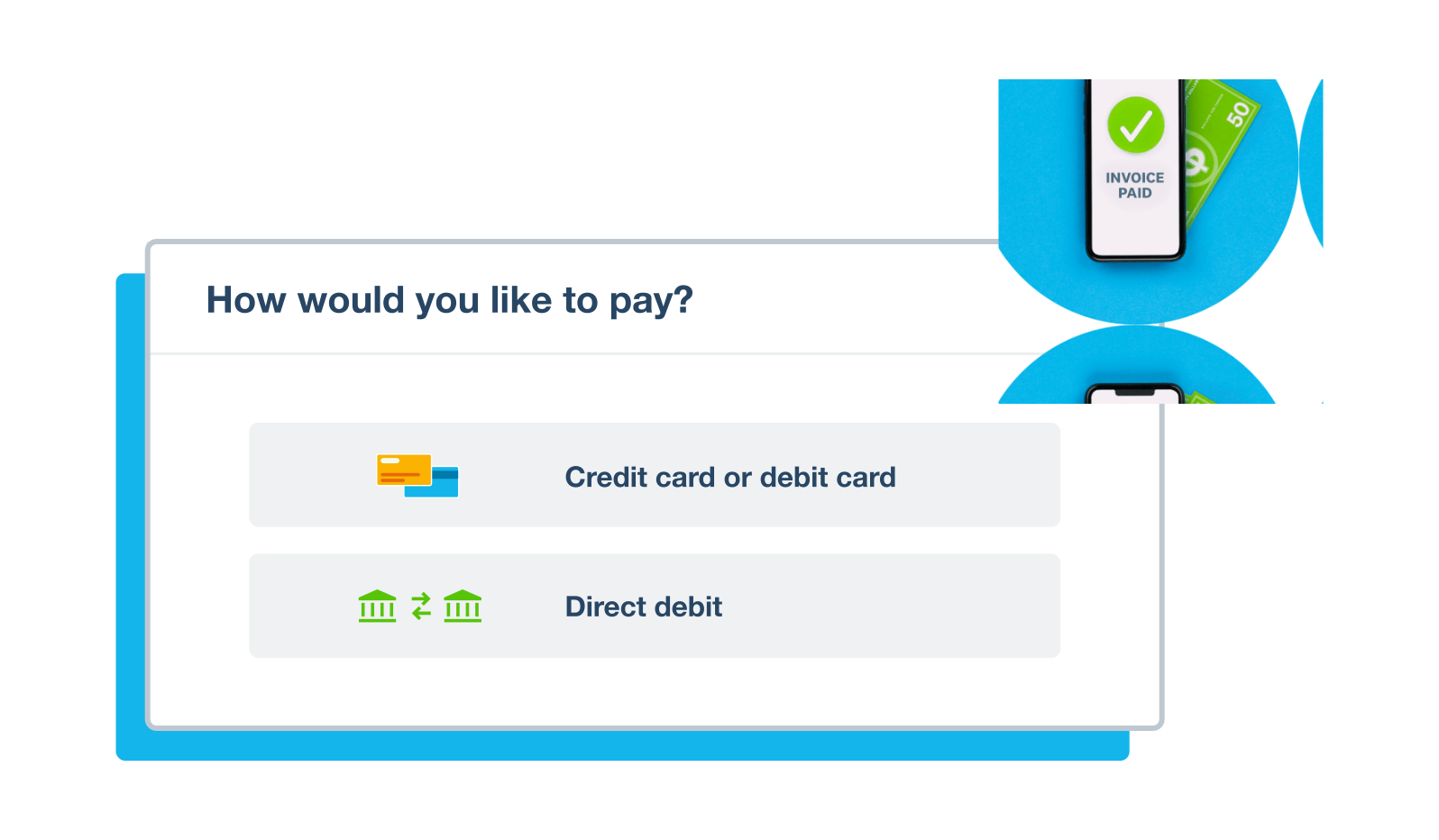
Online invoices allow customers to click straight through and pay instantly, which can reduce wait times for the vendor.
These industries share common traits: they provide essential services, offer value, or have flexible cost structures. Even if you're not in one of these sectors, you can apply these principles to strengthen your own business model.
Preparing for a sales downturn
Recognising the early signs of trouble helps you respond quickly.
Declining customer spending is the most obvious sign of a downturn. Customers buy less and become more cost-conscious, which can work against small businesses.
"Covid reintroduced people to small businesses but it might have been short lived," observes Cowling. "Customers are drifting back to the big chains that can offer lower prices."
How to protect your business against declining sales
Match supply to current demand: "Make sure you're supplying goods and services at the level of current demand, not what demand used to be," advises Southall. Avoid blanket cuts to all products and services since they won't be affected equally.
Watch for unexpected opportunities: Small luxury items like chocolate actually boomed during the 2008 financial crisis because they were an affordable indulgence. Look for similar patterns in your business.
Lean on customer loyalty: Small businesses built goodwill with local communities during the pandemic, as Xero's Behind Small Business research shows. Koziel recommends trading on that loyalty now: "Introduce locals packages or customer appreciation days. Small business customers are incredibly loyal and they will respond."
Coping with delayed payments
Cash flow problems often stem from customers taking longer to pay.
Payment delays increase during economic downturns. A 2025 QuickBooks report highlights the scale of this issue, finding that US small businesses are owed more than $17,000 each on average. This trend is confirmed by Xero data, which shows payment wait times jumped 11% after the 2018 US–China trade tensions and 15% after the first Covid outbreak.
The problem is self-perpetuating. Southall explains: "A business that's paid late will then struggle to pay their bills on time, and so the problem spreads quickly."
How to protect your business against delayed payments
- Send invoices immediately: The clock doesn't start until you've sent the bill. Track how long it takes to get paid and take action if things start to slip.
- Chase overdue payments: "Seek payment on overdue invoices and if you start to suffer delays from your customers then seek similar relief from the people you owe," says Koziel.
- Ask suppliers for flexibility: "It's not uncommon to ask suppliers for more time to pay. Everyone just went through this with Covid."
You can also give customers flexibility to help speed up payments.
Give customers flexibility
Online invoices allow customers to click straight through and pay instantly, which can reduce wait times for the vendor.
Southall says that accepting online payments can also help. "Our data shows that you can reduce wait times by issuing invoices with instant online payment options. There are also a range of apps that you can use to automatically issue payment reminders when invoices are overdue."
Working through cash flow crunches
Most small businesses only hold enough cash to run for 2–3 months. This vulnerability is compounded by late payments, as noted earlier. When sales drop 10% and customers start paying late, the cash situation deteriorates quickly.
Poor cash flow makes it hard to pay employees, suppliers, utilities, and loans. That cranks up stress for everyone involved.
How to protect your business against cash flow problems
Do a cash flow forecast: Plot inbound and outbound payments on a calendar to predict what will be in the bank. You can use software to do it automatically, or try this free Xero cash flow forecast template.
Track who owes what: Keep tabs on unpaid invoices and upcoming bills. If payments slow down, talk to suppliers and lenders about relaxing your deadlines. Anderson advises: "Use a forecast to explain why your cash flow is low and when it will improve."
Match production to demand: Smart forecasting helps you avoid overinvesting in inventory, transport, or staffing. "Don't keep doing what you always did," says Southall. "Respond to the changing market and stay alert to emerging opportunities."
Keep debt flexible: With interest rates climbing, it's tempting to pay down debts faster. Anderson warns against this: "If you put spare cash against your debts and then suddenly need that money back, you'll have to apply for a new loan. The lender may not give it."
Cut costs carefully: Controlling costs protects cash flow, but it's a balancing act. "I've seen people cut off the muscle with the fat," says Anderson. "Try to only cut discretionary spending for starters. And ask your staff for ideas."
Adjusting to inflation
Inflation creates unique challenges during a downturn.
Input costs stay high even as sales slump. Inventory and energy prices don't drop immediately when demand falls.
Laying off workers, the traditional cost-cutting approach, may not make sense this time. Cowling explains: "Employees have been so hard to find and the recession will be over in 12 months, maybe 18; so why would a business lay people off unless they really had no other option?"
With costs holding steady, the focus shifts to monitoring the right metrics.
How to protect your business against rising costs
Track profits and margins, not just revenue. Small businesses often concede margin rather than pass on every cost increase to customers. That approach will catch them out without the right monitoring.
"Owners often check sales or revenue when gauging where the business is at," says Southall. "In normal times, those numbers are a good proxy for profits. But it breaks down when costs and volumes are changing so much. You need to go directly to the profitability measures."
Working out profits and margins requires more bookkeeping, but it's vital for keeping the business viable. If you don't have an accountant or bookkeeper, consider getting one now. Many will produce monthly reports tracking margins and profits for a flat fee.
Handling the squeeze on margins
Many businesses try to protect customers from price increases, but this approach has limits.
Absorbing cost increases erodes your margins. Many businesses raise prices less than their costs increase, taking the hit themselves.
Cowling describes the typical pattern: "A small business might see their costs go up 30% and they feel that pain immediately. But they know they can't pass the whole lot on to customers or sales will tank. So they put prices up 10% and take two-thirds of the hit."
This approach eventually becomes unsustainable.
How to protect your business against tighter margins
Size your price increase correctly: "Businesses need to right-size that increase so they're not going back to their customers three months later with more bad news," says Southall. "You're better off to do it right the first time so try not to be too timid."
Communicate clearly: Koziel notes that customers understand inflation is happening. "Just be clear in your communication. It's the same if you're removing services because, for example, you can't find staff. Be open and honest. Loyal customers will still want to support you."
Managing debt and finance
Your relationship with lenders may need attention during a downturn.
Asset values drop during recessions, which can complicate your banking relationships. Business loans are typically secured by machinery, inventory, or accounts receivable, all of which tend to lose value in a downturn.
Koziel explains the impact: "You may no longer have enough security against your existing loans. And your scope for new lending will shrink or disappear altogether."
How to handle finance in a recession
Talk to your bank early. Banks have seen dozens of recessions and are used to adjusting during down cycles. Don't be afraid to request flexibility, but come prepared with a sound financial strategy.
Discuss security changes: "If you plan to run inventory low, and your loans are usually secured by inventory, then you need to work out how that looks with your lender," Koziel explains.
Share payment concerns proactively: Anderson recommends openness about difficulties: "If your cash flow forecast shows certain payments are at risk, share that information early. Lenders will have much more confidence that you'll make good if they see you're forward looking and proactive."
Making decisions at speed
Downturns require quick, informed decisions.
Economic uncertainty makes decision-making harder. Trade wars, actual wars, and pandemics can disrupt economies unpredictably (see Xero's business continuity guide for Asia), and all of these have either happened or are happening right now.
Southall describes the challenge: "Businesses already juggling the impacts of high inflation, low unemployment, and slowing sales may feel overwhelmed. They don't know what to focus on, or what's coming next."
How to make decisions at speed
Work with an accountant or bookkeeper. They can help you prioritise issues and ensure you have the numbers to make smart decisions.
Southall explains how they help:
- Identify pressure points: They create accounting reports showing where your business is under financial strain
- Prioritise problems: They help you deal with issues in the right order
- Maintain clarity: "A regular cycle of reporting and troubleshooting can help you identify and resolve issues faster and will keep you clear-headed about the strategies you've chosen"
Regular consultations are often handled online for a flat fee, which prevents cost blow-outs and meeting fatigue.
Finding employees during a downturn
Staffing challenges don't disappear when the economy slows.
This recession is different: labour shortages persist. Traditionally, businesses lay workers off during downturns. This time, many won't.
"Businesses have worked so hard to recruit staff that they're going to be very reluctant to shed them at the first sign of a downturn," says Southall. "They may cut back on hours, but wholesale redundancies seem unlikely at this stage."
The labour shortage creates a revenue cap. Koziel notes: "Customers are walking into half-full restaurants and being told they can't be seated because there aren't enough staff. It limits a business's capacity to generate revenue."
High employment should help fuel spending and speed the recovery, but it's a significant constraint for individual businesses right now.
Going on a recruitment drive
Despite the challenges, there may be opportunities to strengthen your team.
Recruitment opportunities may emerge. While unemployment stays low, worker income will likely drop in real terms as wage raises fail to match inflation.
Cowling sees an opportunity: "Wage raises won't match inflation and some employees will find their hours cut. Their spending power will decline which means now is a good time to poach them."
Watch for workers leaving larger businesses. Koziel predicts a redistribution: "Those medium and larger sized businesses may still go with the knee jerk reaction of laying people off. It's a fast way to cut costs. That will give smaller players a chance to find much-needed help."
Stay alert to recruitment opportunities. You might even increase sales during a recession by finally reaching full staffing capacity.
- "A business that has been understaffed hasn't been able to meet demand for months anyway," explains Koziel. "They might not even notice a drop in consumer spending. But if they can suddenly hire extra people and increase their capacity, they may actually find that sales go up."
We told you this recession would get weird.
Recession-proofing your business checklist
Metrics to watch
Monitoring the right numbers helps you spot problems early. Track these metrics regularly during a downturn:
- Debtor days: average time to get paid
- Cash flow: money coming in versus going out
- Profit: not just revenue
- Profit margins: percentage you keep after costs
Actions to consider
Taking proactive steps now can protect your business later. Focus your planning on these areas:
- Right-size your prices to cover increased costs
- Use any downtime to improve processes using Xero's business cost saving ideas
- Trim your budget without cutting essential capabilities
- Adjust inventory to match current demand
- Allocate staff hours more efficiently
Conversations to have
Open communication with key stakeholders helps you navigate uncertainty together. Talk to these stakeholders early:
- Customers: about price or service changes
- Banks: about loan security and payments
- Employees: about waste they see in the business and adjusting hours if needed
Once you've weathered this downturn, prepare for the next one.
For next time
Build a larger cash reserve for next time. If you're reading this during a downturn, it's too late for this cycle. But aim to build an emergency fund covering 3–6 months of operating expenses before the next recession hits.
How a slowdown can create opportunity
A downturn isn't all bad news.
Slowdowns create opportunities, not just challenges. Recession-proofing your business shouldn't be all about going into your shell. Here are upsides to focus on:
- Time to think strategically: "In a boom, you don't have time to do everything the way you might like," says Cowling. "Slowdowns give you time to sort stuff out and reorganise the business to work better."
- Time to train properly: "Small businesses get busy so quickly that they often just hire people without ever really training them properly," notes Koziel. "A slowdown is a chance to set the business up so future employees can succeed."
- Time to fix legacy problems: "Businesses always have a backlog of stuff to do, like fixing machinery or updating databases," explains Cowling. "It's a chance to address legacy problems."
- Cheaper growth opportunities: "Some owners will opt to sell or close their business," says Anderson. "You may be able to acquire customers, equipment, or premises at a lower cost than during a boom."
- Forced efficiency gains: "Those businesses that survive downturns are also usually the most productive," observes Southall. "They improve processes or use new technologies to become more efficient."
Strengthen your business with Xero
You can't control economic cycles, but you can control how prepared your business is. The strategies above, from cash flow forecasting to smart cost management, will help you navigate uncertainty with confidence.
Xero gives you the financial visibility and automated tools to put these strategies into action. Track your cash flow in real time, send invoices faster, and monitor the metrics that matter most during a downturn.
Get one month free and start strengthening your business today.
FAQs on recession-proofing your business
Here are answers to common questions about preparing your business for economic downturns.
How long do recessions typically last?
Recessions typically last 12–18 months, followed by a two-year recovery period. However, the impact on individual businesses varies based on industry, location, and preparation level.
Should I start a business during a recession?
Starting a business during a recession can work if you target essential services or value-driven offerings. Lower competition, cheaper premises, and available talent can offset the challenges of reduced consumer spending.
How much cash reserve should my business have?
Aim to hold enough cash to cover 3–6 months of operating expenses. Most small businesses only hold 2–3 months of reserves, which makes them vulnerable when sales drop and payments slow down.
What's the first thing I should do to prepare for a recession?
Start by reviewing your cash flow forecast and tracking your profit margins, not just revenue. Understanding your financial position helps you make informed decisions about pricing, costs, and staffing.
Can Xero help me recession-proof my business?
Xero provides real-time visibility into your cash flow, automated invoicing to speed up payments, and financial reports to track profitability. These tools help you spot problems early and make faster decisions during uncertain times.
Disclaimer
Xero does not provide accounting, tax, business or legal advice. This guide has been provided for information purposes only. You should consult your own professional advisors for advice directly relating to your business or before taking action in relation to any of the content provided.
Start using Xero for free
Access Xero features for 30 days, then decide which plan best suits your business.