What is accumulated depreciation? Formula and examples
Learn what accumulated depreciation is, how to calculate it, and see examples in action.

Written by Lena Hanna—Trusted CPA Guidance on Accounting and Tax. Read Lena's full bio
Published Tuesday 21 April 2026
Table of contents
Key takeaways
- Recognize that accumulated depreciation is a contra asset account, not a liability, meaning it reduces the book value of your assets on the balance sheet without representing any debt or obligation your business owes.
- Calculate accumulated depreciation using the straight-line method by subtracting an asset's salvage value from its original cost, then dividing by its useful life to find the annual depreciation expense you can track over time.
- Record depreciation as a non-cash expense to lower your taxable income each year, which reduces your tax bill and keeps more cash available in your business without any money actually leaving your accounts.
- Use cloud accounting software to automate depreciation calculations and journal entries, so your asset values stay accurate and your financial statements reflect the true worth of what your business owns.
What is accumulated depreciation?
Accumulated depreciation is the total amount an asset has lost in value since you bought it. This running total appears on your balance sheet, where it reduces the original cost of your assets to show their current book value.
Tracking this figure helps you see how wear, tear, and aging affect what your assets are actually worth today.
Tracking accumulated depreciation helps you:
- show accurate values: Display true asset worth on your financial statements
- calculate book value: Subtract accumulated depreciation from original cost
- make informed decisions: Use realistic asset values for planning and reporting
For example:
- Office furniture that cost $5,000 and depreciates at $1,000 each year has a book value of $2,000 after three years.
- Machinery cost $25,000, with $2,500 depreciation each year. After six years it has depreciated by $15,000, leaving a book value today of $10,000.
Depreciation vs accumulated depreciation
Depreciation is the annual expense that reduces an asset's value each year. Accumulated depreciation is the running total of all those expenses since you bought the asset.
Key differences:
- depreciation: Appears as an annual expense on your income statement
- accumulated depreciation: Appears as a cumulative total on your balance sheet
- recording frequency: Occurs yearly for depreciation; grows continuously for accumulated depreciation
How accumulated depreciation works
Accumulated depreciation works by pairing with a specific asset on your balance sheet. It's a contra asset account, which means it has a credit balance that offsets the debit balance of an asset.
Each time you record depreciation expense on your income statement, you also increase the balance in the accumulated depreciation account. This gradually reduces the asset's book value (original cost minus accumulated depreciation) over its useful life.
The result is a more realistic picture of your asset's current worth while keeping its original cost from your books.
Is accumulated depreciation an asset or a liability?
Accumulated depreciation is a contra asset, not an asset or liability. It appears on your balance sheet as a negative value that reduces your total assets.
Why it's not a liability:
- no debt owed: You don't repay accumulated depreciation to anyone
- no obligation created: It represents value loss, not money owed
A contra asset works by offsetting the value of a related asset account. Here's how it functions:
- reduces total assets: Appears as a negative value on your balance sheet
- offsets original cost: Lowers the recorded value of your assets
- reflects current worth: Shows what your assets are actually worth today
Why understanding accumulated depreciation matters for your business
Understanding accumulated depreciation helps you plan ahead and make better business decisions.
Business planning benefits:
- time asset replacements: Know when to replace equipment before it breaks
- budget for maintenance: Predict upcoming repair costs
- show accurate valuations: Present realistic asset worth to stakeholders
Tracking depreciation also strengthens your financial position with these benefits:
- reduce taxable income: Lower your tax bill and keep more cash
- improve financing chances: Strengthen loan applications with accurate asset values
- attract investors: Present a realistic financial position to potential backers
How does accumulated depreciation affect financial statements?
Accumulated depreciation appears on multiple financial statements, affecting how your business reports asset values and expenses.
Accumulated depreciation on the balance sheet
Accumulated depreciation reduces your asset values from original cost to current worth. It appears directly below the related asset, showing the net book value after accounting for wear and tear over time.
Accumulated depreciation on the income statement
Depreciation expense appears on your income statement and reduces your taxable income each year. Under certain Canadian tax rules, an eligible person or partnership can deduct the full cost of designated immediate expensing properties (DIEPs), up to $1.5 million in a tax year.
Tax benefits of recording depreciation:
- lower taxable income: Reduce profits on paper through depreciation expense
- save on taxes: Pay less tax while spending actual cash
- preserve cash: Keep more money available in your business
Accumulated depreciation on the cash flow statement
Depreciation gets added back to your cash flow because it's a non-cash expense.
While depreciation reduces your net income on the income statement, your cash stays in your business. On the cash flow statement, this amount is added back to show your true cash position.
For example, CPA Canada's 2023 cash flow statement shows an adjustment of $1,435 (in thousands) for amortization to reconcile net income to cash flow.
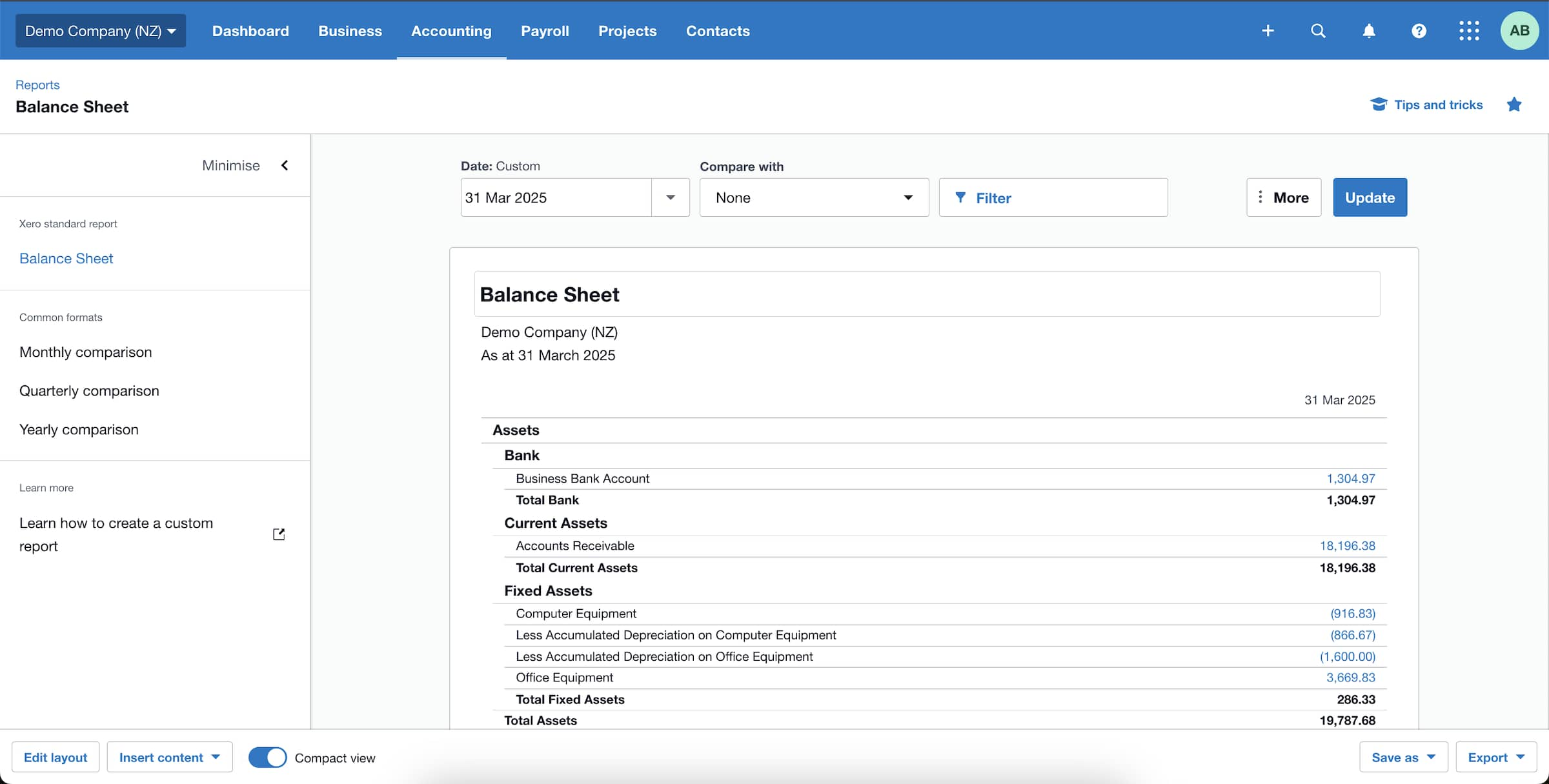
Example: Balance sheet for accumulated depreciation
This example shows how accumulated depreciation changes the net book value of assets and affects your overall financial health.
How to calculate accumulated depreciation
Calculate accumulated depreciation by choosing a depreciation method and applying it consistently over time. Most small businesses use the straight-line method for its simplicity.
For tax purposes, the Canada Revenue Agency applies specific Capital Cost Allowance (CCA) rates, and in the year you acquire a depreciable property, you can usually claim CCA only on one-half of your net additions to a class. Certain non-residential buildings used for manufacturing can include an additional allowance of 6% for a total rate of 10% in certain cases.
The straight-line depreciation calculation
The straight-line depreciation formula is:
Annual depreciation = (asset cost − salvage value) ÷ useful life
Authoritative bodies like CPA Canada use this method, defining estimated useful lives for assets like furniture (3–10 years) and computer software (3–5 years).
Formula components:
- asset cost: The original purchase price of the asset
- salvage value: The estimated resale or scrap value at end of use
- useful life: The expected number of years you'll use the asset
How each factor affects your calculation:
- shorter useful life: Increases annual depreciation expense
- higher salvage value: Decreases annual depreciation expense
- higher asset cost: Increases annual depreciation expense
Here's how to calculate straight-line depreciation step by step.
Calculate straight-line depreciation
Now you can calculate accumulated depreciation using the straight-line depreciation method. In this example, the asset costs $1,000, has a useful life of five years, and a salvage value of $100.
Step 1: Calculate the annual depreciation expense
Apply the straight-line formula to find your yearly depreciation amount.
Using this example:
($1,000 – $100) ÷ 5 = $180 per year
Step 2: Track accumulated depreciation each year
Create a depreciation schedule to track how accumulated depreciation grows over time. Each year, add the annual depreciation expense to the running total.
In this example:
- year 1: 1 × $180 = $180
- year 2: 2 × $180 = $360
- year 3: 3 × $180 = $540
- year 4: 4 × $180 = $720
- year 5: 5 × $180 = $900
Step 3: Calculate the asset's book value at a point in time
Use the formula:
Book value = initial cost – accumulated depreciation
In this example, after three years, the asset's book value is:
$1,000 – $540 = $460
The straight-line method isn't the only option for calculating depreciation.
Other depreciation methods
While straight-line depreciation is the simplest method, other approaches may better suit certain assets or tax situations.
Common alternative methods:
- declining balance: Applies a fixed percentage to the remaining book value each year, creating higher depreciation early on
- double-declining balance: Uses twice the straight-line rate for accelerated depreciation in the asset's early years
- units of production: Bases depreciation on actual usage or output rather than time, suiting machinery with variable use
Your accountant can help you choose the best method for your business and ensure you comply with tax regulations.
How to record accumulated depreciation
The journal entry for accumulated depreciation debits Depreciation Expense and credits Accumulated Depreciation. This entry ensures your financial statements reflect the asset's reduced value.
Record the entry as:
- debit: Depreciation Expense
- credit: Accumulated Depreciation
What each part does:
- debit to Depreciation Expense: Increases your total expenses on the income statement and lowers your taxable income
- credit to Accumulated Depreciation: Increases the contra asset balance, reducing the net book value on your balance sheet
In Canada, claim this deduction by entering the amount from the Total expenses line (9368) of Form T777 on line 22900 of your tax return.
This simple entry keeps your records straight while preserving your cash flow, as the expense is non-cash.
Manage depreciation efficiently with cloud accounting
Tracking depreciation manually can be time-consuming, especially as your business grows and acquires more assets. Spreadsheets can lead to errors that affect your financial reports and tax filings.
Cloud accounting software simplifies tracking your fixed assets and calculating depreciation. With a platform like Xero, you can set up a fixed asset register and automate depreciation calculations. Once you enter an asset's details, the software handles the monthly or yearly journal entries for you.
This saves you time and ensures your asset values stay up-to-date. You get a clear, accurate picture of your financial health and can run your business with confidence. Get one month free to see how Xero can streamline your asset management.
FAQs on accumulated depreciation
Here are some of the most commonly asked questions about accumulated depreciation.
How does accumulated depreciation affect cash flow?
Accumulated depreciation has an indirect effect on cash flow because no money actually leaves your business. However, it provides indirect cash benefits:
- Lower tax bills: Reduce taxable income and pay less in taxes
- Preserve cash: Keep money that would otherwise go to taxes
- Improve cash position: Have more cash available for business operations
What happens to an asset's accumulated depreciation when you sell it?
When you sell an asset, remove both its original cost and accumulated depreciation from your books. For example, a financial statement might note that an asset with a cost of $891 and accumulated amortization of $889 was disposed of. This clears both values from the balance sheet.
Special tax rules may apply. If you sell a certain class of vehicle, such as a Class 10.1 vehicle, Canadian tax law allows you to claim 50% of the CCA that would have been allowed if you still owned it at the end of the fiscal period, which is known as the half-year rule on sale.
Follow these steps when recording an asset sale:
- Remove accumulated depreciation: Clear the contra asset account
- Calculate book value: Subtract accumulated depreciation from asset cost
- Determine gain or loss: Compare book value to sale price
Do I record accumulated depreciation as a debit or a credit?
Record accumulated depreciation as a credit. As a contra asset, it offsets the debit balance of your assets.
Why it's recorded as a credit:
- offsets asset accounts: Balances the debit balance of related assets
- shows value reduction: Reflects decreasing asset worth over time
- appears as negative: Displays as a reduction against total assets on the balance sheet
Is accumulated depreciation a current liability?
Accumulated depreciation is a contra asset, separate from current liabilities. It's a contra asset that reduces the value of your assets on the balance sheet.
Key differences:
- current liabilities: Represent debts due within 12 months
- accumulated depreciation: Represents reduced asset value over time
- repayment requirement: None, because it's not money owed to anyone
Here's more about current and non-current liabilities.
Disclaimer
Xero does not provide accounting, tax, business or legal advice. This guide has been provided for information purposes only. You should consult your own professional advisors for advice directly relating to your business or before taking action in relation to any of the content provided.
Start using Xero for free
Access Xero features for 30 days, then decide which plan best suits your business.