How the sales funnel works
Learn how a sales funnel guides prospects from awareness to purchase and helps your business grow.

Written by Shaun Quarton—Accounting & Finance Content Writer and Growth Marketer. Read Shaun's full bio
Written by Shaun Quarton—Accounting & Finance Content Writer and Growth Marketer. Read Shaun's full bio
Published Tuesday 19 May 2026
Table of contents
Key takeaways
- Map your sales funnel into five stages (awareness, interest, decision, action, retention) and create targeted content for each stage to guide prospects through their buying journey systematically.
- Track stage-to-stage conversion rates, customer acquisition cost (CAC), and customer lifetime value (CLV) to identify where prospects drop off and focus your optimization efforts on those bottlenecks.
- Understand the difference between a sales funnel (prospect-centric, maps the buyer journey) and a sales pipeline (deal-centric, tracks live deals stage by stage) so you can apply the right framework at the right time.
- Invest in retention strategies like follow-up emails, loyalty programs, and responsive customer support, because selling to existing customers costs five to 25 times less than acquiring new ones and can generate 140% more revenue over time.
What is a sales funnel?
A sales funnel is a step-by-step model that maps the journey a potential customer takes from first discovering your business to making a purchase. It helps you visualize where prospects are in the buying process so you can guide them toward a sale.
The funnel starts wide at the top of funnel (TOFU), where prospects first become aware of your brand. As leads move through each stage, the funnel narrows because some drop off due to lack of interest, budget constraints, or alternative solutions. By the bottom of funnel (BOFU), only the most qualified leads remain, ready to buy.
For example, imagine an online store selling speciality coffee beans. A customer might discover the brand through Instagram, browse the website, join the email list for a 10% discount, add a bag of beans to their cart, and finally complete the purchase.
Sales funnels are also known as business growth funnels, conversion funnels, and purchase funnels. Each stage reflects increasing commitment. Understanding this process helps you nurture prospects more effectively and improve conversion rates.
What are the sales funnel stages?
Most sales funnels follow a similar progression, though the number of stages can vary. The most common framework includes five key stages:
- Awareness: prospects discover your business
- Interest: prospects engage and seek more information
- Decision: prospects evaluate whether to buy
- Action: prospects complete the purchase
- Retention: customers return for repeat business
Each stage requires different tactics to move prospects forward. Here's what happens at each one.
Stage 1: Awareness
Awareness is the stage where prospects first learn your business exists. They might find you through a Google search, social media post, word-of-mouth recommendation, or paid advertisement.
Your goal at this stage is to capture attention and make a memorable first impression. Common tactics include:
- Blog posts and search engine optimization (SEO) content: attract organic search traffic
- Social media marketing: build visibility where your audience spends time
- Paid advertising: reach new audiences quickly
- Public relations: earn media coverage and credibility
At this point, prospects may not know they have a problem you can solve. Research shows 96% of visitors aren't ready to purchase when they first land on a website, so your job is to educate and spark curiosity.
Stage 2: Interest
Interest develops when prospects actively seek more information about your business. They might visit your website, subscribe to your email list, or follow your social channels.
Your goal is to nurture that interest and build trust. Many leads don't convert when businesses fail to nurture them properly. Effective tactics at this stage include:
- Email newsletters: share valuable content regularly
- Educational resources: offer guides, webinars, or how-to videos
- Lead magnets: provide free tools or templates in exchange for contact details
- Retargeting ads: stay visible to website visitors
Prospects at this stage are comparing options. Give them reasons to keep you on their shortlist.
Stage 3: Decision
Decision is when prospects evaluate whether your product or service fits their needs. They compare features, read reviews, request demos, or ask detailed questions.
Your goal is to demonstrate value and address objections. Tactics that work well include:
- Case studies: show real results from similar customers
- Free trials or demos: let prospects experience your product firsthand
- Product comparisons: highlight what sets you apart
- Consultations: answer specific questions one-on-one
This stage often determines whether a prospect becomes a customer or chooses a competitor.
Stage 4: Action
Action is when the prospect makes a purchase decision. They complete the transaction, sign a contract, or commit to your service.
Your goal is to remove friction and make buying easy. Focus on:
- Simple checkout process: reduce steps and eliminate confusion
- Clear pricing: avoid hidden fees or complicated tiers
- Flexible payment options: offer payment plans if appropriate
- Limited-time offers: create urgency without being pushy
A smooth buying experience sets the tone for the customer relationship ahead.
Stage 5: Retention
Retention transforms one-time buyers into repeat customers. This stage focuses on satisfaction, ongoing support, and delivering continued value.
Your goal is to encourage loyalty and referrals. Effective retention tactics include:
- Follow-up emails: check in after purchase and offer helpful tips
- Loyalty programs: reward repeat purchases
- Responsive customer support: solve problems quickly
- Upsell opportunities: introduce complementary products or upgrades
Retention is critical for sustainable growth. Selling to existing customers costs far less than acquiring new ones, with research suggesting acquisition can cost five to 25 times more than retention.
Why is a sales funnel important for your business?
A well-structured sales funnel helps small businesses convert more leads into customers while spending less time on prospects who won't buy. It gives you a clear view of how people move from discovering your brand to making a purchase.
Better understand customer behaviour
Tracking your funnel reveals which customers are most likely to buy. By spotting patterns in successful sales, you can recognize ideal prospects earlier and focus your energy where it counts.
For example, your data might show that leads from certain industries convert at higher rates. With that insight, you can prioritize similar prospects and invest more in reaching them. Understanding these patterns also helps you tailor your messaging to speak directly to what drives purchasing decisions.
Forecast sales more accurately
Your sales funnel provides data to predict future revenue with greater precision. By tracking conversion rates at each stage, you can estimate how many leads will become paying customers.
For example, if 20% of qualified leads request a callback and 40% of those convert, you can project sales based on your current lead pool. This also helps you calculate how much you can spend on lead acquisition while staying profitable.
Drive business growth
A well-tracked funnel reveals exactly where you're losing potential customers so you can fix the problem and grow faster. Small businesses that compete effectively with larger retailers often do so by optimizing each stage of their funnel.
For example, if 40% of brochure downloaders request a demo but only 3% of those demos lead to a quote, you've found an opportunity for improvement. Improving your demo presentation could significantly boost conversions at that stage.
Focus on retention too. Around 65% of a company's business comes from existing customers, and selling to them costs far less. Track these metrics to spot retention opportunities and increase your revenue over time:
- Customer lifetime value: how much revenue each customer generates over time
- Repeat purchase rate: how often customers buy again
- Churn rate: how many customers you lose each period
Small improvements at each stage compound into major gains over time.
Sales funnel vs. marketing funnel
Both funnels guide customers toward a purchase, but they focus on different stages and use different tactics. Understanding the distinction helps you assign the right strategies to the right teams.
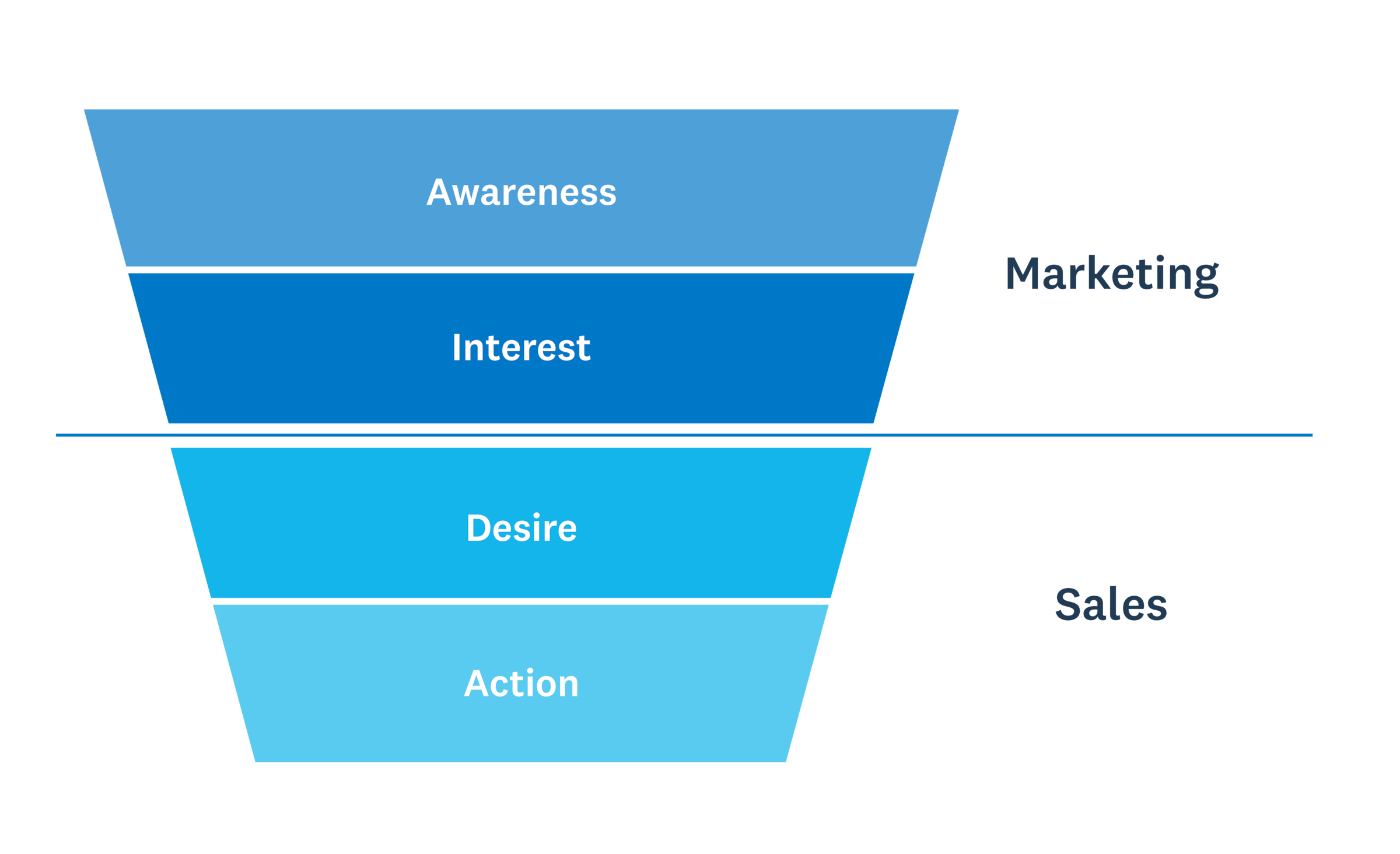
- Marketing funnel: focuses on attracting attention and building interest. Tactics include content marketing, social media, SEO, and advertising. The goal is to generate leads.
- Sales funnel: focuses on converting interested leads into paying customers. Tactics include demos, proposals, negotiations, and closing. The goal is to complete the sale.
In practice, the two funnels overlap. Marketing generates the leads that sales converts. When both teams align on definitions and handoff points, the entire process runs more smoothly. Learn more about marketing for small businesses.
Why aligning marketing and sales matters
When sales and marketing work together, they create a seamless customer experience and drive better results. Aligned organizations enjoy 36% higher customer retention rates.
- Smoother handoffs: qualified leads from marketing help sales focus on high-potential prospects
- Consistent messaging: shared language ensures clear, cohesive communication across touchpoints
- Better insights: combined data gives a complete view of the customer journey for smarter decisions
Sales funnel vs. sales pipeline
A sales funnel and a sales pipeline both track progress toward a sale, but they approach it from different angles. Knowing when to use each framework helps you manage prospects and deals more effectively.
A sales funnel is prospect-centric. It maps the buyer's journey from awareness through to purchase and retention. The funnel shows you how large groups of prospects move (or drop off) at each stage, giving you a big-picture view of your conversion process.
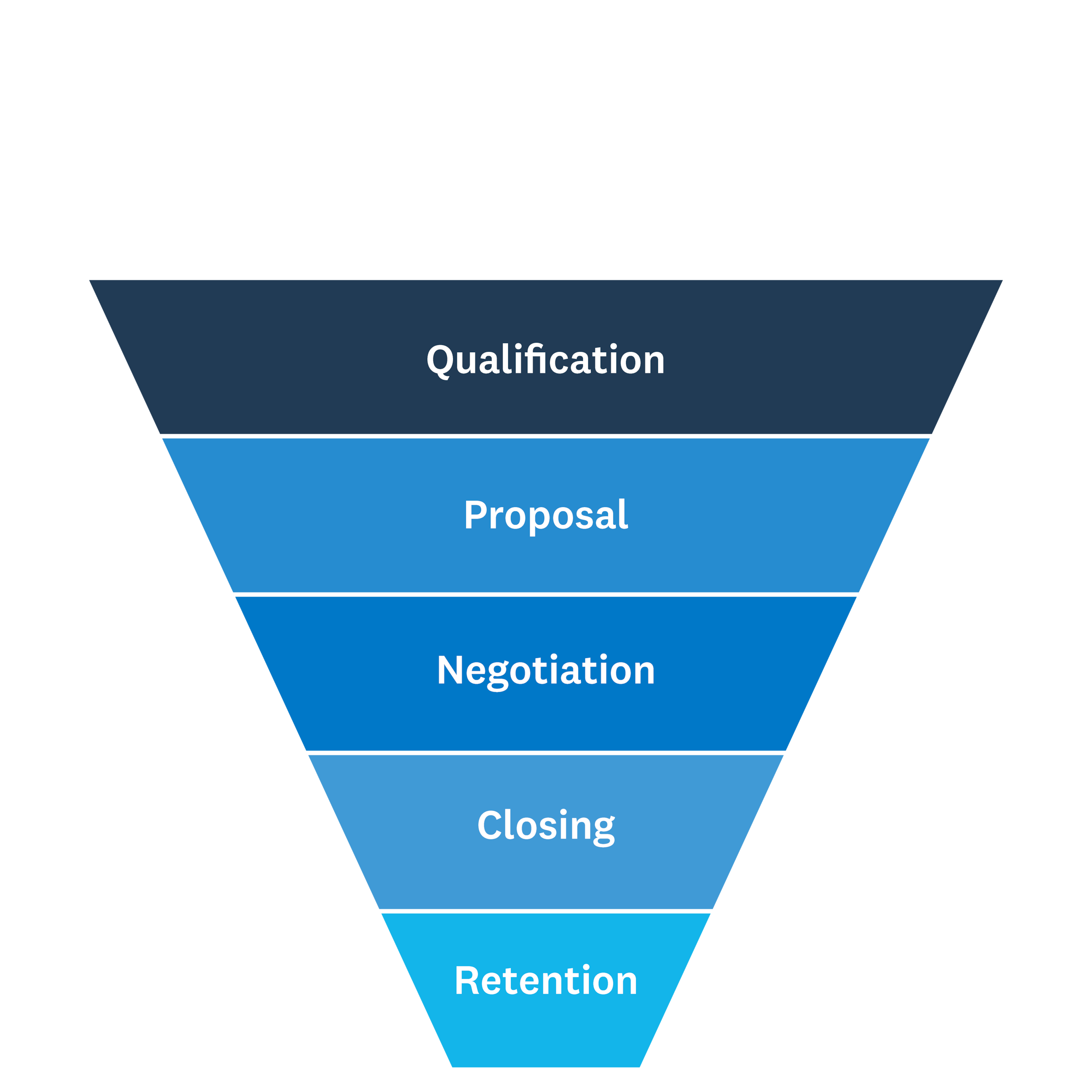
A sales pipeline is deal-centric. It tracks individual live deals as they progress through specific stages, such as initial contact, qualification, proposal, negotiation, and close. The pipeline focuses on what your sales team does to advance each deal.
Here's how the two compare in practice:
- Perspective: the funnel looks at the journey from the buyer's point of view, while the pipeline looks at it from the seller's point of view
- Scope: the funnel covers the full journey including post-sale retention, while the pipeline typically ends at the close
- Primary use: the funnel helps you identify where prospects drop off and optimize conversion rates, while the pipeline helps you forecast revenue and manage active deals
- Best for: the funnel suits marketing-to-sales alignment and long-term strategy, while the pipeline suits day-to-day sales management and deal tracking
For most small businesses, both frameworks are valuable. Use your funnel to understand the overall buyer journey, spot bottlenecks, and improve conversion rates. Use your pipeline to manage current deals, prioritize follow-ups, and forecast revenue. A CRM for small business can help you track both in one place.
Key sales funnel metrics to track
Measuring your funnel's performance tells you what's working and where prospects are falling out. These six metrics give you a clear picture of funnel health and help you make smarter decisions about where to invest your time and budget.
- Conversion rate (stage-to-stage and overall): the percentage of prospects who move from one funnel stage to the next, and the percentage who complete the entire journey from awareness to purchase. Low stage-to-stage rates pinpoint exactly where your funnel needs attention.
- Customer acquisition cost (CAC): the total cost of acquiring a new customer, including marketing spend, sales team costs, and tools. Divide your total acquisition spend by the number of new customers gained in a period. A lower CAC relative to customer value means more profitable growth.
- Customer lifetime value (CLV): the total revenue a customer generates over the full relationship with your business. Compare CLV to CAC to check whether your acquisition spending makes sense. If your CLV is at least three times your CAC, your funnel economics are healthy. Increasing your profits often starts with improving CLV through better retention and upselling.
- Average deal size or order value: the average revenue per closed deal or transaction. Tracking this helps you forecast revenue more accurately and identify opportunities to increase value through bundling, upselling, or pricing adjustments.
- Sales cycle length: the average time it takes for a prospect to move from first contact to closed deal. Shorter cycles mean faster revenue. If your cycle is lengthening, look for stages where deals stall and address the friction.
- Win rate: the percentage of qualified opportunities that result in a closed deal. A strong win rate means your qualification process is effective and your sales approach resonates with prospects. Track this alongside conversion rate to get a full picture of funnel efficiency.
Review these metrics regularly, ideally monthly or quarterly, to spot trends early and adjust your strategy before small issues become costly problems.
Sales funnel examples
Every business tailors its funnel to its audience, but the core structure stays the same. Here's how three common business models apply the stages.
eCommerce sales funnel
eCommerce funnels move customers from product discovery to purchase quickly and with minimal friction.
- Attract: draw visitors through ads, SEO, and social media
- Engage: build interest with compelling product pages, images, and reviews
- Capture: collect email addresses with discounts or free shipping offers
- Nurture: bring visitors back with retargeting ads and abandoned cart emails
- Convert: remove checkout friction to complete the sale
- Retain: encourage repeat purchases with personalized recommendations
B2B sales funnel
B2B funnels focus on building trust and demonstrating expertise over longer sales cycles.
- Attract: generate awareness through content marketing, networking, and referrals
- Engage: build credibility with webinars, case studies, and whitepapers
- Capture: collect contact details through gated content and consultation offers
- Nurture: develop relationships with follow-up emails, demos, and personalized outreach
- Close: close deals through proposals and negotiations
- Retain: strengthen accounts with ongoing support and upsell opportunities
SaaS sales funnel
SaaS funnels convert prospects into users through free trials or demos, then retain them with ongoing value. For SaaS companies, a healthy trial-to-paid conversion rate is typically between 5–10%.
- Attract: drive traffic through SEO, pay-per-click (PPC) advertising, and content marketing
- Engage: build interest with landing pages, explainer videos, and case studies
- Capture: offer free trials, demos, or limited-access plans to get users started
- Nurture: guide new users with onboarding emails, tutorials, and in-app prompts
- Convert: encourage upgrades with premium features and time-limited offers
- Retain: reduce churn with responsive support, regular updates, and loyalty rewards
How to create a sales funnel
Building a sales funnel doesn't have to be complicated. Follow these five steps to create a funnel that consistently converts prospects into customers.
Step 1: Identify your target audience and their needs
Start by defining who your ideal customer is. Consider their demographics, pain points, and buying behaviours. The clearer your picture of the right customer, the more effectively you can tailor each stage of your funnel.
External factors matter too. Leads in growing industries or thriving regions often convert at higher rates. Focus your efforts where the potential is greatest. Learn more about market research.
Step 2: Map each stage to specific actions
Define what happens at each stage of your funnel. What action does a prospect take to move from awareness to interest? From decision to action?
For each stage, identify:
- Prospect actions: what do they do? (visit website, download guide, request demo)
- Your response: what do you do? (send follow-up email, schedule call, present proposal)
- Success criteria: how do you know they're ready for the next stage?
This mapping creates a repeatable process you can track and improve.
Step 3: Create content and touchpoints for each stage
Develop the assets you need to move prospects through your funnel. Each stage requires different content:
- Awareness: blog posts, social media content, ads
- Interest: email sequences, guides, webinars
- Decision: case studies, demos, comparison pages
- Action: clear pricing pages, simple checkout, contract templates
- Retention: onboarding emails, support resources, loyalty offers
Start with the basics for each stage and add more as you learn what works.
Step 4: Set up tracking and measurement
Measuring your funnel is essential for improvement. Track key metrics at each stage:
- Awareness: website traffic, ad impressions, social reach
- Interest: email subscribers, content downloads, time on site
- Decision: demo requests, proposal views, cart additions
- Action: conversion rate, average order value, close rate
- Retention: repeat purchase rate, customer lifetime value, churn rate
Use tools like Google Analytics, your CRM, or your accounting software to monitor these numbers. Look for stages where prospects drop off, as those are your biggest opportunities for improvement.
Step 5: Test and refine your funnel
Your first funnel will improve over time. Review your metrics regularly and look for patterns:
- Where do prospects drop off? That stage needs attention.
- Which content performs best? Create more like it.
- What objections come up repeatedly? Address them earlier in the funnel.
Run small experiments. Test different email subject lines, landing page headlines, or call-to-action buttons. Small improvements at each stage compound into significant gains over time.
Tips for optimizing your business' sales funnel
Once your funnel is running, these strategies help you convert more leads with less effort. Each tip targets a different part of the funnel, from qualification through to post-sale loyalty.
Strengthen lead qualification
Focus on leads most likely to convert. Research suggests 50% of sales time is wasted on unproductive prospecting. Directing your energy toward high-potential prospects saves time and improves close rates.
Refine your targeting by reviewing which leads actually convert. Look for common traits like industry, company size, or the content they engaged with before buying. Use your CRM to track engagement levels and prioritize leads showing strong buying signals.
Use data to refine and scale
Track conversion metrics at each stage to identify where prospects drop off. Tools like Google Analytics help you understand user behaviour and spot problems.
Key optimization tactics include:
- Streamline processes: simplify forms and create smooth pathways for prospects
- Segment your audience: tailor messaging to different customer groups for higher relevance
- Run A/B tests: experiment with email subject lines, landing page copy, and calls to action (CTAs) to find what works best
Enhance the post-sale experience
A strong post-sale experience turns one-time buyers into loyal customers, who may end up spending 140% more over time compared to those with negative experiences.
Create a structured onboarding process that helps new customers succeed from day one. Use automated email sequences to deliver helpful content at the right time, including:
- Quick-start guides: help customers get value immediately
- Tips and best practices: show them what's possible
- Check-in emails: ask how things are going and offer support
Satisfied customers buy again and refer others.
Understand and map customer journeys
Customer journey mapping visualizes the path prospects take from first discovering your business to becoming loyal customers. It's one of the most effective ways to increase sales across your entire funnel.
Creating a journey map helps you:
- Spot drop-off points: see exactly where you're losing prospects
- Tailor your messaging: match content to each stage of the decision process
- Improve conversions: fix the specific moments where prospects hesitate or leave
Map your current customer journey by talking to people who recently bought from you. Ask how they found you, what convinced them to purchase, and what almost stopped them. Their answers reveal opportunities to strengthen your funnel.
Start building your sales funnel today
A clear sales funnel helps you understand how prospects become customers and where you can improve. By mapping each stage, tracking the right metrics, and testing what works, you'll convert more leads while spending less time on those who won't buy.
The key is visibility. When you can see exactly where prospects are in your funnel and how your business is performing, you make better decisions.
With Xero, you get the financial insights to track what matters at every stage of your growth. Get one month free and see how clear reporting supports smarter sales decisions.
FAQs on sales funnels
Here are answers to frequently asked questions about sales funnels and how to use them effectively.
What are the five stages of a sales funnel?
The five stages are awareness (prospect discovers your business), interest (prospect engages with your content), decision (prospect evaluates whether to buy), action (prospect makes a purchase), and retention (customer returns for repeat business). Each stage requires different tactics to move prospects forward.
What's the difference between a four-stage and five-stage sales funnel?
A four-stage funnel typically ends at action (the purchase). A five-stage funnel adds retention to emphasize keeping customers and encouraging repeat business. Retention is often more cost-effective than acquiring new customers, which is why most modern frameworks include it.
How long should prospects stay in each stage?
Timeframes vary by business type and purchase complexity. An eCommerce customer might move from awareness to action in minutes, while a B2B prospect could take months. Focus on tracking conversion rates between stages rather than setting arbitrary time limits.
What metrics should I track at each stage of my sales funnel?
Track website traffic and social reach (awareness), email subscribers and engagement (interest), demo requests or quote enquiries (decision), conversion rate and average order value (action), and repeat purchase rate and CLV (retention). These metrics show where prospects progress smoothly and where they drop off.
Can I skip sales funnel stages for certain customers?
Yes. Real customers often move through stages in different ways. Some jump from awareness directly to action through strong referrals or impulse purchases. Others loop back through stages multiple times. The funnel is a useful, flexible framework rather than a rigid rule.
What's the difference between a sales funnel and a sales pipeline?
A sales funnel is prospect-centric and maps the buyer's journey from awareness to retention. A sales pipeline is deal-centric and tracks individual live deals through stages like qualification, proposal, and close. The funnel helps you optimize conversion rates across your entire audience, while the pipeline helps you manage and forecast specific deals.
Disclaimer
Xero does not provide accounting, tax, business or legal advice. This guide has been provided for information purposes only. You should consult your own professional advisors for advice directly relating to your business or before taking action in relation to any of the content provided.
Start using Xero for free
Access Xero features for 30 days, then decide which plan best suits your business.