Bookkeeping vs accounting: which does your business need?
Learn how bookkeeping vs accounting work together to cut admin and guide better decisions for your small business.
Written by Lena Hanna—Trusted CPA Guidance on Accounting and Tax. Read Lena's full bio
Written by Lena Hanna—Trusted CPA Guidance on Accounting and Tax. Read Lena's full bio
Published Monday 13 April 2026
Table of contents
Key takeaways
- Recognize that bookkeepers handle daily transaction recording and basic financial tasks, while accountants provide strategic analysis and complex tax services, so you can choose the right professional based on your specific business needs.
- Hire a bookkeeper first when you spend more than five hours weekly on financial record-keeping or need help with invoicing and monthly reports, then add an accountant when your annual revenue exceeds $500,000 or you need strategic financial planning.
- Understand that bookkeepers typically require certificate programs or associate degrees, while accountants need bachelor's degrees and often CPA certification, which affects both the services you receive and the fees you pay.
- Consider using both professionals together for comprehensive financial support, with a bookkeeper managing daily transactions and an accountant providing strategic advice and tax compliance for optimal business growth.
Bookkeeping vs accounting
Bookkeeping is the day-to-day recording and organizing of financial transactions. Accounting involves analyzing, interpreting, and reporting on financial data to provide strategic business insights.
The key difference: bookkeepers handle data entry and basic financial tasks, while accountants provide analysis and strategic advice. Both roles are essential for managing business finances, but they serve different purposes at different stages of your financial management process.
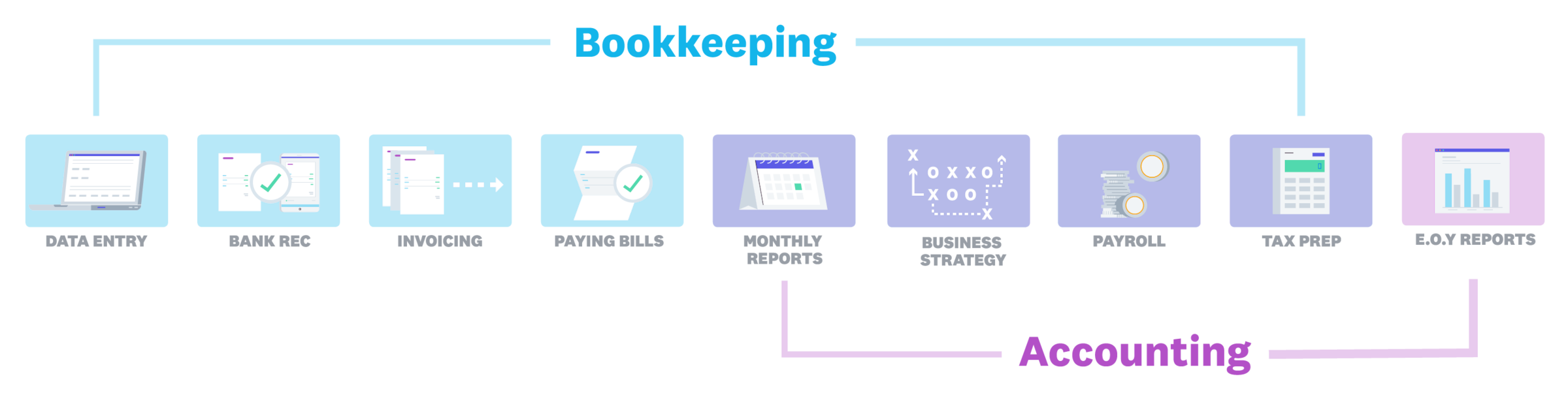
Bookkeeping covers data entry to strategy. Accounting covers reporting, taxes and strategy.
What bookkeepers do
A bookkeeper records, organizes, and maintains your business's financial transactions on a daily basis. Their work keeps your records accurate and your business compliant.
Core bookkeeping responsibilities include:
Daily tasks:
Monthly activities:
- Generating financial reports for business owners
- Running payroll for employees
- Preparing preliminary tax documentation
Some bookkeepers also provide basic financial analysis and highlight trends in your business performance.
What accountants do
An accountant analyzes, interprets, and reports on your financial data to provide strategic insights and ensure compliance, adhering to professional guidelines like the Canadian Standards on Quality Management (CSQM). They typically hold accounting degrees and professional certifications such as Chartered Professional Accountant (CPA), a designation which meets or exceeds all International Federation of Accountants standards.
Core accounting services:
- Preparing official financial statements (income statements, balance sheets, cash flow statements) based on official standards like CSRS 4200, Compilation Engagements
- Filing tax returns and managing tax compliance
- Conducting financial analysis and forecasting
- Providing strategic business advice based on financial data
Strategic services:
- Business planning and budgeting
- Investment and growth strategy recommendations
- Risk assessment and financial planning
- Audit preparation and representation
Some accounting firms also offer bookkeeping services, so you can manage all your financial needs in one place.
Difference between accountants vs bookkeepers
The main difference is that bookkeepers record and organize financial data, while accountants analyze that data to provide strategic insights. Here's how they compare:
Education and qualifications:
- Bookkeepers: Typically complete certificate programs, on-the-job training, or associate degrees
- Accountants: Typically hold bachelor's degrees in accounting, often with CPA certification
Service scope:
- Bookkeepers: Focus on accurate record-keeping and basic reporting
- Accountants: Focus on analysis, strategic advice, and complex tax services
Business impact:
You might use a bookkeeper for daily financial management and an accountant for strategic planning and tax compliance. This approach gives you full financial support without paying for services you don't need.
When to hire a bookkeeper vs accountant
Your business needs determine which professional to hire first. Here's how to decide:
- have regular transactions that need organizing
- spend more than five hours per week on financial record-keeping
- need help with invoicing and bill payments
- want monthly financial reports to track performance
Hire an accountant when you:
- need strategic financial advice for business decisions
- have complex tax situations or multiple revenue streams
- plan significant business changes (expansion, investment, loans)
- require detailed financial analysis and forecasting
Hire both a bookkeeper and an accountant when you:
- generate annual revenue over $500,000
- operate in multiple locations or jurisdictions
- need both daily financial management and strategic planning
- want to focus entirely on running your business, not managing finances
Most small businesses start with a bookkeeper and add an accountant as they grow and need more strategic financial guidance.
Education and qualifications required
Professional qualifications affect both the services you receive and the fees you pay. Understanding credential requirements helps you choose the right financial support for your business.
Bookkeeper qualifications:
- Entry-level: High school diploma plus bookkeeping software training
- Professional: Certificate in bookkeeping or associate degree in accounting
- Experience: 1–3 years of practical bookkeeping experience
Accountant qualifications:
- Minimum: Bachelor's degree in accounting or related field
- Professional: Chartered Professional Accountant (CPA) designation, a certification program that consists of three components: education, practical work experience, and a final examination.
- Specialized: Additional certifications in tax, forensic accounting, or business valuation
- Experience: 2–5 years of professional accounting experience
What this means for your business:
Higher qualifications usually mean higher fees, but you also get more comprehensive services. Choose a professional whose qualifications match your business needs and budget.
Choose the right financial support for your business
Start with a bookkeeper if you need organized records and basic reporting. Add an accountant when you need strategic advice and complex financial analysis.
Many businesses use a bookkeeper for daily financial management and an accountant for strategic planning and tax compliance. This combined approach helps you keep accurate records while gaining the insights you need to grow.
With cloud accounting software like Xero, you can give both professionals real-time access to your financial data, making collaboration easier. Get one month free and see how Xero can support your bookkeeping and accounting needs.
FAQs on bookkeeping vs accounting
Still have questions? Here are answers to common questions about choosing between bookkeeping and accounting services.
Can a bookkeeper handle your accounting needs?
A bookkeeper can handle basic financial record-keeping and simple reporting. However, they typically can't provide strategic financial analysis, tax planning, or complex business advice. For those services, you need an accountant.
Is accounting software like Xero considered bookkeeping or accounting?
Accounting software like Xero handles both bookkeeping tasks (recording transactions, bank reconciliation) and some accounting functions (financial reports, basic analysis). The software doesn't replace professional expertise but helps both bookkeepers and accountants work more efficiently.
Which is more cost-effective for small businesses?
Bookkeepers typically cost less per hour than accountants. For basic financial management like transaction recording and invoicing, a bookkeeper is more cost-effective. Add an accountant when you need strategic advice, tax planning, or financial analysis to help your business grow.
When should you upgrade from a bookkeeper to an accountant?
Consider adding an accountant when you:
- generate annual revenue exceeding $500,000
- face major business decisions or complex tax situations
- need strategic financial planning for growth or investment
Handy resources
Advisor directory
You can search for experts in our advisor directory
When you should hire a bookkeeper
Find out all the things bookkeepers can do for your business
Xero dashboard
See your key information on the business dashboard
Disclaimer
This glossary is for small business owners. The definitions are written with their requirements in mind. More detailed definitions can be found in accounting textbooks or from an accounting professional. Xero does not provide accounting, tax, business or legal advice.