Britain’s £868 billion blind spot: the millions of small businesses this country takes for granted
Xero calls for a jobs boost and fairer rates system to back 20 ‘overlooked’ small business sectors
London – October 8, 2026 – Millions of the small businesses Britain relies on every day are being written out of the national economic conversation, according to new analysis from Xero and the Centre for Economics and Business Research (Cebr).
The research covers 20 sectors. It identifies an ‘overlooked economy’ of 3.3 million businesses employing fewer than ten people, who underpin everyday life in Britain. They build our homes, stock our shelves, move our goods, fix our cars and advise our companies.
CEBR groups them into four areas: businesses that build Britain, serve local communities, keep the country running, and provide specialist expertise. Despite their importance, these businesses often lack the visibility needed to make their voices heard.
Together, they turn over £868 billion a year, support 3.8 million jobs - almost one in six in the private sector, and contribute £360 billion directly to the UK economy in gross value added (GVA). They also hand £97 billion a year to the Exchequer in business taxes. That is more than the UK government spends on education. And more than it spends on defence or transport.
Big economic contribution, little visibility
CEBR analysed five years of UK Parliamentary debate recorded in Hansard alongside the economic contribution made by different sectors.
The average sector was mentioned 2,420 times over five years. But sectors like rental and leasing were mentioned only 26 times, roughly once every ten weeks. Wholesale trade, where businesses employing fewer than ten people turn over almost £118 billion, was mentioned just 170 times.
By contrast, hospitality and catering was mentioned 5,578 times. More than 200 times as often as rental and leasing. This disparity highlights the need to widen the policy debate beyond well-known industries to make sure all small business voices are heard.
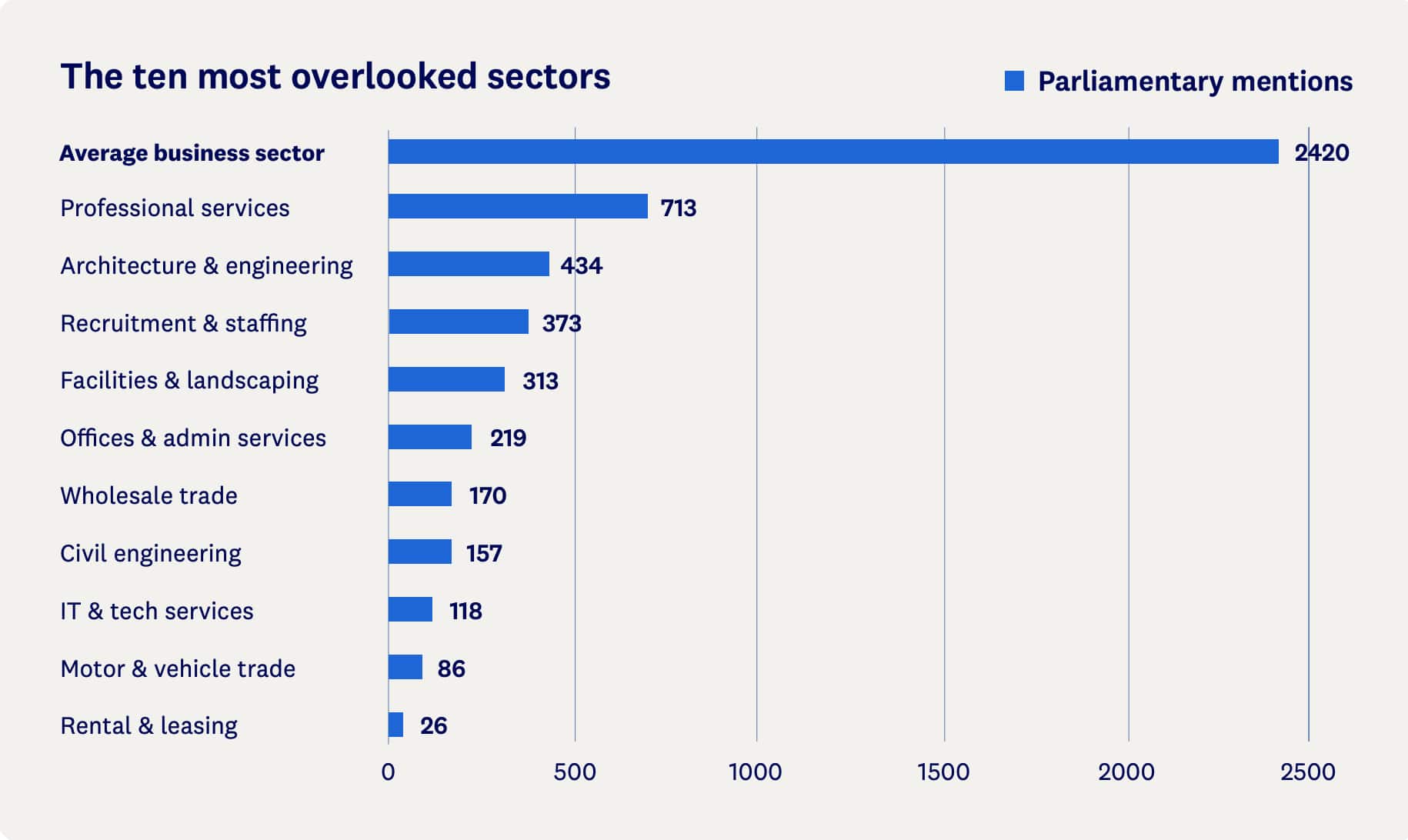
The ten most overlooked sectors - source: CEBR
Being overlooked has a price
The imbalance is not just a question of image. When a sector is not in the room, the problems it faces do not get fixed, and the smallest businesses end up paying for a debate they were never part of:
- Last year’s rise in employer National Insurance hit small, low-wage sectors hardest of all: a business paying someone £20,000 now pays 50% more in employer NI than before.
- Since April 2026, two identical small businesses in the same town can pay different business rates purely because of the sector they happen to be in.
Kate Hayward, UK Managing Director at Xero, said: “A huge portion of our economy often gets ignored, and it’s not okay. Many of these small firms keep our country moving, but operate away from the high street and without the profile or resources of larger brands.
“That isn’t a small thing. When millions of businesses are missing from the conversation, we make decisions from an incomplete picture and these businesses carry the cost. And the effect of this multiplies. If these overlooked businesses stop hiring, then whole towns and communities feel it. We’re calling on policy makers to recognise there are so many different types of small businesses and give them a much needed jobs boost and a fairer rates system that doesn’t penalise them.”
From overlooked to supported
Xero is calling on the UK Government to make sure the voices of all small business sectors are heard. Importantly, creating an environment that makes it cheaper for them to hire and to create a fairer business rates system. That is the difference between businesses growing and businesses disappearing.
- A jobs boost for the smallest firms: cut employer NICs on the first 0–9 employees, increase the employment allowance for small firms and introduce a short-term hiring credit for genuinely new jobs. This would help put the smallest employers at the centre of employment policy and make it easier for them to create new jobs.
- A fairer business rates system: raise Small Business Rate Relief from £12,000 to £25,000 and reform the multiplier so businesses of the same size are not charged different rates simply because of the sector they operate in. Xero believes this would better protect the smallest businesses and create a fairer system for firms looking to grow.
- Promote the vital role of accountants and bookkeepers: run a national promotional campaign to encourage small business owners to work with an accountant or bookkeeper that can help them overcome barriers.
‘It can feel isolating’
Behind the numbers are business owners who are feeling this every day. Many report having nowhere obvious to turn for advice, no one making their case, and little confidence that growth will be rewarded.
Kyle Hyams, Director of construction business Intsa Services, said: “Builders like us are not based on the high street, and we're often portrayed negatively in the press. I don’t feel like we have a dedicated voice to represent us, which can be isolating.
“For companies like ours that have been trading for over 10 years and generating a lot in tax revenue, we’re struggling to get the support we need. The cost of fuel has been an issue for a long time, and where we’ve invested over £100k to replace our fleet of over a dozen to comply with ULEZ we could only claim for three on the grant offered. It feels like some small measures like the opportunity for low interest loans to invest further within the industry would be a great incentive for us to grow.”
When these businesses struggle, their communities struggle
The ‘overlooked economy’ is concentrated in the places that need growth the most.
In London, these small businesses generate more than £183 billion in turnover, contribute almost £90 billion to the economy and support 747,000 jobs. Greater Manchester has the largest ‘overlooked economy’ outside of the Capital, generating more than £35 billion in turnover and supporting 178,000 jobs. In Birmingham they generate £22.7 billion and support 124,000 jobs; in Leeds, £21.2 billion and 99,000 jobs.
And the effect travels. These businesses buy from other businesses, and their employees spend their wages in local shops. For every £1 the overlooked economy generates directly, a further 74p is created elsewhere in the economy. Counted in full, it supports 6.9 million jobs — 28.3% of the UK workforce.
You can read the full Xero Overlooked Economy report here, with a second report from Xero’s Overlooked Economy research series set to be released later in 2026.
ENDS
Media Contact
Xero Communications | Hannah Collett | ukpress@xero.com
About the research and methodology
Xero commissioned the Centre for Economics and Business Research (CEBR) to examine the economic contribution and visibility of some of the UK’s smallest businesses.
CEBR analysed all 84 sectors of the UK economy using official economic data and parliamentary debates recorded in Hansard. From this analysis, the research identified the 20 sectors with the greatest turnover from businesses employing fewer than ten people. Together, these sectors form the “overlooked economy” examined in the research.
CEBR assessed the economic contribution made by these businesses, including their turnover, GVA, employment, wages and tax contribution. It also analysed how frequently different sectors were discussed in Parliament over a five-year period, providing a measure of their visibility in national policy debate.
For the purposes of the report, the 20 sectors were grouped into four broad families based on the nature of the work they do and how they contribute to the economy and their communities:
- Building Britain: agriculture and farming; architecture and engineering; building construction; civil engineering; facilities and landscaping; and trades and fitting.
- Serving Communities: hospitality and catering; motor vehicle trade; real estate; and rental and leasing.
- Keeping Communities Running: energy and utilities; office and admin services; recruitment and staffing; retail trade; transport and logistics; and wholesale trade.
- Independent Experts: IT and tech services; legal and accounting; management consultancy; and professional services.
About Xero
Xero is a global small business platform that helps customers supercharge their business by bringing together the most important small business tools, including accounting, payroll and payments — on one platform. Xero’s powerful platform helps customers automate routine tasks, get timely insights, and connects them with their data, their apps, and their accountant or bookkeeper so they can focus on what really matters. Trusted by millions of small businesses and accountants and bookkeepers globally, Xero makes life better for people in small business, their advisors, and communities around the world. For further information, please visit xero.com.
Related media and enquiries
For all media enquiries, please contact the Xero media team.
- Media release
Xero research reveals UK’s top accounting and bookkeeping firms are twice as profitable – with AI adoption at the core
New research from Xero finds top performing firms embedding AI into daily workflows save up to 10.6 hours a week
- Media release
UK small businesses struggle as sales and jobs slow for a third consecutive quarter
New Labour government facing growing pressure to prove its pro-small business rhetoric with strong action for SMEs
- Media release
Xero Announces New AI Innovations at Xerocon London as it Powers 5 Million Customers Globally
JAX, Xero’s agentic platform, simplifies end-to-end bookkeeping, automates routine tasks & proactively manages cash flow
Start using Xero for free
Access Xero features for 30 days, then decide which plan best suits your business.